Contents:
Why Suimenkul Chokmorov matters
Chokmorov stood at the centre of the period often described as the Kyrgyz cinematic miracle. From the late 1960s into the 1970s, filmmakers such as Bolot Shamshiev, Tolomush Okeyev and Gennady Bazarov made films in which local landscapes, gestures and historical experience were more than an exotic backdrop. Chokmorov became one of the most recognisable faces of that cinema.
He did not arrive on set from drama school. By the time he accepted his first role, Chokmorov had graduated from one of the Soviet Union’s leading art institutes and was teaching painting. That background matters. He understood the composition of a frame, could hold a pause and knew how much a face could communicate without extra movement.
Popular memory often lets the actor eclipse the painter. Chokmorov, however, continued to make portraits, landscapes and still lifes throughout his screen career. His work makes more sense when the camera and the canvas are treated as two parts of the same search for character.
Chon-Tash, drawing and volleyball
Suimenkul Chokmorov was born on 9 November 1939 in Chon-Tash, a village near Frunze. His childhood fell across the war years. The National Bank’s biography records a serious childhood illness and long periods away from ordinary play. His elder brother Namyrbek became his first drawing teacher, while reproductions in art books gave him pictures to copy and study.
When his health improved, doctors encouraged sport. The advice led far beyond casual exercise. While studying in Leningrad, Chokmorov qualified as a Master of Sport in volleyball and played for the city’s student team. Art school, training and competitive matches occupied the same years.
Volleyball does not explain his acting, but it helps account for his physical assurance. In historical and adventure films he sits a horse, crosses difficult ground and occupies a frame like someone at home in his body, rather than an actor briefly dressed as an outdoorsman.
Training as a painter
Chokmorov began his professional education at the Frunze Art School. He then entered the painting faculty of the Repin Institute of Painting, Sculpture and Architecture in Leningrad, where he studied under the painter Yevsey Moiseenko. He graduated in 1964 and returned to Frunze.
Back home, he taught painting and composition at the art school. Visual art was already his profession; cinema came later. Describing him as an actor who also painted reverses the order in which his career developed. A trained painter was discovered by a film director.
The first film: Bolot Shamshiev’s gamble
In 1967, Bolot Shamshiev cast Chokmorov in the lead role of Shot at the Karash Pass, adapted from Mukhtar Auezov’s story. The choice carried risk for both men. It was Shamshiev’s first fiction feature, and Chokmorov had neither formal acting training nor experience in front of a motion-picture camera.
He played Baktygul, a man gradually pushed towards violence by injustice and humiliation. The role depends less on speeches than on changes in silence, gaze and posture. It suited a painter accustomed to finding character in a face and the placement of a body.
The debut did not trap Chokmorov in a single stern persona. He moved between adventure films, historical drama, literary adaptations and contemporary psychological stories. His career connected Kyrgyzfilm to Mosfilm, filmmakers across Central Asia and Akira Kurosawa’s international Soviet-Japanese production.
Five films to begin with
Shot at the Karash Pass (1968). The debut is the clearest starting point. Chokmorov’s restraint, physical precision and ability to hold attention without theatrical emphasis are already present.
The Scarlet Poppies of Issyk-Kul (1971). This adventure about the pursuit of smugglers shows him as an action lead. Issyk-Kul is not treated as scenery alone; distance, water and shoreline shape the danger.
The Fierce One (1973). Tolomush Okeyev’s adaptation of Mukhtar Auezov explores a hard conflict between an individual, a community and nature. Chokmorov received an All-Union Film Festival acting award for the role.
The Red Apple (1975). Based on a story by Chingiz Aitmatov, the film moves him from historical adventure into contemporary psychological drama. It is an especially clear example of his ability to play private fracture rather than external combat.
Ulan (1977). Tolomush Okeyev’s drama follows a man losing control of his life. As Azat, Chokmorov dismantles the dependable hero image and allows the character to be vulnerable, abrasive and painfully exact.
Four acting awards
Chokmorov received four All-Union Film Festival awards for male performance. The honoured films were The Scarlet Poppies of Issyk-Kul in Tbilisi in 1972, The Fierce One in Baku in 1974, Ulan in Yerevan in 1978 and Men Without Women in Tallinn in 1982.
The range matters more than the total. The group includes an adventure hero, a man at odds with nature and his community, a contemporary social drama and a late ensemble performance. Festivals were responding to breadth, not simply rewarding the same screen type four times.
Chokmorov also received the Toktogul State Prize and became the first Kyrgyz film professional named a People’s Artist of the USSR. Those honours establish his official standing, but the differences between the roles explain his continuing appeal more clearly than a list of titles.
Chokmorov the painter
Museum biographies credit Chokmorov with more than 400 works. He painted landscapes and still lifes, but portraiture held a particular attraction. Known works include Mother, My Son and portraits of Akira Kurosawa and Monica Vitti. His subjects’ public status mattered less than the character and lived experience visible in the face.
Many of the major works belong to the Gapar Aitiev Kyrgyz National Museum of Fine Arts. A particular painting will not necessarily be on permanent display: only part of the collection is shown at any one time, while works move between galleries, exhibitions and storage. Check the programme on the museum’s official website before visiting.
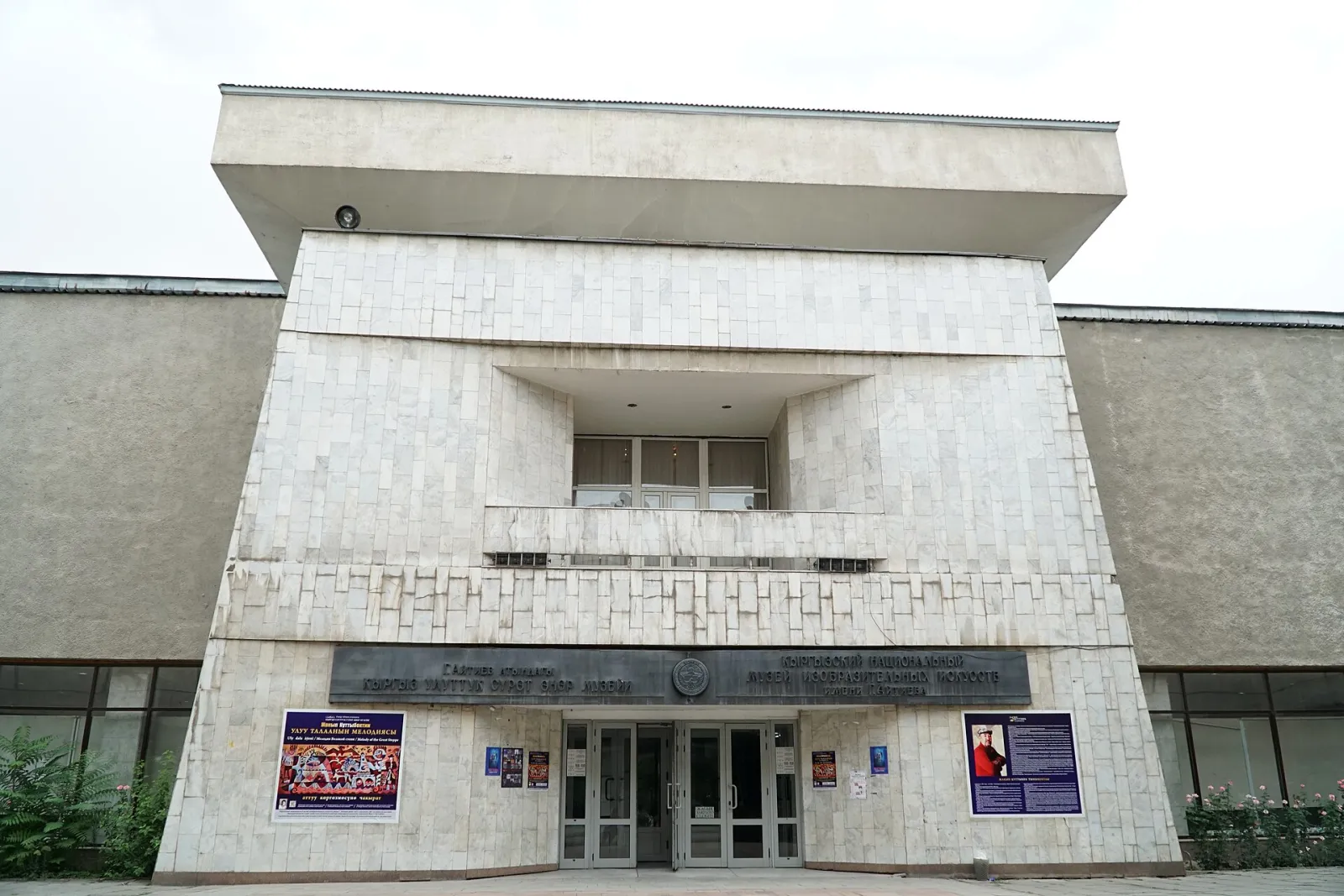 1/2. The Aitiev Museum holds major paintings by Chokmorov Photo: Adam Harangozó, Wikimedia Commons, CC BY-SA 4.0; edited for this site.
 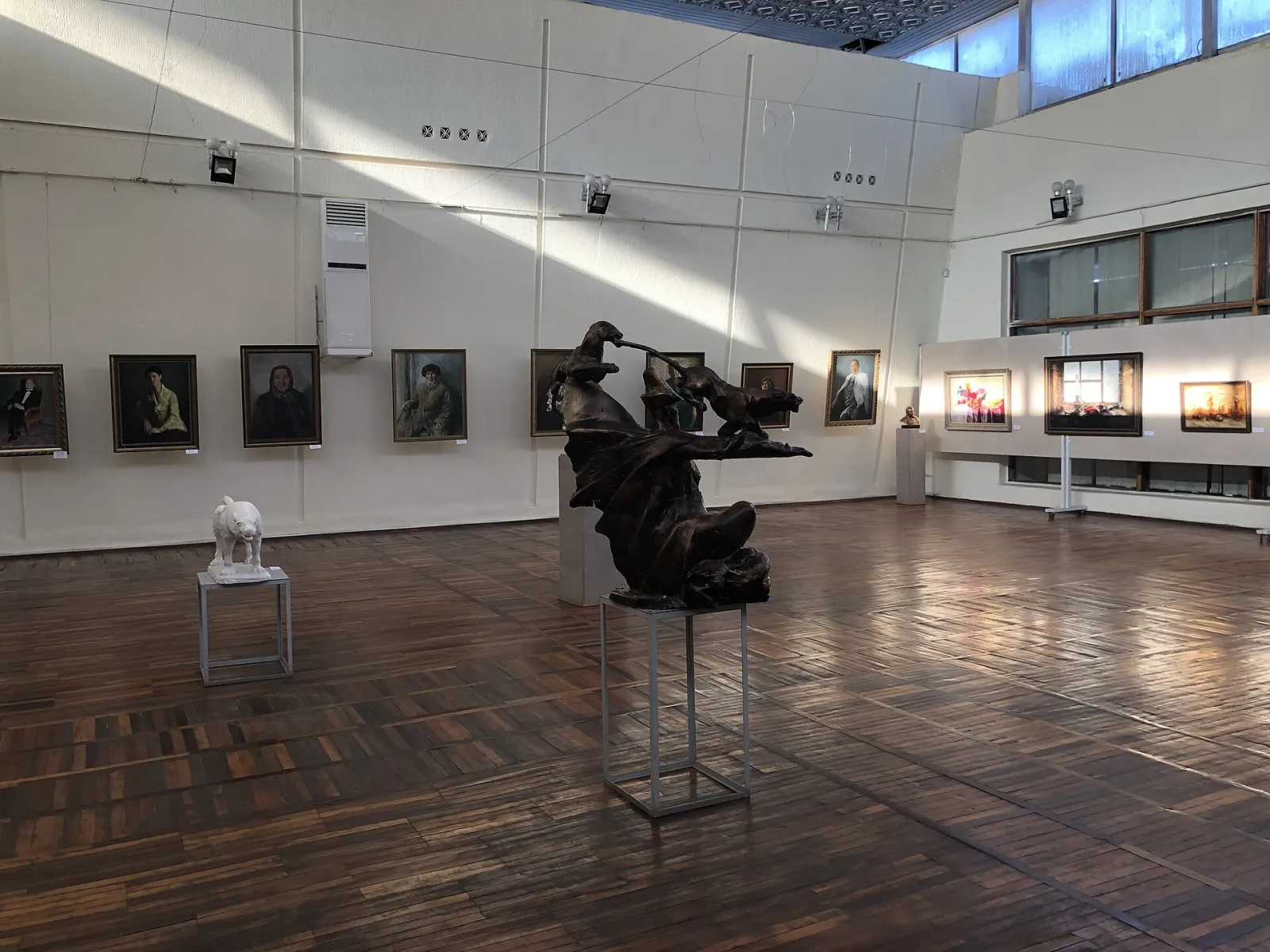 2/2. Painting and sculpture in the museum galleries Photo: Davide Mauro, Wikimedia Commons, CC BY-SA 4.0; edited for this site.
 The museum’s online catalogue includes individual records, among them the 1990 watercolour Inside a Yurt. We do not reproduce Chokmorov’s paintings here because copyright may still apply. The museum record supplies both the image and reliable information about medium, dimensions and inventory number.
Aitmatov and Kurosawa
Chokmorov appeared repeatedly in films connected to Aitmatov’s prose, including Jamila, I Am the Tien Shan, The Red Apple and Early Cranes. They do not form a single series: different directors, genres and periods place the actor in a new relation to Aitmatov’s fictional world each time.
The connection extended beyond film production. Works by Chokmorov hang in the Chingiz Aitmatov House Museum among the writer’s belongings and gifts. The interior is a useful reminder that writers, painters and filmmakers of this generation did not inhabit separate biographies. They worked within an overlapping cultural circle.
Chokmorov worked under Akira Kurosawa in Dersu Uzala and later painted the Japanese director’s portrait. Here the link between cinema and painting becomes literal: an encounter on a film production turned into a portrait. The film is not a Kyrgyz production, but it reveals Chokmorov’s place in a wider Soviet and international industry.
Memory, the studio museum and the 5,000 som note
A Suimenkul Chokmorov studio museum operates at 170 Toktogul Street in Bishkek. At its opening, the city described a collection of paintings, personal papers, belongings, awards and archive photographs. The museum does not maintain a dependable official timetable online, so confirm access shortly before making a special trip.
Chokmorov’s portrait appears on the front of the 5,000 som banknote. The reverse shows Bishkek’s Ala-Too cinema. The two sides form an unusually coherent story: the artist associated with the screen and the city venue through which films met their audience.
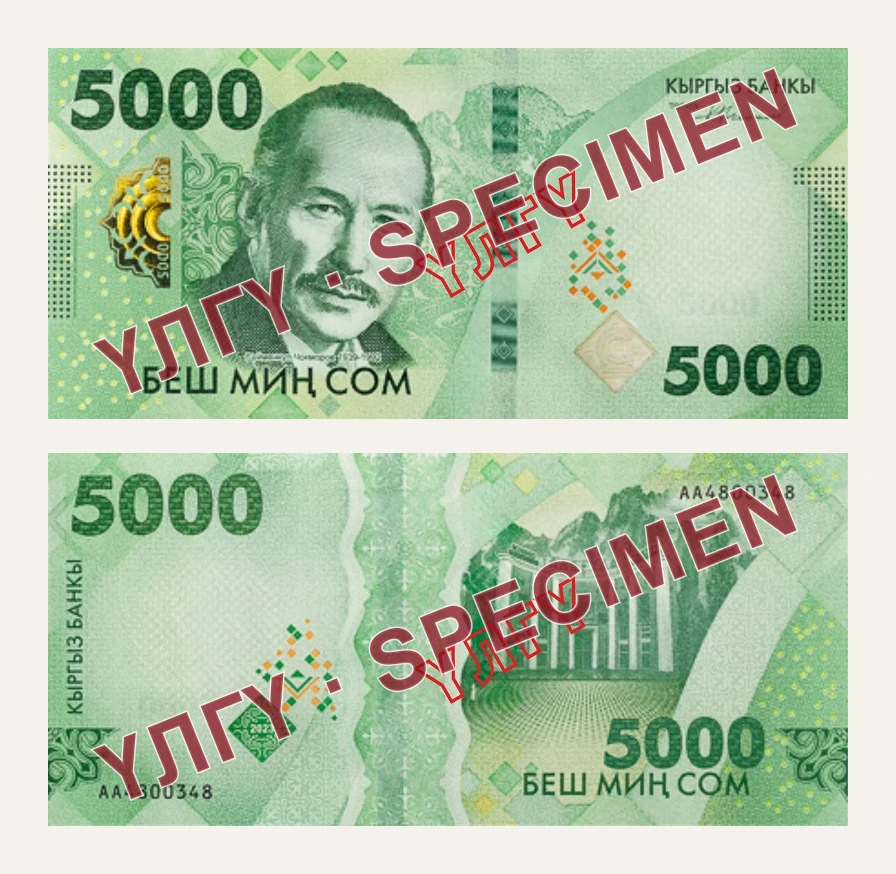 The 5,000 som note: Chokmorov on the front and the Ala-Too cinema on the reverse
His legacy is distributed among several places. The studio museum preserves a working environment and personal objects. The Aitiev Museum holds paintings. The banknote and Bishkek monument present a public commemorative image. None replaces the films themselves, so the strongest introduction combines at least one screening with a museum visit.
Frequently asked questions about Suimenkul Chokmorov
Who was Suimenkul Chokmorov?
Suimenkul Chokmorov was a Kyrgyz painter and film actor who lived from 1939 to 1992. He trained at the Repin Institute and played leading roles in several defining works of Kyrgyz cinema.
What was Chokmorov’s first film?
His first role was Baktygul in Bolot Shamshiev’s Shot at the Karash Pass. Production began in 1967 and the film was released in 1968.
Which Chokmorov films should I watch first?
A useful first set is Shot at the Karash Pass, The Scarlet Poppies of Issyk-Kul, The Fierce One, The Red Apple and Ulan. Together they show his adventure, historical and psychological work.
Was Chokmorov a professional athlete?
Yes. While studying in Leningrad, he qualified as a Master of Sport in volleyball and played for the city’s student team.
Where can I see Chokmorov’s paintings?
Major works are held by the Gapar Aitiev Kyrgyz National Museum of Fine Arts in Bishkek. Individual paintings may be in storage or a temporary exhibition, so check the current display before visiting.
Which banknote carries Chokmorov’s portrait?
Suimenkul Chokmorov appears on the front of Kyrgyzstan’s 5,000 som note. The reverse of the current design shows the Ala-Too cinema in Bishkek.
Share on social media
If you found this guide useful, share it on social media. It takes a moment and helps more travellers discover the project. Thank you!
Anything to add?
Share your experience, leave a comment or suggest an improvement.