Contents:
- Why Toktogul matters
- Ketmen-Töbö, family and his first major contest
- How an improvising akyn worked
- Arrest and Siberian exile
- Love songs, satire and instrumental music
- What Zatayevich actually recorded
- How Toktogul's students preserved the songs
- The Soviet canon and a living legacy
- Where Toktogul's name appears today
- Where to begin
- Frequently asked questions
Why Toktogul matters
Toktogul Satylganov brought together four roles in a single performance: poet, singer, instrumentalist and participant in a public argument. He did not recite a fixed printed text. He held rhythms, melodies, familiar images and the facts of a particular occasion in memory, then shaped a song in front of his listeners. His legacy therefore belongs to literature, music and the history of public speech at the same time.
Toktogul was born in 1864 and died in 1933. His lifetime crossed the final years of Kokand rule, the colonial administration of the Russian Empire, the Andijan uprising, revolution and the first Soviet decades in Kyrgyzstan. Each period added a layer to his biography: an imperial court made him a convict in exile, while Soviet institutions later turned an oral repertoire into books, school lessons and a national canon.
The most useful starting point is to see him as a working performer rather than a monument to social protest. He sang about love, age and journeys, faced other akyns in improvised contests, ridiculed powerful people, performed epic narratives and created music for the komuz.
Ketmen-Töbö, family and his first major contest
The strongest biographical sources place his birth in the Ketmen-Töbö Valley. The specific village appears under several names and spellings: Kushchu-Suu, Kysha, Sazy-Jiyde and Sasyk-Jiyde. The variation reflects the recording of local place names and later administrative descriptions of the valley. What is secure is the wider location in today's Toktogul District.
His mother Burma occupies an important place in the biographical tradition. She was known as a performer of koshok, ritual laments that turn personal grief into a rhythmic address to a community. Toktogul heard not only finished stories and songs from her, but also a way of shaping emotion for listeners. Early mentors are said to have included the akyns Chongdu, Esenaman and Naken.
The National Bank records that Toktogul began composing and playing the komuz at thirteen. By 1882 he was already competing in aytysh and defeated Arzymat, a singer attached to a powerful manap. Later accounts turned the encounter into a confrontation between an independent popular voice and a court performer. Beneath that ideological frame lies a clear professional achievement: the young akyn answered an experienced opponent without a prepared script and held a large audience.
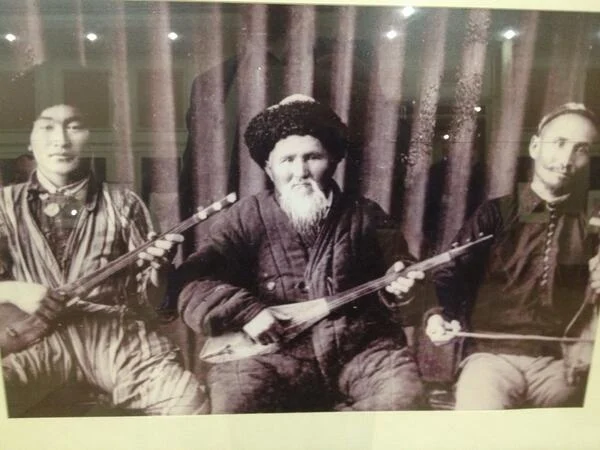 Toktogul Satylganov in the centre, holding a komuz. Photo: Uson smagulov, Wikimedia Commons, CC BY-SA 4.0; edited for this site.
How an improvising akyn worked
In this biography, akyn means more than “poet”. A performer needed command of melodies and metrical formulas, an immediate grasp of the relationships among the guests, the nerve to answer an opponent and the ability to reshape a song as the crowd reacted. The komuz provided pulse and structure while leaving space to form the next line.
An aytysh unfolded as an exchange of improvised replies. Rivals might test one another's memory, pose riddles, praise a lineage or patron, expose a weakness or debate justice. Persuasion depended on more than the literal words: voice, composure, musical pattern and the timing of a reply all mattered.
Our guide to the komuz explains the instrument and its playing techniques. With Toktogul, the crucial point is the bond between word and music. His work was not a written poem to which a tune was added later; it came into being as a complete performance.
Arrest and Siberian exile
In 1898 the Andijan uprising challenged the Russian administration in the Fergana Valley. Mass arrests followed its defeat, and Toktogul was accused of involvement. Archival research connects the case to a denunciation by local political rivals, although the court treated the charge as participation in rebellion.
He received a death sentence that was commuted to penal labour in Siberia. Later biographies disagree over the dates of escape, return and possible re-arrest. Some give 1904 or 1905, while the National Bank's official biography places his final return in 1910. A petition from the returned exile reached the governor of Fergana in May 1910, establishing that he was back by that point.
The homeward journey later acquired dramatic embellishments, but the documented core is powerful enough: Toktogul survived penal labour, years of separation and a return to a broken household. The biographical tradition records the death of his son Topchubay and the remarriage of his wife. Songs of farewell, captivity and reunion carried those experiences more effectively than an official chronology, although their English and Russian titles vary between editions.
Love songs, satire and instrumental music
“Alymkan” remains Toktogul's best-known love song. “Nasylkan” and “Külüyipa” belong to the same early lyrical world. They are a useful corrective to the single image of the social critic: his performance culture also made room for courtship, humour and reflections on the brevity of youth.
The satirical line includes “Besh Kaman”, “Chakyrbai Sütkor” and “Eshen-Kalpa”, often rendered in Russian as “Five Boars”, “The Moneylender Chakyrbai” and “Eshen-Kalpa”. Satire worked through recognition and public embarrassment. The target heard his own features described at the same moment as the rest of the gathering.
Toktogul's musical repertoire included küü and the song forms known as kerbez, terme and sanat. Works associated with him include “Toguz Kayryk”, “Ming Kyyal”, “Shyngyrama” and “Toktoguldun Kerbezi”. When choosing a modern recording, look for the performer and the lineage or printed source of the version rather than relying on an anonymous upload.
What Zatayevich actually recorded
In 1928 the musicologist Alexander Zatayevich met Toktogul in Frunze and notated eighteen works. The phrase is often shortened to “recorded Toktogul”, which can suggest that a sound recording survives. Zatayevich was writing music into notation, not making an audio recording of the singer and his komuz.
The notation was still decisive for the history of Kyrgyz music. It fixed melodic movement, mode and the form of a piece as heard in a particular performance. Musicians and researchers could work from it after Toktogul's death, even though the page could not preserve timbre, gesture, flexible tempo or the response of the audience.
This leaves two complementary routes into Toktogul's art. Printed notation reveals musical construction, while a performance lineage carries a manner of playing from person to person. The fullest understanding comes from comparing the book, the score and a living performance rather than searching for one final “original”.
How Toktogul's students preserved the songs
Much of Toktogul's poetic corpus was written down after his death. Students and contemporaries reconstructed songs from memory, among them Kalyk Akiev, Alymkul Üsönbaev and Korgol Dosuev. They knew the repertoire through shared journeys and performances, but they preserved it within the same oral system in which a version changes with its performer.
This does not make the entire corpus unreliable, but it changes how it should be read. A printed text may carry the teacher's work through a student's memory, an editor's choices and the orthography of the publication date. Aytysh material is particularly fluid: one participant may reconstruct both sides of a dialogue or transmit a partner's reply in his own performance style.
That path differs from the manuscript practice of Togolok Moldo, who wrote down texts and versions of epic narratives himself. Comparing the two lives shows why “author” in an oral culture does not always imply one immutable text.
The Soviet canon and a living legacy
After 1917 Toktogul welcomed the new order and performed songs about political change. Soviet literary history placed this repertoire at the centre of his image and fixed the label “democratic akyn”. The label reflected genuine social satire and later pro-Soviet works, but it also pushed love lyrics, musical experimentation and the uncertainty of oral transmission into the background.
Systematic collection of his poetic texts began in the late 1930s, after his death. Editors, folklorists and former students built a printed corpus at a moment when the republic needed national classics. A book about Toktogul therefore tells two histories at once: that of a nineteenth- and twentieth-century performer, and that of Soviet institutions shaping cultural memory.
None of this reduced the songs to museum objects. They remain current because they can be performed again. Each new version reveals which phrases and musical gestures a performer considers central, and how the distance between an old song and a modern stage is negotiated.
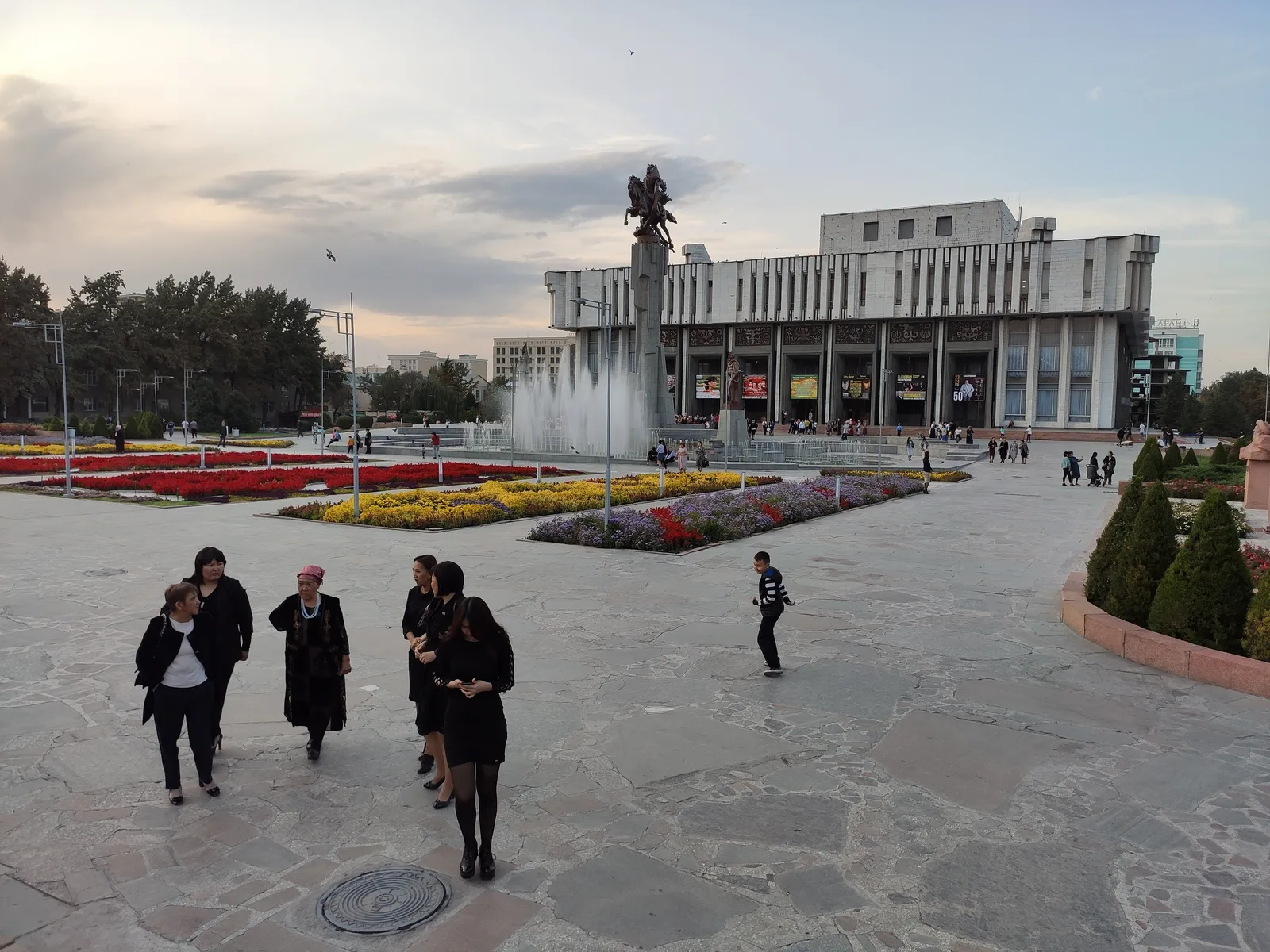 Toktogul Satylganov Kyrgyz National Philharmonic. Photo: Oystercard, Wikimedia Commons, CC BY-SA 4.0; edited for this site.
Where Toktogul's name appears today
In Bishkek, the Kyrgyz National Philharmonic bears Toktogul's name. The State Museum of Literature and Art named after him holds his komuz, archival photographs and a bust by Olga Manuilova. It is a museum of literature and art, not a house in which the akyn lived. Our overview of museums in Kyrgyzstan helps place it within a city visit.
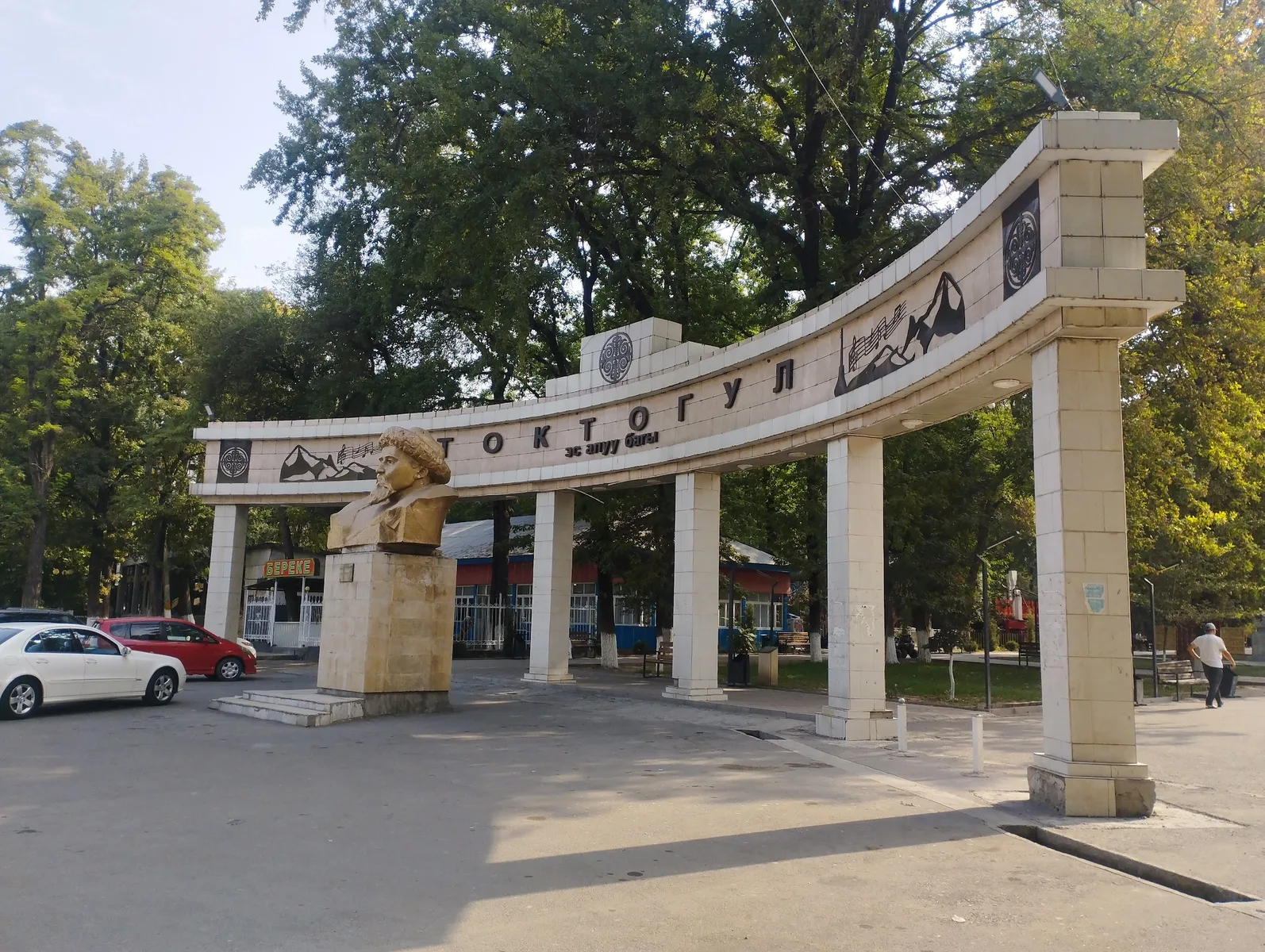
Toktogul town and district, the hydroelectric station and the reservoir carry the same name. These places belong to the later history of commemoration rather than serving as a literal setting for his entire life. The separate guide to Toktogul Reservoir covers the road, shore access and a safe stop on the Bishkek-Osh journey.
Toktogul's portrait appears on the front of Kyrgyzstan's 100 som banknote. The reverse shows Toktogul Hydroelectric Power Station, so a single note joins the person to infrastructure later named in his honour. The different issues and security features are explained in our guide to the 100 som banknote.

Where to begin
Begin with “Alymkan”, then find one satire and one instrumental piece. This sequence introduces three different Toktoguls: the lyricist, the participant in public conflict and the komuz player. When choosing a performance, check who is playing and which teacher, archive or edition underlies the version.
Kyrgyz readers can open the 1989 first volume of the collected works, which contains songs and aytysh material. In translation, always check the translator's name. A literal version may carry the meaning while losing rhythm, wordplay and the timing of a reply.
The National Bank of the Kyrgyz Republic publishes a concise official biography. The Kyrgyz two-volume collection is available through the digital library Bizdin.kg.
Frequently asked questions about Toktogul Satylganov
Who was Toktogul Satylganov?
He was a Kyrgyz improvising akyn, singer and virtuoso komuz player. He created lyrical and satirical songs, competed in aytysh and performed instrumental pieces.
When did Toktogul Satylganov live?
The generally accepted dates are 25 October 1864 and 17 February 1933. He was born in the Ketmen-Töbö Valley, in what is now Toktogul District.
Why was Toktogul exiled to Siberia?
He was accused of involvement in the 1898 Andijan uprising. His death sentence was commuted to penal labour in Siberia. Archival research connects the accusation to a denunciation by local political rivals.
Does a recording of Toktogul's voice survive?
No authenticated audio recording of his voice is known to be publicly available. In 1928 Alexander Zatayevich notated eighteen works as Toktogul performed them, but this was written musical notation rather than a sound recording.
Which banknote features Toktogul?
Toktogul Satylganov appears on the front of Kyrgyzstan's 100 som banknote. The reverse depicts Toktogul Hydroelectric Power Station.
Share on social media
If you found this guide useful, share it on social media. It takes a moment and helps more travellers discover the project. Thank you!
Anything to add?
Share your experience, leave a comment or suggest an improvement.