Contents:
How to make the most of a stop at Toktogul Reservoir
Think of the reservoir as part of a longer route rather than a developed resort. The main road approaches the water several times and opens onto broad views, but not every point has a beach, lifeguards or clear parking. A roadside viewpoint is enough for a short stop. Toktogul town is more convenient for an overnight stay.
Water levels vary noticeably during the year and from one year to another. They depend on inflow from the Naryn and operation of the hydroelectric power station. A shoreline that meets the water on a satellite image may be a long strip of mud or steep descent on the day you arrive.
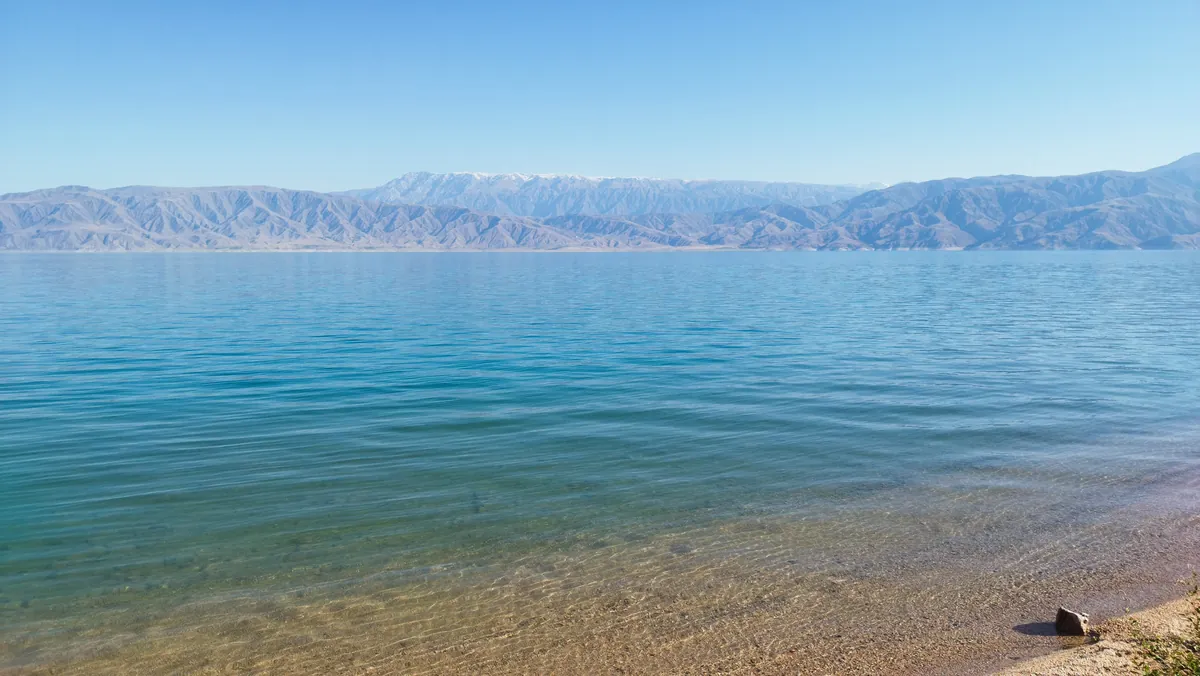 1/2. The reservoir shoreline at water level Photo: Arthur Dolchenko, Wikimedia Commons, CC BY-SA 4.0; edited for this site.
 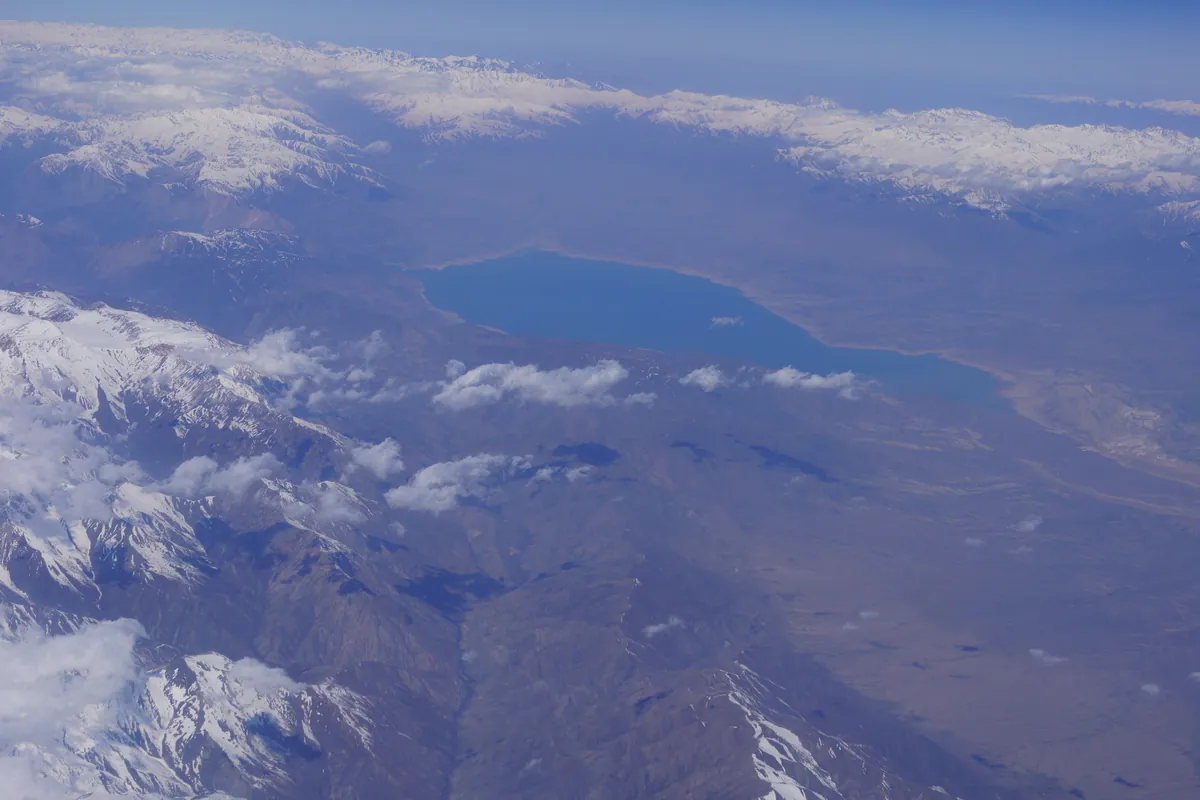 2/2. The scale of the reservoir from the air Photo: Thermokarst, Wikimedia Commons, CC BY-SA 3.0; edited for this site.
 The basin is hot in summer and has little shade. Bring plenty of drinking water, a hat and closed shoes. A clay track becomes slippery after rain, so it is better to leave an ordinary car on firm ground and walk the final metres.
How to get to the reservoir
From Bishkek. The road passes through the Too-Ashuu Tunnel, Suusamyr Valley, Ala-Bel Pass and Chychkan Gorge. Allow 5-7 hours to Toktogul town without long stops. The journey takes longer in winter and after snowfall, and individual sections may be temporarily restricted because of avalanches and ice.
From Osh. The main route runs through Jalal-Abad, Tash-Kumyr and Kara-Kul. Allow 5-6 hours to Toktogul, accounting for roadworks, lorries and stops.
A well-maintained ordinary car is suitable for the main road. A four-wheel-drive vehicle does not remove the risk on a muddy shore or grant permission to enter the hydropower station's protected zone. Before a winter trip, check pass conditions in updates from the Kyrgyz Ministry of Transport and emergency service warnings.
Do not plan a difficult descent after sunset. Download an offline map, identify where you will rejoin the main road and keep enough fuel to reach the next major filling station.
Why the reservoir was built
Toktogul Hydroelectric Power Station regulates the Naryn and is the key station in the Lower Naryn cascade. The reservoir's total design capacity is 19.5 billion cubic metres. This explains both the scale of the water and the dramatic changes in shoreline when the level falls. The station appears on the reverse of the 100 som banknote.
Modernisation of all four generating units was completed in 2025. The station's installed capacity increased from 1,200 to 1,440 MW. The Kyrgyz Ministry of Energy and OJSC Electric Stations publish current technical data.
The reservoir began filling in the 1970s after the dam was built. Toktogul town and district are named after the akyn Toktogul Satylganov. Reliable sources do not support the popular interpretation of his name as the phrase “stop Gula”, so it should not be used as the history of the name.
The dam, turbine hall and neighbouring structures remain a restricted industrial facility. Do not pass barriers or assume that a road on the map leads to a tourist viewpoint.
The shore, swimming and fishing
For a picnic, choose firm ground above the waterline and well away from scree. Wind can raise waves quickly, while sudden changes in depth, mud and remnants of the flooded landscape lie beneath the water. Do not jump from the shore or leave children by the water without an adult.
Swim only at a place known to local residents, with an easy exit and calm water. An empty shore is not necessarily safe. A remote bay will usually have no lifeguards, reception or vehicle access for emergency services.
The reservoir contains fish, but seasonal restrictions, permitted tackle and environmental patrols regulate fishing. Check the conditions in our guide to fishing in Kyrgyzstan before travelling. Use a boat only with serviceable life jackets and due regard for the wind, never as a way to approach the dam.
Toktogul town is suitable for an overnight stay, food and replenishing your water supply. You can add Chychkan Gorge as a separate stop if the weather and daylight allow an unhurried journey across the passes.
Share on social media
If you found this guide useful, share it on social media. It takes a moment and helps more travellers discover the project. Thank you!
Anything to add?
Share your experience, leave a comment or suggest an improvement.