Contents:
Checked on 28 August 2026. Rules, spawning closures, payment methods and the regime of a particular body of water change. Verify them immediately before fishing.
What to check before fishing
Kyrgyzstan updated its fishing rules by an order dated 19 December 2025. The rules distinguish commercial, recreational and sport fishing and define fishing resources, permits, tackle and restrictions. Old leaflets based on the 2015 rules can no longer serve as the sole basis for a trip.
Fishing ticket or card. The current rules require documents granting the right to catch aquatic biological resources. The type depends on whether the fish belongs to a valuable species subject to quotas. For Issyk-Kul, electronic tickets in 2026 are available for 1, 2 or 3 days; do not automatically apply this system to another body of water. Before paying, confirm the location, species, period of validity, catch limit and issuing authority.
Seasonal bans. Recreational and sport fishing may be suspended nationwide or for particular species and waters during spawning. The responsible fisheries authority sets dates for a specific season, so last year’s calendar does not prove that fishing is allowed now. Check the current order and regional inspectorate notices immediately before you go.
Size and catch limits. Check minimum sizes, limits and permitted species against the current rules and ticket conditions. If you cannot identify a species confidently, it is safer to release the fish without injuring it.
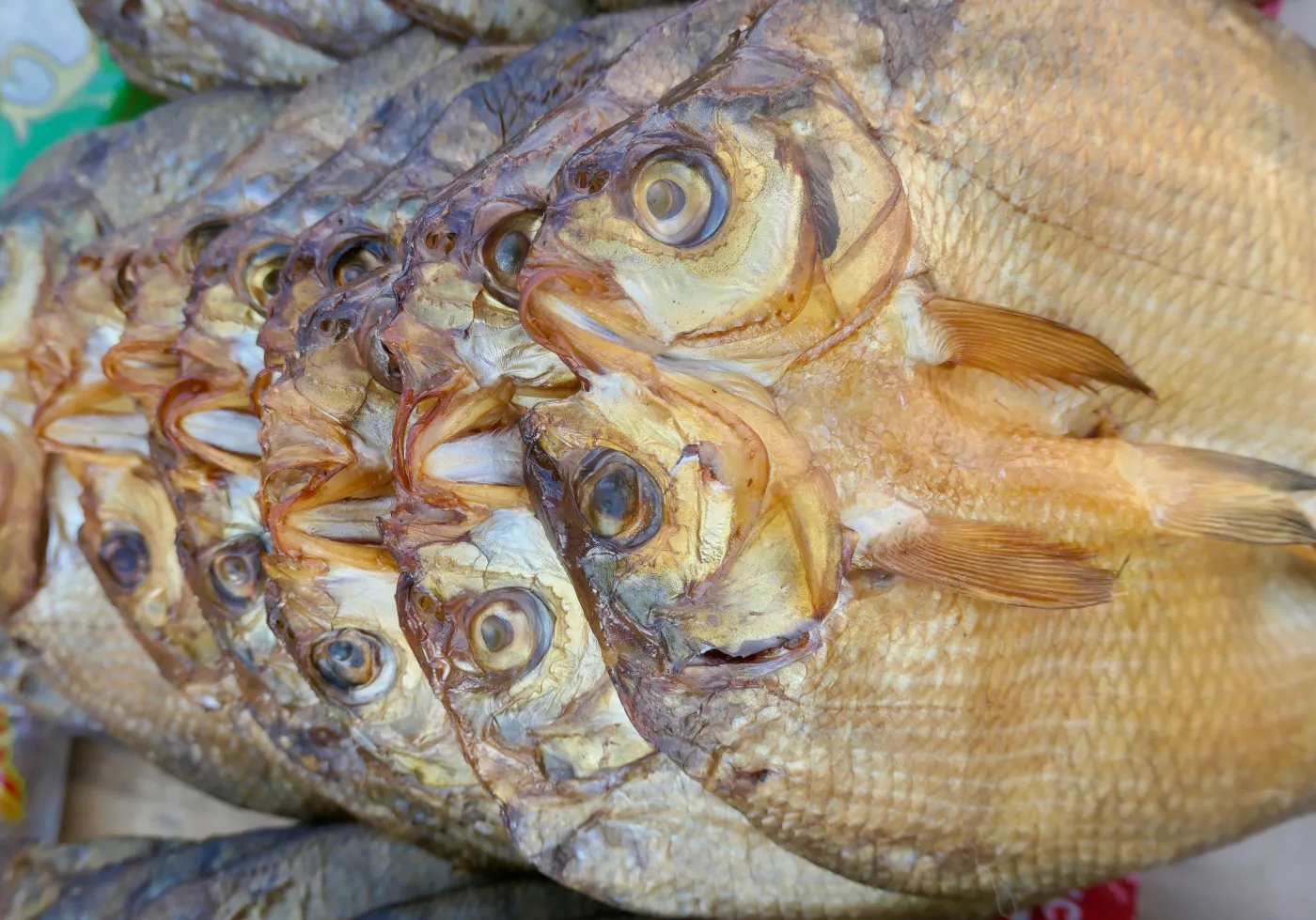 Fish at Karakol's Slavic Bazaar. Photo: Bruno Rijsman, Wikimedia Commons, CC BY 2.0; edited for this site.
Tackle. Synthetic nets, electric fishing systems and other poaching gear are not recreational tackle. Permission to use a rod does not allow you to set a net, fish in a closed zone or leave tackle unattended.
A useful starting point for checking the legal basis is the Fishing Rules of 19 December 2025. Then confirm local conditions with an inspector or the water’s administration: the regime may change faster than travel articles.
Where people fish in Kyrgyzstan
Lakes and reservoirs. Anglers visit Issyk-Kul, Son-Kul, the Toktogul Reservoir, Orto-Tokoy and smaller lakes. A large body of water does not mean unrestricted access along its whole shore. Part may lie within a nature reserve, spawning area, border zone or private property.
Mountain rivers. River fishing requires a precise understanding of the permitted section. In spring and after heavy rain, water levels rise quickly, currents strengthen and a familiar crossing becomes impassable. Do not enter the water alone or stand below a rockfall or eroding bank.
Fish farms and paid ponds. These are the most straightforward choice for a short trip without expedition preparation. Even here, ask whether tackle is included, the catch is charged separately, catch-and-release is allowed and who is responsible for veterinary and environmental compliance.
Issyk-Kul and Son-Kul
Issyk-Kul and Son-Kul have a separate fish-protection regime. Decree No. 261 imposed a moratorium on commercial fishing in both lakes from 21 July 2026 to 21 July 2029. It covers commercial catching, transport, sale, storage, purchase and export of fish.
Recreational and sport fishing are expressly excluded from the moratorium, but this exception does not remove ticket requirements, spawning closures, protected zones, catch limits or restrictions on species and tackle. Before setting out, obtain an answer for your exact shore and date from the regional inspectorate or water administration. The terms are set out in the current decree.
At Son-Kul, high-altitude weather is another factor: the lake lies above 3,000 metres, access depends on the passes, and nights can be cold even in summer. At Issyk-Kul, the main danger on the water is wind. Waves develop quickly, and it is easy to underestimate the distance to shore.
Guides, tackle and safety
A good fishing guide names the exact body of water before payment, explains its legal regime and shows which ticket is required. “We will sort it out there” is not a substitute for a permit. Also confirm whether transfers, boat, life jacket, tackle and catch storage are included.
- On a boat. Put on a life jacket before departure, not after the weather deteriorates. Do not overload the craft and keep your phone in a waterproof case.
- On shore. Check the stability of rocks and banks. Waders without a belt and the skill to escape a current add risk.
- On ice. Do not rely only on frost or other people’s footprints. A local specialist must confirm the ice’s thickness and condition.
- With your catch. Do not leave line, hooks or packaging. Take rubbish away even if the site was already untidy.
As of 8 July 2026, electronic tickets for Issyk-Kul were issued through MegaPay. The app section, fees and payment process can change. Obtain current instructions before paying, verify the body of water and validity period, save the ticket offline and carry identification.
Share on social media
If you found this guide useful, share it on social media. It takes a moment and helps more travellers discover the project. Thank you!
Anything to add?
Share your experience, leave a comment or suggest an improvement.