Contents:
Checked on 3 September 2026. Enabling infrastructure is under construction, but the main dam, reservoir and powerhouse are not complete. Financing and the intergovernmental structure for the main phase are still being assembled.
What the project’s present status actually means
Kambarata-1 is often described as a hydropower plant under construction, but that needs context. Work on site has focused on the infrastructure required before the main build can begin: roads, an access tunnel, a bridge across the Naryn, a 110 kV line, a substation and a workers’ camp. The high dam and generating station have not yet been built.
The distinction matters economically. Enabling works already create orders for builders and suppliers, while new electricity arrives only after the main civil works, reservoir filling, equipment installation and testing. Our overview of Kyrgyzstan’s major projects in 2026 explains why these phases should not be treated as interchangeable.
Site access is taking shape
- A 126 m transport tunnel has been excavated.
- Roads, a bridge, site power and a camp have been under construction.
- They provide access for the future main works.
No main dam yet
- The powerhouse and spillways have not been completed.
- The reservoir has not been filled.
- The plant generates no electricity today.
No full financial close
- World Bank technical assistance is funded.
- Construction finance is still being structured.
- The three-country joint venture remains planned.
What Kambarata-1 is designed to become
The World Bank’s current public factsheet gives a design capacity of 1,860 MW, a 261 m concrete dam, a reservoir holding 5.2 billion cubic metres and annual generation of about 6,000 GWh. These are design figures, not the output of an operating plant.
Some earlier and technical documents still show 256 m, 5.4 billion cubic metres and 5,600 GWh. The differences reflect the continuing update of the feasibility study and design alternatives. The reliable broad picture is a roughly 260 m dam, a large seasonal reservoir and a 1.86 GW power station. Approved final design documents must settle the precise values.
Kyrgyzstan’s Ministry of Energy has said the selected concept uses roller-compacted concrete. The method places and compacts concrete in layers and suits a very large gravity dam. It still demands detailed foundation work, spillways, temperature control, seismic analysis and independent safety review.
Where Kambarata-1 sits in the Naryn cascade
The future plant is upstream of operating Kambarata-2 and the entire Toktogul cascade. Water released from Kambarata-1 will continue through the existing plants below it. The new reservoir would therefore influence the operation of a chain of assets rather than a single isolated site.
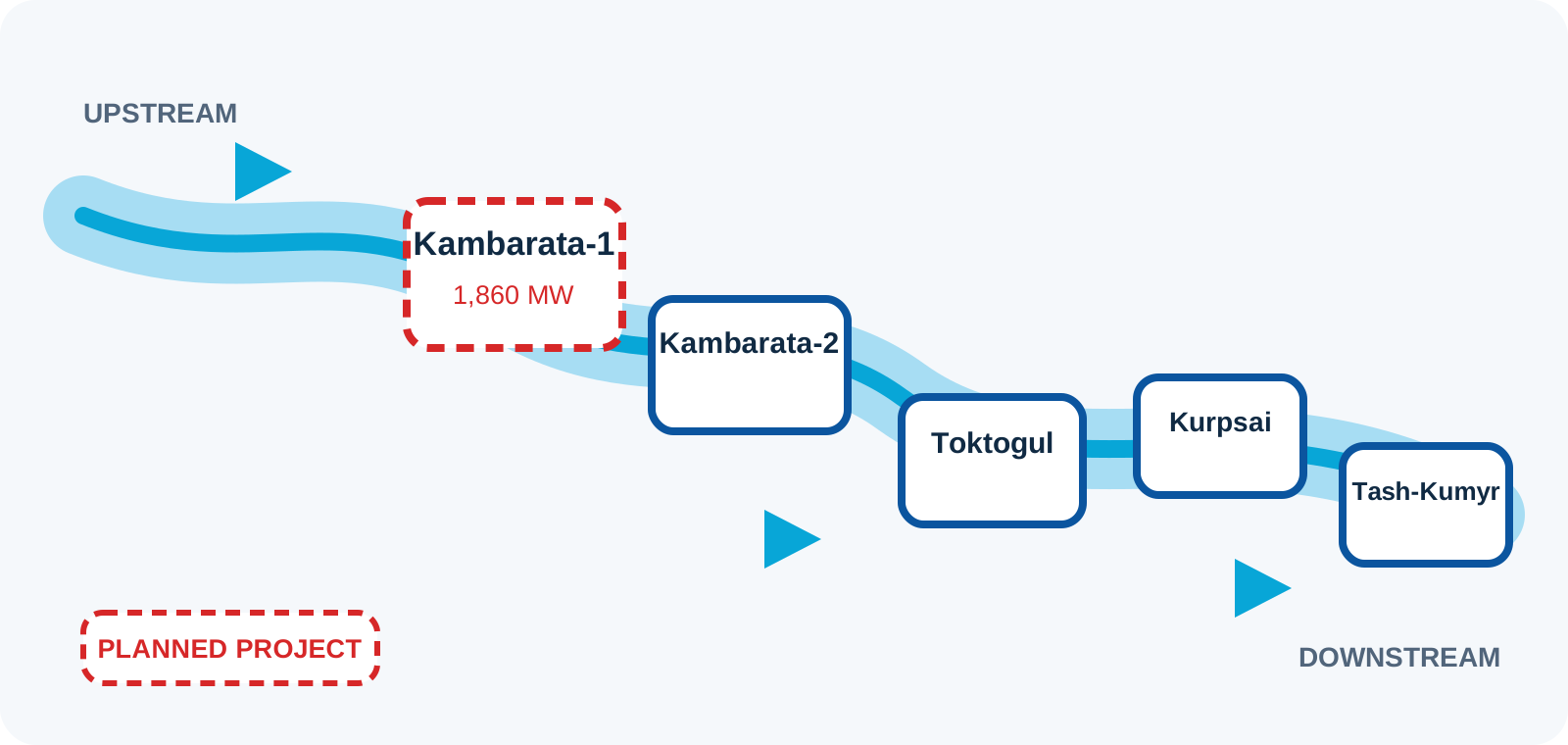 Kambarata-1 in the Naryn cascade. The diagram shows the downstream order of plants, not geographic distance or scale. Image: I Love KG.
A large storage reservoir can shift some generation between seasons. Water can be retained during higher inflows and released for winter electricity demand. Downstream users also need water for summer irrigation, however, so operation cannot be based only on the priorities of one power station.
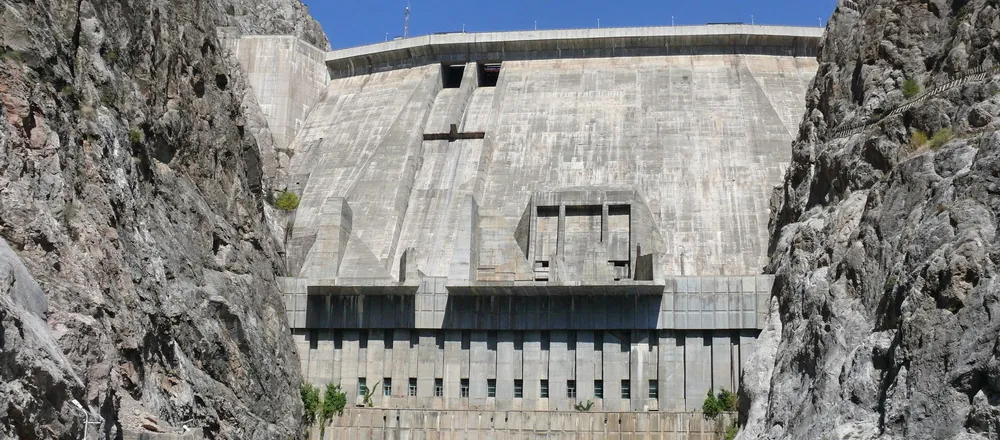 The operating Toktogul plant farther down the Naryn. This is not Kambarata-1, but part of the existing cascade. Photo: heinerbischkek, Wikimedia Commons, free use permitted; edited for this site.
What is complete in the enabling programme
The latest detailed official breakdown, published by the Ministry of Energy on 11 March 2026, reported the 126 m access tunnel fully excavated. The road from the Bishkek-Osh highway to the site was about 90% complete, while the road from Cut No. 2 to the dam site was about 85% complete. The bridge was assessed at 40-50% and the 100-person camp at 60%.
On 16 April, the ministry expected the principal enabling works to be complete by the end of that month. That was a forecast, not a public acceptance certificate for every asset. The accurate wording as of 3 September 2026 is that preparation is well advanced, while no separate public notice confirms formal completion of the whole package.
The bridge is essential for heavy equipment because it links the site to the right bank. The 110 kV line and substation initially supply the construction operation. Their completion does not start the turbines; it allows larger excavation, concrete and installation contracts to mobilise.
How much the project costs and who may finance it
The working cost estimate has changed with design and prices. World Bank documents provide a range of roughly $4-4.5 billion. It is neither a final bill nor an already disbursed construction loan.
Approved technical assistance totals $18.6 million. It funds the feasibility update, environmental and social instruments, the financing model and implementation support. For construction, the World Bank is considering a multiphase programme of up to $1.5 billion if approved. The governments are working with other development institutions to assemble the remainder.
Three statements must be kept separate: money has been approved for studies; a bank is considering construction finance; and the full project has reached financial close. As of September 2026, the first two are supported, the third is not. The World Bank’s Kambarata-1 factsheet sets out the current structure.
Why Kyrgyzstan, Kazakhstan and Uzbekistan are involved
Farther downstream, the Naryn becomes the Syr Darya, tying its water and electricity to several countries. Kyrgyzstan wants winter generation and a smaller energy deficit. Kazakhstan and Uzbekistan have an interest in predictable water operation for energy and irrigation, as well as access to electricity.
The proposed joint venture would be based in Kyrgyzstan, with a planned 34% Kyrgyz stake and 33% each for Kazakhstan and Uzbekistan. The shares remain subject to the intergovernmental agreement, financing and final legal documents. They should not yet be presented as an operating ownership structure or a settled division of profit.
For Kyrgyzstan’s economy, the project is about more than future electricity sales. Construction, transport, materials, engineering and debt service all create different effects at different stages. Revenue from an operating plant comes later and depends on tariffs, buyers, hydrology and financing terms.
What is being assessed for water, nature and communities
A large reservoir changes a river reach and land use. Project assessments consider seasonal flows, water quality, fish and terrestrial ecosystems, cultural sites, movement restrictions, the influx of workers and effects on local livelihoods.
Consultations with communities, civil society and neighbouring countries took place in 2024 and 2025. Draft environmental and social assessments, a management plan, a grievance mechanism and a livelihood restoration and resettlement framework have been prepared. Their existence does not mean there will be no impacts; the purpose is to identify them before main construction and define mitigation and compensation.
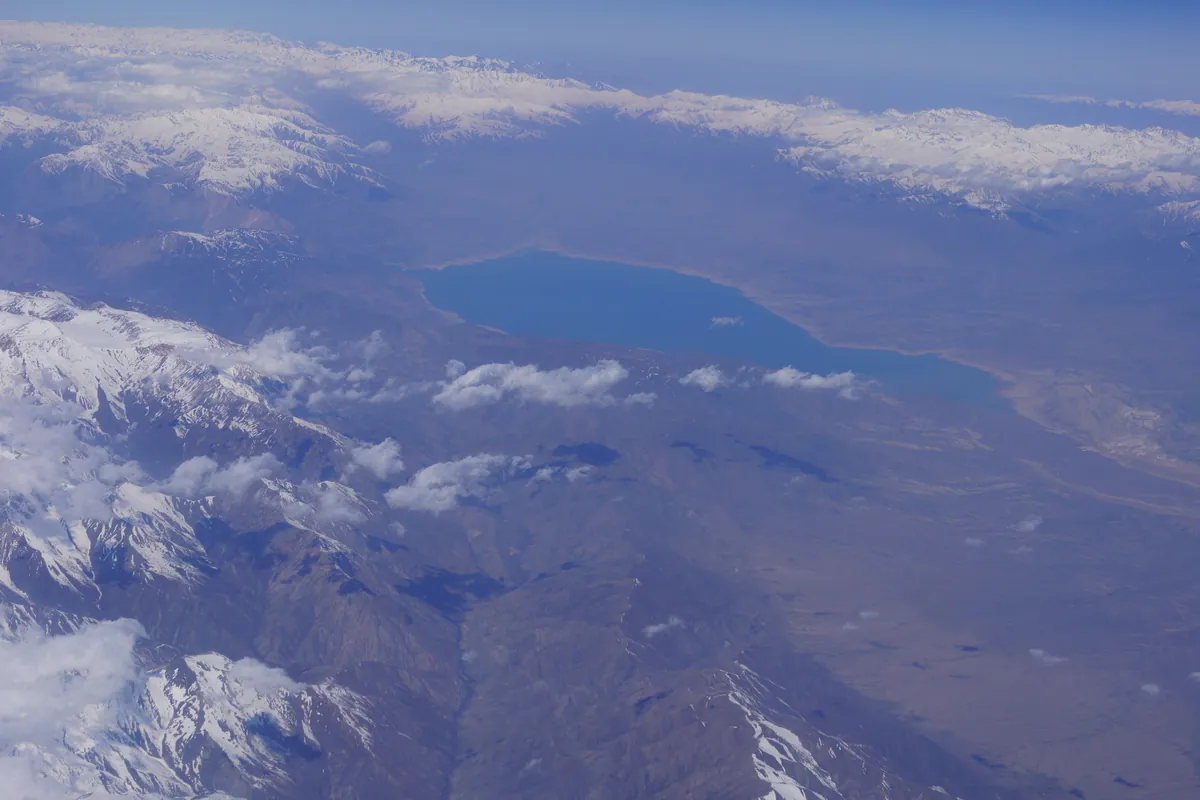 Toktogul Reservoir downstream shows the scale of existing regulation on the Naryn. Kambarata-1 would create a separate upstream reservoir. Photo: Thermokarst, Wikimedia Commons, CC BY-SA 3.0; edited for this site.
Seismic design and dam safety require particular scrutiny for a structure of this height. AFRY prepared the updated feasibility study, and an independent international dam-safety panel reviews the project. Oversight must continue through design, construction, first filling and commissioning rather than end with one pre-construction report.
When will Kambarata-1 generate electricity?
There is no confirmed first-power year. The official state project register gives an overall implementation horizon to 2034, but that is not a confirmed first-power date. The intergovernmental agreement, full financing package, final design, major contracts and main works still have their own decision points.
The useful sequence to watch is a signed and ratified three-country agreement, an operating joint venture, financial close, approved design, main procurement, dam and powerhouse construction, equipment installation, reservoir filling and tests. Without that chain, a precise commissioning date remains a promise rather than a schedule.
The current enabling status and financing discussions are described in the Ministry of Energy’s update of 16 April 2026.
Can travellers visit Kambarata-1?
The construction site is not a tourist attraction. Heavy equipment, security and project traffic use roads built for the works. We do not publish a map pin or directions into the controlled site because a map does not grant access.
The hydropower context is easier to understand from public sections of the Bishkek-Osh road and in Kara-Kul, which grew beside the operating Toktogul cascade. Dams, substations, tunnels and service roads remain controlled infrastructure there too. Do not cross barriers or fly a drone.
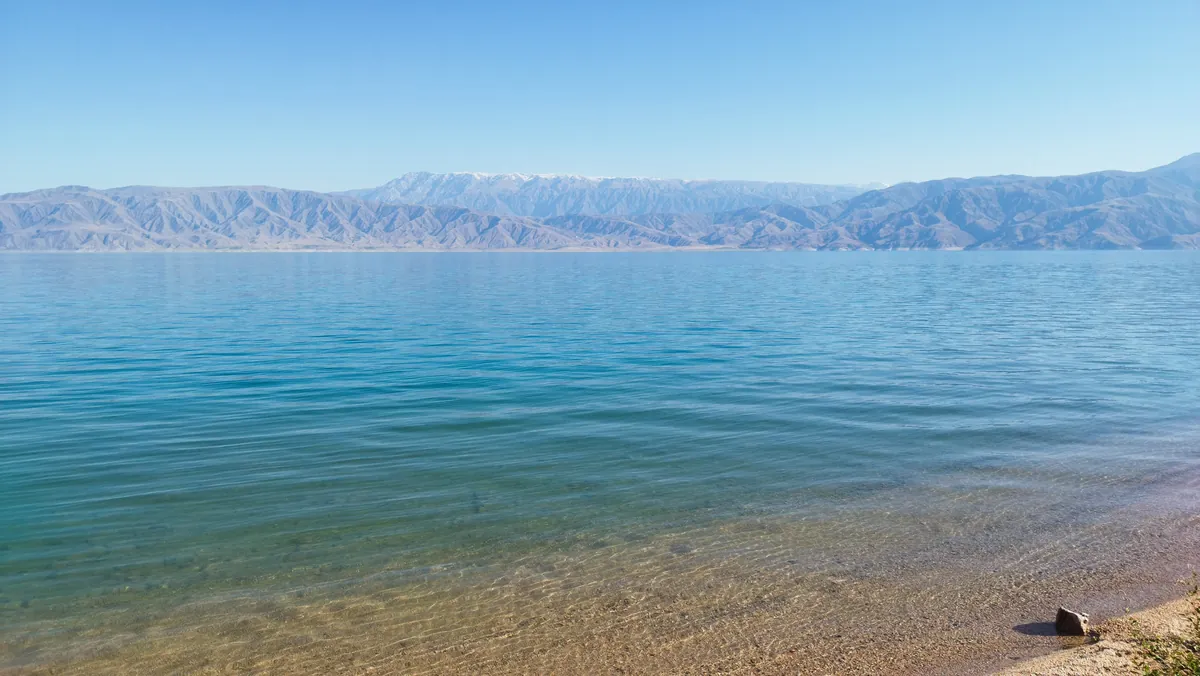 A public view of Toktogul Reservoir farther down the cascade gives scale without entering the Kambarata-1 work site. Photo: Arthur Dolchenko, Wikimedia Commons, CC BY-SA 4.0; edited for this site.
Use current road information for the Bishkek-Osh journey. Kambarata-1 should not become an improvised detour towards a guarded industrial site.
Frequently asked questions
Is Kambarata-1 under construction?
Yes, if referring to enabling roads, a tunnel, bridge, site power and a workers’ camp. The main dam, powerhouse and reservoir are not complete, so the plant does not generate electricity.
How much power will Kambarata-1 produce?
The current public design gives 1,860 MW and about 6,000 GWh of expected annual generation. These remain design figures until construction and commissioning are complete.
Who will own Kambarata-1?
A joint venture is planned with Kyrgyzstan holding 34% and Kazakhstan and Uzbekistan 33% each. The intergovernmental agreement and final structure are still being prepared.
How much will Kambarata-1 cost?
Working estimates are about $4-4.5 billion. The full construction financing package has not reached financial close, so the total and terms can change.
When will Kambarata-1 open?
There is no confirmed first-power date. The intergovernmental agreement, financing, main construction, equipment installation, reservoir filling and tests must come first.
Can visitors enter the Kambarata-1 construction site?
The work site is not a tourist attraction. Project and service roads do not grant public access; security and safety requirements take priority.
Share on social media
If you found this guide useful, share it on social media. It takes a moment and helps more travellers discover the project. Thank you!
Anything to add?
Share your experience, leave a comment or suggest an improvement.