Contents:
Checked on 3 September 2026. Costs and schedules for major infrastructure change. This guide distinguishes active construction, enabling works and proposals that are not yet operating assets.
One year, four very different stages
A “project” may be an open road, an active building site, a package of early works or a memorandum. Those stages matter economically too: construction already buys materials and employs people, while a railway or power station delivers its main service only after commissioning.
The railway through Torugart
- Tunnel, earthworks and site infrastructure are under way in Kyrgyzstan.
- The roughly 304-kilometre section does not yet carry freight.
- The government programme places completion of the corridor in 2030.
Kambarata-1
- Access roads, a bridge, tunnel, power line and workers’ camp have been prepared.
- The main dam and generating station are not complete.
- Financing and the three-country structure remain central tasks in 2026.
Roads and airports
- Repairs, new sections and reconstruction are proceeding at different sites.
- Kilometres reported under separate programmes should not be added automatically.
- A signed aircraft purchase is not the same as a delivered and operating aircraft.
The China-Kyrgyzstan-Uzbekistan railway
This is Kyrgyzstan’s most visible active infrastructure build in 2026. The domestic section runs from Torugart via Arpa, Kosh-Dobo and Makmal to Manas, the city formerly named Jalal-Abad, and measures about 304 kilometres. A transshipment station is planned near Makmal: the line uses China’s 1,435 mm gauge to that point and 1,520 mm towards the existing network.
The Ministry of Transport reports tunnelling at all 29 planned tunnels, alongside earthworks, temporary access roads and power supply for the sites. The design also requires 50 bridges. Almost 40% of the route in Kyrgyzstan consists of tunnels and bridge structures, which is why the formal launch in late 2024 never implied a quick opening.
Our dedicated China-Kyrgyzstan-Uzbekistan railway guide explains the route, gauge break, financing and differing completion milestones.
Secured financing and physical work distinguish the railway from a memorandum. It still has no passenger tickets or freight timetable. The government programme runs to the end of 2030; interim progress is best checked through the Ministry’s reports on work actually completed.
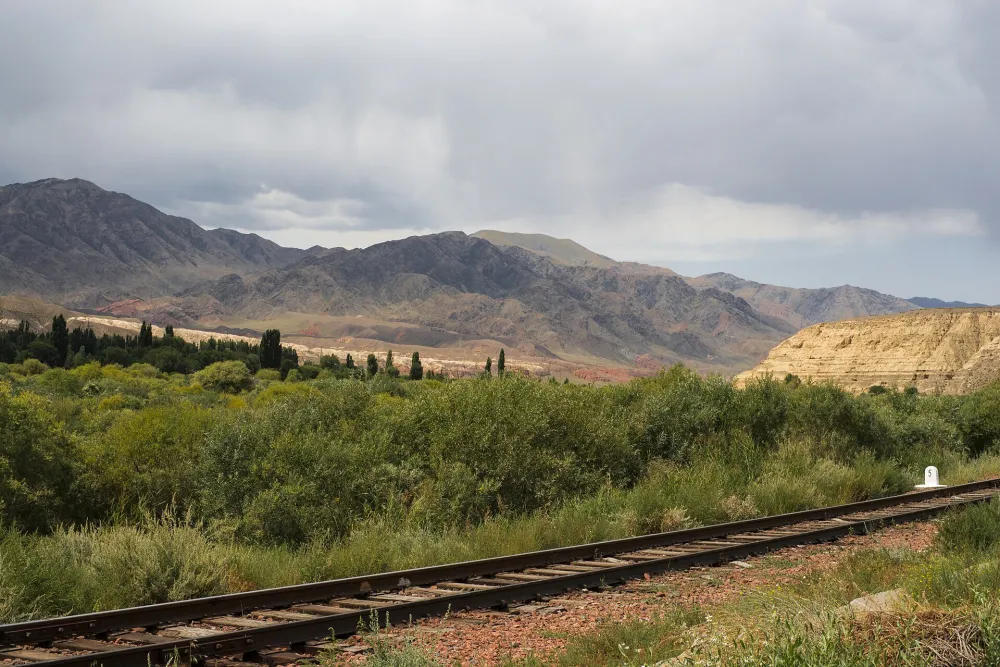 The existing railway in Boom Gorge. This is not the new corridor’s construction site, but it shows the terrain railways must cross in Kyrgyzstan. Photo: Vilya Shoni, Wikimedia Commons, CC BY 4.0; edited for this site.
Kambarata-1: early works are nearly complete, the dam is still ahead
Kambarata-1 is being developed on the Naryn River upstream of Kambarata-2. The current design calls for 1,860 MW of capacity, a 261-metre dam and annual generation of roughly 6,000 GWh. Kyrgyzstan is developing it with Kazakhstan and Uzbekistan, while the World Bank supports technical, environmental and social studies and is considering construction finance.
In mid-April 2026, the Ministry of Energy expected the main enabling works to be completed by the end of that month. They include access roads, a bridge across the Naryn, a tunnel, a 110 kV line, a substation and a temporary workers’ settlement. These are essential to the future build, but they are not the dam, reservoir or powerhouse.
The next decisive questions concern financing and the three governments’ agreement on ownership and operation. “Kambarata-1 is under development” and “Kambarata-1 will soon generate electricity” are therefore very different claims. The accurate 2026 status is advanced early works and preparation for the main phase, without a promised first-power date.
Our dedicated guide to Kambarata-1 explains the dam design, the three-country structure, environmental studies and the milestones that still precede generation.
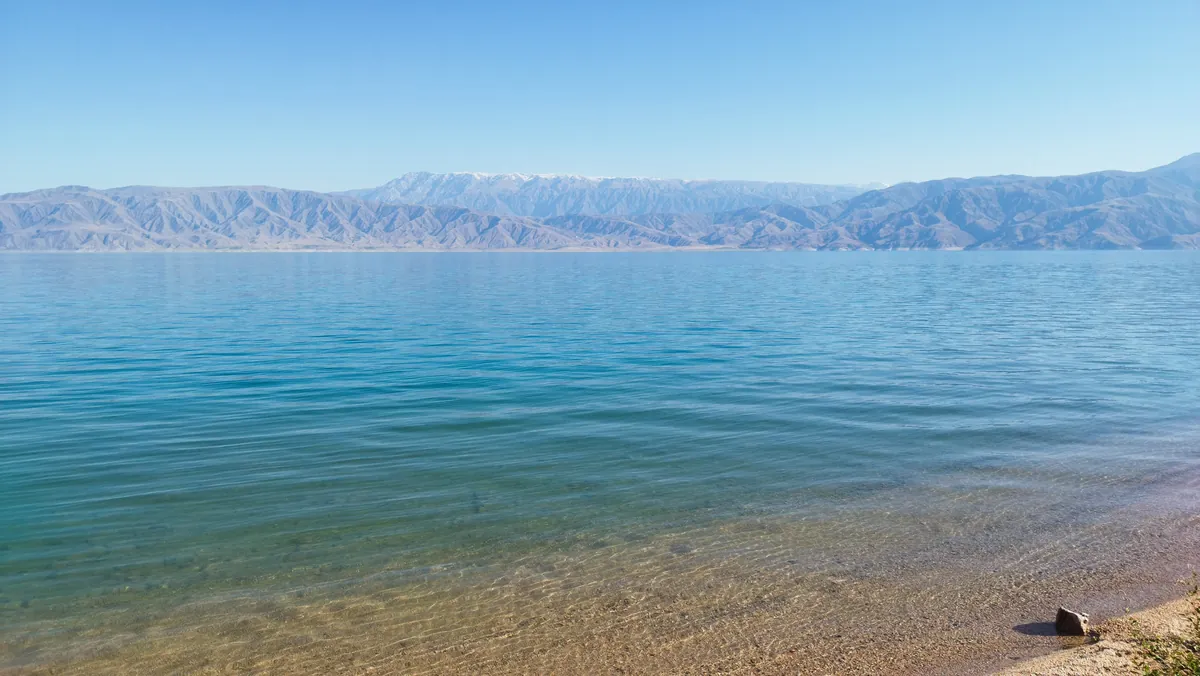 Toktogul Reservoir farther downstream on the Naryn. Kambarata-1 will be a separate facility above the existing cascade. Photo: Arthur Dolchenko, Wikimedia Commons, CC BY-SA 4.0; edited for this site.
Roads: dozens of sites, not one megaproject
The 2026 road season combines several budgets and contracts. The Ministry of Transport planned construction and repair on 700 kilometres under state capital investment and another 457 kilometres under its annual title list. Calling the total “1,157 kilometres of new road” would be misleading: the lists cover repair, reconstruction and new work, and use different programme classifications.
Continuing schemes named by the ministry include Balykchy-Bokonbaevo-Karakol, Naryn-Baetov, Ala-Buka-Zhany-Bazar-Kirovka and Safarovka-Barpy. Other work covers structures on the alternative North-South road, Bishkek’s northern bypass and access roads to tourism areas.
Drivers need the status of a specific section, not a national kilometre total. Work on an open highway brings dust, machinery, temporary markings, single-lane control and uncertain journey times. Before a long drive, check the Ministry’s current construction list and fresh notices for your route. Our separate guide covers the established Bishkek-Osh highway.
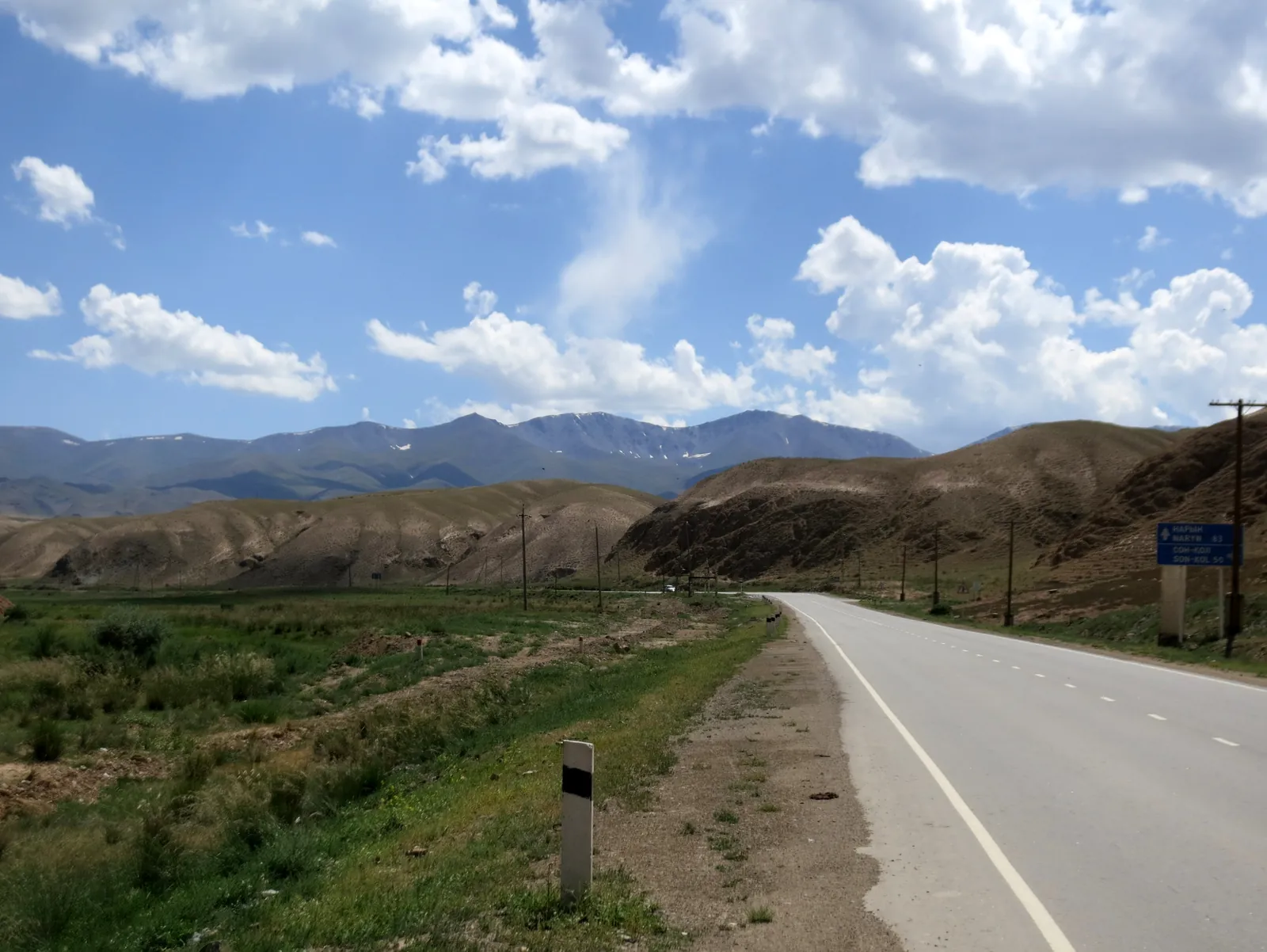 1/3. The northern section beyond Kochkor Photo: ThomasG, Wikimedia Commons, CC BY-SA 3.0; edited for this site.
 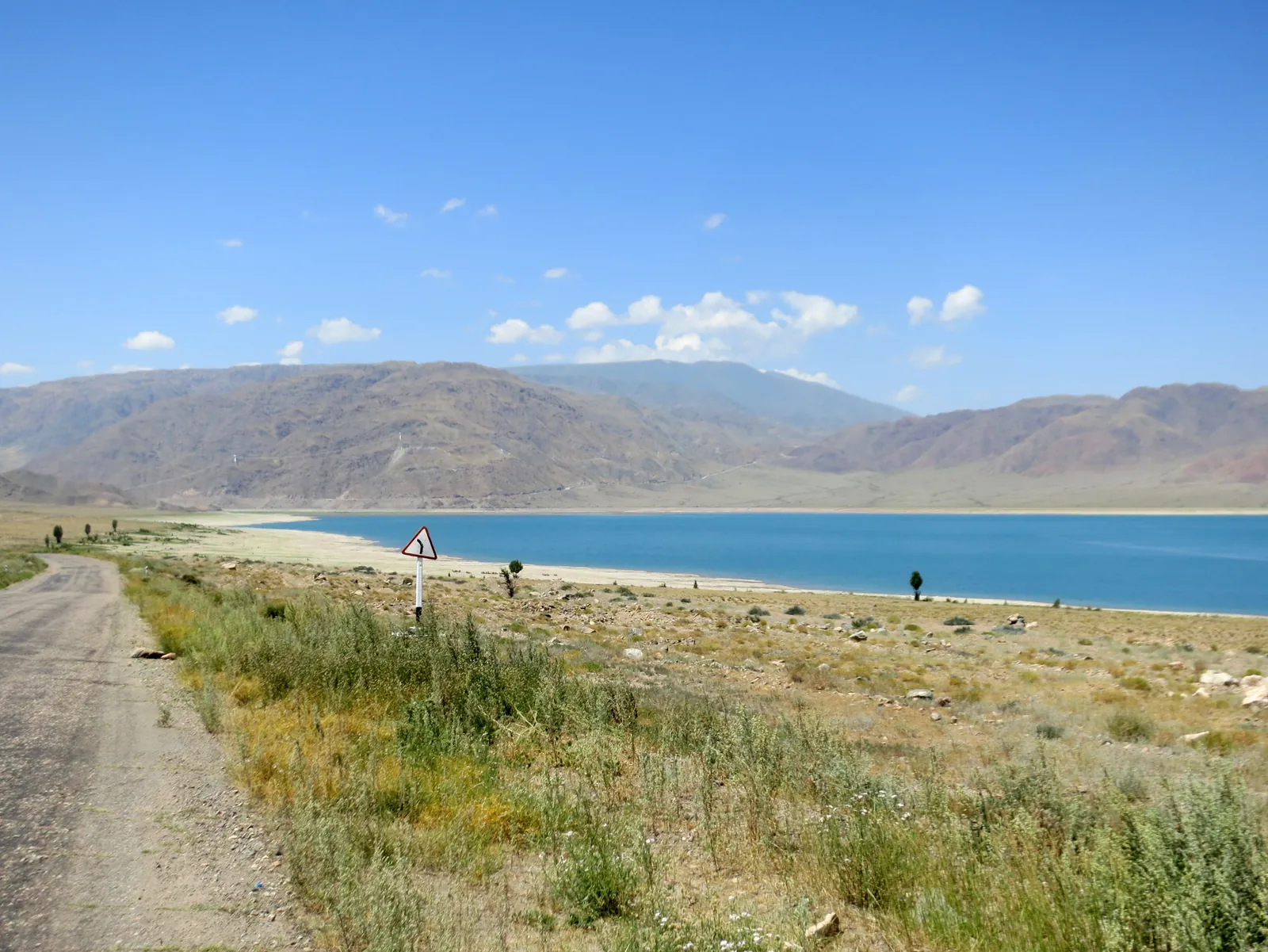 2/3. Orto-Tokoy on the way from Balykchy Photo: ThomasG, Wikimedia Commons, CC BY-SA 3.0; edited for this site.
 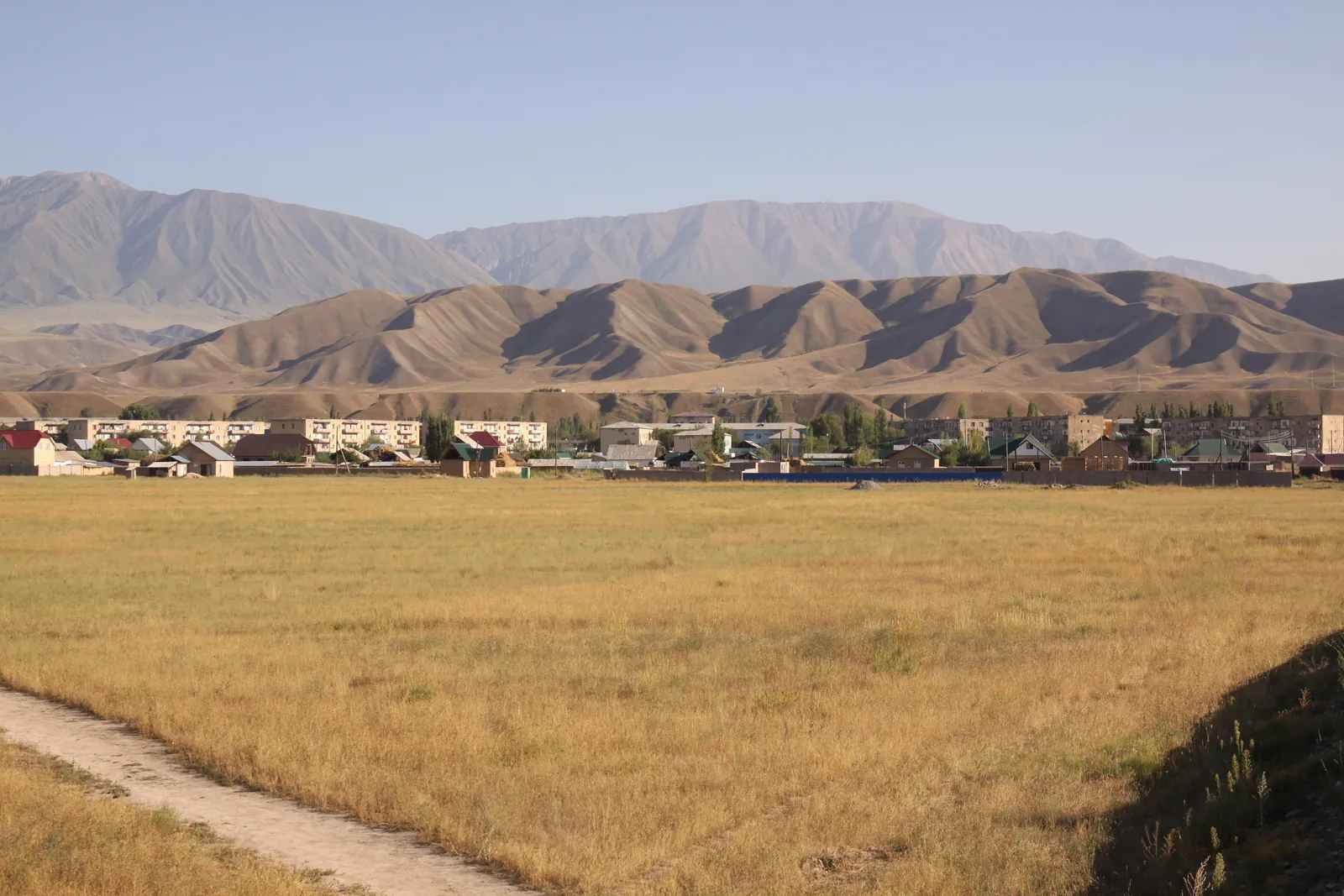 3/3. The high valley around Kazarman Photo: JohnNewton8, Wikimedia Commons, CC BY-SA 4.0; edited for this site.
 Airports and the national fleet
In June 2026, the government inspected the ongoing reconstruction at Manas. The work covers terminal infrastructure and the passenger journey on the ground. An earlier programme allocated KGS 8.4 billion to regional airport modernisation. Talas, Karakol, Naryn and Kazarman had already reopened after previous stages, so not every 2026 announcement describes a completely new airport.
Aircraft are a separate part of the programme. In March, an agreement was signed to acquire two Airbus A321ceo aircraft for Airports of Kyrgyzstan and the national carrier Asman Airlines. Delivery was scheduled for late 2026. Until handover, their honest status is “contracted and expected”, not two aircraft already operating routes.
Construction alone does not create a flight. A published service also requires certification, crews, an airline decision and a timetable. Our guide to Kyrgyzstan’s airports explains when Manas, Osh, Tamchy or Karakol makes sense and how to verify a service.
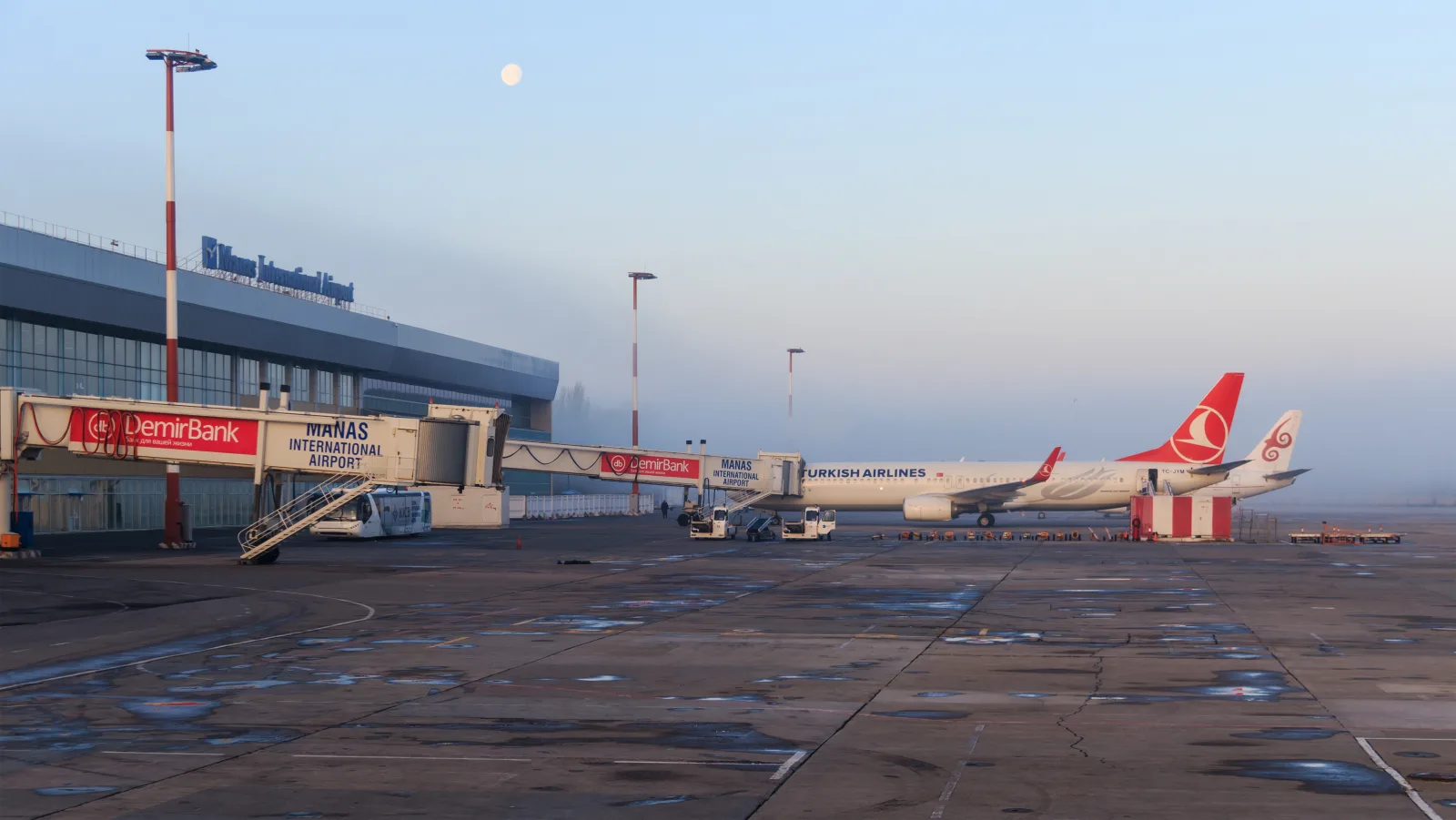 The Manas apron in 2016. The photograph predates the current reconstruction phase. Photo: A.Savin, Wikimedia Commons, Free Art License; edited for this site.
What should not yet be called a construction site
Bishkek’s proposed western bypass illustrates an early stage. The National Investment Agency reported a cooperation agreement for the scheme. The document records the parties’ intent; by itself it does not prove closed financing, final design, a construction contract or machinery working along the full route.
The same discipline applies to the Makmal-Karakol railway. A public-private partnership agreement was signed under the project’s “regulatory sandbox”, but the National Investment Agency still described it as under development in May 2026, not as an active construction site. “Under development”, “agreement signed”, “planned” and “construction started” are not interchangeable. The next meaningful milestone is approved finance, a contract, a permit or physical work, not another presentation.
What travellers may notice now
- Journey time. Roadworks can add hours before a completed road begins to save time.
- Choice of base. New approaches change access to Kazarman, Naryn Region and southern Issyk-Kul, but services develop more slowly than asphalt.
- Air tickets. A new terminal or aircraft matters only after a confirmed service goes on sale for your date.
- Town life. Construction brings machinery, worker accommodation, cafés and warehouses, together with dust, noise and diversions.
- Prices and jobs. A large site raises local demand for materials, transport and labour. Our guide to Kyrgyzstan’s economy explains the wider mechanism.
Milestones that genuinely change a project’s status
For the railway, watch completed tunnels, bridges and earthworks, followed by track laying and tests. For Kambarata-1, the important steps are a final intergovernmental agreement, financial close, approved documentation and the transition from enabling works to the main dam. For roads, look for the commissioning of a named section rather than a national annual target.
Airport milestones are completion of a runway or terminal, certification and ticket sales. For aircraft, they are handover, registration and entry into service. This approach makes infrastructure news easier to read without cynicism or premature excitement: a major build advances through a sequence of verifiable steps.
Frequently asked questions
What is Kyrgyzstan’s largest active construction project in 2026?
The China-Kyrgyzstan-Uzbekistan railway stands out for the scale of its transport works. Tunnelling, earthworks and site infrastructure are under way in Kyrgyzstan, but the line is not open.
Is Kambarata-1 already under construction?
Enabling facilities were built and were approaching completion in spring 2026. The main dam and power station are not complete; finance and the three-country development structure remain part of the next phase.
Will the railway open in 2026?
There is no basis for expecting full opening in 2026. The government programme places completion of the China-Kyrgyzstan-Uzbekistan corridor at the end of 2030.
Why can’t official roadwork kilometre totals simply be added together?
The figures belong to different budget programmes and include construction, reconstruction and repair. Without the section lists and methodology, the sum creates a false measure of completely new road.
Does a new airport guarantee new flights?
No. The facility must be completed and certified, and an airline needs an aircraft, crew and published schedule. For a traveller, the decisive evidence is a confirmed ticket for a specific date.
Share on social media
If you found this guide useful, share it on social media. It takes a moment and helps more travellers discover the project. Thank you!
Anything to add?
Share your experience, leave a comment or suggest an improvement.