Contents:
Why Maldybaev matters
Maldybaev’s life captures the period in which Kyrgyz music moved from oral performance and amateur circles onto a professional stage. He did not abandon song tradition in pursuit of academic forms. He brought a singer’s ear, command of the Kyrgyz language and practical stage experience into romances, choruses, cantatas, musical drama and opera.
His importance lies in institutions as much as compositions. Maldybaev directed the first music college in Frunze, performed as a tenor and dramatic actor, wrote for plays and worked with composers trained in European orchestration and large-scale form. That collaboration produced the first national opera.
The National Bank of the Kyrgyz Republic counts roughly 300 works, including more than 200 songs and choruses. The figure shows the scale of his output, but it also needs context: Maldybaev wrote many vocal works himself, while the major operas were composed jointly with Vladimir Vlasov and Vladimir Fere.
The “singer boy” from Kara-Bulak
Abdylas Maldybaev was born on 7 June 1906 in Kara-Bulak, in the Kemin district. He sang regularly at school concerts and acquired the nickname Yrchy bala, “the singer boy”. The name points to two parts of his later career: composition began with the voice, and performance put him in front of an audience before he received specialist training.
His first song, Akynai, dates from his youth. Official biographies remember it as a tender song of young love. More revealing is the way he combined words, melody and performance from the outset. The piece lived not merely as notation but as music that another singer could remember and carry.
Maldybaev graduated from the pedagogical college in Frunze in 1929. The college trained staff for a new education system, while its drama and music circles created an entry point to the stage. For Maldybaev, the path from school concert to professional theatre ran through precisely this environment.
Actor, tenor and theatre composer
According to the National Bank’s biography, Maldybaev first stepped into a production as a replacement for an ill actor. The emergency appearance became a profession. He acted in Nikolai Gogol’s The Government Inspector, Dmitry Furmanov’s Mutiny and Rakhmankul Shukurbekov’s Zhapalak Zhatpasov.
Theatre taught disciplines that domestic music-making could not: sustaining a role, working with partners, timing silence and deciding when music should carry a scene or leave room for speech. With Pyotr Shubin he wrote music for the play Karachach. The performer was becoming a theatre composer.
Maldybaev continued to appear on stage after his large works had entered the repertoire. In Aichurek he sang Kulchoro, a companion of Semetey. His work on the opera was therefore grounded in performance as well as composition: he knew how Kyrgyz words sat in a vocal line and what a part demanded from a singer during a full production.
A college for a new profession
Frunze’s first music college opened in 1930, with Maldybaev as its director. At the same time, the theatre studio was becoming a state theatre. These institutions created an entire working system. Musicians needed training in notation, voice and ensemble; the stage needed singers, orchestral players, conductors and a repertoire of its own.
Maldybaev combined administration with acting before moving fully into theatre. Three strands continued to meet in his work: the composer shaped musical ideas, the singer tested them in the voice, and the actor understood dramatic pacing. Calling him the “first Kyrgyz composer” should therefore describe his connecting role, not suggest that a profession was invented by one isolated person.
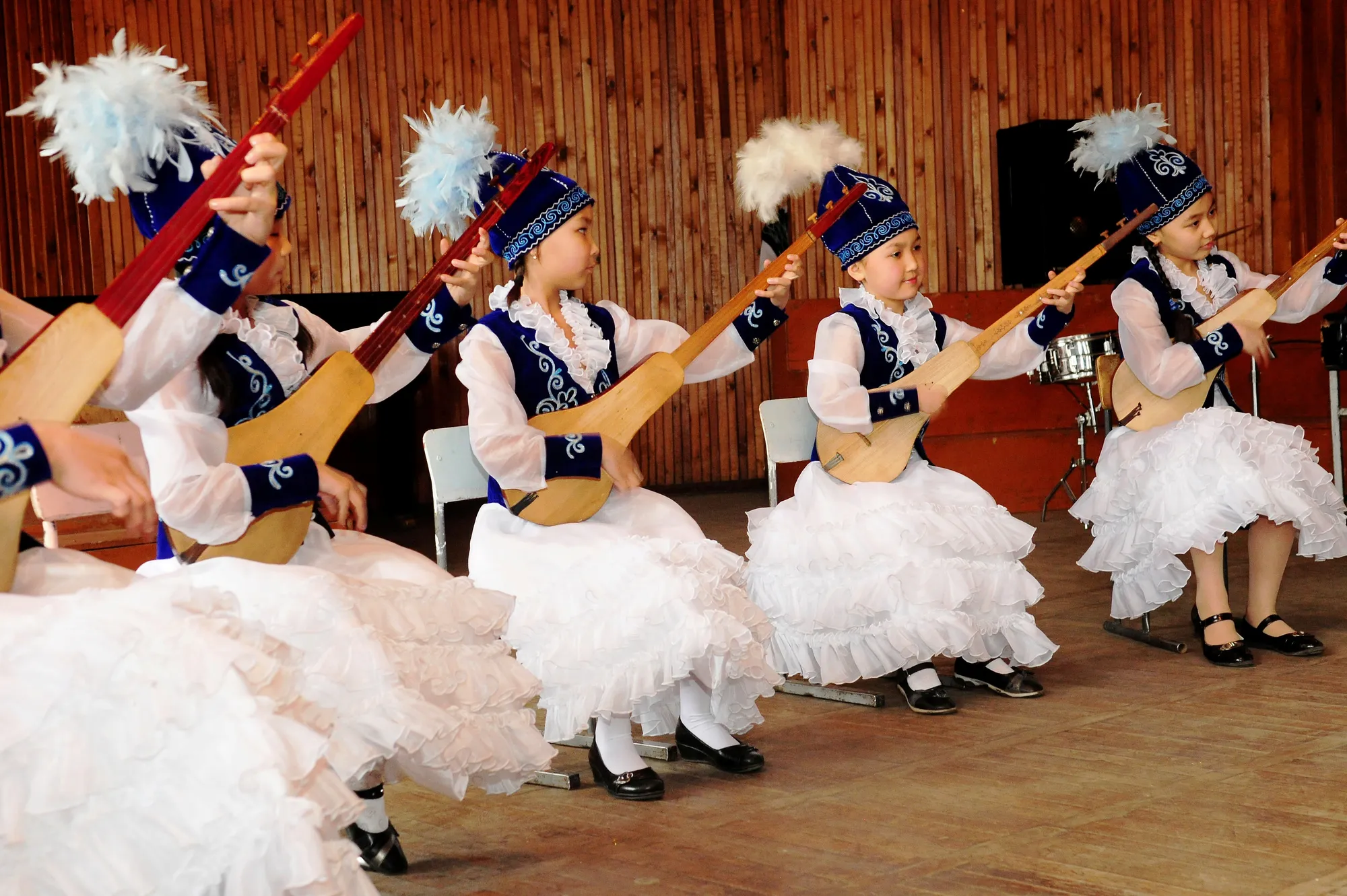 Ensemble training remains part of Kyrgyzstan’s musical culture
From 1947 to 1950 Maldybaev studied in the national studio of the Moscow Conservatory. By then he was already an experienced performer and composer. The training systematised his command of composition and orchestration; it did not mark the beginning of his creative life, since his first songs, theatre scores and opera had come earlier.
How Aichurek became an opera
The route to opera passed through the musical production Altyn Kyz and the drama Azhal Orduna. The next step required extended vocal roles, large-scale structure and an orchestra. Maldybaev created Aichurek with Vladimir Vlasov and Vladimir Fere. It premiered on 12 April 1939, a date official histories treat as the birth of Kyrgyz national opera.
The story belongs to the Manas epic cycle and the world of Semetey. Familiar heroes entered a new stage language of arias, ensembles, chorus and orchestral passages. The source tradition remained audible through names, conflicts, Kyrgyz speech and melodic inflection, connecting the opera to the living art of the manaschi.
Aichurek proved that Kyrgyz material could sustain a full opera. The three composers continued to collaborate on Patriots, Manas, On the Shores of Issyk-Kul and Toktogul. Each work posed a similar problem: how to make local narrative, language and melody function inside a professional theatre.
Why the operas have three authors
The shorthand claim that “Maldybaev wrote the first Kyrgyz opera” leaves out essential information. The score of Aichurek bears three names: Abdylas Maldybaev, Vladimir Vlasov and Vladimir Fere. Joint authorship was neither a courtesy nor a reason to diminish one collaborator.
Maldybaev contributed knowledge of Kyrgyz sung speech, local melodic material and the practical demands of the stage. Vlasov and Fere brought formal academic training and experience in large-scale composition. Together they produced a score that an opera company could perform. The revealing story is one of collaboration, not a contest to identify a single “real” author.
This working method also belonged to the Soviet project of constructing professional national cultures. It accelerated access to orchestral technique while operating inside the cultural policy of its time. The operas can therefore be heard both as works of art and as historical records of a new institution taking shape.
Songs, chorus and the stage
Opera secured Maldybaev’s place in history, but his songs reached a broader audience. He composed solo pieces, choruses, romances, children’s music, cantatas and oratorios. His vocal beginnings are evident in the clarity of the melodic line and close attention to the natural movement of words.
Not all this music should simply be labelled “folk”. Maldybaev could draw on traditional song and komuz music, yet he wrote authored works for particular performers, stages and institutions. Folklore and professional composition meet here without becoming the same thing.
He remained a working performer for decades. The National Bank notes that Maldybaev sang and acted in opera productions into the 1960s. The composer was still testing music in performance after the system he had helped establish had already trained a new generation of soloists.
The anthem of the Kirghiz SSR
Vlasov, Maldybaev and Fere composed the music for the anthem of the Kirghiz Soviet Socialist Republic, adopted in 1946. The catalogue of the Russian State Library confirms the same three names. This was the anthem of a Soviet republic, not the present national anthem of Kyrgyzstan.
The distinction matters because short biographies often collapse two political periods. The current anthem of the Kyrgyz Republic belongs to the post-Soviet state and has music by Nasyr Davlesov and Kalyi Moldobasanov. Maldybaev’s anthem belongs to a different constitutional and musical history.
The theatre and the 1 som note
Abdylas Maldybaev died in Frunze on 1 June 1978. That year, the Kyrgyz National Academic Opera and Ballet Theatre was named after him. The dedication is unusually exact: it remembers not only a famous composer, but a singer, actor and co-creator of the company’s earliest operas.
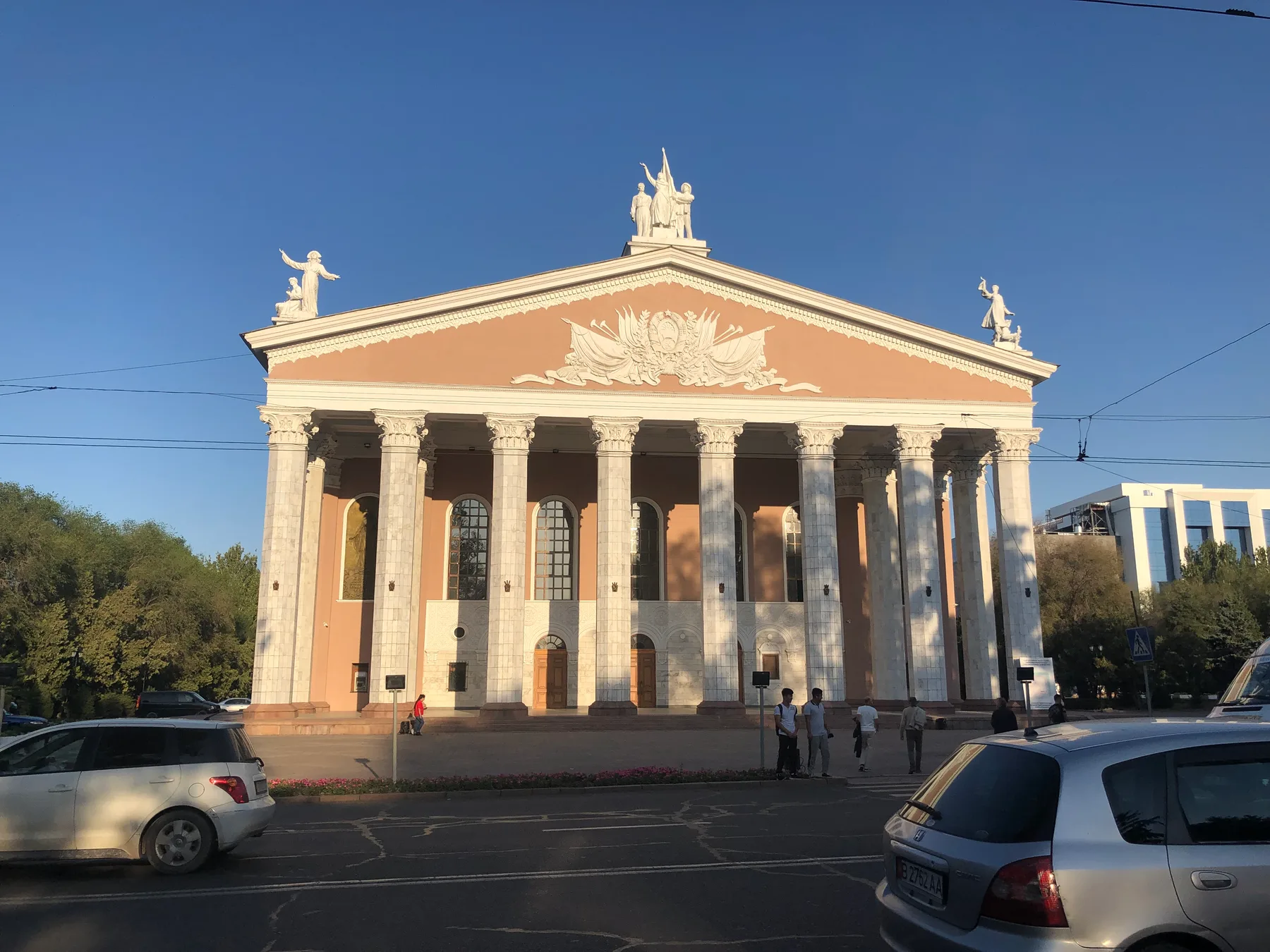 The Abdylas Maldybaev Opera and Ballet Theatre in Bishkek. Photo: Davide Mauro, Wikimedia Commons, CC BY-SA 4.0; edited for this site.
The theatre stands on Abdrakhmanov Street in central Bishkek, opposite the national fine arts museum. Its history also intersects with Bubusara Beyshenalieva, the ballerina who became one of the defining artists of the stage that now carries Maldybaev’s name.
Maldybaev’s portrait appears on the older-series 1 som banknote. The reverse shows a komuz, a kyl-kyiak and the national philharmonic building, joining a person, traditional instruments and a professional concert institution in one design. The reverse of the 5 som note featuring Beyshenalieva depicts Maldybaev’s theatre.
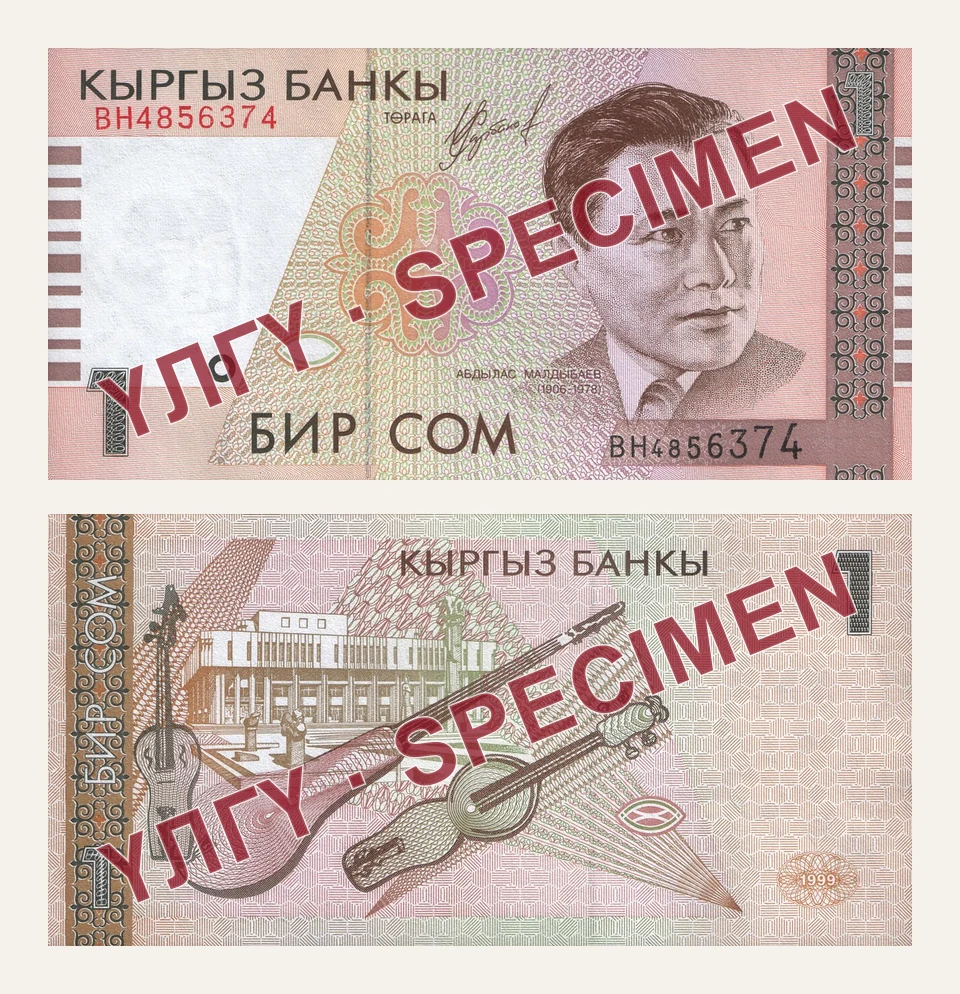
The National Bank of the Kyrgyz Republic publishes the core chronology and account of his work. Details of his education and connection with the capital are also documented by the Bishkek city administration.
Frequently asked questions about Abdylas Maldybaev
Who was Abdylas Maldybaev?
Abdylas Maldybaev was a Kyrgyz composer, operatic tenor and actor. He directed the first music college in Frunze, wrote songs and theatre music, performed on stage and helped create the first Kyrgyz operas.
Who composed the opera Aichurek?
Aichurek was composed jointly by Abdylas Maldybaev, Vladimir Vlasov and Vladimir Fere. It premiered on 12 April 1939, a date treated as the birth of Kyrgyz national opera.
Did Maldybaev compose Kyrgyzstan’s current national anthem?
No. Maldybaev, Vlasov and Fere composed the 1946 anthem of the Kirghiz SSR. The present anthem of the Kyrgyz Republic was written after the Soviet period, with music by Nasyr Davlesov and Kalyi Moldobasanov.
Why is the Bishkek Opera and Ballet Theatre named after Maldybaev?
Maldybaev performed as a singer and actor, wrote for the stage and co-created the first national operas. The Kyrgyz National Academic Opera and Ballet Theatre received his name in 1978.
Which banknote features Abdylas Maldybaev?
His portrait appears on the front of the older-series 1 som banknote. The reverse shows a komuz, a kyl-kyiak and the Kyrgyz National Philharmonic in Bishkek.
Share on social media
If you found this guide useful, share it on social media. It takes a moment and helps more travellers discover the project. Thank you!
Anything to add?
Share your experience, leave a comment or suggest an improvement.