Contents:
Why Bubusara Beyshenalieva matters
Beyshenalieva entered the profession while Kyrgyz ballet was still becoming an art form in its own right. The new theatre needed dancers with rigorous training. Composers and choreographers needed performers who could carry Kyrgyz stories through classical technique rather than present them as decorative interludes. Her body became part of the institution-building: technique, stamina and the ability to make a character legible without speech.
Her repertory did not split neatly into “national” works and “real” classics. Cholpon and Aydai could share a season with Odette-Odile, Juliet or Kitri. That range helped the Kyrgyz stage move beyond staged folklore and enter the professional ballet world with its own stories and a company able to meet the same technical demands.
In 1958, Beyshenalieva was named a People’s Artist of the USSR. The honour indicates the reach of her reputation, but three more concrete facts explain her importance better: almost three decades of major roles, sustained teaching and a public image that still appears in theatres, city space and Kyrgyzstan’s national currency.
From Tash-Dobo to the Vaganova school
Bubusara was born on 17 May 1926 in Tash-Dobo, a village near Frunze. Older biographies also use its former name, Vorontsovka. At the age of ten, she joined the first group of talented children sent from Kyrgyzstan to train in Leningrad.
At the Leningrad Choreographic School, now the Vaganova Academy of Russian Ballet, the day revolved around class: placement, turnout, exact positions, jumps, turns, musicality and relentless repetition. For a child from a Kyrgyz village, the change involved far more than distance. She had to negotiate another language, city life and a profession in which the body is an instrument that must be maintained every day.
Biographical sketches often reduce those years to the attractive phrase “a pupil of Agrippina Vaganova”. The larger point is the system she absorbed. The Leningrad school offered a method for rehearsing difficult roles and passing technique to another generation. Beyshenalieva would later apply that discipline in the theatre and dance school in Kyrgyzstan.
A Bolshoi debut and a return to Frunze
In 1939, the thirteen-year-old Beyshenalieva appeared at the Bolshoi Theatre during the First Decade of Kyrgyz Art and Literature. It was not yet a debut in a complete principal role. It was an early appearance before a Moscow audience and a public measure of what the Leningrad training had produced.
She returned to Frunze in 1941 and joined the Kyrgyz Opera and Ballet Theatre as a soloist. Her permanent stage career began as the war disrupted resources, travel and ordinary life. The young company nevertheless continued to rehearse and build a repertory.
Beyshenalieva had to grow up quickly on stage. Executing the choreography was only part of the task. She also needed to make a heroine intelligible to audiences who might be seeing a full-length ballet for the first time. With no dialogue to lean on, character came through the pace of a step, the angle of the head, the direction of a glance and the line of the arms.
Cholpon: a ballet that grew with its ballerina
The defining national work in Beyshenalieva’s career was Mikhail Raukhverger’s ballet Cholpon. It drew on a tale, but its artistic project was modern for its time: to make a full-length ballet in which a Kyrgyz story lived inside professional choreography, orchestral music and large-scale stage design.
Beyshenalieva danced the title role, then later returned as the sorceress Aydai. The shift is unusually revealing. She first occupied the centre of the story as its young heroine, then came back in a more commanding character role. According to the National Bank’s biography, Cholpon remained in her repertory until 1971.
The two roles trace the development of her craft. Cholpon asks for lightness and a clear lyrical line. Aydai depends on stage authority, dramatic gesture and the ability to organise the audience’s attention. They are not two versions of the same heroine, but distinct acting problems set to familiar music.
Five roles that show her range
Cholpon and Aydai in Cholpon. Two parts in the same ballet reveal the length of her stage life and her progression from lyrical heroine to character role.
Odette-Odile in Swan Lake. The double role contrasts Odette’s softness and unease with Odile’s brilliance and assurance, while maintaining the same high technical standard. For any company, it is a test of a principal ballerina’s maturity.
Maria and Zarema in The Fountain of Bakhchisarai. Beyshenalieva worked with both central female characters. Maria is built around restraint and vulnerability; Zarema moves through sharper dramatic energy. Together they show a ballet actress, not only a virtuoso dancer.
Juliet in Romeo and Juliet. Prokofiev’s score asks the performer to move from youthful immediacy towards tragedy. The role succeeds when the character’s inner development is as convincing as the individual variations.
Asel in the ballet of the same name. Drawn from a story by Chingiz Aitmatov, this contemporary Kyrgyz work brought recognisable lives and a recent social world to the stage. It gave Beyshenalieva a modern heroine rather than another version of an established folkloric type.
How classical ballet and the Kyrgyz stage met
Beyshenalieva’s repertory also included Aurora in The Sleeping Beauty, Kitri in Don Quixote, Medora in Le Corsaire, Laurencia, the Sylph in Chopiniana and leading parts in the Kyrgyz ballets Anar, Kuyruchuk and Spring in Ala-Too. The demands stretch from academic purity and virtuosity to dramatic gesture and a local sense of movement.
Her contribution was larger than proving that a Kyrgyz dancer could perform European classics. The process also worked in the other direction. A secure professional school allowed composers and choreographers to make large works from Kyrgyz material without reducing them to a dance number inserted between spoken scenes.
The cover of this article uses Altymysh Usubaliev’s 1957 portrait of Beyshenalieva. He did not paint her in an emphatic leap. She is seated, perhaps before or after going on stage, with a black costume, carefully placed hands and a glance turned away from the viewer. It restores the working person behind the ballet emblem. The painting belongs to the collection of the Gapar Aitiev Museum, though a particular work may be in storage rather than on display.
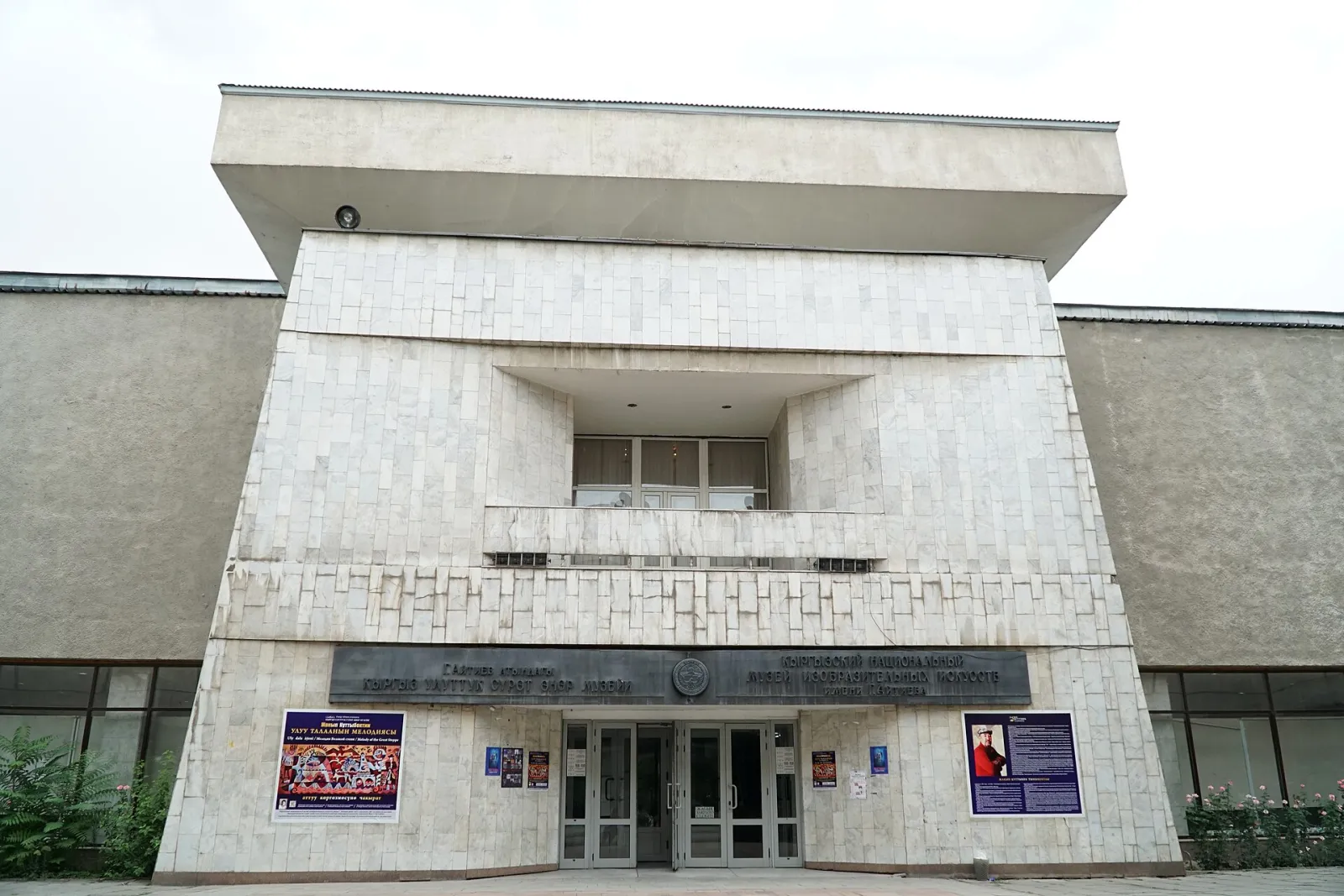 1/2. The Aitiev Museum holds Usubaliev’s 1957 portrait of Bubusara Beyshenalieva Photo: Adam Harangozó, Wikimedia Commons, CC BY-SA 4.0; edited for this site.
 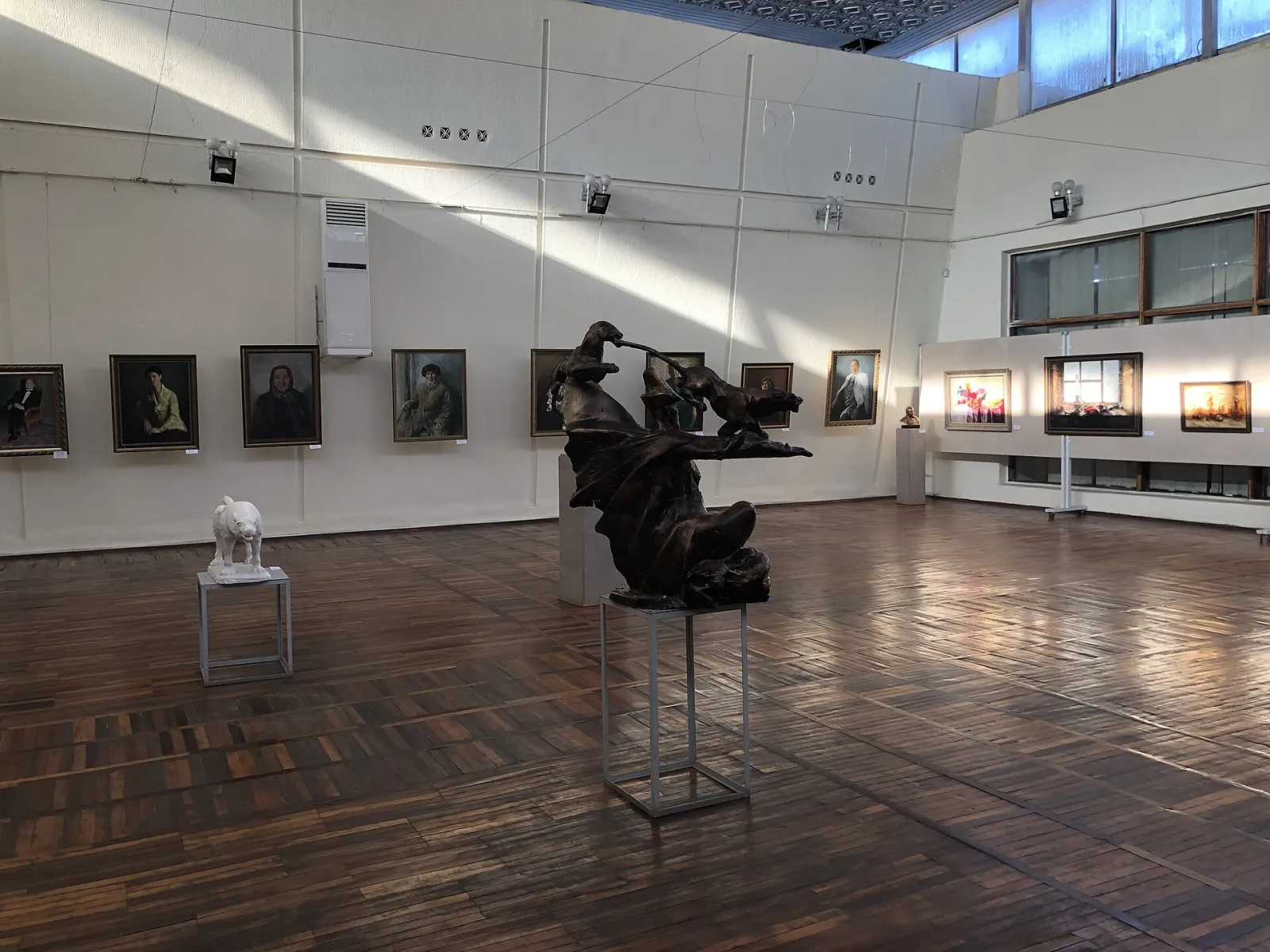 2/2. Painting and sculpture in the museum galleries Photo: Davide Mauro, Wikimedia Commons, CC BY-SA 4.0; edited for this site.
 Morning Star: ballet preserved on film
In 1959, Lenfilm and the Frunze film studio made the colour ballet film Cholpon - Morning Star. It featured dancers from the Kyrgyz Academic Theatre, including Beyshenalieva, Uran Sarbagishev and Reina Chokoeva. Roman Tikhomirov directed it.
The film is a rare moving record of that generation’s theatre craft. A camera changes how dance is seen: close-ups isolate the face and hands, editing directs the eye and a set gains cinematic depth. It is therefore not a neutral recording of the stage production, but it does preserve performance style, costume and the scale of the company’s ambition.
It should not be the only introduction to Beyshenalieva. The screen captures one role at one point in time, while her career encompassed very different dramatic and technical problems. Morning Star works best alongside the repertory, theatre history and museum portrait.
Teacher and public figure
From 1949, Beyshenalieva taught at the music and choreography school in Frunze. This mattered in practical terms for a young ballet tradition. She passed on a technique that she was still testing every night on a major stage, rather than teaching a method detached from professional performance.
Her teaching continued the Leningrad line under different conditions. Training had to respond to the children entering the school, to local musical instincts and to a theatre that needed a stable company of its own. One exceptional career could thereby become part of a system that reproduced the profession.
Beyshenalieva also served as a deputy and took part in the republic’s public cultural life. Soviet biographies tend to list such offices as another honour. Their more useful meaning is that a leading performer represented culture both on stage and within the public institutions of her time.
Where her legacy appears today
In Bishkek, Beyshenalieva’s name appears in several forms. A monument beside the Opera and Ballet Theatre catches her in motion. A street and the Kyrgyz State Institute of Culture and Arts carry her name. These places show the public image; the theatre, film and training tradition reveal the profession behind it.
Her portrait appears on the front of Kyrgyzstan’s older-series 5 som banknote. The reverse shows the Kyrgyz Opera and Ballet Theatre named after Abdylas Maldybaev. The two sides make a coherent pair: the ballerina and the stage on which her art developed.
 The 5 som note: Beyshenalieva on the front, her theatre on the reverse
In 2026, Kyrgyz Post issued a miniature sheet for the centenary of her birth. Its design shows how the official image continues to evolve: the banknote linked Beyshenalieva to the state theatre, while the stamp places her portrait beside dancing figures and a strip of film.
Frequently asked questions about Bubusara Beyshenalieva
Who was Bubusara Beyshenalieva?
Bubusara Beyshenalieva was Kyrgyzstan’s first ballerina, a principal dancer in Frunze and a teacher. She lived from 1926 to 1973 and helped establish professional ballet in Kyrgyzstan.
Where did Beyshenalieva train?
From 1936, she studied at the Leningrad Choreographic School, now known as the Vaganova Academy of Russian Ballet.
Which ballet is most closely associated with her?
Her name is particularly linked to Cholpon. She danced the title heroine and later the sorceress Aydai, keeping the work in her repertory until 1971.
Which classical roles did she dance?
Her roles included Odette-Odile in Swan Lake, Juliet, Aurora, Kitri, Maria and Zarema, Medora, Laurencia and the Sylph in Chopiniana.
Can I see Beyshenalieva on film?
Yes. She appears in the colour ballet film Cholpon - Morning Star, made jointly by Lenfilm and the Frunze studio in 1959.
Which banknote features Beyshenalieva?
Her portrait is on the front of Kyrgyzstan’s older-series 5 som banknote. The reverse shows the Abdylas Maldybaev Kyrgyz Opera and Ballet Theatre.
Share on social media
If you found this guide useful, share it on social media. It takes a moment and helps more travellers discover the project. Thank you!
Anything to add?
Share your experience, leave a comment or suggest an improvement.