Contents:
Why visit the Gapar Aitiev Museum
The Kyrgyz National Museum of Fine Arts named after Gapar Aitiev stands on Abdrakhmanov Street, opposite the Opera and Ballet Theatre. It is the country’s principal art museum. Instead of a general historical timeline, it presents Kyrgyzstan through painting, drawing, sculpture, felt, embroidery, wood, leather and jewellery.
The museum is a good early stop during a stay in Bishkek. Its galleries show how artists interpreted mountain landscapes, city and rural life, clothing, work and the profound changes of the twentieth century. Familiar travel images become material choices and points of view rather than simple decoration.
The collection is larger than the display. The museum holds about 18,000 objects, but only a selection can be shown at one time. Individual works may be on loan, in conservation or temporarily removed while a gallery changes.
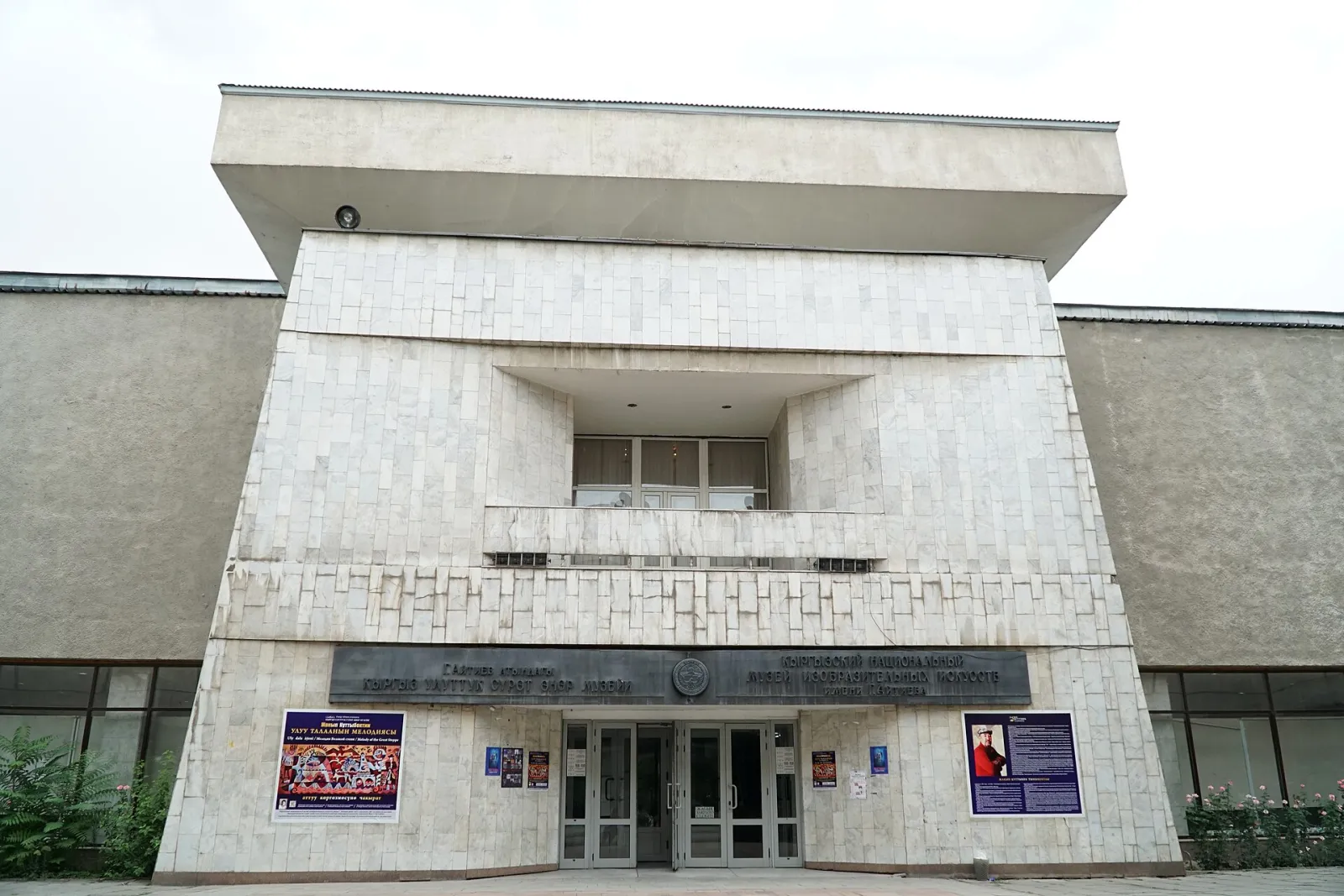 The museum building, completed in 1974. Photo: Adam Harangozó, Wikimedia Commons, CC BY-SA 4.0; edited for this site.
What the collection contains
The museum’s official inventory summary lists roughly 4,000 paintings, 9,600 works on paper, about 1,000 sculptures and more than 3,000 objects of applied art. Kyrgyz fine and applied art forms the broadest and most important section. Russian painting from the eighteenth to the twentieth century and works from other schools provide a wider context.
Painting and graphic art. These galleries trace the development of professional art in Kyrgyzstan. Landscapes allow you to compare different ways of seeing the mountains and Issyk-Kul. Portraits place people within a period, while scenes of daily life preserve details of dress, interiors, work and city rhythm.
Sculpture. A freestanding sculpture rewards movement. Walk around it, study the outline from the side and notice the empty space between figures. Several quiet viewpoints reveal far more than one photograph from the front.
Applied art. Felt, embroidery, patterned weaving, wood carving, embossed leather and silver jewellery explain how a beautiful object was also used. Look for seams, joins and wear, then ask where the piece belonged inside a yurt. Our guide to the Kyrgyz yurt explains the structure of the home, while the ak-kalpak article follows one of its most visible felt traditions.
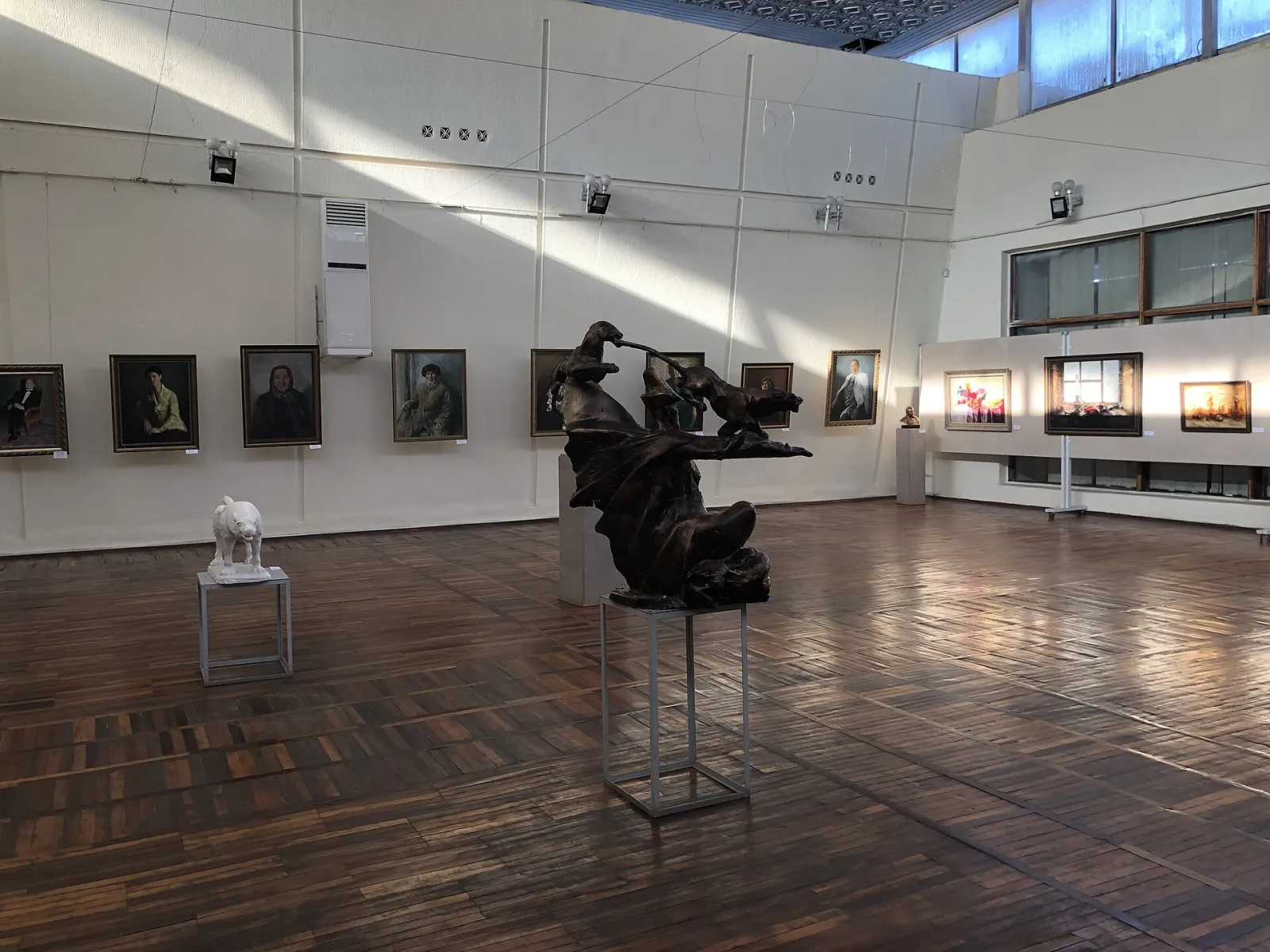 1/3. Painting and sculpture share the same gallery Photo: Davide Mauro, Wikimedia Commons, CC BY-SA 4.0; edited for this site.
 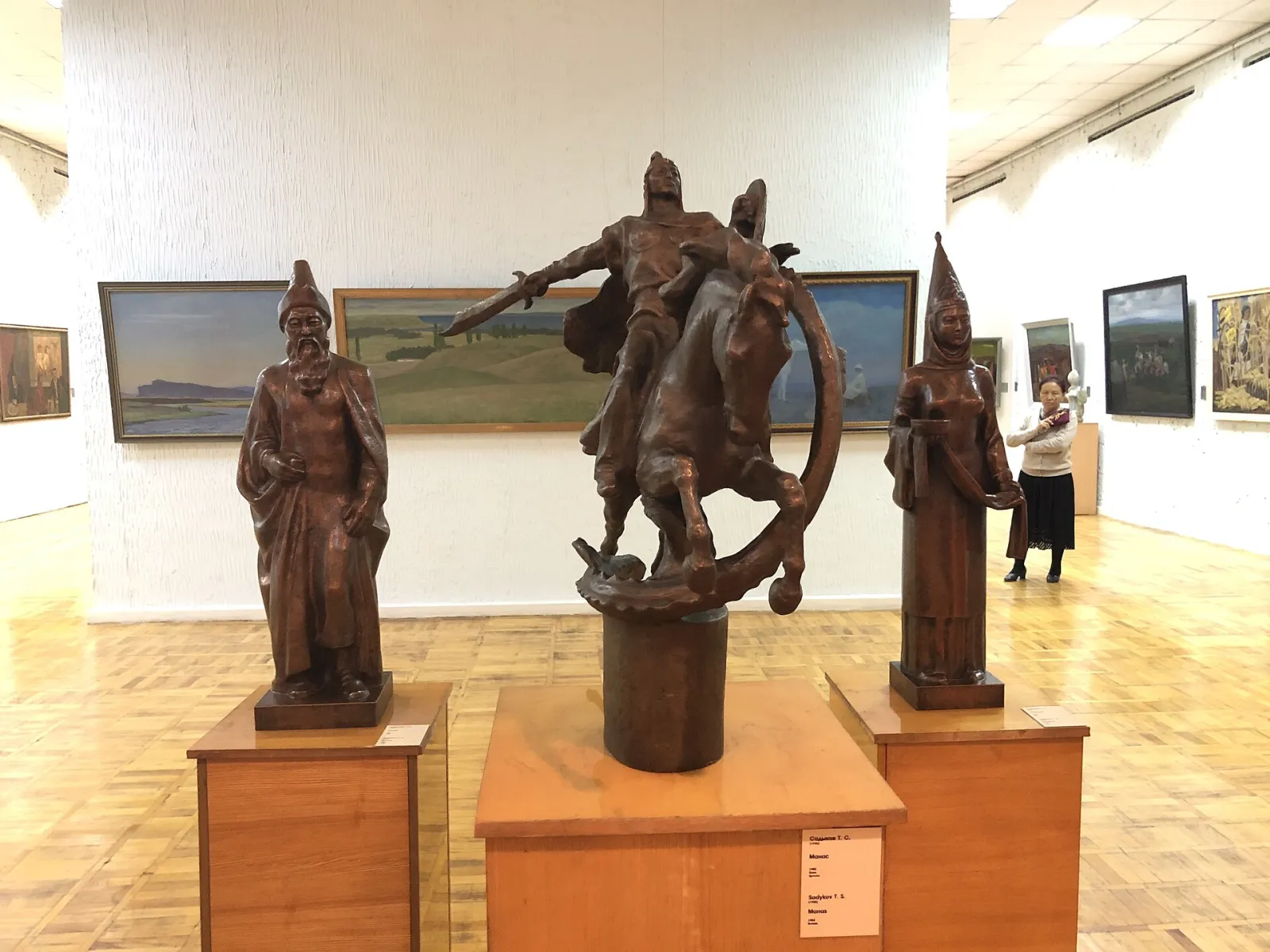 2/3. Sculpture seen against Kyrgyz painting Photo: Davide Mauro, Wikimedia Commons, CC BY-SA 4.0; edited for this site.
 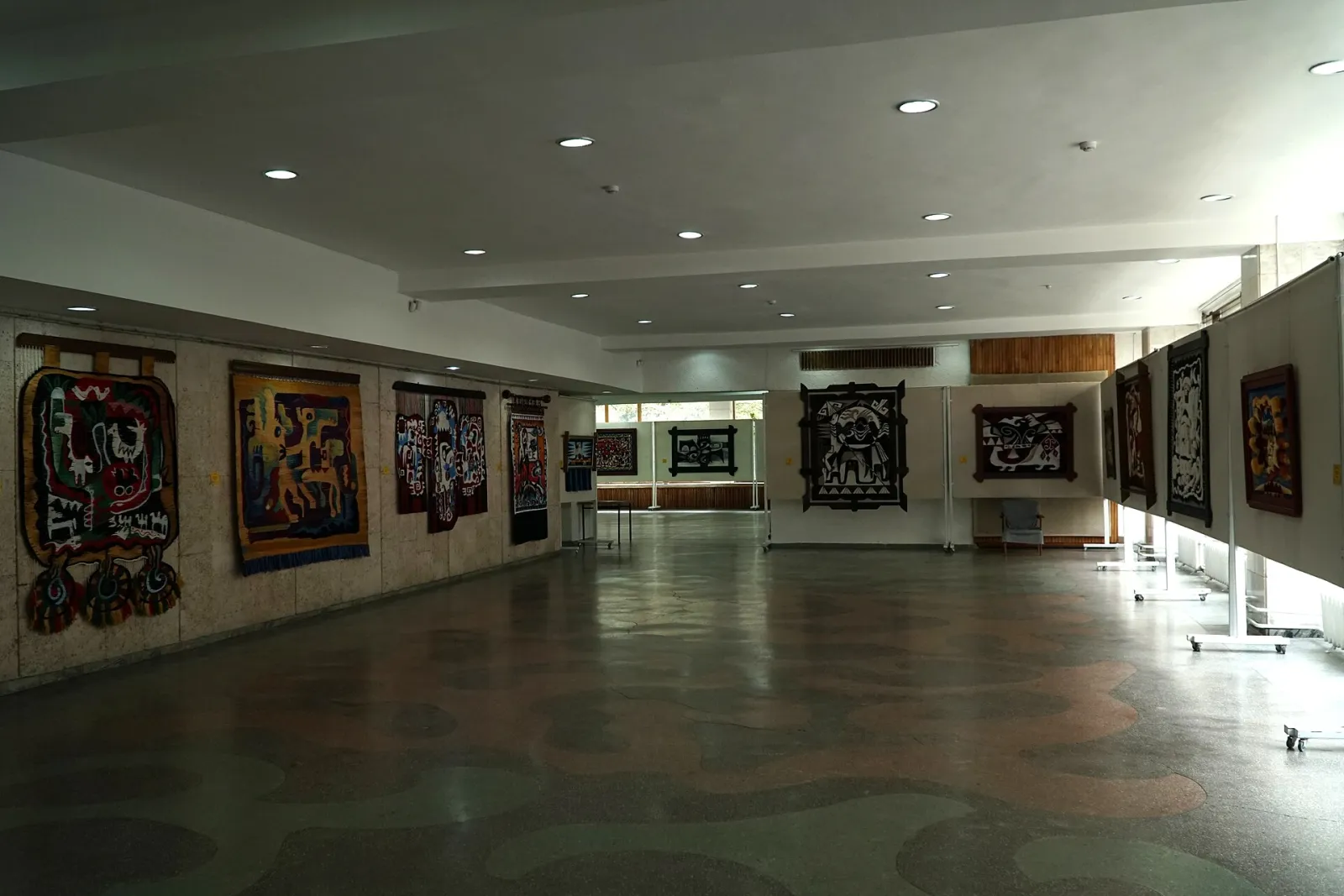 3/3. A textile exhibition reveals the scale of the halls Photo: Adam Harangozó, Wikimedia Commons, CC BY-SA 4.0; edited for this site.
 How to look at Kyrgyz art without an art-history degree
Begin with three simple observations: what is shown, what material the artist used and where the image places you as a viewer. In a landscape, compare the height of the horizon and the colour of distant mountains. In a portrait, study posture, hands and surrounding objects. In a textile, find the repeated unit and the point where the rhythm changes.
Read the label afterwards. The museum’s rules promise information in Kyrgyz or Russian; English and German are not guaranteed throughout the building. A camera translator will handle a short label, but copy the artist’s name and title exactly if you want to find the work later in the museum’s online collection.
There is no need to give every gallery equal time. Choose one thread, such as mountain landscapes, portraits, applied art or visions of the city. A clear theme produces a more coherent visit and leaves room for the unexpected work that makes you stop.
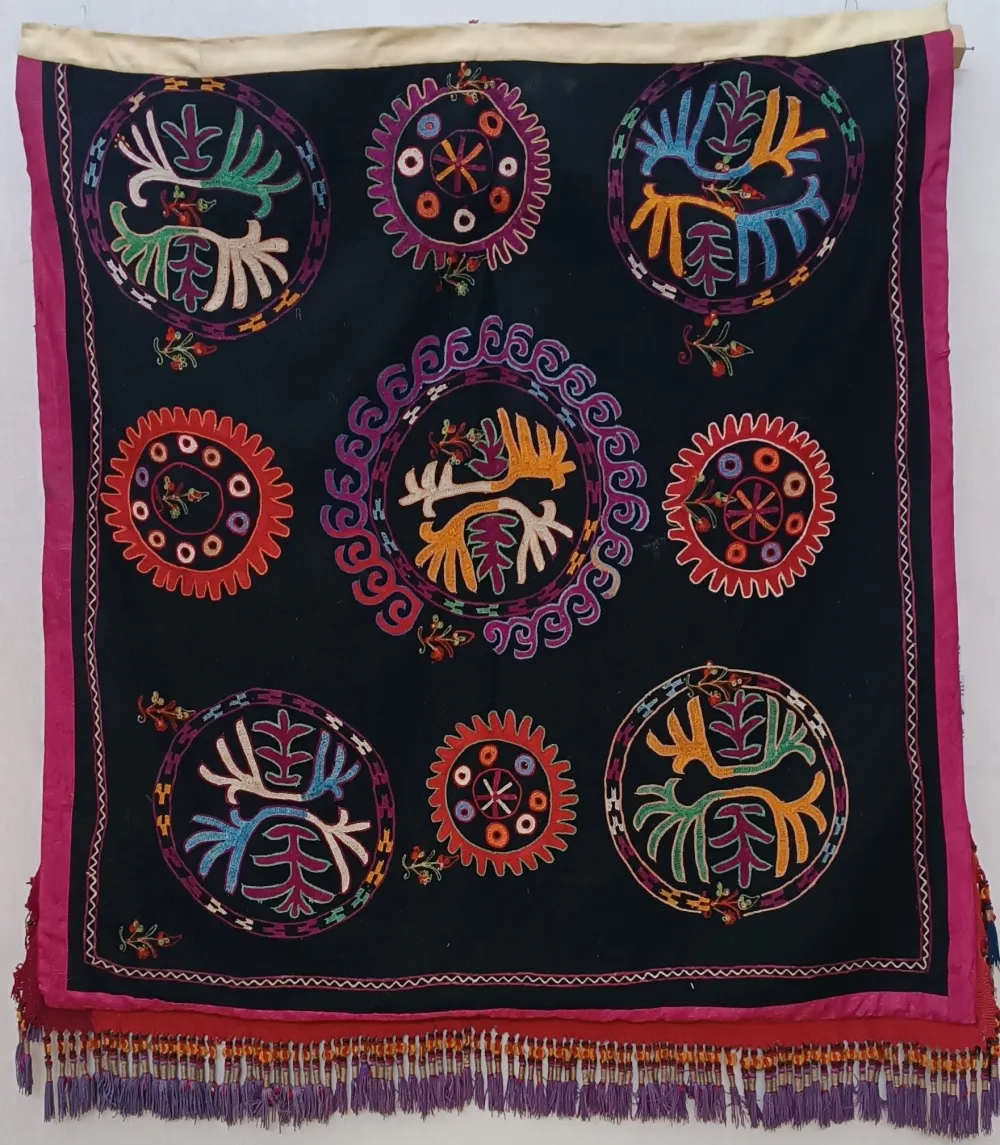 1/2. Ayak-kap, a hanging bag used to store bowls, twentieth century Photo: Zenwort, Wikimedia Commons, CC BY-SA 4.0; edited for this site.
 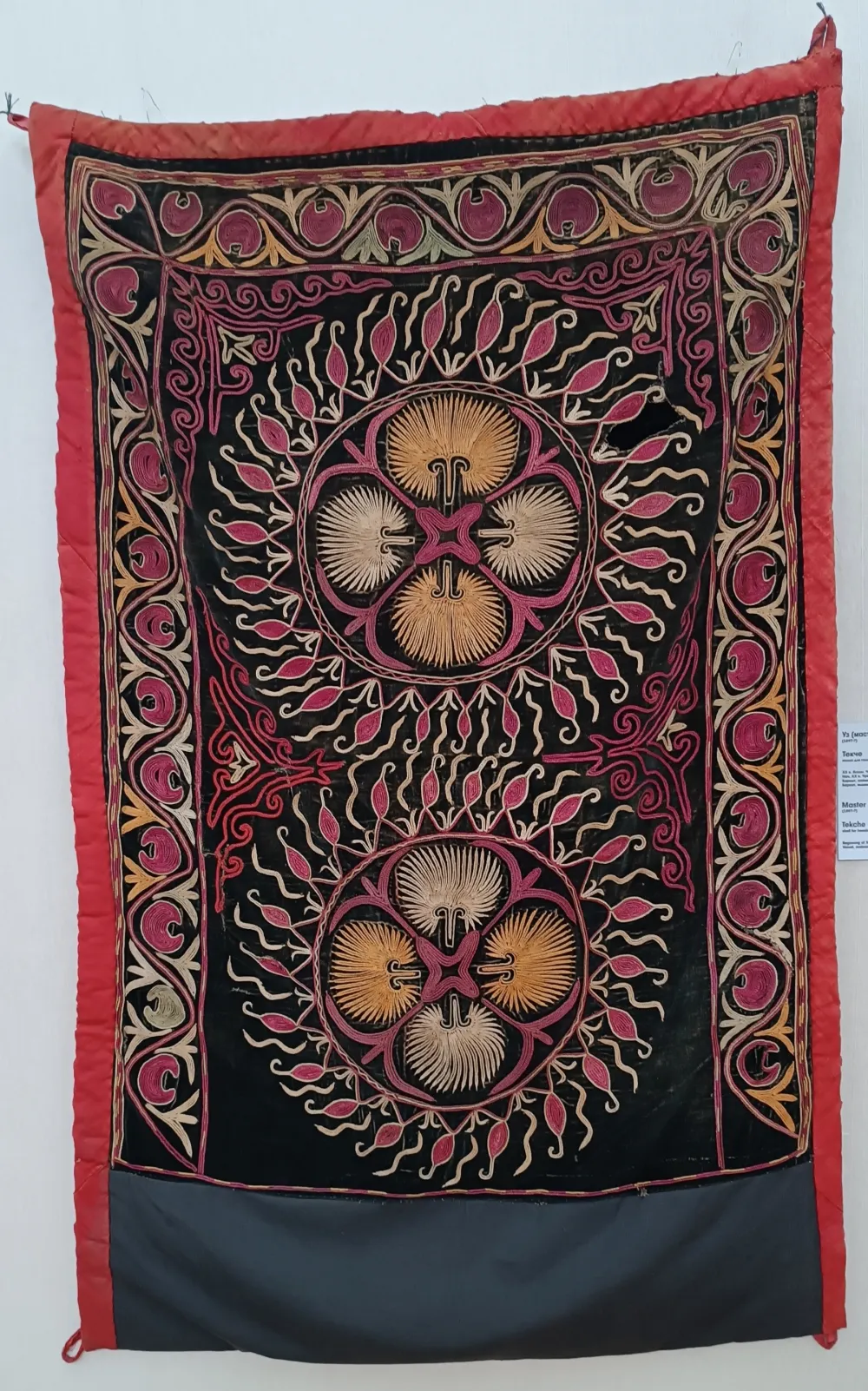 2/2. Tekche, an embroidered furnishing textile, twentieth century Photo: Zenwort, Wikimedia Commons, CC BY-SA 4.0; edited for this site.
 Who Gapar Aitiev was
Gapar Aitiev lived from 1912 to 1984 and was one of Kyrgyzstan’s first professional artists. He worked as a painter, sculptor and theatre designer. His landscapes sit alongside portraits and scenes of everyday life in the museum collection.
His name on the building stands for a formative period in the country’s professional art, but this is not a single-artist museum. The collection includes Semyon Chuikov, Sabyrbek Akylbekov, Alexander Ignatiev, Olga Manuilova, Altymysh Usubaliev, whose 1957 portrait of Bubusara Beyshenalieva appears below, Suimenkul Chokmorov and later generations working in very different styles.
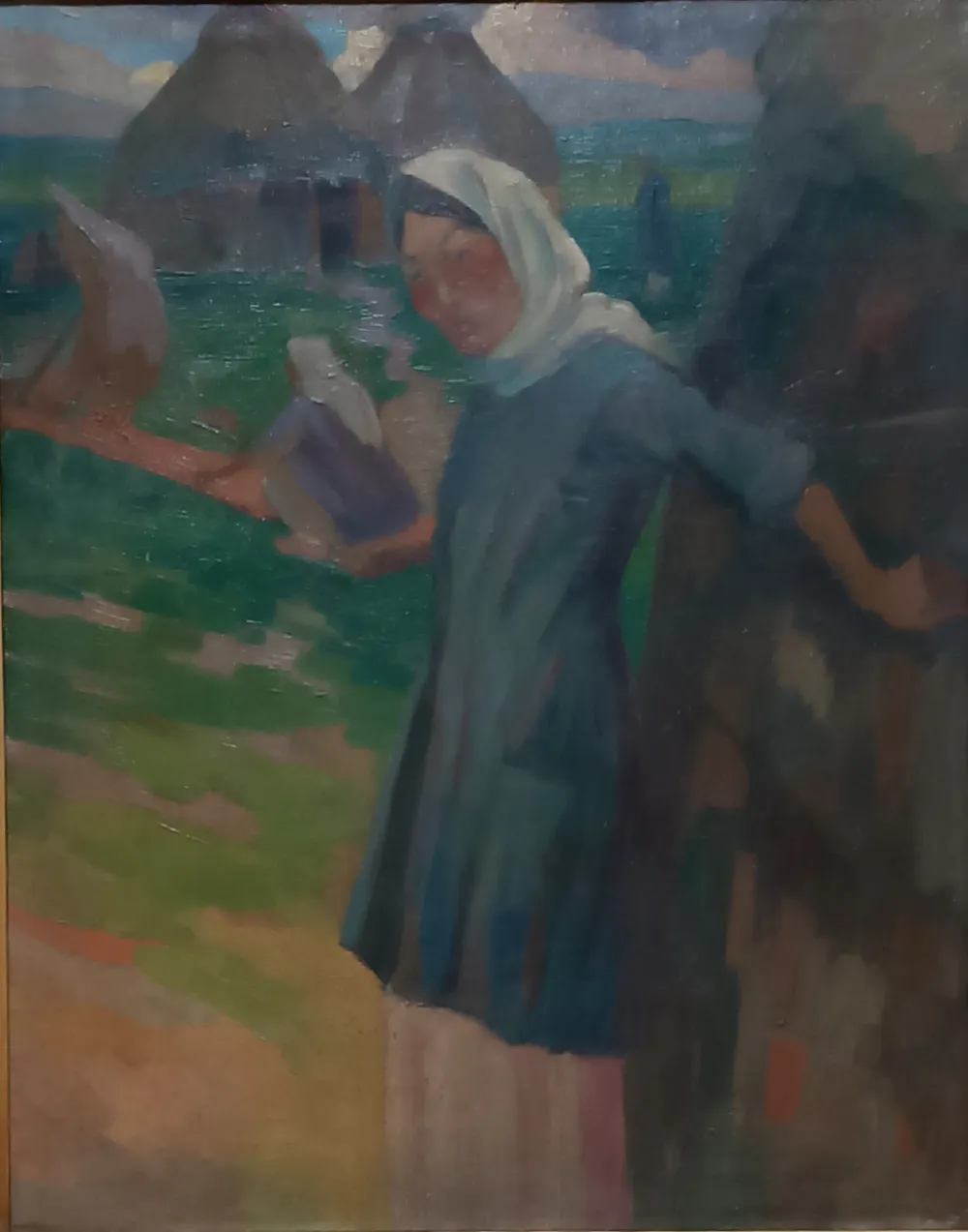 1/2. Woman by a Yurt, Vladimir Obraztsov, 1932 Image: Vladimir Obraztsov; photo by Zenwort, Wikimedia Commons, Public domain; edited for this site.
 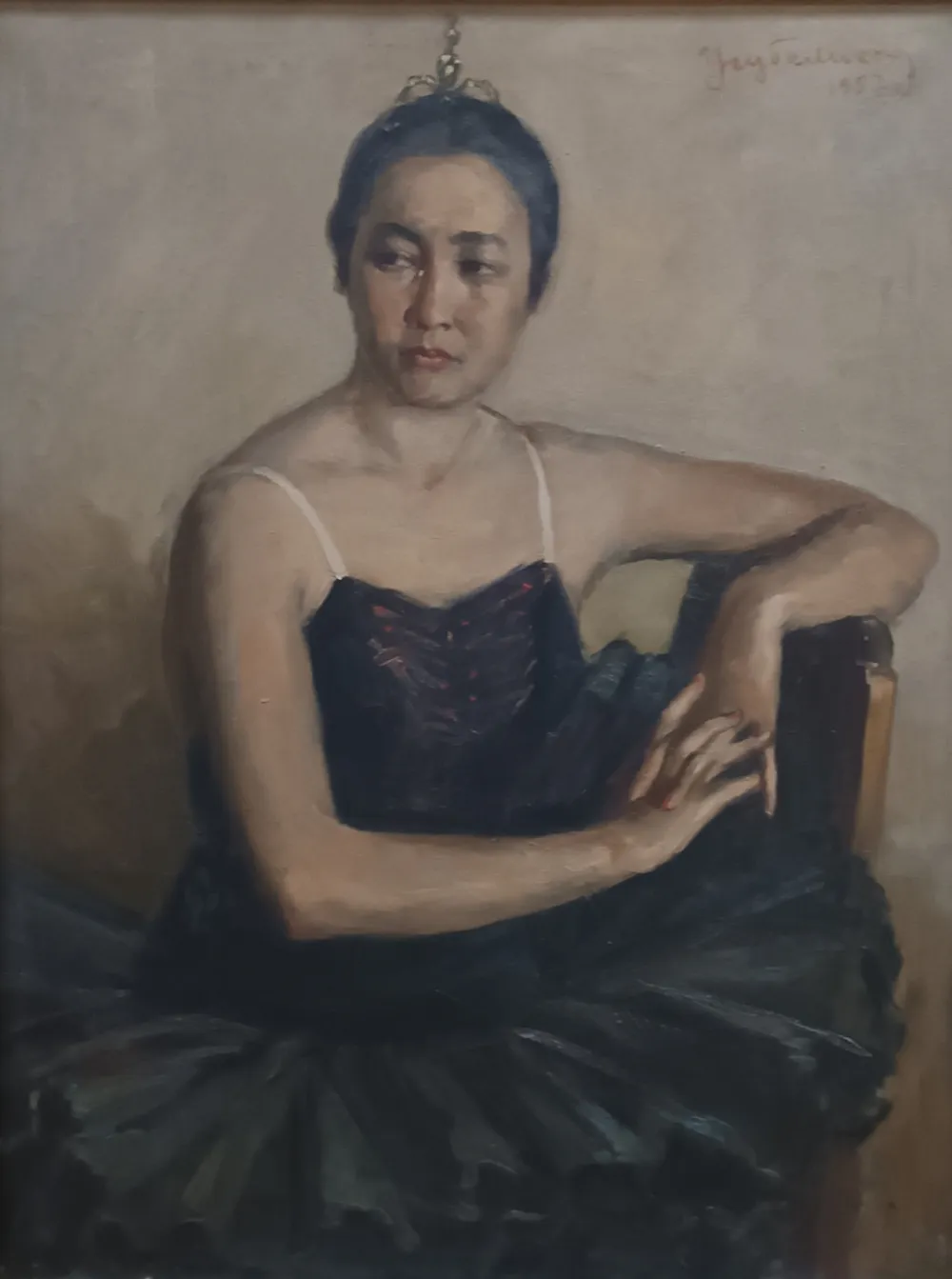 2/2. Portrait of Bübüsara Beyshenalieva, Altymysh Usubaliev, 1957 Image: Altymysh Usubaliev; photo by Zenwort, Wikimedia Commons, Public domain; edited for this site.
 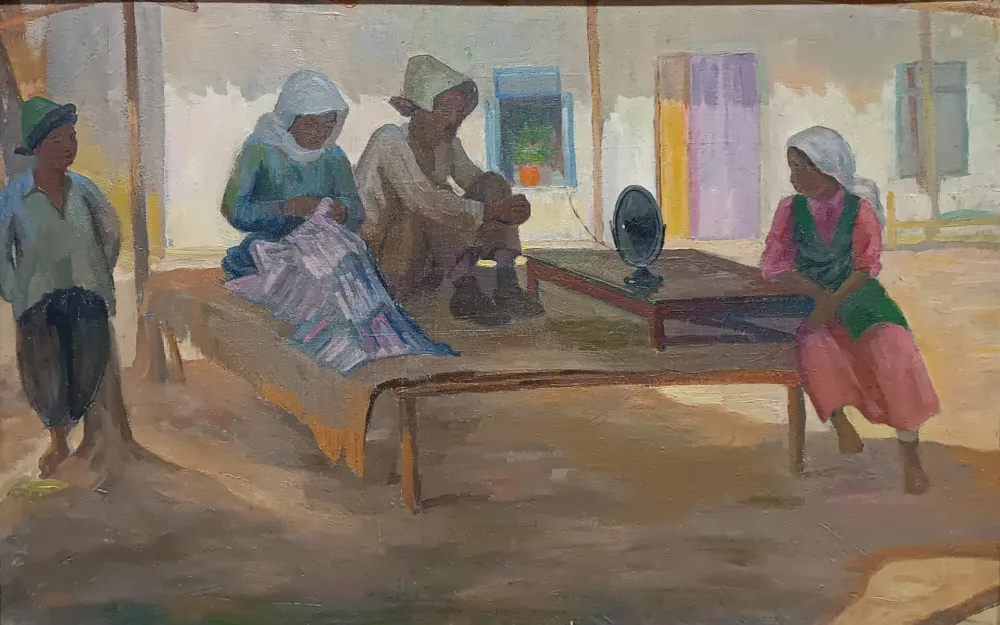 Listening to the Radio, Vladimir Obraztsov, early 1930s. Image: Vladimir Obraztsov; photo by Zenwort, Wikimedia Commons, Public domain; edited for this site.
How the museum began
The first picture gallery opened on 1 January 1935. Its initial group of 72 works by Russian artists came from the State Tretyakov Gallery and the People’s Commissariat for Education of the Russian SFSR; Semyon Chuikov took part in selecting them. Acquisitions from republican exhibitions and works by artists in Kyrgyzstan steadily changed the balance of the collection.
The present museum building was completed in 1974. Broad galleries and high light suit large canvases, sculpture and temporary display walls. The stone cladding, deep entrance and open interiors also make the building a useful example of Soviet museum architecture in central Bishkek.
How temporary exhibitions work
Temporary galleries can change the character of a visit. They host contemporary art, themed selections from storage, textiles, photography and guest projects. Check the museum’s official website on the day you plan to go rather than relying on an old listing.
A temporary exhibition may use a separate ticket or set stricter photography rules. If one particular show is the reason for your visit, confirm that its gallery is open, whether it is included in general admission and whether cameras are permitted.
Opening hours, tickets and visitor rules
As checked on 23 August 2026, Bishkek’s municipal tourism portal listed Tuesday to Sunday, 10:00-18:00, with Monday closed. The museum’s own rules stop admission and ticket sales 30 minutes before closing, so 17:30 is the latest possible entry under that timetable. Individual galleries and exhibitions can close or change hours temporarily.
Tickets. Standard admission is sold at the museum ticket desk on the day of the visit. We could not find a current official public price list on the check date, so confirm the amount with reception on 0312 66 16 23 or the marketing department on 0312 66 49 59. A special event may have its own ticket.
Bags and cloakroom. Outerwear and items larger than 30×40×20 cm must go into the cloakroom. Water, food, umbrellas and bulky objects are not permitted in the galleries. Avoid arriving with a full trekking pack after checking out of your accommodation.
Accessibility. Museum rules provide for access by visitors with reduced mobility and allow wheelchairs. They do not describe every lift or step-free connection, so contact the museum or ask at the information desk if you need a particular temporary gallery.
Photography. Amateur photography for personal, non-commercial use requires the administration’s consent. Flash, tripods, monopods and selfie sticks are banned. Temporary exhibitions and individual works may prohibit cameras altogether. Professional, staged, media and commercial shoots require advance agreement. The details are set out in the official visitor rules.
A focused introduction
- Choose applied art and one painting gallery.
- Compare two works on one theme instead of racing around the building.
- Leave the temporary show for another visit.
A good first visit
- Cover applied art, Kyrgyz painting and sculpture.
- Keep 15-20 minutes for the current temporary exhibition.
- This is the most comfortable option for a first-time visitor.
A slower museum day
- Read labels and compare artists from the same generation.
- Add the Russian collection and graphic art.
- Take a pause between the permanent and temporary displays.
What to see nearby
The museum occupies an easy part of central Bishkek. The Opera and Ballet Theatre is opposite, with Oak Park and Victory Square close by. It fits naturally into our walking route through Bishkek: place the museum in the middle of the day, then continue through the parks.
For a second museum day, choose the National Historical Museum. Its question is different: how society and statehood changed across the territory of Kyrgyzstan. Our guide to museums in Kyrgyzstan compares more options by region and subject.
Frequently asked questions
How long do I need at the Gapar Aitiev Museum?
Allow about 90 minutes for a first visit. A focused look at applied art and one painting gallery takes 45-60 minutes, while the permanent and temporary displays can easily fill two hours or more.
Can I take photographs inside?
Amateur photography for personal, non-commercial use requires the administration’s consent. Flash, tripods, monopods and selfie sticks are banned. Temporary exhibitions and individual works may prohibit photography.
Are labels available in English?
Official rules guarantee labels in Kyrgyz or Russian. English and German are not available consistently throughout the museum, so a camera translation app is useful.
Can I buy a standard ticket online?
The official visitor rules describe buying standard admission at the museum ticket desk on the day. A separate event may use its own online ticket service and entry procedure.
Is the museum suitable for wheelchair users?
Museum rules provide for visitors with reduced mobility and allow wheelchairs. Contact the museum or ask at the information desk to confirm a step-free route to the specific gallery you need.
Share on social media
If you found this guide useful, share it on social media. It takes a moment and helps more travellers discover the project. Thank you!
Anything to add?
Share your experience, leave a comment or suggest an improvement.