Contents:
What an ak-kalpak is
The name describes the object directly: ak means white in Kyrgyz, while kalpak names the distinctive hat. Pale felt forms the body. Black, dark blue, brown or coloured trim picks out the seams, brim and embroidered motifs.
The ak-kalpak belongs to Kyrgyz men’s traditional dress. Men of different ages wear it, but height, turn-up, edging and ornament vary. A tall ceremonial hat, a compact everyday version and an older museum example can all belong to the same tradition without looking identical.
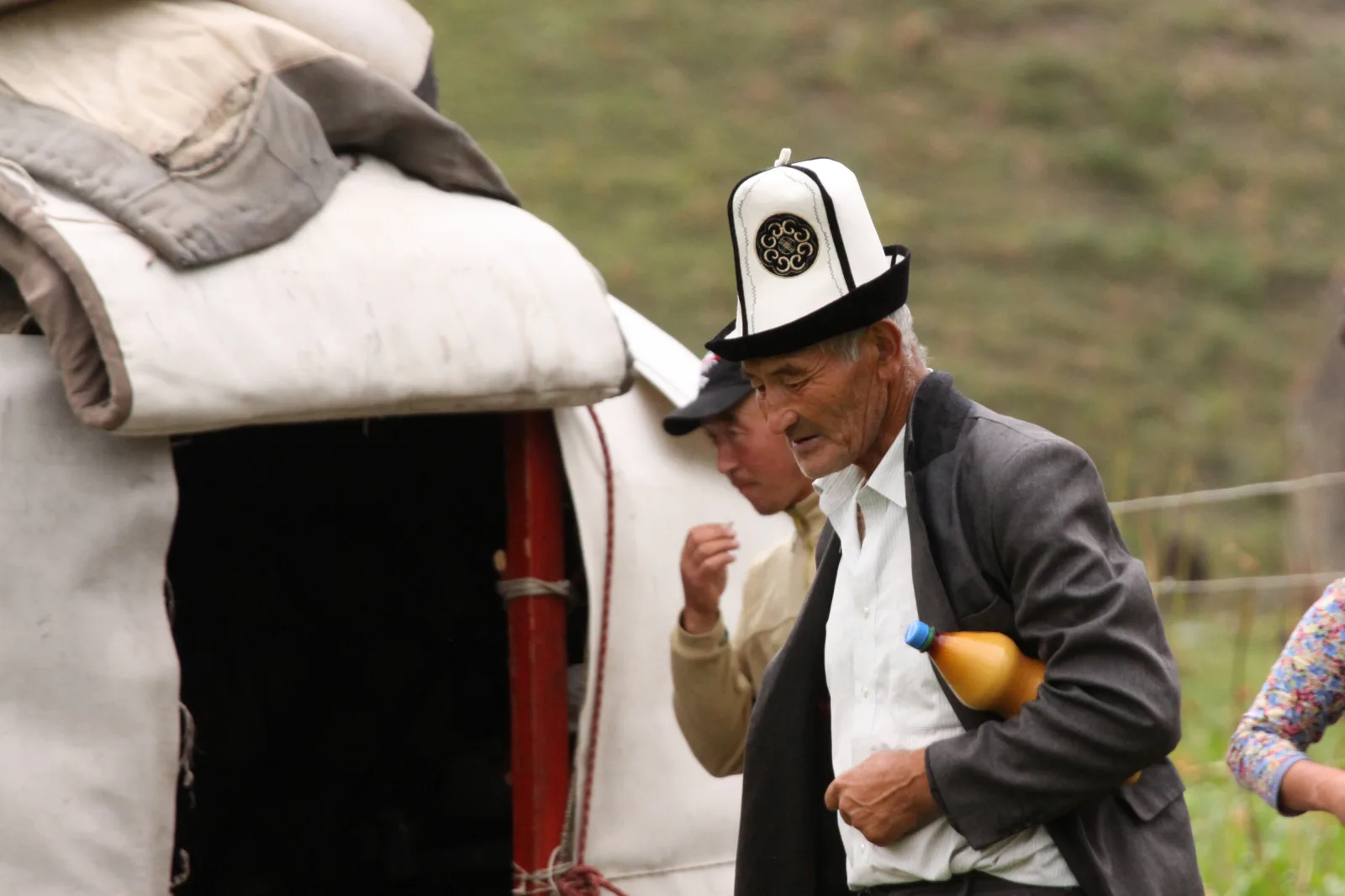 1/3. An ak-kalpak beside a yurt Photo: JohnNewton8, Wikimedia Commons, CC BY-SA 4.0; edited for this site.
 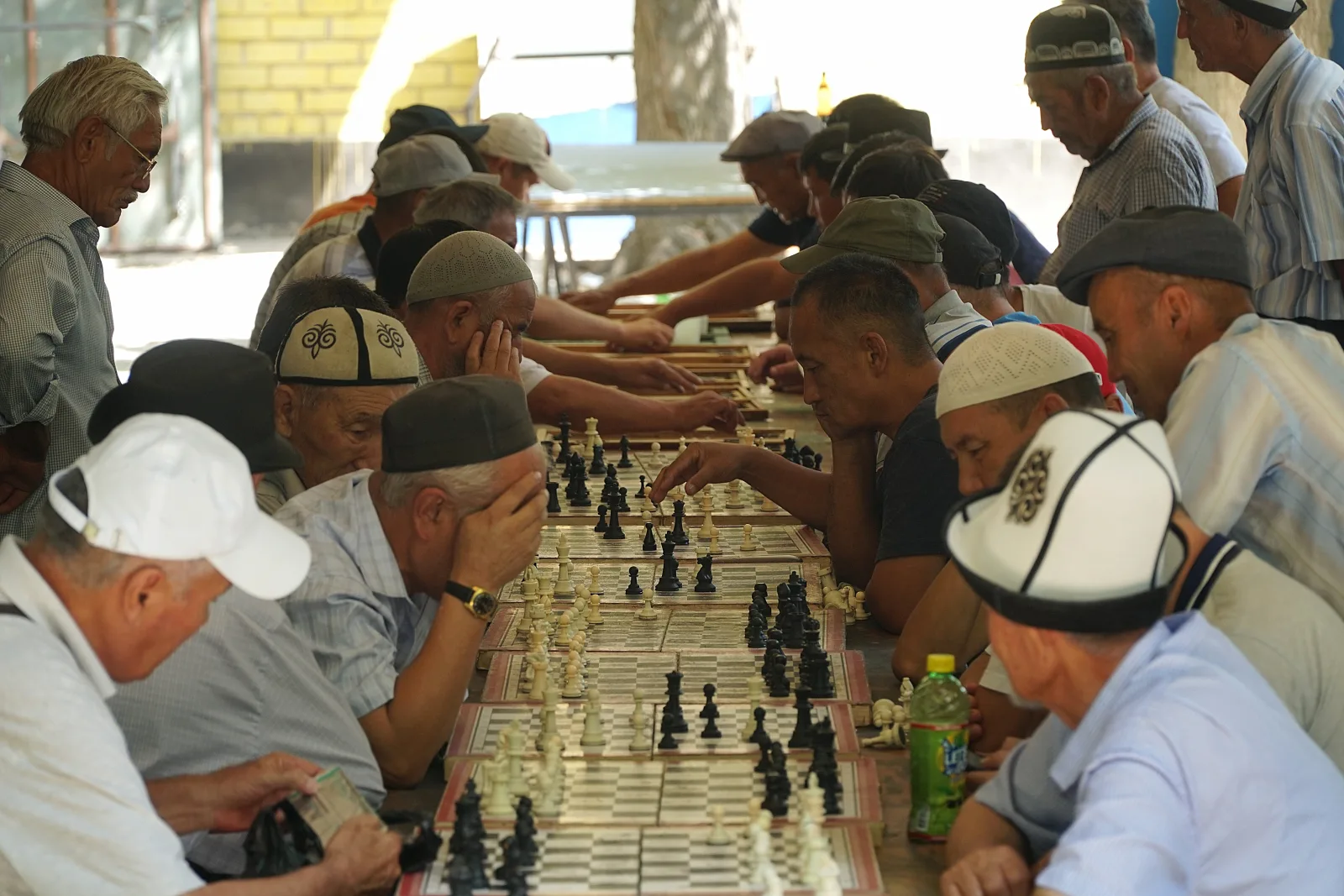 2/3. White and dark kalpaks in an everyday city scene Photo: Adam Harangozó, Wikimedia Commons, CC BY-SA 4.0; edited for this site.
 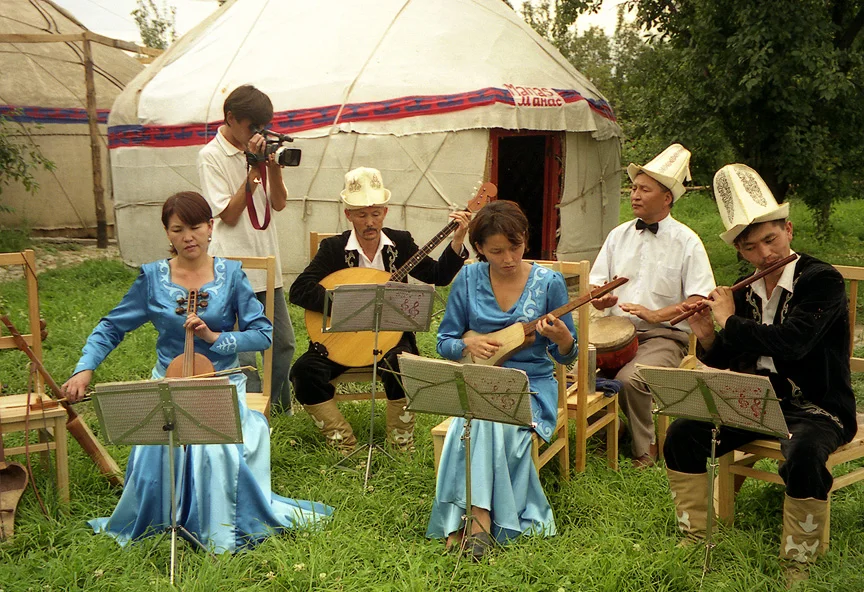 3/3. Musicians in Karakol, 2002 Photo: Simon Garbutt, Wikimedia Commons, public domain; edited for this site.
 How the shape is constructed
The tall body may be assembled from separate pieces of felt or formed without long vertical cuts. In a common four-part construction, seams meet at the crown and divide the surface into four panels. The lower edge turns outwards and may be reinforced with fabric or finished in a contrasting band.
Vertical lines help the felt hold its profile and also become part of the design. Makers add embroidery or appliqué to the panels, and some hats have a tassel at the crown. A particular ak-kalpak need not include every feature: its cut and finish depend on size, use and the maker’s practice.
UNESCO’s nomination file records hats shaped without cuts, hats assembled from two or four strips of felt and more than 80 named varieties. That breadth matters more than memorising a rigid catalogue. There is no single compulsory profile for every age and occasion.
How an ak-kalpak is made
The work starts before a pattern touches the felt. Wool is cleaned, laid out and worked into a dense sheet. Good felt needs an even, resilient structure: loose material soon collapses, while an unnecessarily thick sheet makes a tall hat heavy.
-
Make the felt
Wool is cleaned, layered, dampened and compressed until the fibres lock into a single sheet.
-
Choose the cut
The maker adapts a pattern to the head size, intended height and chosen construction.
-
Build the shape
Pieces are cut, stitched and reinforced at the edges so the hat keeps its form without a rigid frame.
-
Add the finish
The panels receive braid, cloth, appliqué or embroidery before the maker checks fit and symmetry.
The skill is passed on through shared work. A learner watches, repeats each operation and receives corrections as the piece develops. UNESCO’s documentation identifies craftswomen as the main practitioners and bearers of the making skills. A workshop may organise its work differently today, but the judgement behind felt density and a balanced cut is still learned most effectively by doing.
What its symbolism can tell us
The UNESCO nomination records a symbolic reading in which the four sides evoke the four directions, the edging refers to the course of life, the tassel recalls ancestors and a branching motif suggests the continuation of a family line. This is a valuable documented interpretation of the tradition.
It is not a universal key to every hat on a market stall. A motif may be chosen by the maker, adapted for a customer, copied from an earlier piece or applied in a factory. To understand a particular design, ask who made it, what the motif is called and why those colours were used.
Pay attention to the source of the explanation. “This meaning appears in the nomination file” is more precise than claiming that a photograph reveals the wearer’s age, marital status and character.
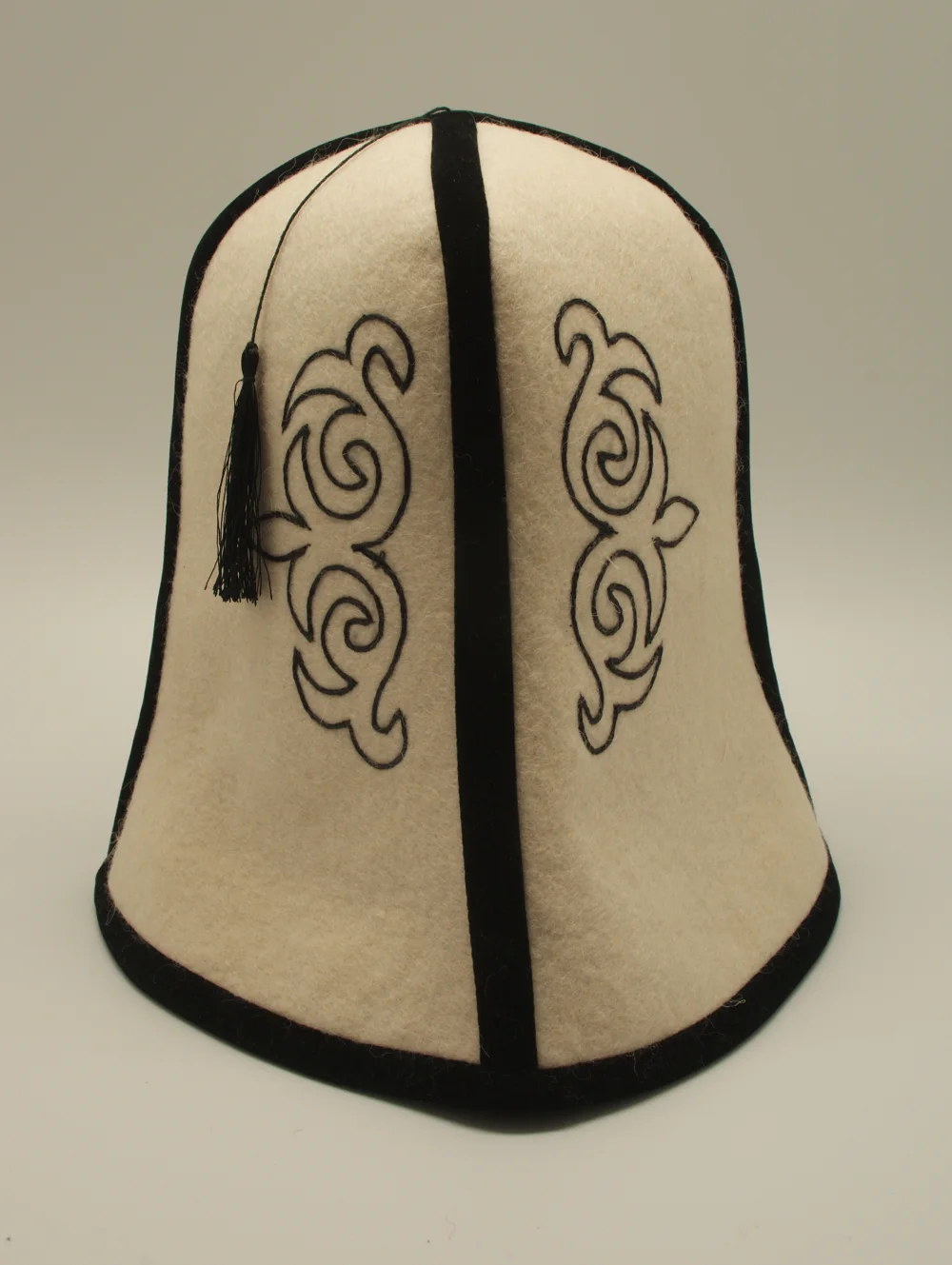 1/3. Seams, panels, edging and tassel Photo: Clément Bucco-Lechat, Wikimedia Commons, CC BY-SA 3.0; edited for this site.
 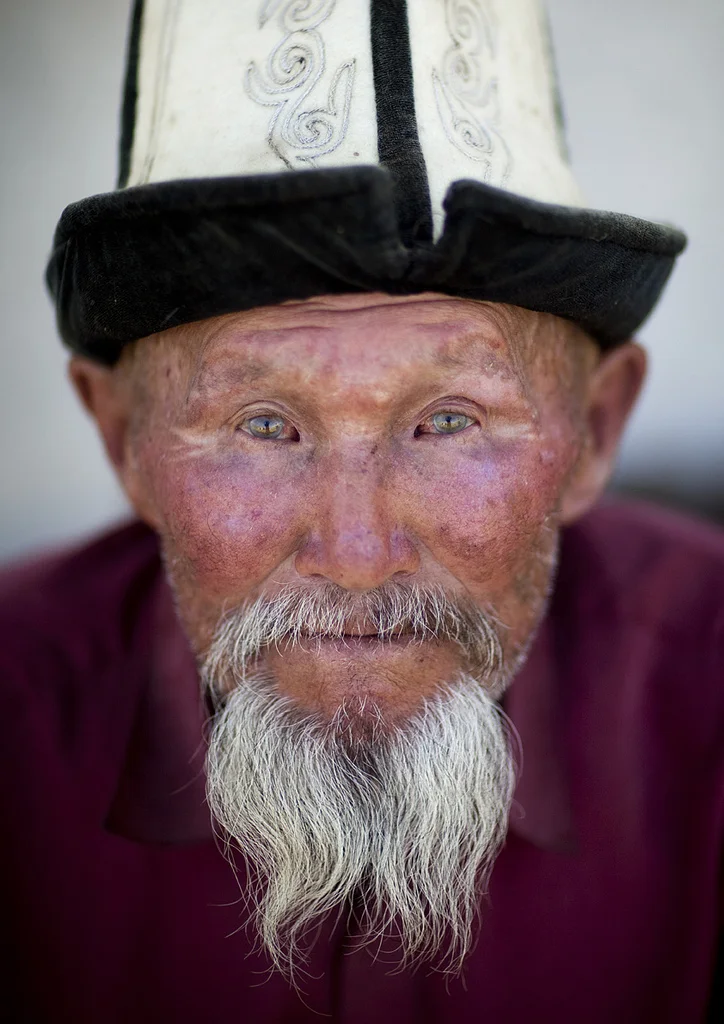 2/3. A softer fit and turned-up edge Photo: Ceyhun Kavakci, Wikimedia Commons, CC BY-SA 2.0; edited for this site.
 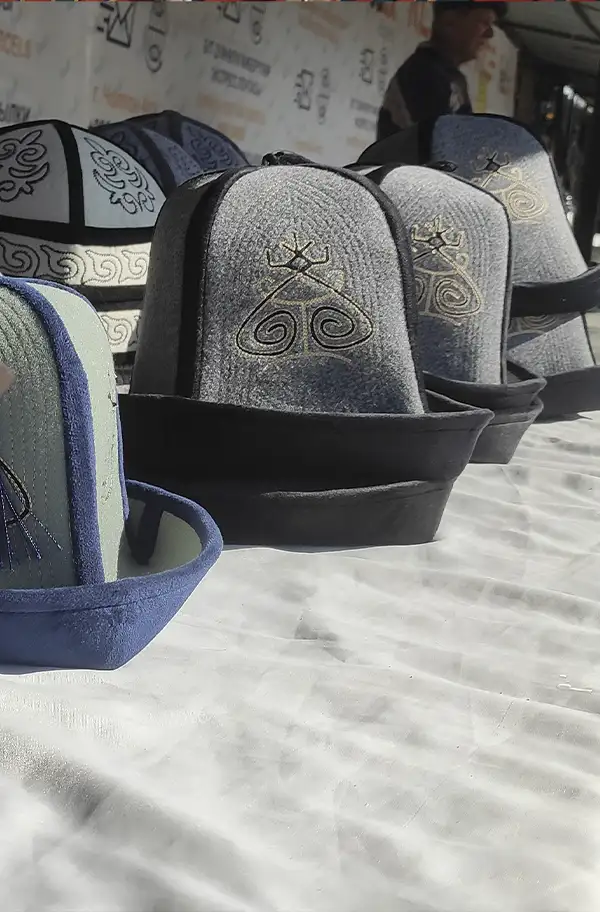 3/3. Contemporary models offered for sale Photo: I Love KG archive.
 When and how it is worn
You will see ak-kalpaks in everyday life, at family celebrations, official ceremonies, concerts and sporting events. Frequency is personal and contextual. One man may wear his regularly, another may keep it for particular occasions, and someone else may treasure one at home as a gift.
White felt shades the head from strong sun, while its fibrous structure helps retain warmth in cooler weather. Comfort still depends on the density, height and fit of the individual hat. A tight band soon becomes uncomfortable; an oversized kalpak shifts in the wind.
Calling it only a stage costume misses the point. The photographs from Osh and Karakol show several settings: chess in a public space, a musical performance and life near a yurt. The tradition remains alive because the hat still has a place in contemporary life.
What UNESCO recognition covers
In 2019, ak-kalpak craftsmanship, knowledge and the skills of making and wearing it entered UNESCO’s Representative List of the Intangible Cultural Heritage of Humanity. The listing covers a practice, not every physical hat: felting, cutting, sewing, embroidery, wearing and transmission.
A newly made hat from a small workshop can therefore continue the tradition, while an old object without context does not explain it on its own. Safeguarding depends on makers, learners, access to materials and opportunities to use the hat, not only on museum display cases.
Why 5 March is Ak-kalpak Day
Kyrgyzstan marks Ak-kalpak and National Clothing Day on 5 March. Parliament established the official date in 2016 and broadened the name in 2017. It is a modern observance intended to focus attention on the hat and national dress.
Schools, cities and state institutions may hold exhibitions, public events and themed activities, but the programme changes each year. Check current local announcements before planning a visit. Kyrgyzstan’s National Statistical Committee confirms the 5 March date.
How to choose one
A market or souvenir shop may place handmade hats, machine embroidery and mass-produced pieces side by side. Price alone does not settle their origin. Start with the purpose: a hat you intend to wear needs a better fit than one bought only for display.
- Check the size. Wear it for several minutes. The band should not press on your forehead or slip over your eyes.
- Flex the felt. It should recover without a sharp crease, bald patches or a crumbling edge.
- Follow the seams. Imbalance is easiest to spot at the crown and where the vertical bands meet.
- Inspect the finish. Braid, lining and embroidery should lie flat, without loose threads or lifting glued sections.
- Ask who made it. Request the maker’s name, material, method and care instructions. A clear answer means more than a generic “national souvenir” label.
Our guide to souvenirs from Kyrgyzstan covers other gifts and checks before export. To see what felt can do on a much larger scale, continue to the guide to the Kyrgyz yurt.
How to handle it respectfully
The nomination file describes keeping a kalpak in a clean, elevated place. Do not put it on the ground, sit on it or turn it into a throwaway joke prop. At home, keep it dry and support its shape rather than crushing it under luggage.
Do not try on somebody else’s hat without asking. In a workshop, check which pieces may be handled or photographed. If you receive one as a gift, ask the maker about care: water, steam and aggressive cleaning can alter both felt and embroidery.
Historic headwear, clothing and craft can be studied in Kyrgyzstan’s museums. Look for a label with region, date, material, maker or former owner. Those details usually explain an object better than the generic caption “national hat”.
Ak-kalpak essentials
What is an ak-kalpak made from?
Its traditional base is white wool felt. Cutting and stitching create the shape, while cloth, braid, appliqué or embroidery finish the panels and edge.
Can a visitor wear an ak-kalpak?
Yes, particularly when it has been bought to wear and fits properly. Treat it as meaningful headwear: keep it off the ground and do not use it as a mocking costume prop.
What does the embroidery mean?
The tradition has documented symbolic interpretations, but the same motif need not carry one fixed meaning on every hat. Ask the maker about a particular design.
When is Ak-kalpak Day?
Kyrgyzstan marks Ak-kalpak and National Clothing Day on 5 March. The date was formally established in 2016 and the observance received its broader name in 2017.
Share on social media
If you found this guide useful, share it on social media. It takes a moment and helps more travellers discover the project. Thank you!
Anything to add?
Share your experience, leave a comment or suggest an improvement.