Contents:
- Why visit the Frunze Museum
- How the old annexe ended up inside a modern building
- What the domestic rooms show
- Who Mikhail Frunze was
- How to read the Soviet exhibition
- The museum and the history of Kyrgyzstan
- Hours, tickets and visitor rules
- How long to allow
- What to see nearby
- Frequently asked questions
Why visit the Frunze Museum
The museum's defining object appears on the ground floor: a whitewashed adobe annexe standing beneath a much larger glass-and-concrete structure. Few places in Bishkek bring nineteenth-century domestic architecture and the monumental confidence of the 1960s into such direct contact.
The upper floors address Mikhail Frunze, the Russian Revolution and the Civil War. Their permanent display retains the visual language of a Soviet memorial museum: large portraits, documents, weapons, sculpture, maps and theatrical centrepieces. This makes the museum more than a one-man biography. It also records how the state constructed a hero and used that figure to explain history.
The house and the annexe were separate buildings. The family's main house has not survived. The structure enclosed by the present museum was an outbuilding used as a summer kitchen, store and medical consulting room.
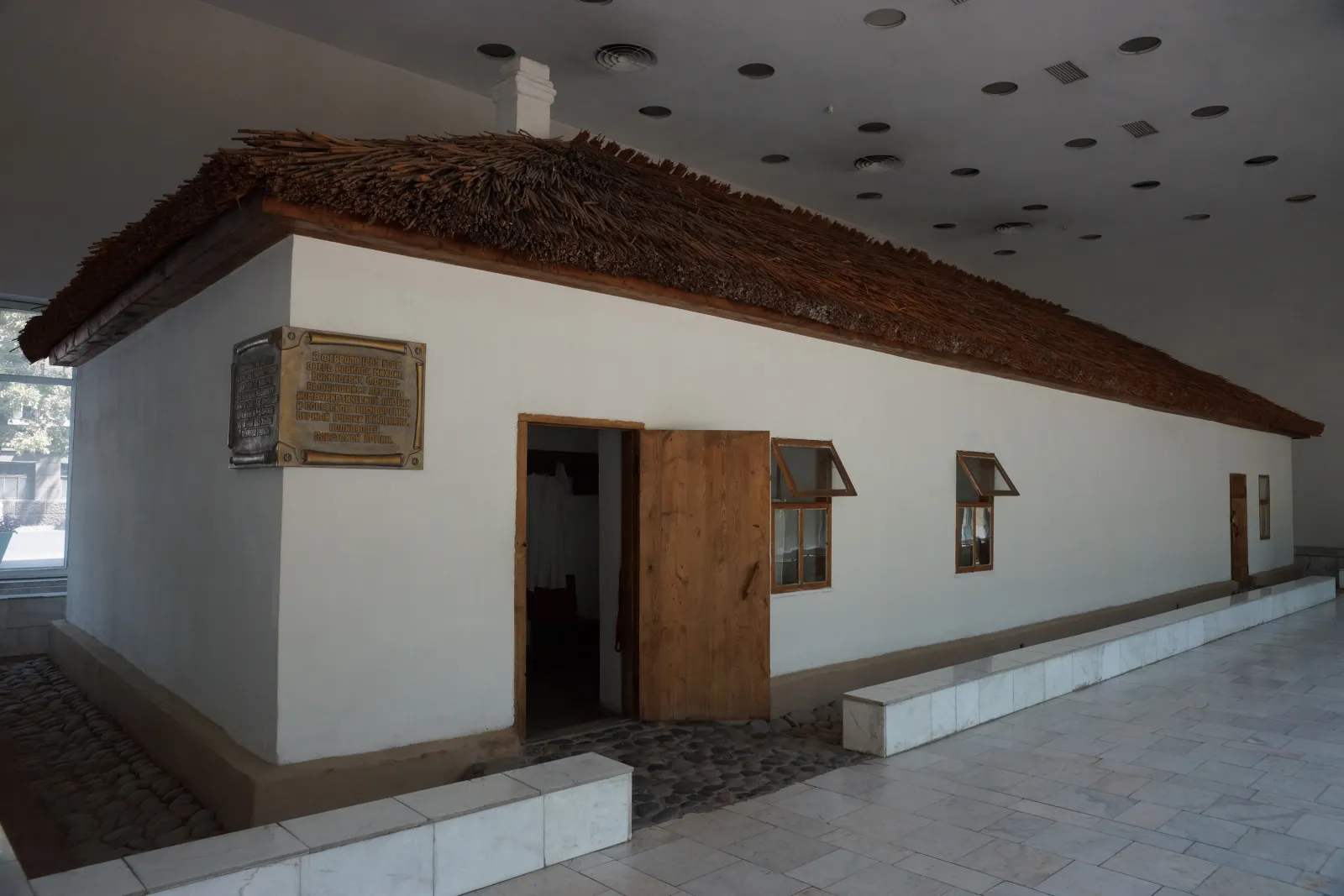 The preserved annexe inside the museum. Photo: DNikon, Wikimedia Commons, CC BY-SA 4.0; edited for this site.
How the old annexe ended up inside a modern building
Mikhail's father, Vasily Frunze, built the family house in Pishpek in 1879. The annexe stood nearby, linking the doctor's practice with the everyday work of the household. Mikhail Frunze was born in Pishpek on 2 February 1885 and spent his early childhood on this plot.
The museum was founded on 9 December 1925, shortly after Frunze's death, and admitted its first visitors on 5 March 1927. A substantial reconstruction followed in 1937. During redevelopment in the 1950s the old buildings were demolished, but the annexe was retained as the memorial object.
The present museum opened in 1967. Its designers placed the annexe beneath a high new volume and made the ground floor transparent, so that the small building remains visible from the street. Above it, heavy concrete façades carry reliefs about revolution and civil war, with a copper profile of Frunze completing the composition.
The building is a strong example of Soviet modernism. Its exhibition area covers about 2,000 square metres, and the museum has been listed as a historical and cultural monument of national significance since 2002. The architecture alone can justify a short visit, even if military history is not your main interest.
What the domestic rooms show
The annexe contains recreated domestic and service rooms from a late nineteenth-century household: a sitting room, bedroom, kitchen, furniture, tableware and everyday objects. They bring the story down from the scale of military campaigns to that of a single room. Look at the thickness of the walls, low doorways, stove and the way the rooms connect.
A memorial display does not make every chair or kitchen utensil a possession of the Frunze family. Some objects reconstruct the period. Museum labels should help distinguish a personal item, an original document and a representative object selected to furnish an interior.
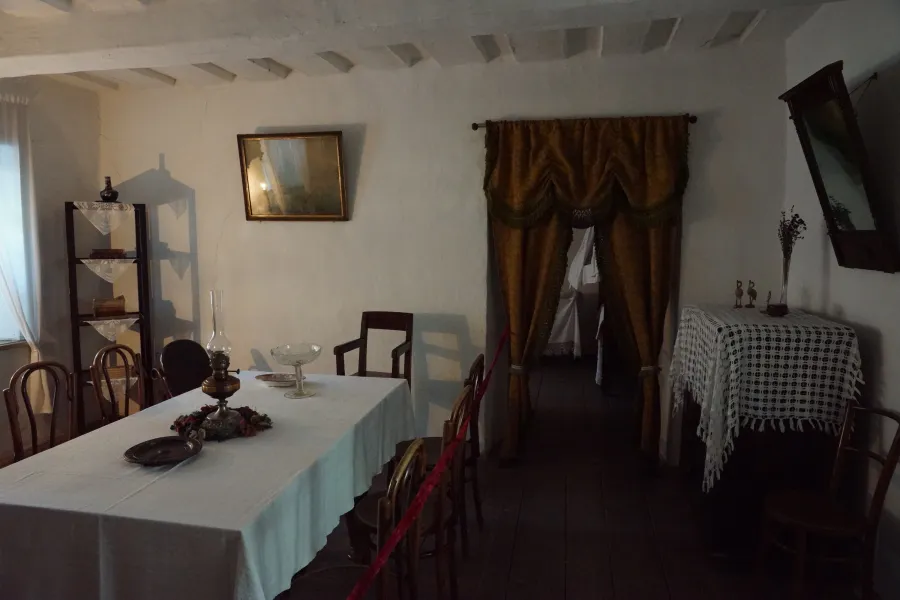 1/4. Rooms connected within the annexe Photo: DNikon, Wikimedia Commons, CC BY-SA 4.0; edited for this site.
 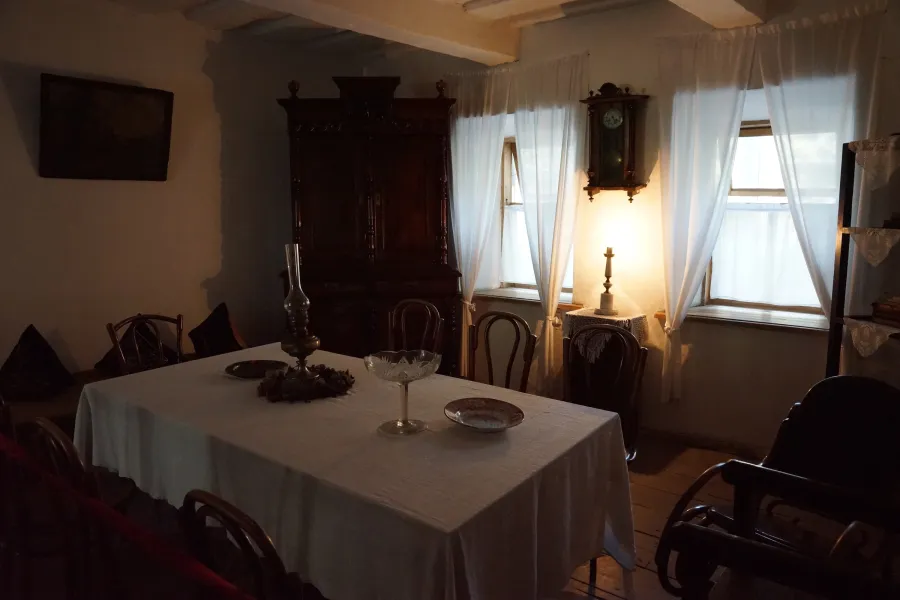 2/4. Recreated sitting room Photo: DNikon, Wikimedia Commons, CC BY-SA 4.0; edited for this site.
 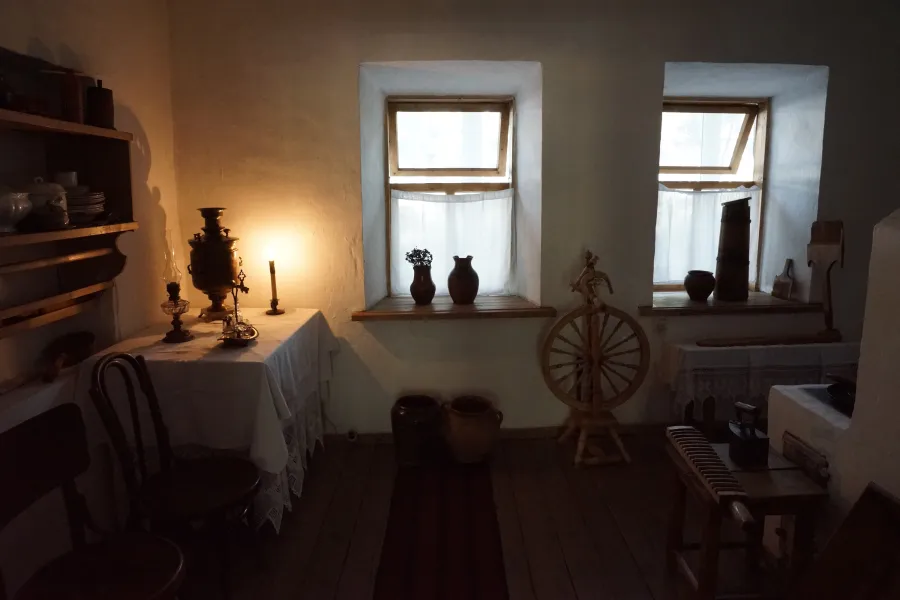 3/4. Kitchen and household utensils Photo: DNikon, Wikimedia Commons, CC BY-SA 4.0; edited for this site.
 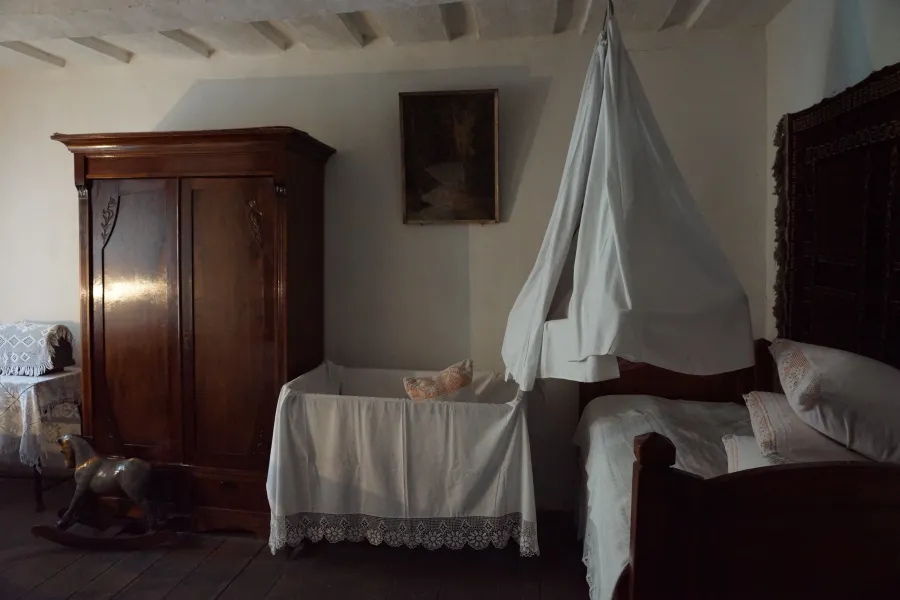 4/4. Recreated bedroom Photo: DNikon, Wikimedia Commons, CC BY-SA 4.0; edited for this site.
 Who Mikhail Frunze was
Mikhail Frunze became a senior Bolshevik military and political leader and one of the Red Army's principal commanders during the Russian Civil War. Bishkek bore his surname from 1926 until 1991, so his legacy extends beyond the museum into the city's former name, street plan, monuments and Soviet architecture.
In 1919 and 1920 Frunze commanded the Turkestan Front and took part in the establishment of Soviet power in Central Asia, including the military operation against the Emirate of Bukhara. The Soviet exhibition frames these events as revolutionary victories. A contemporary visitor should also keep the wider scale in view: warfare, regime change, casualties and the subsequent transformation of society.
You do not need to arrive with a final verdict on Frunze. It is more useful to separate three questions: what happened, how the museum's creators explained it and which voices or consequences later historical work brings back into the picture.
How to read the Soviet exhibition
Begin by identifying the source. A document, letter, photograph or weapon provides one kind of evidence; its caption and position in the gallery direct your interpretation. Then consider scale. A statue or machine-gun cart dominates the room emotionally, even when a small archival card contains more precise information.
Notice words such as liberation, defeat, establishment of power and heroism. They disclose the narrator's position. Ask whose perspective appears in the gallery and whose is barely audible. Read in this way, the old permanent exhibition becomes a revealing document of its own period rather than a sequence of slogans to accept or dismiss.
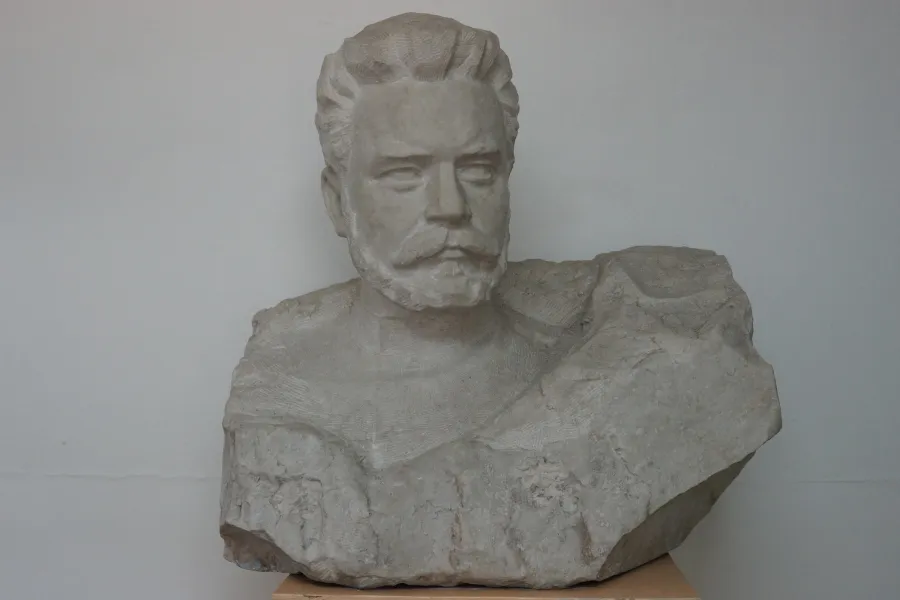 1/4. The memorial image of a hero Photo: DNikon, Wikimedia Commons, CC BY-SA 4.0; edited for this site.
 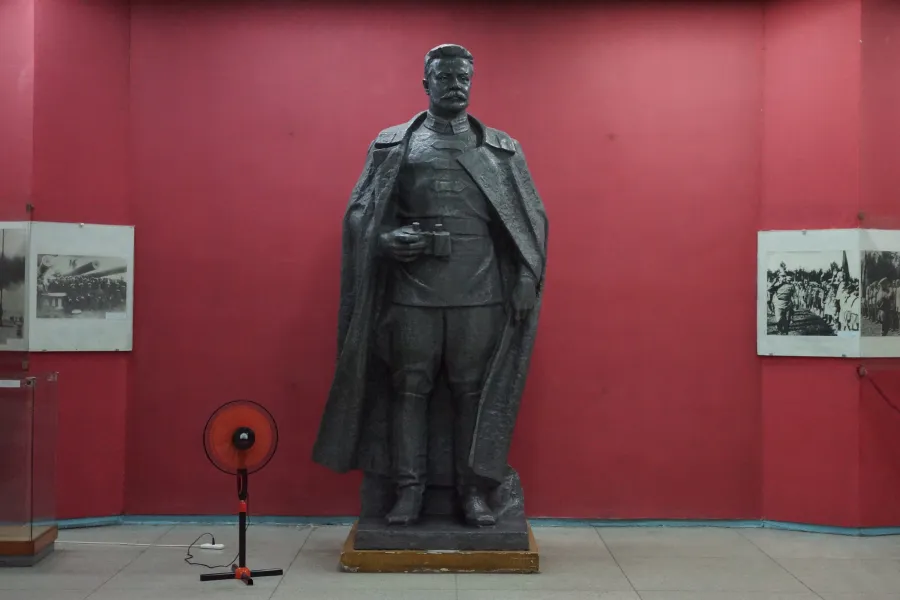 2/4. Sculpture as the centre of a display Photo: DNikon, Wikimedia Commons, CC BY-SA 4.0; edited for this site.
 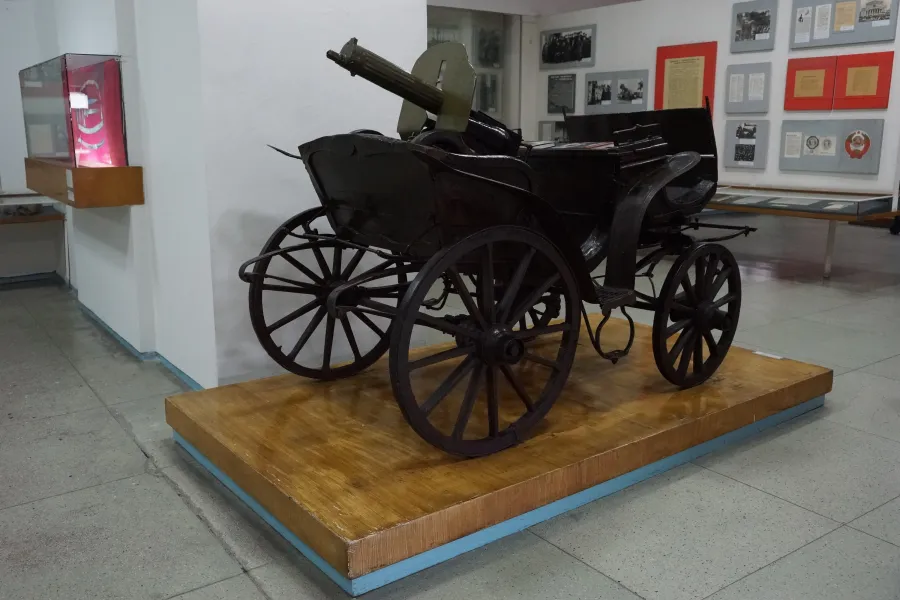 3/4. A tachanka in the Civil War gallery Photo: DNikon, Wikimedia Commons, CC BY-SA 4.0; edited for this site.
 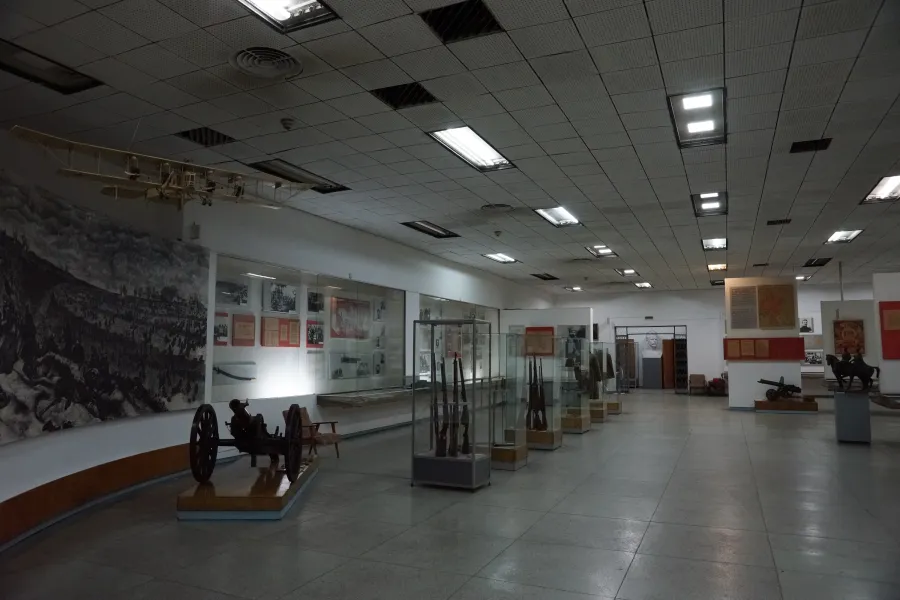 4/4. The permanent exhibition Photo: DNikon, Wikimedia Commons, CC BY-SA 4.0; edited for this site.
 The museum and the history of Kyrgyzstan
The Frunze Museum predates many of the country's present institutions. It began as the Central Museum, collecting material on the history, ethnography and natural environment of Kyrgyzstan. More specialised museums and collections later grew from that work. Today's National Historical Museum offers a much broader chronology and makes a useful sequel.
The memorial museum itself contains several historical layers: late nineteenth-century Pishpek, the revolutionary cult of the 1920s and 1930s, the architectural confidence of the 1960s and today's effort to reassess the Soviet legacy. That accumulation makes it more interesting than a conventional biographical display.
Opening hours, tickets and visitor rules
As of 23 August 2026, the museum lists opening hours of 11:00 to 16:30 every day. It closes for a sanitation day on the last Friday of every month. Admission ends 30 minutes before closing, so the last normal entry is at 16:00. Check notices on the museum's official website in Russian before setting out.
Tickets. Adult admission is 80 som. School and university students from Kyrgyzstan pay 50 som with ID, international students pay 100 som with ID, and other foreign visitors pay 150 som. A general tour is listed at 120 som for 45 minutes or 160 som for 60 minutes. Call +996 312 66-06-04 or +996 312 66-06-07 in advance if a guide matters to your visit.
Photography. The visitor rules allow free amateur photography for personal use without flash or tripod. The price list separately includes a photo and video service at 150 som. Ask at the ticket desk before any staged, prolonged, professional or commercial shoot. The museum publishes the full restrictions in its official visitor rules in Russian.
Before entering. Large bags, backpacks, coats and umbrellas must be left in the cloakroom. Food and drink are not allowed in the galleries. Flash, tripods, monopods and selfie sticks are prohibited. The official site does not confirm a lift, step-free route or accessible toilet, so call ahead if you require specific access arrangements.
How long to allow
Architecture and annexe
- Study the façade and transparent ground floor from outside.
- Walk through the annexe, separating reconstruction from memorial objects.
- Choose one upstairs gallery instead of rushing through the entire display.
A good first visit
- Combine the annexe, architecture and principal Frunze galleries.
- Compare documents with the language of captions and monumental staging.
- Keep ten minutes for the exterior reliefs and copper profile.
Visit with historical context
- Book the listed 45- or 60-minute general tour.
- Return to selected documents and rooms independently afterwards.
- Continue the day at the National Historical Museum.
What to see nearby
The museum stands in central Bishkek, close to Old Square and Oak Park. It fits naturally into our Bishkek walking tour, adding an indoor historical stop between architecture and parks. For visual art, continue to the Gapar Aitiev Museum.
The National Historical Museum provides the clearest comparison. The Frunze Museum builds its narrative around one man and retains a Soviet memorial setting; the historical museum spans archaeology, ethnography, the Soviet period and independent Kyrgyzstan. Our guide to museums in Kyrgyzstan lists further options.
Frequently asked questions about the Frunze Museum
Is this the original house where Mikhail Frunze lived?
The main family house has not survived. The adobe structure enclosed by the museum is a separate annexe associated with the family and used as a summer kitchen, store and medical consulting room. Its interiors are partly reconstructed.
How much is admission to the Frunze Museum?
As of 23 August 2026, adult admission is 80 som, school and university students from Kyrgyzstan pay 50 som with ID, international students pay 100 som, and other foreign visitors pay 150 som.
When is the museum open?
The museum lists daily opening hours of 11:00 to 16:30. It closes on the last Friday of every month for a sanitation day. Admission ends at 16:00, 30 minutes before closing.
Can I take photographs inside?
Amateur photography for personal use is free without flash or tripod. Ask at the ticket desk about staged, prolonged, professional or commercial work, as the price list separately names a photo and video service.
Is the museum worthwhile if I am not interested in military history?
Yes. The preserved annexe inside a modern building, the Soviet modernist architecture and the opportunity to examine how a 1960s museum constructed a historical hero are strong reasons to visit in their own right.
Share on social media
If you found this guide useful, share it on social media. It takes a moment and helps more travellers discover the project. Thank you!
Anything to add?
Share your experience, leave a comment or suggest an improvement.