On this page:
Never step onto the field or into the warm-up lane: stay behind the barrier, keep horse access routes clear and follow stewards immediately. A rider cannot stop a galloping horse the moment the whistle sounds.
What happens on the field
Two teams compete for the ulak, a heavy game object. A rider lifts it from the ground, secures it against the leg or passes it to a teammate while the side drives towards the opposition goal. A successful score is called a salym. The team with more salyms wins.
The tai kazan is a broad, circular goal with sloping sides. To score, the rider must lower or throw the ulak into the opposition’s goal. Play restarts from the central area after a salym.
Ulak
- The 2024 federation rules permit either a goat carcass or a mould.
- The prescribed weight of the mould is 30 kilograms.
- Check the regulations of the specific tournament before attending.
Tai kazan
- Each team defends one goal and attacks the other.
- A salym counts when the ulak is fully, or at least two-thirds, inside.
- Contact becomes especially tight around the rim, well away from public space.
Four active riders
- A squad may register up to 12 riders, with four on the field at once.
- Rolling substitutions take place through a marked line.
- An extra rider on the field triggers a penalty for the team.
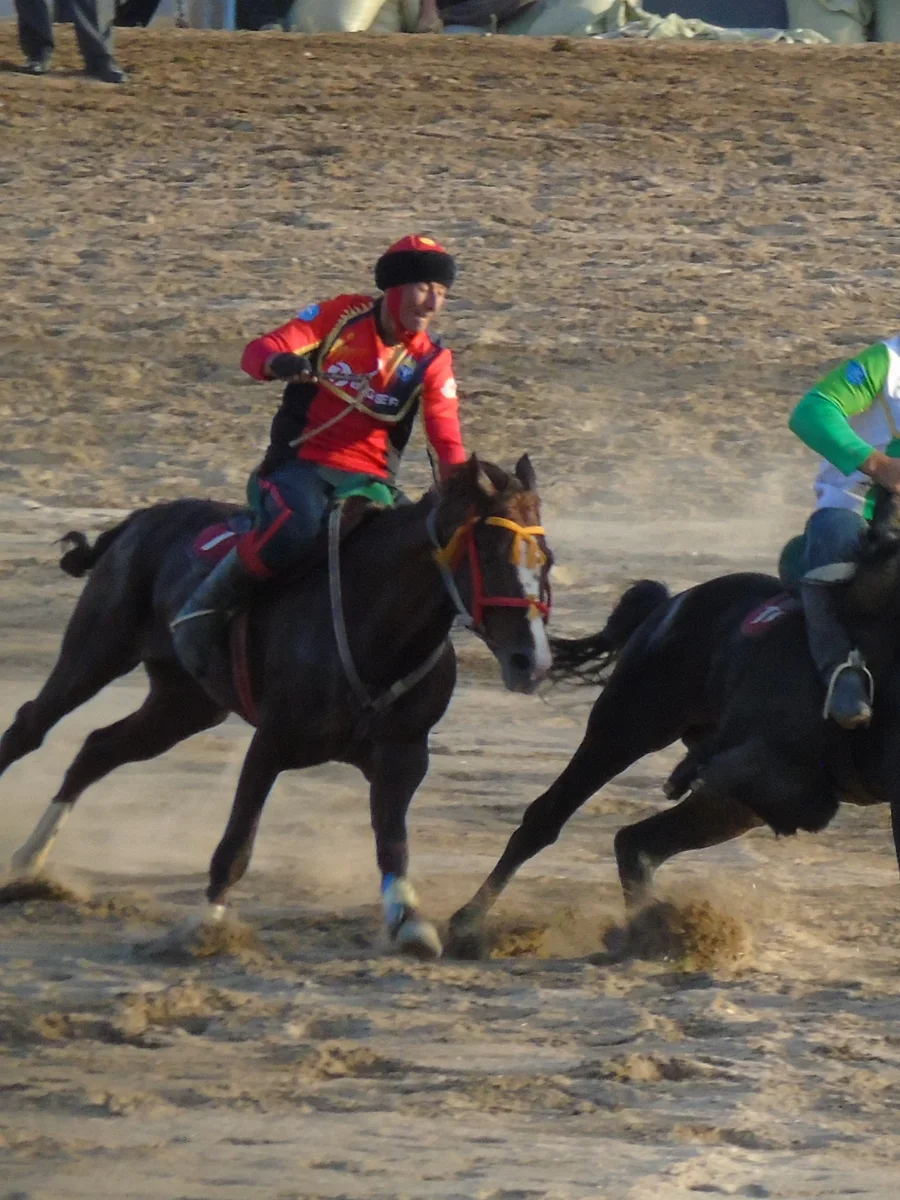 1/4. An attack around the tai kazan at the 2018 World Nomad Games Photo: Helen Owl, Wikimedia Commons, CC BY-SA 4.0; edited for this site.
 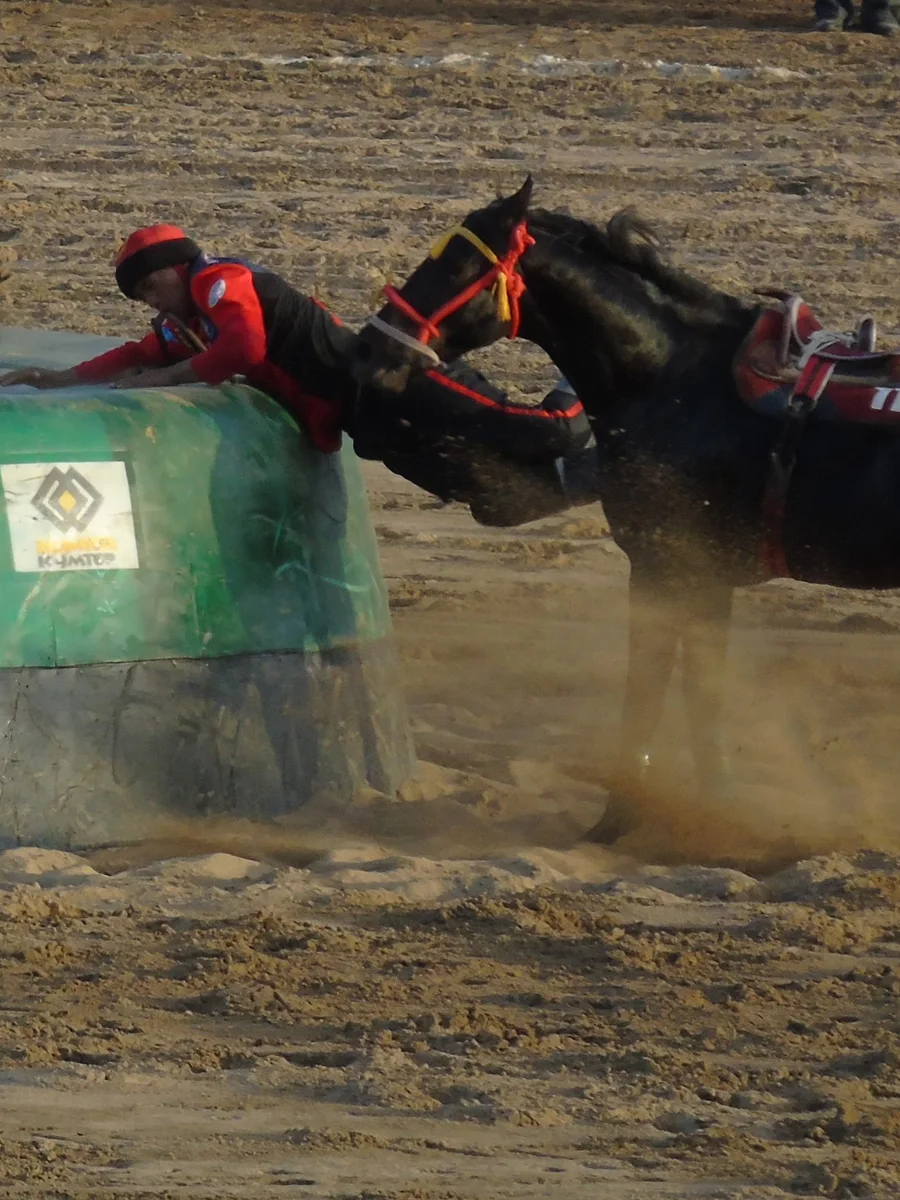 2/4. A scoring attempt at the tai kazan Photo: Helen Owl, Wikimedia Commons, CC BY-SA 4.0; edited for this site.
 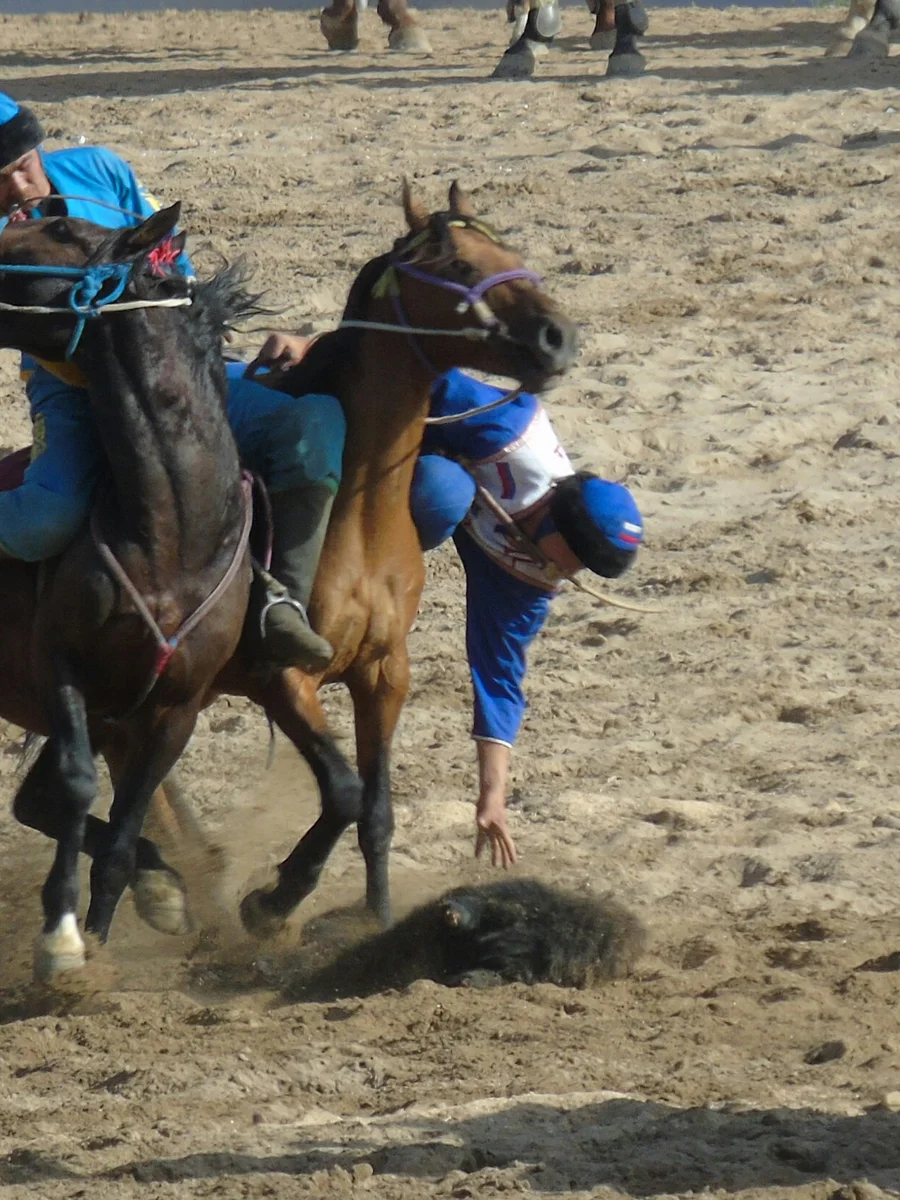 3/4. Competing for the pickup Photo: Helen Owl, Wikimedia Commons, CC BY-SA 4.0; edited for this site.
 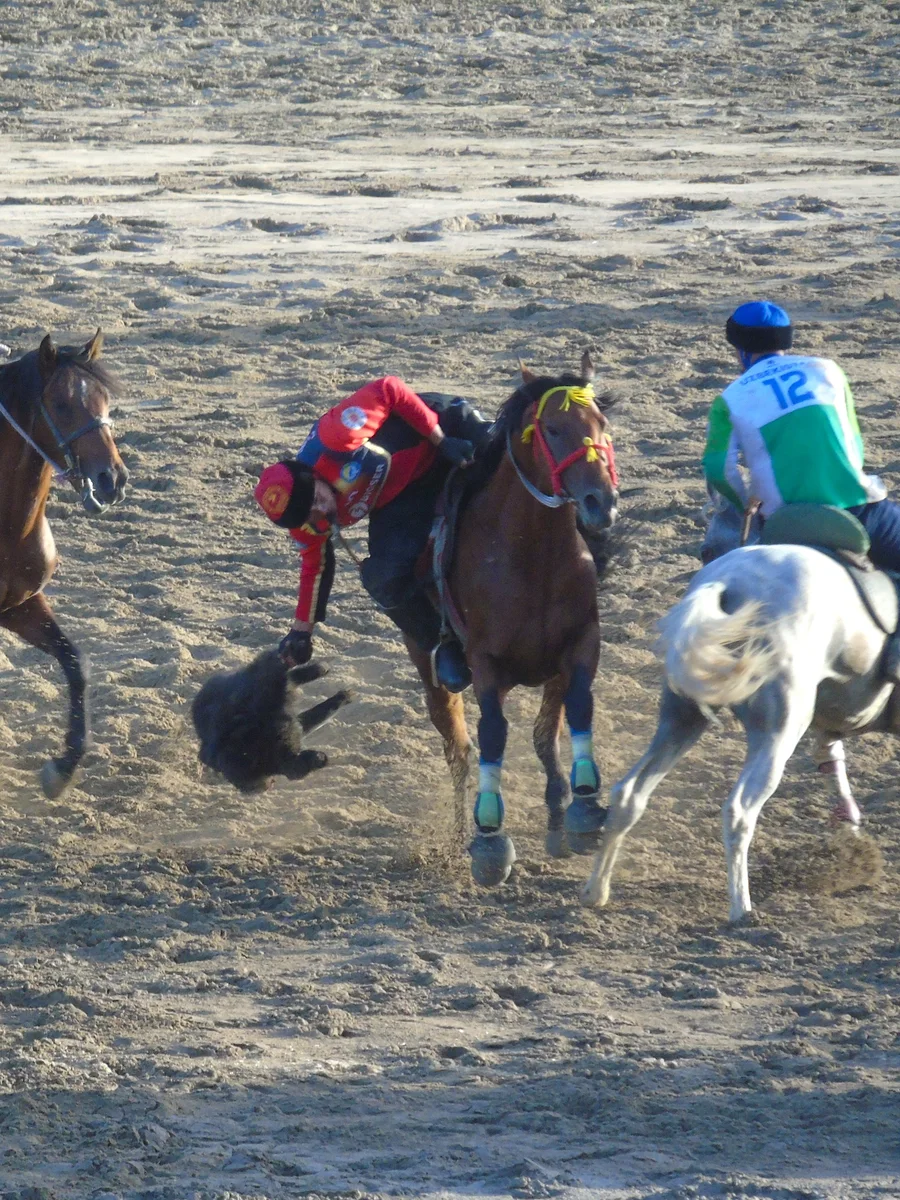 4/4. Lifting the ulak under pressure Photo: Helen Owl, Wikimedia Commons, CC BY-SA 4.0; edited for this site.
 The basic match rules
The current rulebook used here was issued by the Kyrgyz Kok Boru Federation in 2024. It specifies a field 210 metres long and 80 metres wide, or 70 metres wide where the perimeter is enclosed. The playing surface is covered with 6 to 8 centimetres of washed sand.
The standard match has three 15-minute periods separated by ten-minute breaks. A tournament may set a different duration in its own regulations. A draw can lead to extra time and a bullit tie-break, with the exact order depending on the competition format.
Physical pressure is part of the sport, but only within defined limits. Riders may use body and horse positioning to challenge for space. They may not strike an opponent, grab them by hand, block at a dangerous angle or ride into a player who is leaning down for the ulak. The referee stops play if riders or horses are in danger.
Carcass or mould
There is no single answer for every event. The 2024 rules allow a goat carcass or a mould. They set the mould at 30 kilograms and provide separate weights for a prepared carcass under different field conditions. UNESCO’s heritage entry describes a mould in modern games, but the event regulations are the decisive source for the match in front of you.
If animal use matters to your decision, ask the organiser which ulak the tournament has approved before buying a ticket. A poster or an old video is not sufficient evidence: professional tournaments, village games and staged demonstrations can follow different arrangements.
Why accounts conflict: kok boru lives as heritage, professional sport, local play and festival performance. The shared name does not guarantee an identical rulebook or game object.
How to follow the play
-
Start and first pickup
At the whistle, riders attack the ulak from the starting area. One tries to lift it from the ground without losing speed or balance.
-
Break out of the cluster
Teammates create a route for the carrier while opponents use legal pressure to stop the move before it opens up.
-
Sprint or handover
The side may continue through one rider or transfer the ulak. Watch the riders away from the object: they are shaping the next corridor.
-
Attack the tai kazan
Space narrows around the goal. The carrier must protect the ulak, approach at a workable angle and release it as defenders turn the attack away.
-
Salym and restart
Once the score is confirmed, the referee stops the passage. The teams reset and the ulak returns for the next contest.
The game becomes easier to read when you watch the space rather than only the ulak. One rider carries, another opens a lane, a third offers a handover and the fourth protects against a counterattack. Those jobs change within seconds, and substitutions keep the pace high.
Horses, equipment and penalties
Horses must pass veterinary inspection before competing. Tack may not carry sharp or hard decoration that could injure a horse or rider. A horse known to bite must wear a suitable muzzle, and one that continues to bite or kick after a warning is removed.
Riders must use protective equipment and approved head protection. Continuing without a helmet after a warning leads to a time penalty. Striking with a hand, foot or whip, dangerous charging, trying to unseat an opponent and hitting a horse on the head can bring a time penalty or red card.
Rules reduce risk; they do not make a contact equestrian sport risk-free. Competent officiating, veterinary checks, a prepared sand surface, sound barriers and a clear route for medical help matter as much as the spectacle.
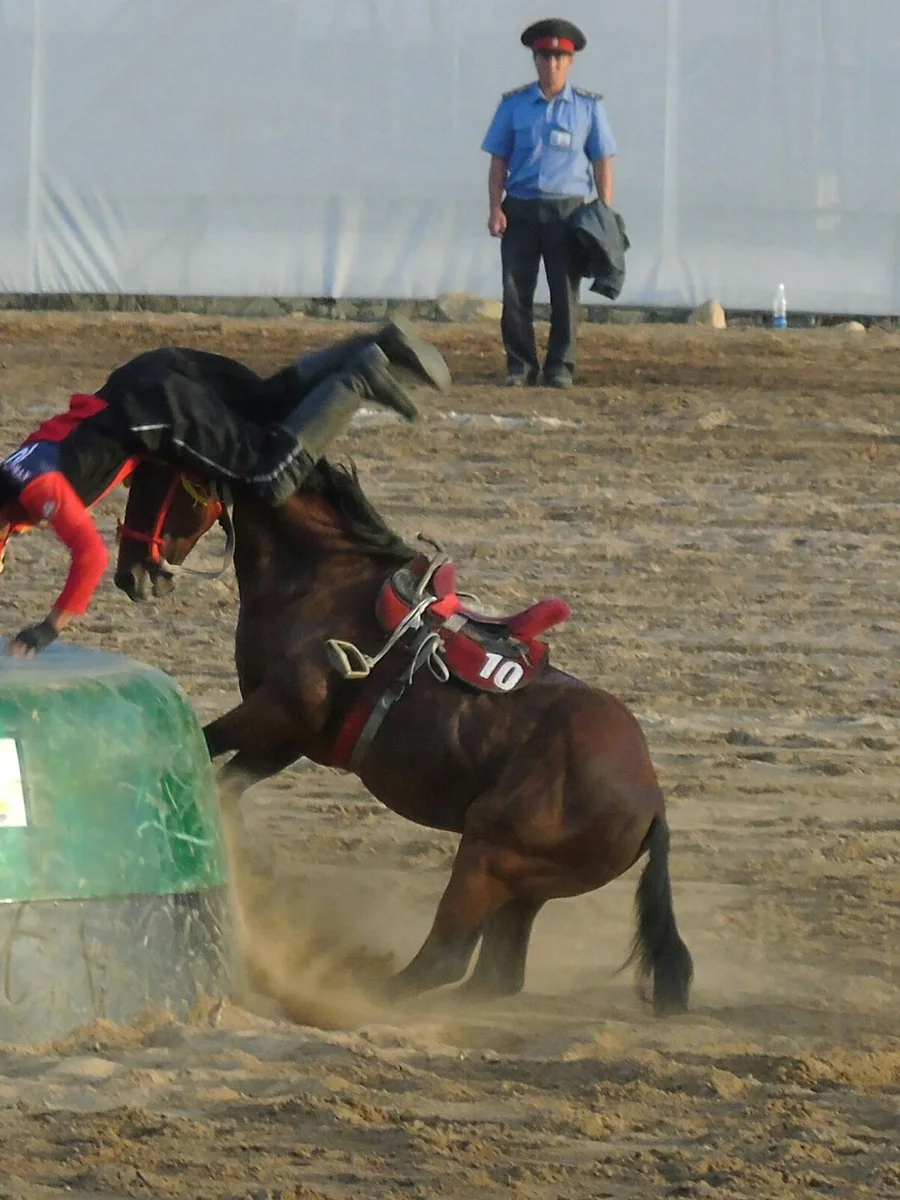 1/3. Close play around the rim of the tai kazan Photo: Helen Owl, Wikimedia Commons, CC BY-SA 4.0; edited for this site.
 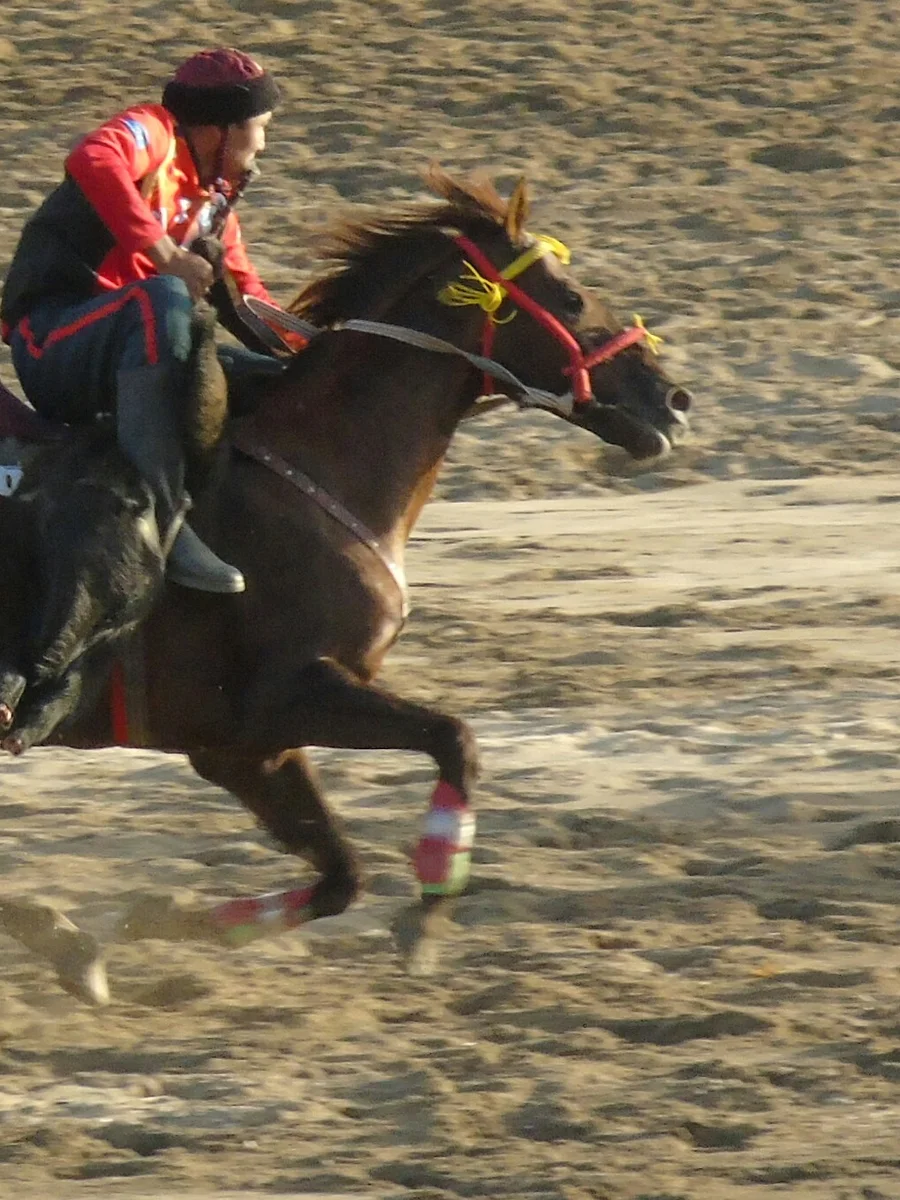 2/3. A sprint across open field Photo: Helen Owl, Wikimedia Commons, CC BY-SA 4.0; edited for this site.
 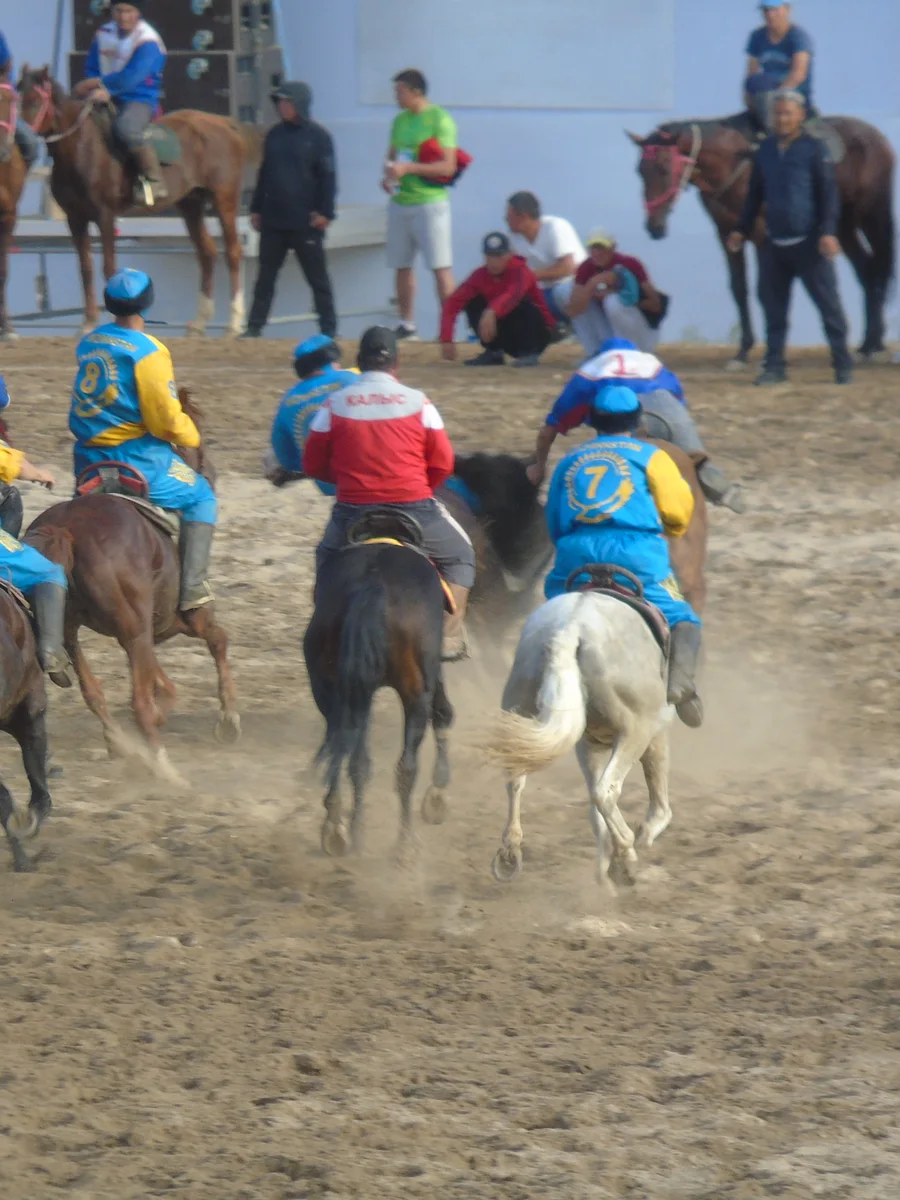 3/3. The teams reshape during play Photo: Helen Owl, Wikimedia Commons, CC BY-SA 4.0; edited for this site.
 Where to find fixtures
Kok boru does not have a daily tourist show schedule. The federation runs separate competitions across its top, first, youth and other leagues. Its listings repeatedly feature the Nooruz Cup, Victory Cup and Independence Cup, but dates, teams, venue and public access are announced for each edition.
Check the Kyrgyz Kok Boru Federation website and its official notices. For a practical visit, use our guide to the 2026 World Nomad Games together with the official Games website. Confirm the fixture again on the day: a tournament bracket, weather or field conditions can move the start time.
- Ask for the exact hippodrome or field, public entrance and spectator sector.
- Check whether you need registration or a ticket and whether sales are available on site.
- Confirm the first match and the approximate time of the team you want to see.
- Ask about large cameras and any separate media zone.
- Do not make a long journey on the strength of a holiday date without a confirmed fixture.
Large events often use hippodromes. International games have brought kok boru to Cholpon-Ata, while tournaments and official events have also taken place in Bishkek. A past venue is not a promise for the next match.
How to watch safely
Arrive early
- Locate the public entrance, protected viewing area and exit before horses enter.
- Bring water, sun, wind and dust protection, plus a warm layer in colder weather.
- Tell children that the barrier is never a shortcut for a photograph.
Stay behind the barrier
- Keep away from gates, horse corridors, the start line and the warm-up exit.
- Do not wave objects or use flash close to horses.
- Move immediately if a steward asks you to clear an area.
Wait for permission
- Do not walk to the tai kazan, riders or horses until the field has officially opened.
- Ask before taking a close portrait.
- Never touch or feed a horse without the owner’s or handler’s permission.
A raised stand or a section protected by a substantial barrier gives the clearest view. On an open ground the wind lifts sand into the crowd, so glasses are more useful than trying to stand closer to the touchline.
Photography and ethical context
Avoid reducing the sport to a sensational nickname, and do not obscure the object being used. An accurate caption names the ulak, explains the scoring aim and states whether the event used a mould or carcass when that fact is known. If the photograph does not establish it, the caption should not guess.
Photograph from the spectator zone with a longer lens. Do not ask a rider to repeat a dangerous move after the match, stand between a horse and its exit, or publish a close-up injury as entertainment. Ask before photographing people off the field, children or veterinary treatment.
UNESCO inscribed kok boru on the Representative List of the Intangible Cultural Heritage of Humanity in 2017. That status recognises a living practice, the transmission of skill and the community around it. It does not remove questions about horse welfare, rider safety or the choice of ulak at a modern competition.
What to explore next
Kok boru makes more sense alongside other living practices. Our guide to traditional archery separates a competition, demonstration and beginner lesson. The article on berkutchi looks at working with a golden eagle and the ethics of attending a display. The wider culture guide connects games with crafts, music and festivals.
Frequently asked questions
How many riders are on the field?
Under the Kyrgyz federation’s 2024 rules, each team has four active riders. A squad can register up to 12, allowing rolling substitutions during the match.
How long does a kok boru match last?
The standard format has three 15-minute periods with ten-minute breaks. An event’s own regulations may change the duration and add extra time or a bullit when scores are level.
Does kok boru use a carcass or a mould?
The 2024 rules allow either a goat carcass or a mould. The mould is set at 30 kilograms. Ask the organiser or read the event regulations to learn which object a specific tournament uses.
What is a tai kazan?
A tai kazan is the circular goal defended by each team. Riders attack the opposition’s goal, and a salym counts when the ulak is fully or at least two-thirds inside.
Where can a visitor watch kok boru?
Follow official notices from the Kyrgyz Kok Boru Federation and the World Nomad Games. Matches are organised as separate tournaments, so confirm the date, venue, entrance and start time before travelling.
May I approach the riders and horses afterwards?
Only once the field is open and with permission from the rider, owner or handler. Keep horse corridors clear, never approach directly from behind, do not feed a horse and avoid flash nearby.
Share on social media
If you found this guide useful, share it on social media. It takes a moment and helps more travellers discover the project. Thank you!
Anything to add?
Share your experience, leave a comment or suggest an improvement.