Contents:
Book time with a berkutchi, not merely “a photo with an eagle”. Ask for an explanation of the bird, equipment and training, find out whether a free flight is possible, and state in advance if you want a demonstration without live bait.
What is a berkutchi?
A bürkütchü, commonly written berkutchi in English, works with a golden eagle. The role involves daily care, reading the bird's condition, teaching it to return and preparing it for a training or hunting flight. “Eagle hunter” is the usual shorthand, but an encounter for visitors is at its best when the practitioner can also act as a teacher.
Falconry covers more than one species. Falcons, hawks and other raptors may be flown, and Kyrgyz speakers may use the broader word kushchu for a bird-of-prey specialist. A berkutchi works specifically with the much larger golden eagle. That means a bird at a festival is not necessarily an eagle, however loosely a caption describes it.
A trained bird encounter is also different from watching a wild eagle. The golden eagle beside a berkutchi carries equipment, remains close to people and responds to familiar cues. For free-ranging raptors, use our guide to wildlife in Kyrgyzstan and keep well away from nests.
Why the tradition survives
Hunting with raptors began as a way to obtain food in open country. The knowledge passed from an experienced hunter to a learner: how to read a bird, choose terrain, maintain the equipment and preserve contact once it took flight. Today it is also sustained through family teaching, demonstrations, festivals and competitions.
Kyrgyzstan joined the multinational UNESCO inscription for falconry as living human heritage in 2021. The listing recognises the knowledge and its communities. It does not certify the welfare standards of every tourist show, so each encounter still deserves scrutiny.
The berkutchi belongs to the wider world of Kyrgyz nomadic culture: horses, mountain terrain, the taigan hunting dog and the craftspeople who make gloves, jesses, hoods and perches. The combination varies by family and purpose. A costume, yurt and horse make a handsome scene, but do not by themselves prove expertise.
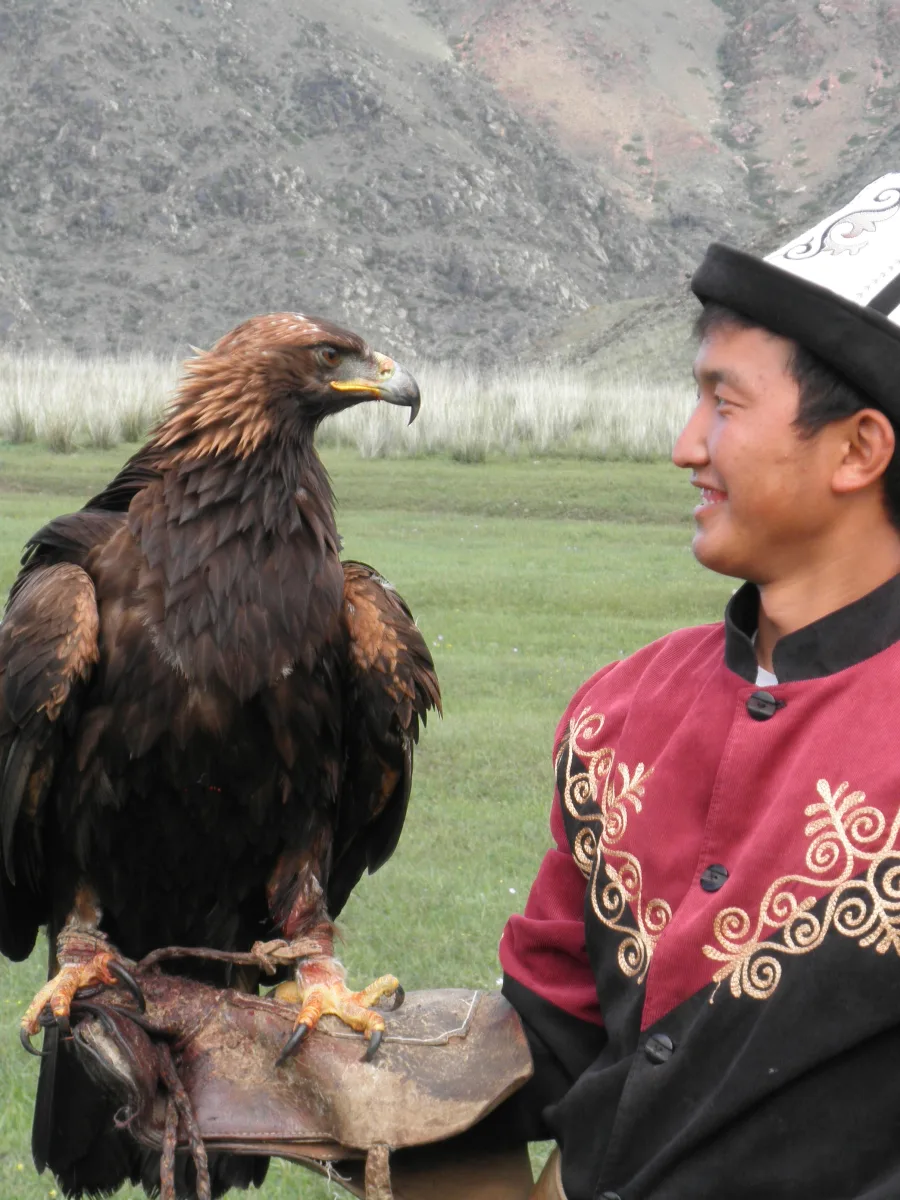 1/3. Golden eagle, glove and attentive handling Photo: Stoni111121, Wikimedia Commons, CC BY-SA 4.0; edited for this site.
 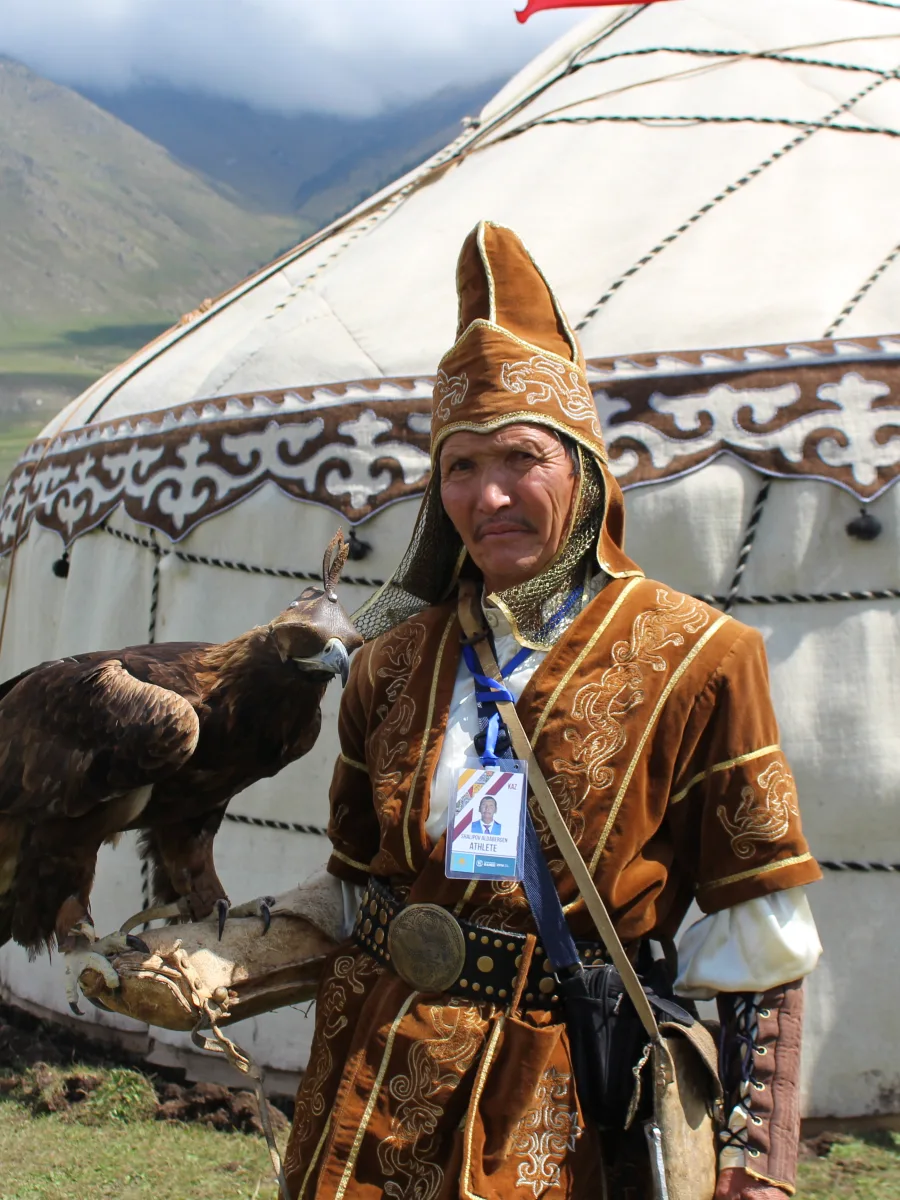 2/3. A competitor at the 2016 World Nomad Games Photo: Save the Dream, Wikimedia Commons, CC BY 2.0; edited for this site.
 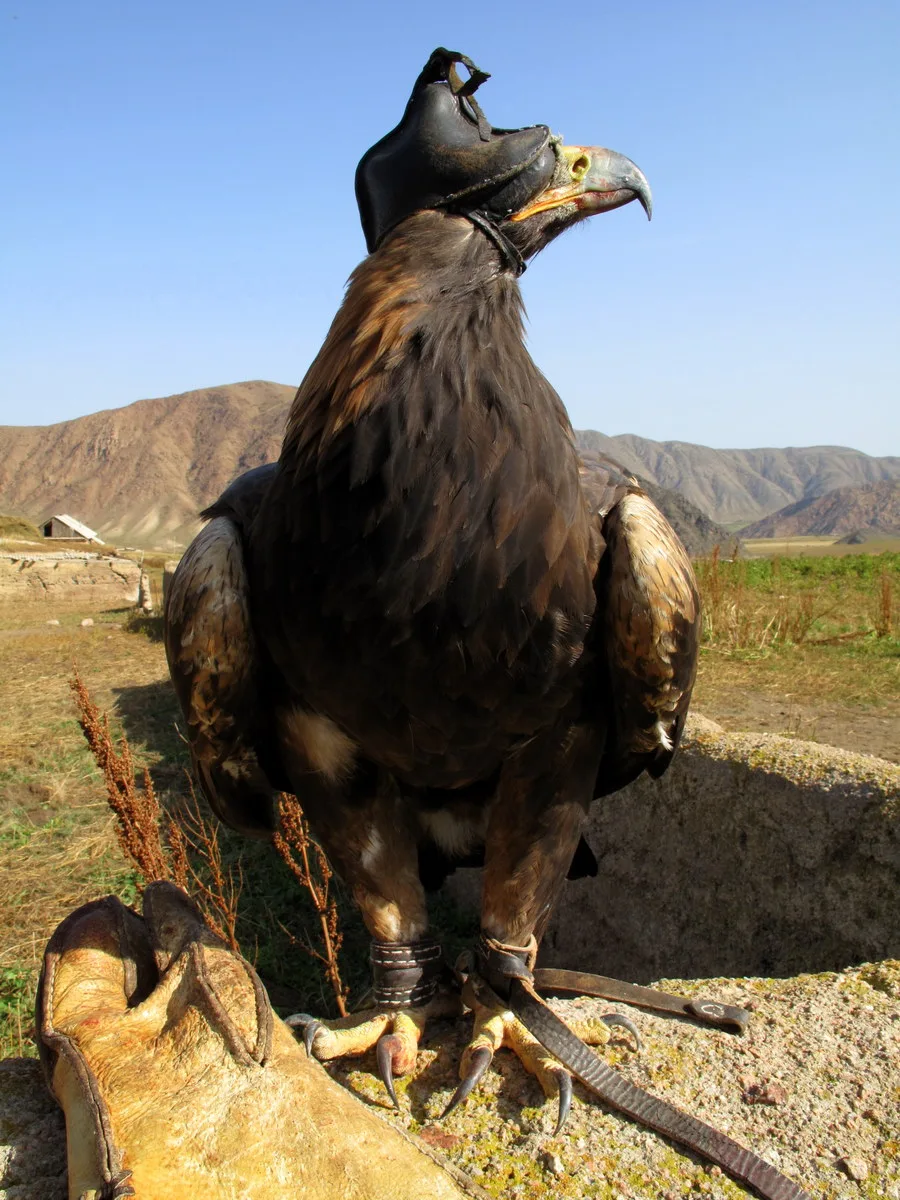 3/3. A hood reduces visual stimulation while the bird waits Photo: Peretz Partensky, Wikimedia Commons, CC BY-SA 2.0; edited for this site.
 How a golden eagle is trained
Training proceeds in small steps. The bird becomes accustomed to a person's voice and presence, perches calmly on a protected glove, moves over a short distance and returns for a food reward. Distance then increases, a lure is introduced and, where these are part of the family's practice, the bird grows familiar with unfamiliar terrain, a horse and a taigan.
The heavy glove protects the hand and gives the eagle a stable perch. Leather jesses control the bird before release. A hood blocks its view while it waits or travels and limits stimulation. Names, designs and methods differ, so ask the berkutchi to show each item and explain how it is used.
The relationship is not a single trick. A skilled handler watches appetite, weight, plumage, breathing, grip and response to the surroundings. Bad weather, fatigue or agitation may shorten a session. That is a sound professional decision rather than a failed performance.
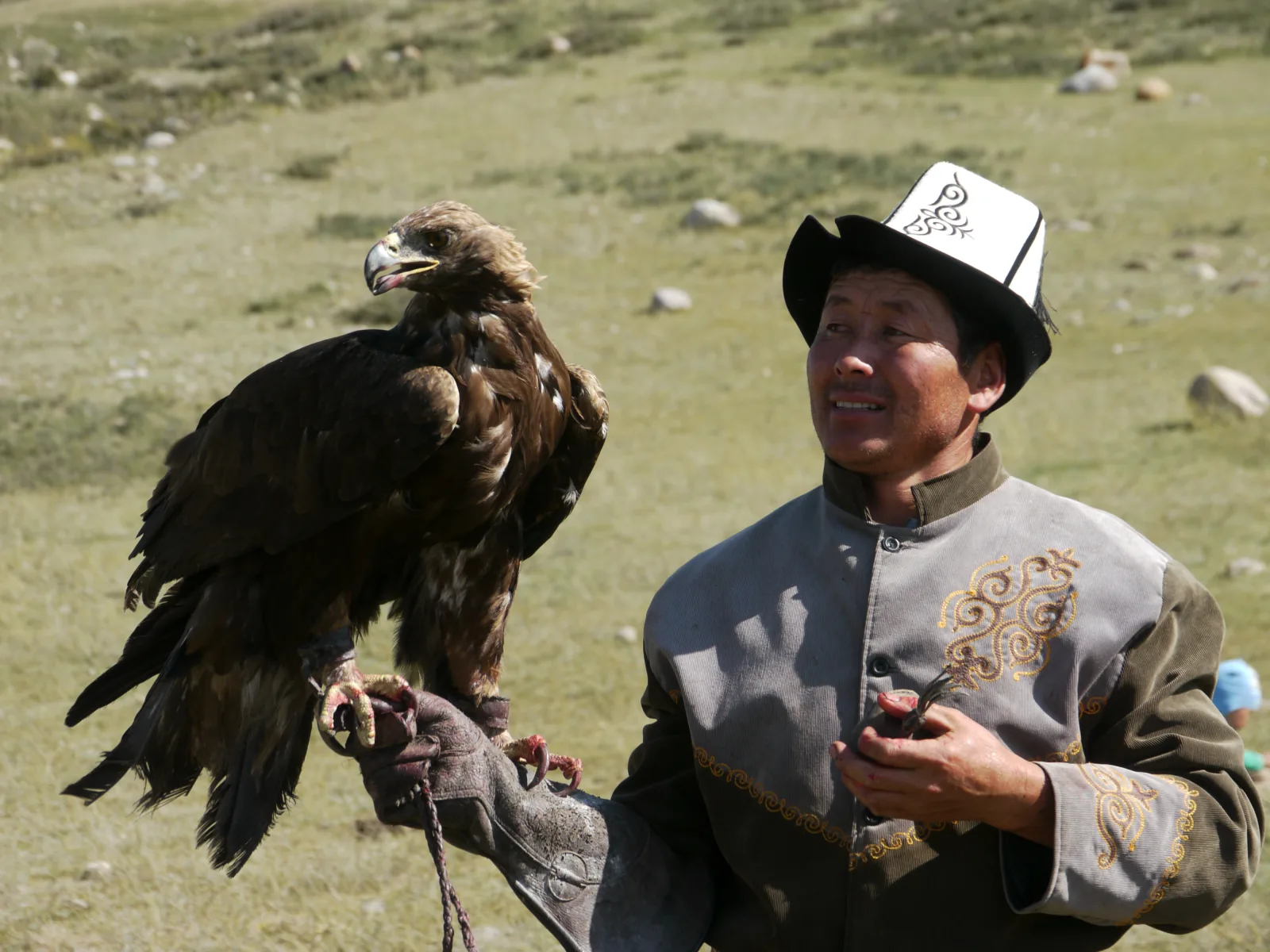
A berkutchi with his bird in Barskoon valley in 2013. Photo: tjabeljan, Wikimedia Commons, CC BY 2.0; edited for this site.
Demonstration, festival or hunt
Explanation and training flight
- The best format for questions about the bird, equipment and training.
- You can request a lure-based demonstration without a live animal.
- The place and duration are arranged with the berkutchi rather than found at a ticket window.
Several handlers and competitions
- A chance to compare birds, equipment and competitive exercises.
- Dates, grounds and photography rules change each year.
- Crowds and music leave less time for a conversation with one practitioner.
A seasonal practice, not a guaranteed attraction
- It depends on season, law, weather, terrain and the bird’s condition.
- Prey and a successful result cannot be promised.
- Discuss the use of live quarry explicitly before making any booking.
For a first introduction, choose a private explanation and a short training session. It has more substance than a queue for portraits and lets you set clear boundaries in advance. A festival is better for competition and scale. A real hunt requires separate preparation and should never be sold as a guaranteed photo opportunity.
Where to meet a berkutchi
Bokonbaevo and nearby villages on the south shore of Issyk-Kul form the most accessible base for travellers. Community tourism organisations, guesthouses and operators can arrange an encounter with a local practitioner. This is not a permanent attraction with fixed opening hours: a berkutchi may be at home one day, training in another valley the next.
Contact the organiser several days ahead and request an exact meeting point. Establish whether transport from Bokonbaevo, interpretation and a flight are included. Current festival and demonstration announcements can be checked with CBT Kyrgyzstan, but an old date or price on a page is not a timetable for the following season.
The map pin marks Bokonbaevo: it is a useful arranging point, not the address of a single venue. The final meeting may take place in a village, gorge or open hillside beyond town.
What to confirm before paying
-
State the format you want
Ask for a talk, equipment demonstration and training flight. If you do not want live quarry, say so before booking.
-
Record the place and inclusions
Confirm the meeting point, transport, duration, language, group size and total price for the group.
-
Ask about the plan for the bird
Find out whether there will be free flight, a lure or a horse, and whether wind, heat, fatigue or the eagle’s condition may cancel an exercise.
-
Agree on photography
Ask separately about portraits of the practitioner, flash, drones and holding the bird. Silence is not permission.
Do not compare offers on duration alone. Twenty calm minutes of explanation and one natural flight can be more rewarding than an hour of posing. If an organiser promises every exercise in any weather, ask what happens when the berkutchi decides the bird should stop.
How to assess the bird's welfare
A good demonstration leaves room for the berkutchi's judgement and the eagle's condition. The bird has a secure perch, access to water and shelter from excessive heat or precipitation. Equipment should not rub, and the handler watches behaviour before and after flight. Refusing to release an eagle in dangerous wind or heat is evidence of responsibility.
Look at the space around the bird. An eagle should not be passed from visitor to visitor for a long portrait session, surrounded tightly or subjected to shouting near its head. Repeatedly forcing the wings open for photographs is another poor sign. Ask whether the bird can rest and who provides veterinary care when it is needed.
Tourism always changes the setting: the encounter is paid, condensed into a legible sequence and photographed. That need not empty it of meaning when the practitioner genuinely explains the work and the bird takes priority over a schedule. You are paying for time and knowledge, so a shortened flight for welfare or weather is not a reason to demand a discount.
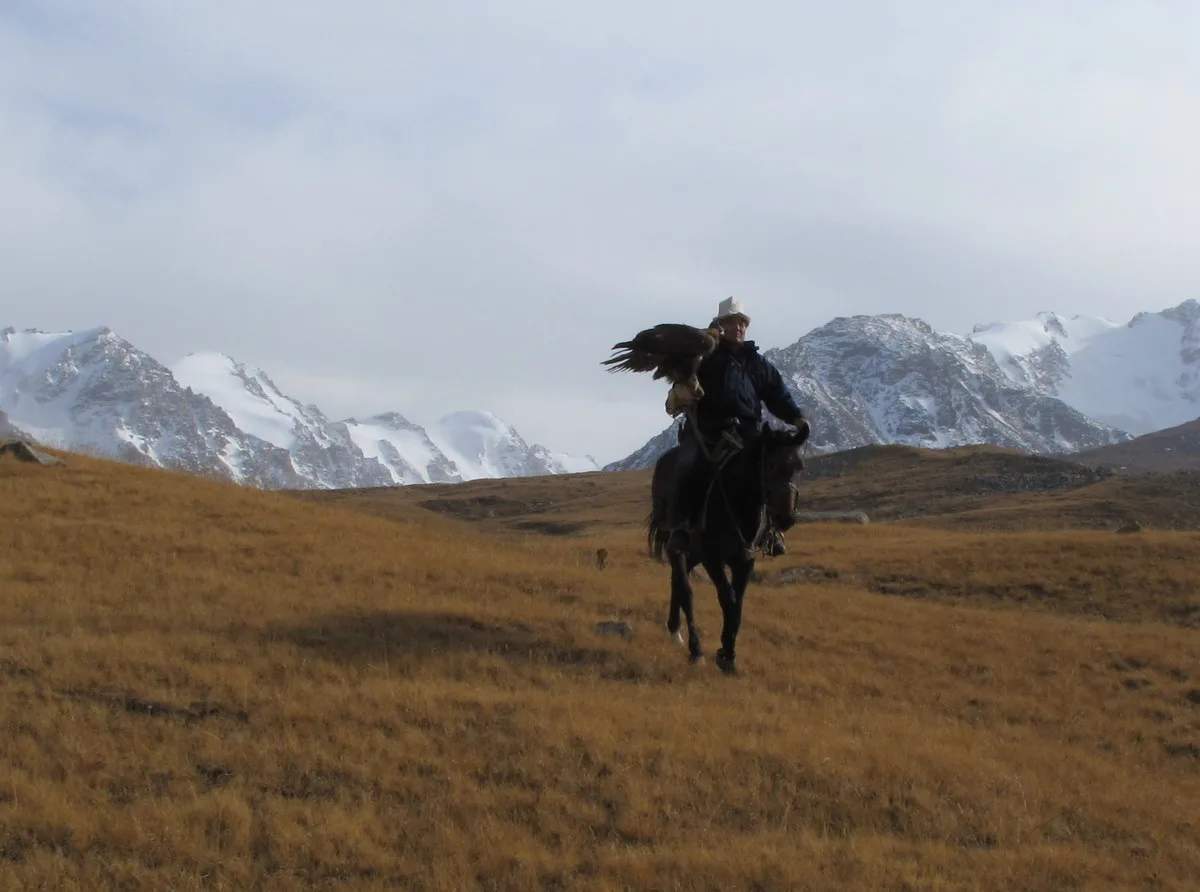 1/2. Golden eagle, horse and open mountain terrain Photo: Peretz Partensky, Wikimedia Commons, CC BY-SA 2.0; edited for this site.
 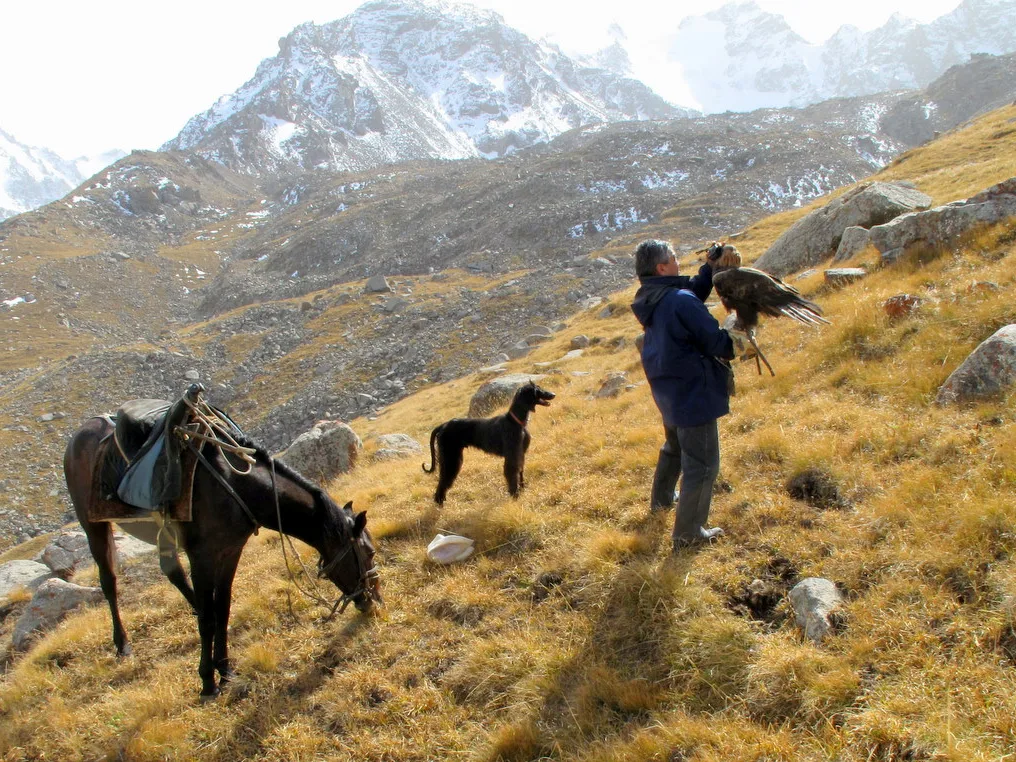 2/2. A break in the mountains above Issyk-Kul Photo: Peretz Partensky, Wikimedia Commons, CC BY-SA 2.0; edited for this site.
 Photography and safety
Ask the person first, then follow their instructions around the bird. Do not approach from behind, touch feathers, jesses or hood, or lean your face towards the beak. Children should remain with an adult at the distance set by the berkutchi. Keep dogs away from the demonstration area.
Do not use flash or launch a drone without explicit permission. Noise and an object above the eagle can alter its behaviour. For a flight, stand to the side of the line, set your shutter speed in advance and never run across the bird's path for a photograph.
Do not ask to hold the eagle simply because another visitor did. A golden eagle is heavy, and its talons are built for a powerful grip. If the berkutchi offers, put on the supplied glove, plant your feet and follow one instruction at a time. Both visitor and practitioner remain free to say no.
How to fit the encounter into a trip
A berkutchi encounter fits naturally into an Issyk-Kul circuit. On the south shore, combine it with Skazka Canyon, a night in a yurt camp or the Barskoon valley. Keep some slack in the day: the site may be off the main road, and wind can delay a flight.
Our own Kyrgyzstan itinerary places the encounter alongside landscapes and a family meal. That context makes it easier to see a working tradition linked to place, animals and family teaching rather than an isolated costume performance.
Frequently asked questions about berkutchi
Where is the easiest place to meet a berkutchi in Kyrgyzstan?
Bokonbaevo and nearby villages on the south shore of Issyk-Kul are the most accessible base. Arrange the encounter in advance through a community tourism office, guesthouse or operator.
Are a berkutchi and a falconer the same thing?
A berkutchi works specifically with a golden eagle. Falconry is the wider practice and includes other raptors. Tourism copy sometimes blurs the terms, so ask which bird will appear.
Does a demonstration use live prey?
It does not have to. A training flight can use a lure. If you do not want to see a live animal used, tell the organiser before booking and ask them to confirm the format.
Can I hold the golden eagle?
Only when the berkutchi offers and supervises it. You need the correct glove, a stable stance and close attention to instructions. You never have to accept for the sake of a photograph.
Can I film the eagle with a drone?
Only with direct permission from the berkutchi and organiser. A drone may alarm or distract the bird. The pilot must also comply with local flight rules and the distance set by the handler.
Why might a flight be shortened or cancelled?
Strong wind, heat, precipitation, fatigue or the bird's condition can make a flight unsafe. Cancelling for the welfare of the eagle and the safety of people is a normal professional decision.
Share on social media
If you found this guide useful, share it on social media. It takes a moment and helps more travellers discover the project. Thank you!
Anything to add?
Share your experience, leave a comment or suggest an improvement.