The lead photograph provides international context: it was taken in Türkiye. Kyrgyz competitions have their own disciplines and rules, explained below.
Contents:
- What jaa atuu means
- What counts as a traditional bow
- Three distinct formats
- How foot archery works
- Why horseback archery is harder
- Competition and Salbuurun
- What happens in a first lesson
- How to assess range safety
- Questions for an organiser
- Clothing, children and photography
- What to combine it with
- Frequently asked questions
Take your first shot only on the instructor's command: do not nock an arrow while anyone is near the targets, do not point a bow outside the safe sector and never release an empty string.
What jaa atuu means
Jaa atuu is Kyrgyz for archery. Today the term covers sporting contests, festival demonstrations, club practice and short introductory sessions for travellers. It is a living field with several rule sets, not a single frozen ritual.
A bow suited open mountain and steppe landscapes, where a person needed to travel light and act at a distance. The skill belonged to hunting and warfare before surviving in games, family memory and modern ethnosport. Related compact bows and shooting methods occur across Central Asia, so a shared design should not be claimed as the invention of one country.
For a visitor, the useful distinction is between a beginner lesson, a sporting contest and a staged show. A lesson needs clear commands and repeatable technique. A contest follows a published rulebook. A show may be spectacular without teaching you how to handle a bow safely.
What counts as a traditional bow
In tourist and festival settings, “traditional” usually describes a short, reflexed bow without a complex sight, stabilisers or cams. Historical composite bows combined several materials. A modern replica may use wood, fibreglass and synthetic adhesive: it preserves a form and shooting method without pretending to be a museum object.
The exact definition belongs to the event. One rulebook may restrict materials, another the shape, length, arrows or release method. “Traditional bows allowed” therefore tells you little about whether a specific model is eligible.
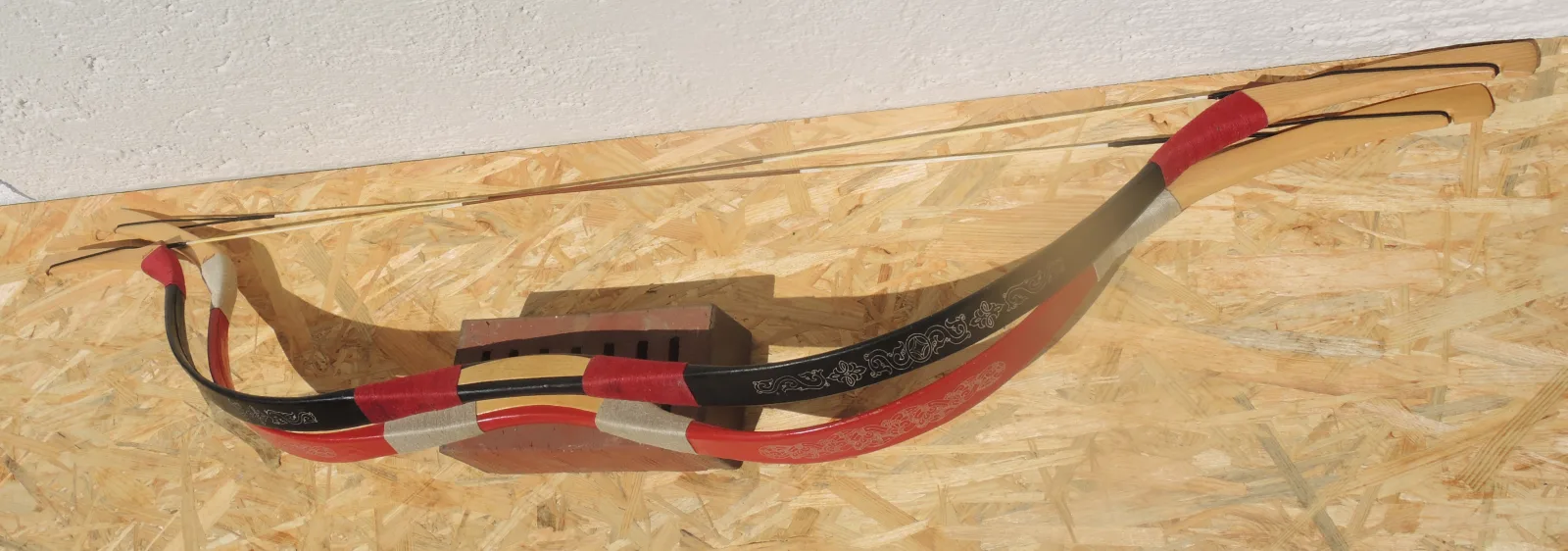 Modern short bows made for horseback archery. Photo: Monika Fischer, Wikimedia Commons, CC BY-SA 2.0; edited for this site.
For a beginner, fit matters more than decoration. A bow that is too heavy encourages a raised shoulder, a collapsing posture and string contact with the forearm. The instructor should choose the bow, arrows and protection, then check your form at short range.
Three distinct formats
A foot-archery lesson with an instructor
- Begins with commands, stance and movement before any arrow is released.
- The bow is matched to the participant and the range is kept short.
- This is the right choice if you have never shot before.
A foot-archery competition
- The rulebook sets the distance, target, number of arrows and time.
- Traditional-bow requirements vary from one discipline to another.
- A tourist lesson should not be measured against a competition round.
Shooting from a moving horse
- Requires an independent seat and reliable control of the horse.
- The track must be separated from spectators and other riders.
- Beginners start on the ground and establish their riding ability separately.
How foot archery works
Archers stand on one line and shoot only towards the targets. The instructor first demonstrates stance, hand position, nocking and a controlled draw. The participant then shoots a few arrows at close range. Everyone retrieves arrows together on a separate command, once the bows are clear.
Traditional archery uses several ways to grip and release the string. A beginner does not benefit from mixing them in one session. Repeat one clear sequence instead: set your feet, check the sector, nock, draw, aim, release and keep the bow facing the target.
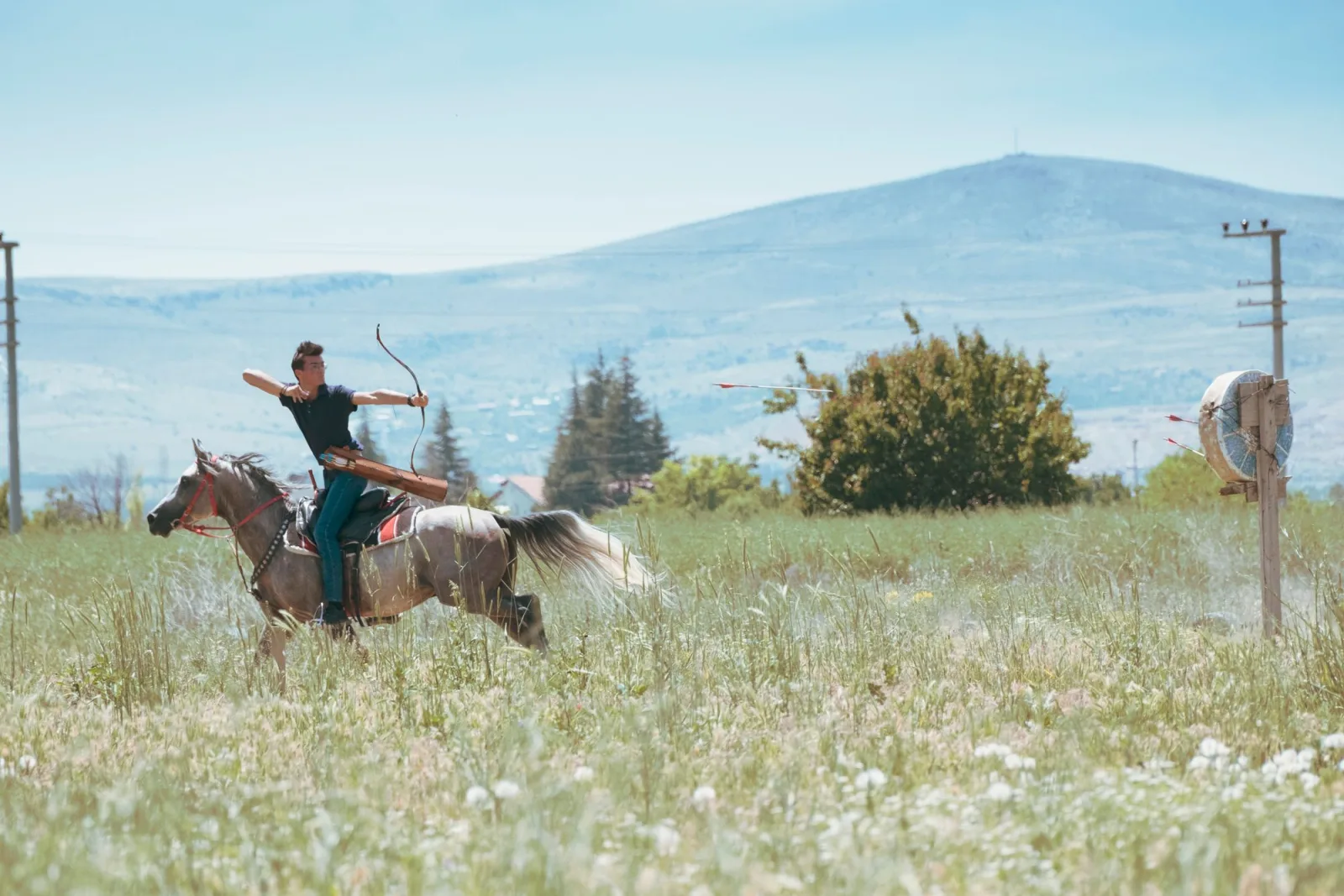 1/2. Horseback archery at a side target, Konya, Türkiye Photo: Necati Ömer Karpuzoğlu, Pexels, Pexels License; edited for this site.
 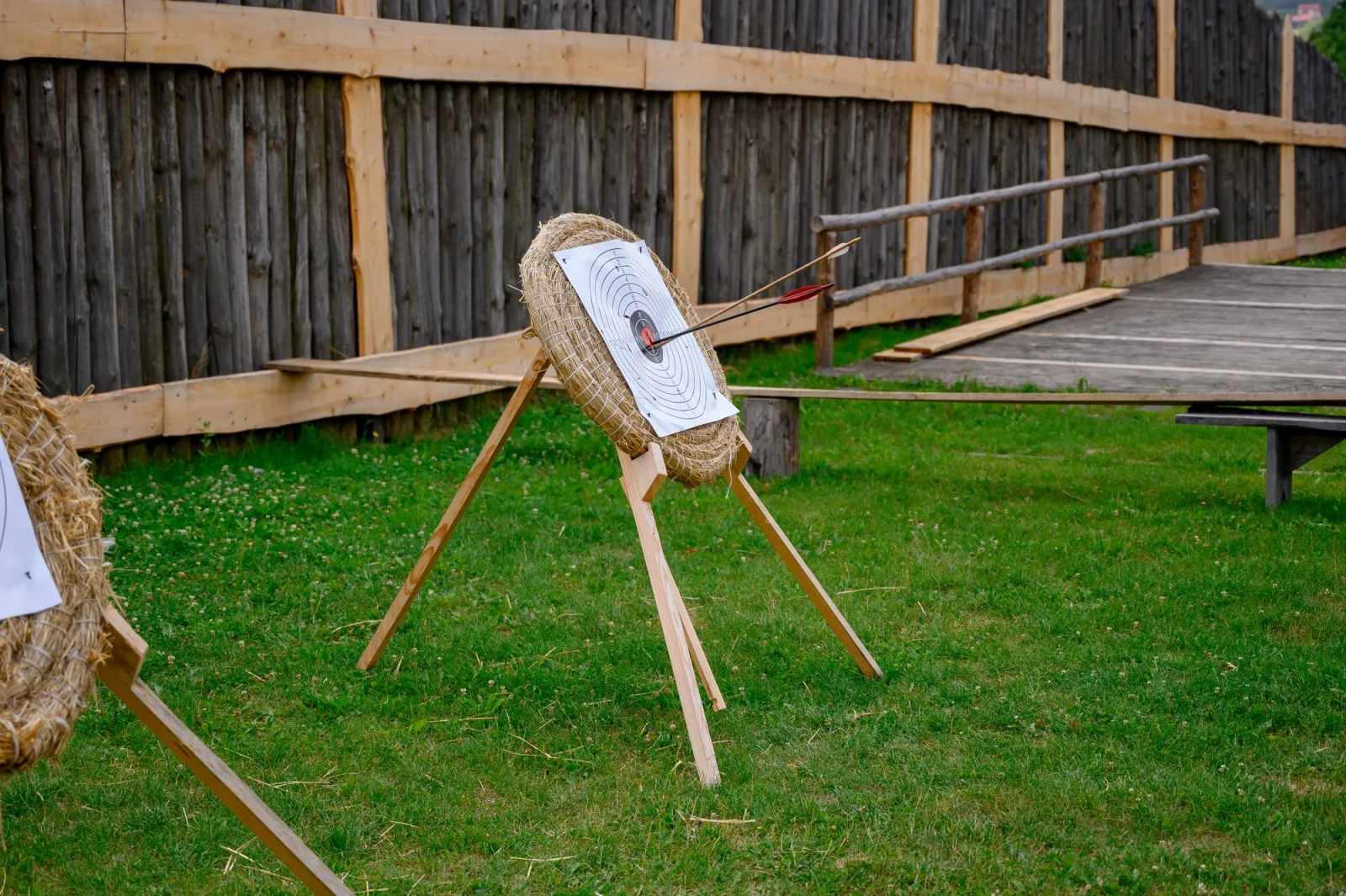 2/2. A target and stopping material on an outdoor range Photo: Meri Verbina, Pexels, Pexels License; edited for this site.
 Why horseback archery is harder
The rider must keep the horse on its line, stabilise the body and use both hands for the bow. Reins may not remain in their normal working position at the moment of the shot, so the horse needs to hold the track calmly while the rider manages speed and balance.
Safe instruction separates the skills. The participant first shoots on foot, then rehearses the movement on a fixed model or a quiet horse under close supervision. Progression to walk, trot or canter depends on actual riding ability, the horse's response and the range design, not on the wish to film an impressive clip.
Competition organisers build a separate lane and position targets along the course. The official Kyrgyz-style description for the 2026 World Nomad Games specifies a 100-metre track, 3 metres wide, but that is one competition rule. It is not a standard for a visitor's first session.
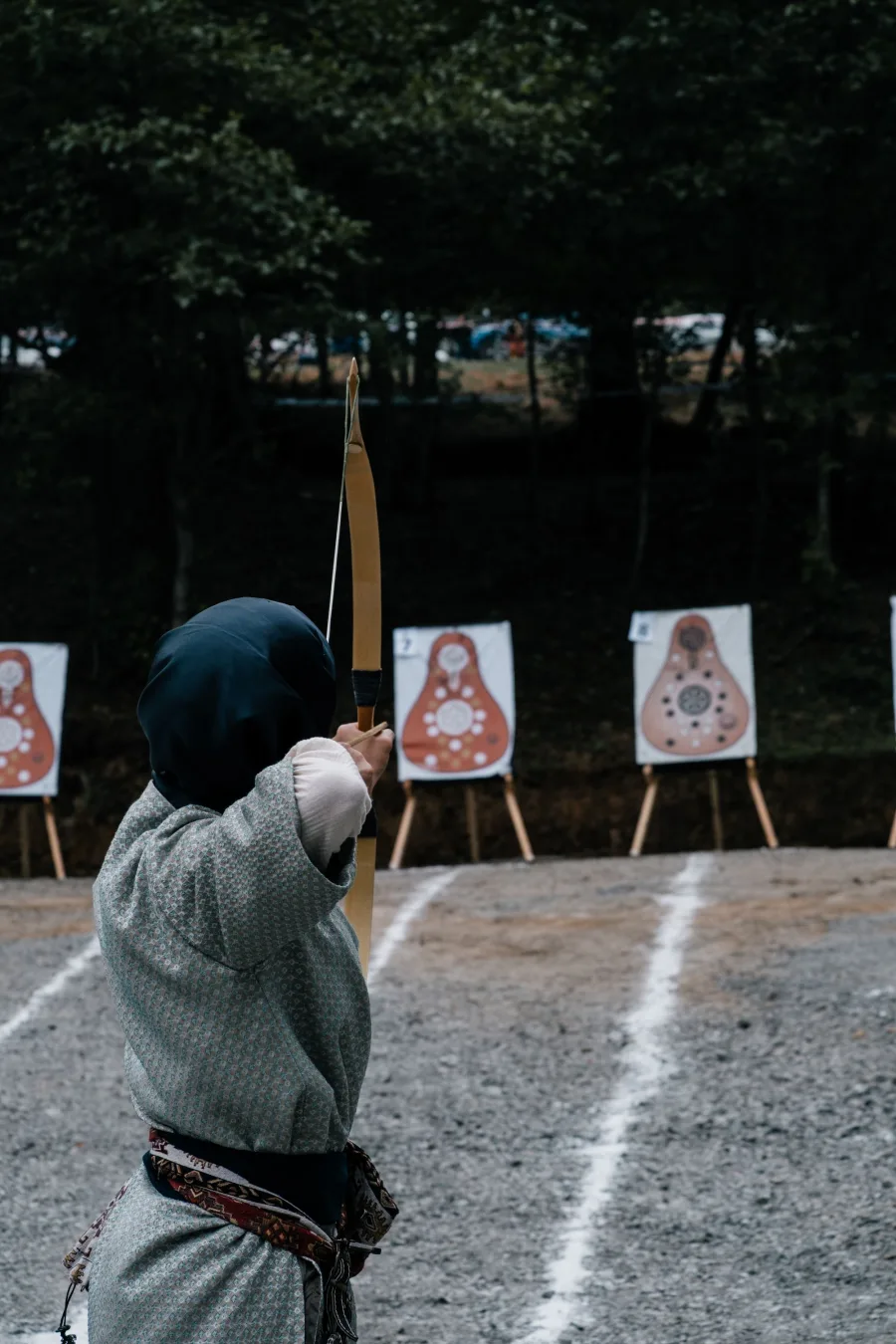 1/3. Traditional foot archery at a festival in Türkiye Photo: Semih Kukçu, Pexels, Pexels License; edited for this site.
 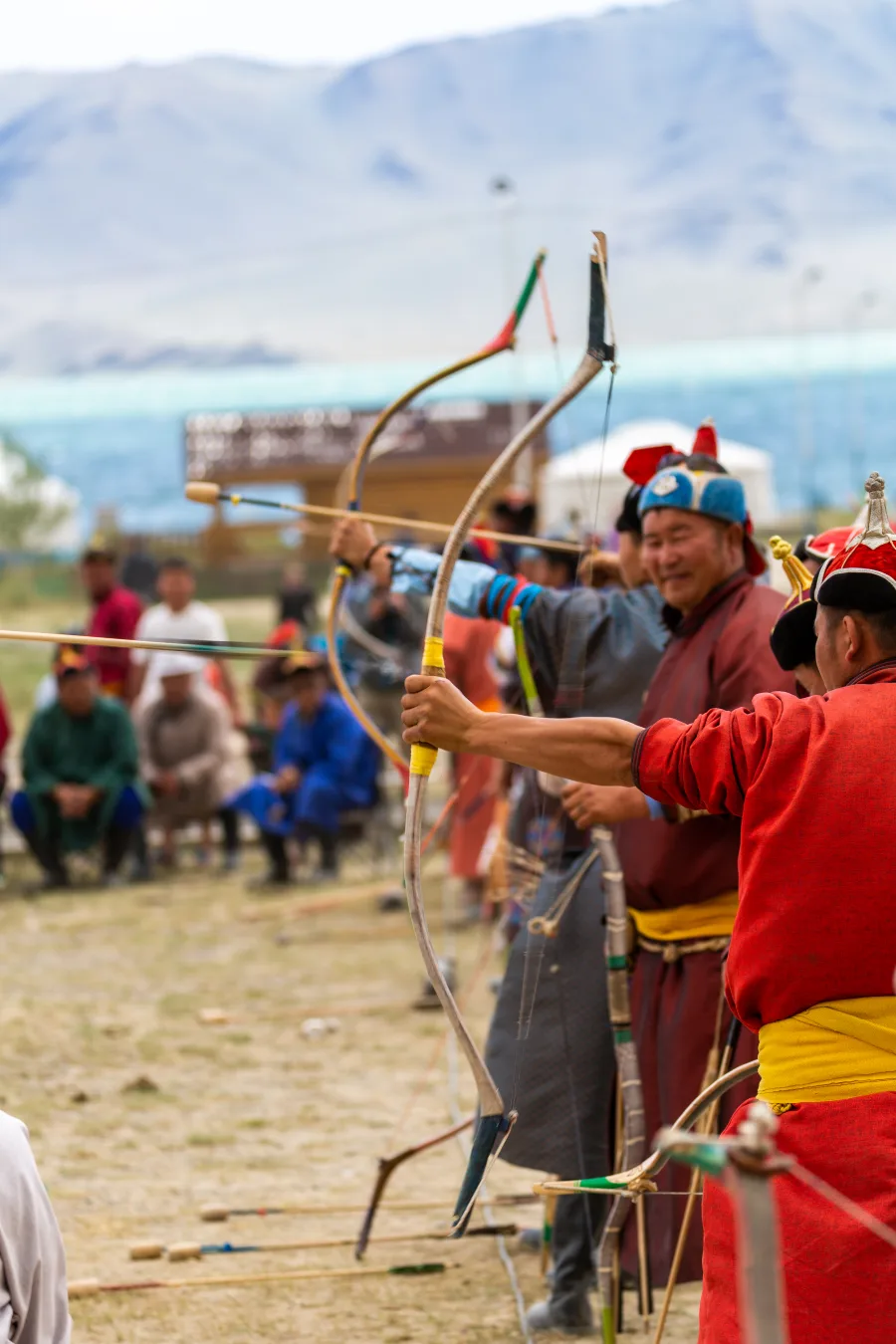 2/3. Mongolian archery competition in Bayan-Ölgii Photo: Bfreeproductions, Wikimedia Commons, CC BY-SA 4.0; edited for this site.
 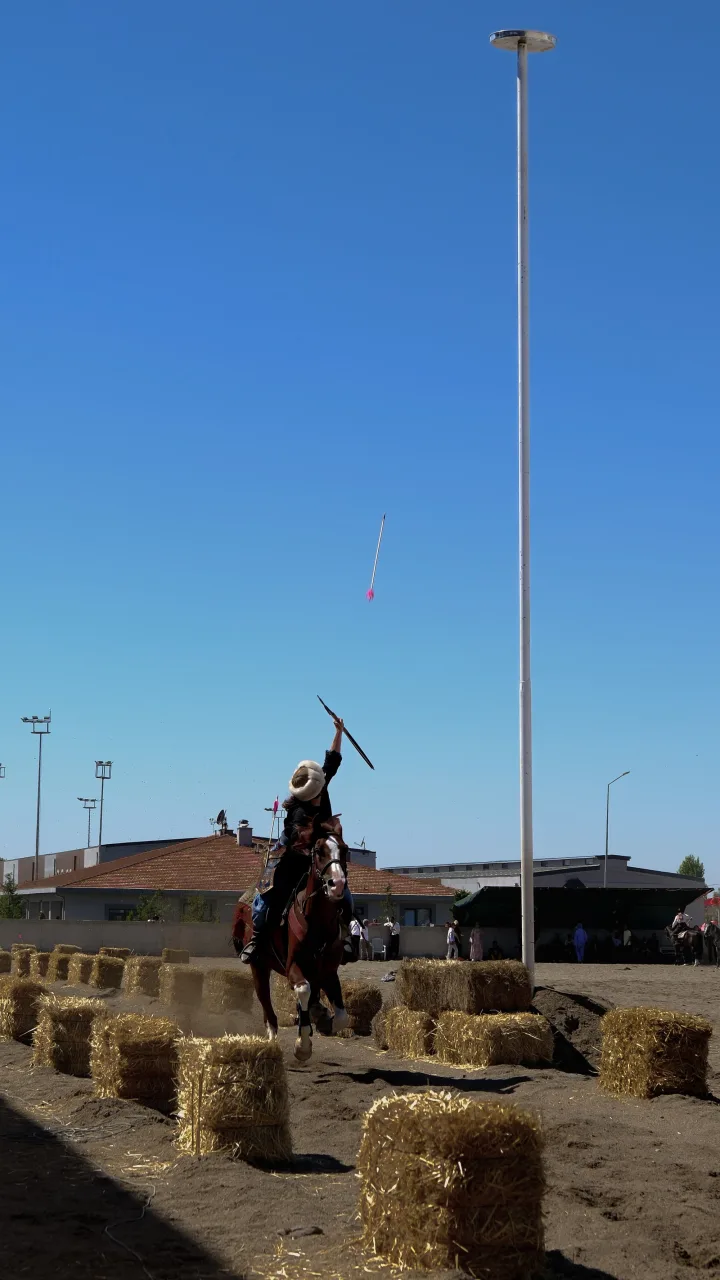 3/3. Festival exercise with a high target, Türkiye Photo: Alparslan Uzun, Pexels, Pexels License; edited for this site.
 Competition and Salbuurun
Kyrgyz sporting programmes may treat foot and horseback archery as separate disciplines. For example, the Teke Buta rules at the VI World Nomad Games use a 40-metre distance and a 50-centimetre target. Those figures describe trained competitors in one event, not a sensible beginner range.
The official World Nomad Games programme distinguishes traditional archery on foot from horseback archery and lists separate rules within each group. Disciplines and schedules change between editions.
Salbuurun is broader than archery alone. It brings together traditional hunting knowledge and modern competition, which may involve birds of prey, taigan sighthounds and bows. It should not be used as a complete synonym for jaa atuu.
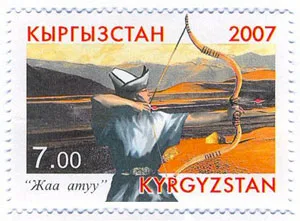
Kyrgyzstan postage stamp ‘Jaa atuu’, 2007. Image: Kyrgyzstan Post, Wikimedia Commons, public domain; edited for this site.
What happens in a first lesson
-
Inspect the range and learn the commands
The instructor identifies the shooting line, safe sector, waiting area and the signal that allows everyone to retrieve arrows.
-
Fit the bow and protection
The draw weight should allow calm repetition. Arm and finger protection must stay secure without obstructing the string.
-
Rehearse before shooting
Feet, torso, hands and the direction of the bow are checked before an arrow is placed on the string.
-
Shoot short sets
A few arrows leave time to correct form. The entire line walks forward only together and on command.
-
Stop before fatigue takes over
If shoulders rise, fingers lose control or the string begins striking the arm, pause and rebuild the movement.
A short lesson does not make someone an independent archer. It should leave you able to follow commands and repeat a basic sequence. Choosing your own bow, increasing the distance and progressing to horseback shooting require further instruction.
How to assess range safety
The shooting line needs one unmistakable boundary. Targets belong in a separate sector with reliable stopping material and clear space beyond. Spectators, children, animals, roads and footpaths must never cross the direction of fire.
The bow, string and every arrow should be checked before a set. A cracked shaft, damaged fletching or loose point is removed. An arrow is nocked only on the line and only when the sector is clear. Do not “test” an empty bow by releasing the string: a dry shot can damage equipment.
The World Archery beginner manual explicitly prohibits dry firing, requires a drawn bow to face a clear target and sends archers forward together on command. These are sensible minimums for a visitor range even when the session is not Olympic archery.
Leave the range if: people walk behind targets while shooting continues, bows are drawn upwards or sideways, arrows are issued without inspection, or commands are drowned out by music, crowds or moving horses.
Questions for an organiser
- Who teaches the session: an instructor should control the line throughout, not simply hand over a bow.
- How many people shoot at once: a large group needs assistants and a separate waiting area.
- How the sector is separated: ask for a photograph of the range when booking remotely.
- What equipment is included: confirm bow, arrows, arm and finger protection, plus a horse and riding helmet for a mounted format.
- What happens in wind or after an equipment fault: a responsible organiser shortens, adjusts or cancels the session.
- What experience is required: “suitable for everyone” does not replace limits based on size, ability to follow commands and riding level.
Prices, duration and age conditions belong to the individual range. Confirm the total group price, number of sets, language of instruction and cancellation terms before paying. Competition age categories are not universal admission rules for tourists.
Clothing, children and photography
Wear closed, stable footwear and clothing that cannot catch the string. Remove or secure loose scarves, wide sleeves, long cords, bracelets and hair. For a mounted session, the range's helmet and footwear requirements matter more than a costume for photographs.
There is no universal safe age for a child. The organiser must assess whether the child can hold a training bow, follow commands and wait behind the line. An adult should remain nearby, but should not reach in to correct the child's arms at full draw without the instructor's direction.
Photograph from behind or beside the line, at the position chosen by the instructor. Never ask an archer to turn a drawn bow towards the camera or step near the target for a better angle. Agree drone, flash and close-up photography in advance, particularly around horses.
Traditional Archery (Kyrgyzstan) pictogram. Image: Абдырашит Сатылганов, Wikimedia Commons, CC BY-SA 4.0; edited for this site.
What to combine it with
On the southern shore of Issyk-Kul, archery may appear alongside other elements of nomadic culture. Start with our guide to meeting a berkutchi: Salbuurun can bring these skills into one programme, but each has its own purpose and safety requirements.
Our pages on the Kyrgyz yurt, the ak-kalpak and nomadic culture in Kyrgyzstan add material context. If an organiser sells an “ethno day”, ask for a timed sequence. Archery needs a calm, controlled range and should not be squeezed between a horse show and a queue for portraits.
Frequently asked questions about traditional archery
Can I try archery for the first time without an instructor?
No. A first session should use a closed range and an instructor who controls the shooting line, selects the bow and gives the command to retrieve arrows.
How does a traditional bow differ from an Olympic recurve?
Traditional disciplines usually use a short reflex bow without a complex sight or stabilisers. The exact definition depends on the competition rules, and a modern replica may include synthetic materials.
What is Teke Buta?
Teke Buta is the name of a Kyrgyz competition target and its traditional-archery rule set. At the 2026 World Nomad Games, the discipline uses a 40-metre distance and a target 50 centimetres across.
Can a beginner start by shooting from a horse?
It is safer to learn the bow on foot and establish confident riding separately. The instructor, horse and range determine any progression to walk, trot or canter.
Do Salbuurun and jaa atuu mean the same thing?
No. Jaa atuu means archery. Salbuurun covers a wider complex of traditional hunting knowledge and competitions that may involve bows, birds of prey and taigan sighthounds.
How can I tell whether a range is safe?
Look for one shooting line, a separated target sector with stopping material, clear space behind it and a single command system. Arrows are inspected, and everyone retrieves them together after the signal.
Share on social media
If you found this guide useful, share it on social media. It takes a moment and helps more travellers discover the project. Thank you!
Anything to add?
Share your experience, leave a comment or suggest an improvement.