Contents:
What a boz üi is
Boz üi is the Kyrgyz name for the round portable dwelling usually called a yurt in English. Its wooden frame separates into manageable pieces, while the felt covers and ropes can be rolled for transport. The system supports seasonal movement between pastures without building a new house at every camp.
A yurt is more than a museum object. It is a structure, a collection of craft skills and a setting for family life. Size, layers, woven bands, decoration and interior arrangements vary. A lavish restaurant yurt therefore no more represents every Kyrgyz yurt than a city mansion represents every house.
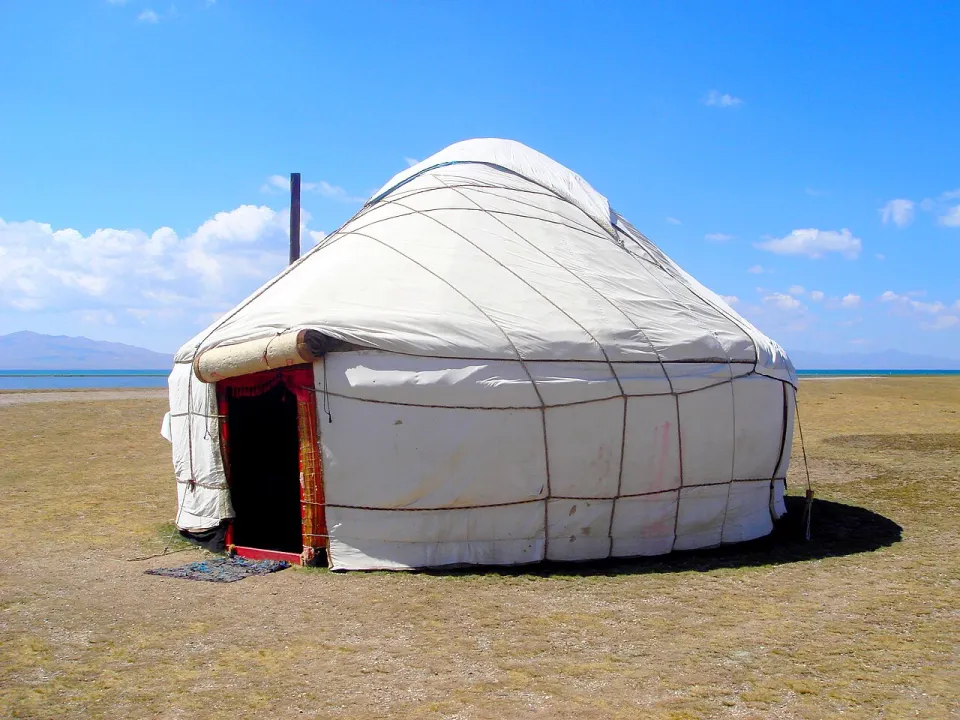 1/3. A portable dwelling on high summer pasture Photo: Ondřej Žváček, Wikimedia Commons, CC BY-SA 3.0; edited for this site.
 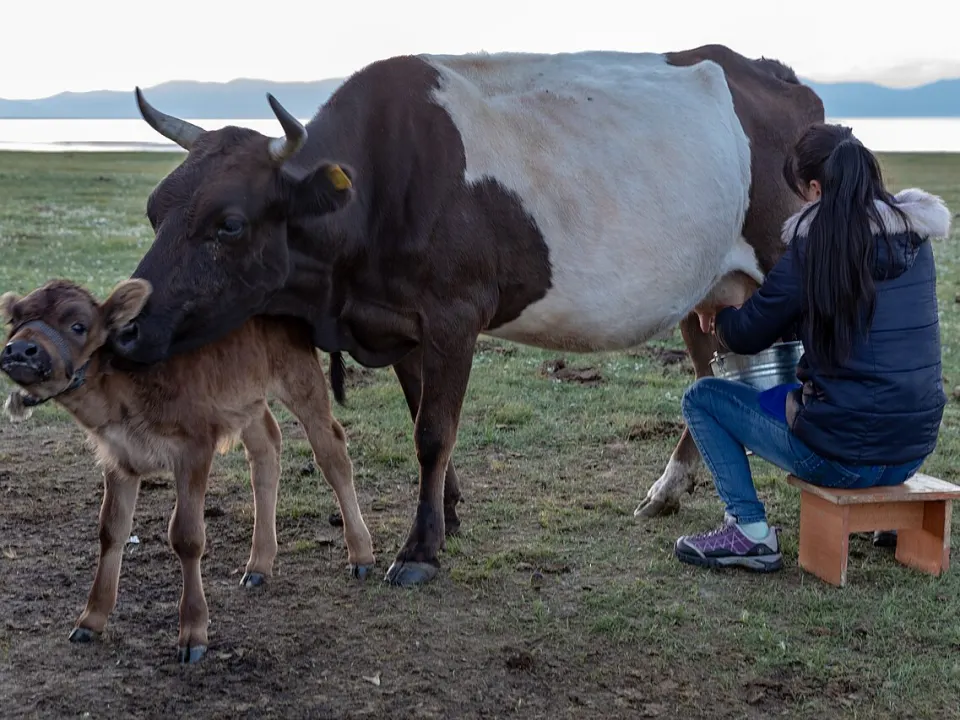 2/3. Daily work beside a summer camp Photo: Ninara, Wikimedia Commons, CC BY 2.0; edited for this site.
 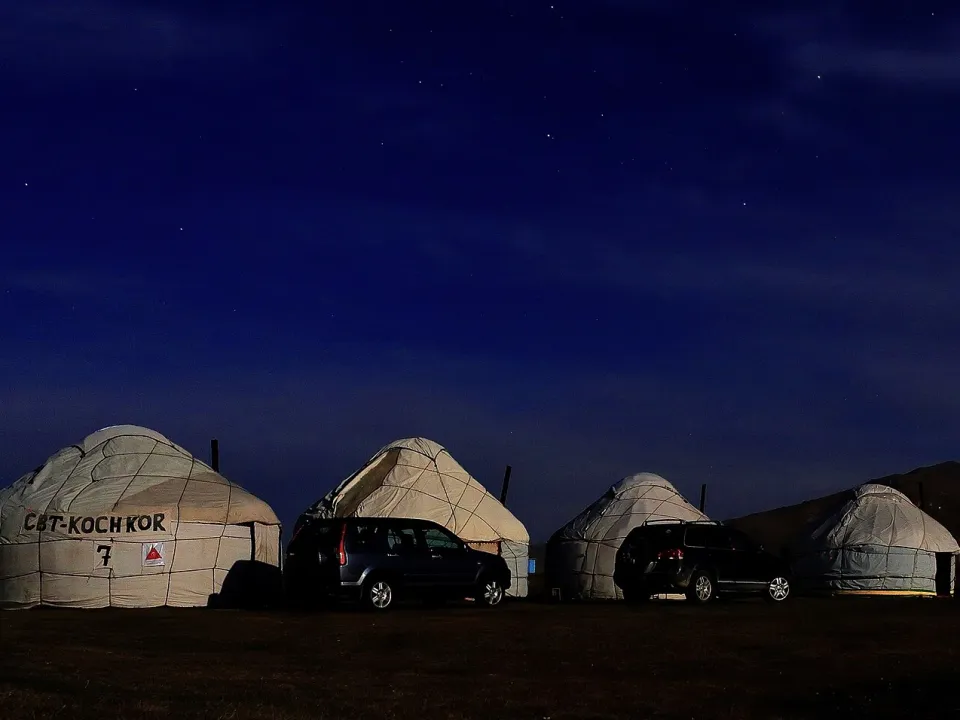 3/3. A modern yurt camp at night Photo: Thomas Depenbusch, Wikimedia Commons, CC BY 2.0; edited for this site.
 The parts of a yurt
Kerege form the circular lattice wall. Several folding sections are opened, joined and closed around the door frame. The lattice sets the diameter but still collapses for transport.
Uuk are the curved roof poles. Their lower ends attach to the kerege and their upper ends fit into the wooden crown. The repeated poles create the familiar domed outline.
The tündük is the wooden ring at the centre of the roof. It receives the upper ends of the uuk, leaves an opening for daylight and ventilation, and allows smoke to escape when a hearth or stove is used. A tündük forms the centre of the flag of Kyrgyzstan.
Bosogo is the doorway frame to which the kerege sections are joined. Mats and felt covers go over the walls and roof. Woven bands and ropes connect the parts and hold the structure under tension around its circumference.
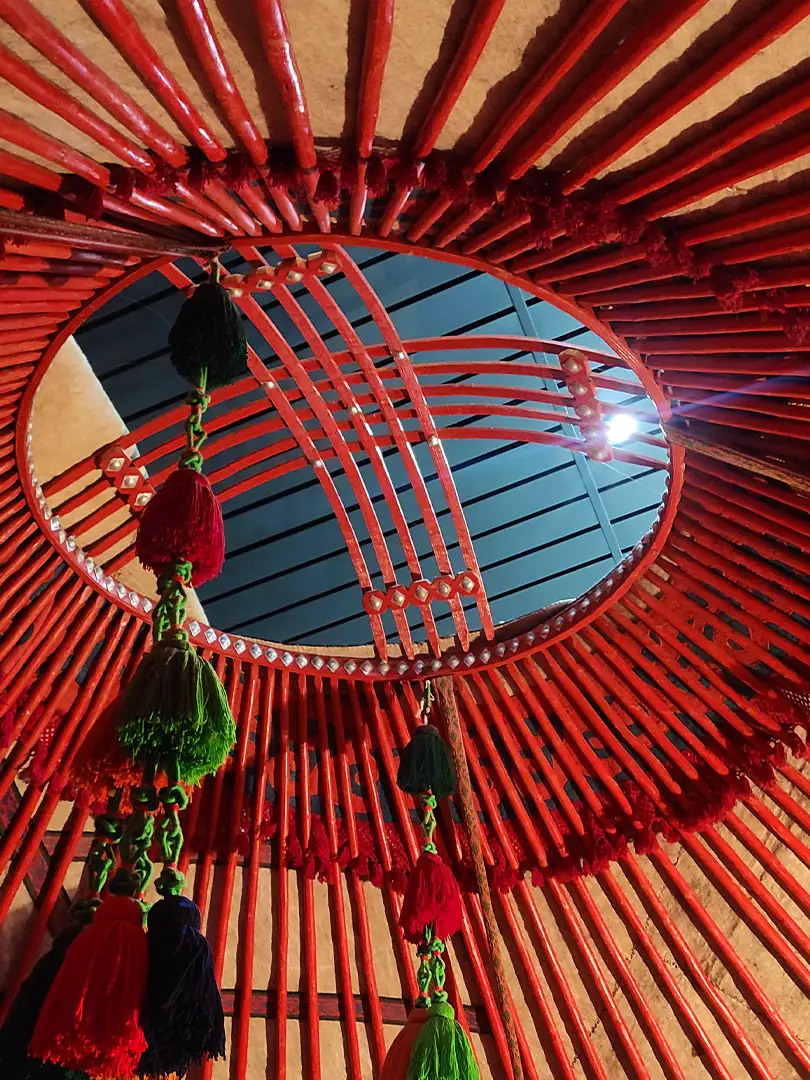
Look at the joints. From outside, a yurt reads as one solid felt volume. Inside, its stability is easier to understand: a lattice, roof poles, crown and tension bands work as one connected system.
How a yurt is assembled
The exact order varies with size and local practice, but the underlying logic remains the same. The wall circle and doorway come first, the roof rises next, and the frame is then covered and tied. A large yurt needs several people because the tündük must remain supported while roof poles are added around it.
-
Open the kerege
The folding lattice sections are stretched around a circle, joined together and tied to the doorway frame.
-
Raise the tündük
The crown is held on a support pole at the centre while the roof is still open.
-
Fit the uuk
Roof poles are tied to the kerege in sequence and their upper ends are inserted into the tündük.
-
Cover the frame
Mats and felt sections are laid over the wall and roof while the top opening remains adjustable.
-
Tension the ropes
Bands and ropes secure the covers, bind the structure around its circumference and keep wind from lifting the felt.
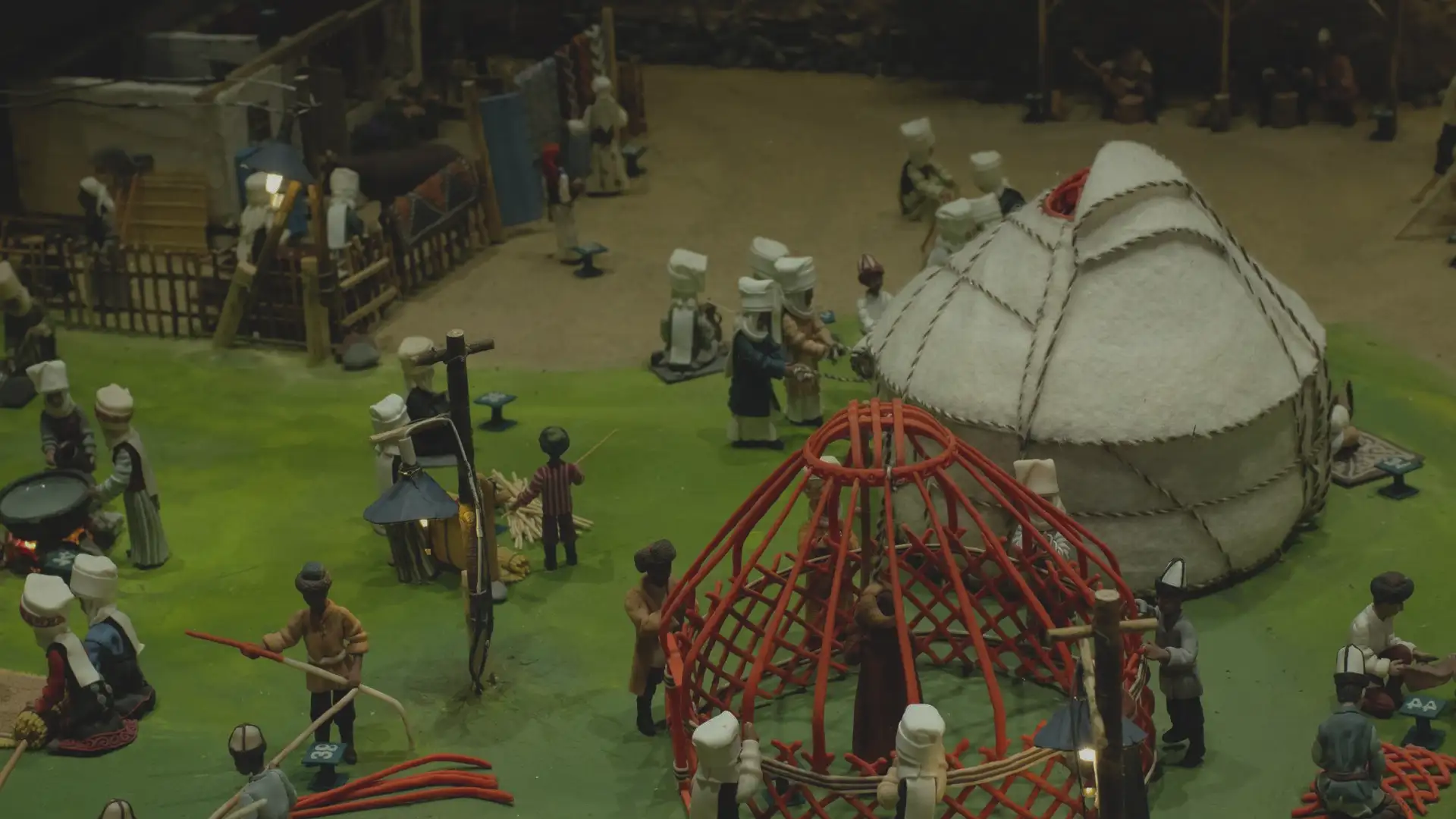
This miniature at the private Supara complex makes the frame easy to read, but it remains a model. Watching an experienced team assemble a full-size yurt reveals the order of tensioning, the teamwork and the small knots that a miniature cannot show.
Who makes the frame, felt and decoration
The main materials belong to a pastoral and mountain environment: wood for the frame, sheep's wool for felt, plus leather, fabric and fibre for fastenings and decoration. Readily available materials do not make the yurt a simple project. Poles need the right curve, the tündük must hold its geometry, and large felt covers cannot afford weak seams.
UNESCO describes a traditional division of skills in which men and their apprentices make the wooden frame and details from wood, leather, bone and metal. Women produce outer covers and interior decoration through felting, weaving, spinning, braiding, sewing and embroidery. A workshop today may organise its work differently, but the range of skills explains why one yurt embodies the labour of many people.
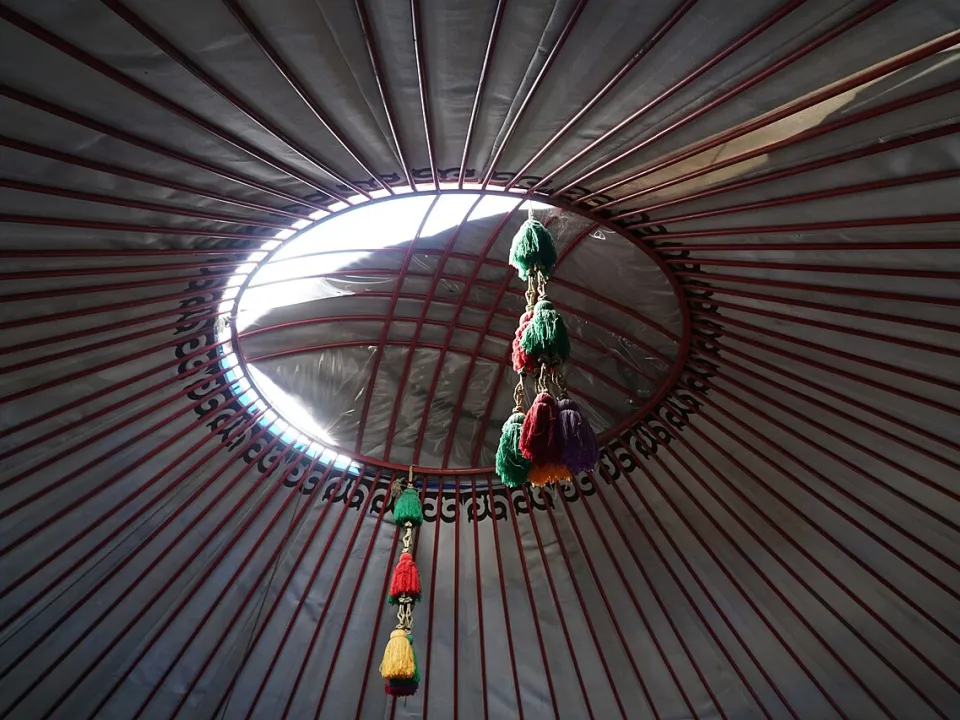 1/3. The tündük and uuk form the roof Photo: Adam Harangozó, Wikimedia Commons, CC BY-SA 4.0; edited for this site.
 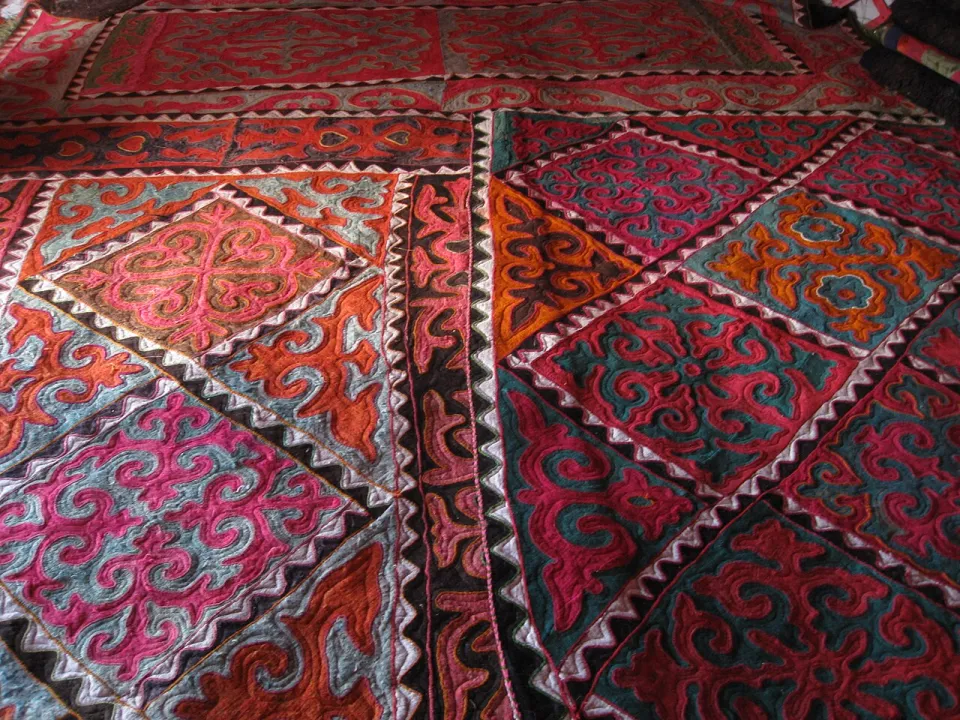 2/3. Shyrdak rugs used on the floor and around the interior Photo: surrealpenguin, Wikimedia Commons, CC BY-SA 2.0; edited for this site.
 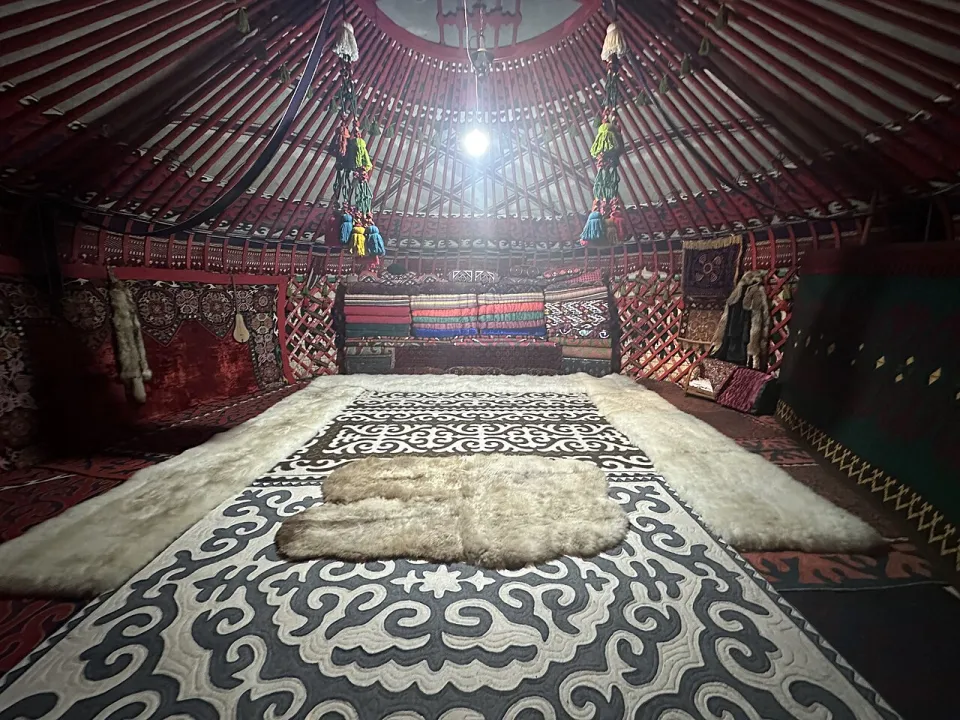 3/3. A contemporary display yurt in Kyrgyzstan Photo: Incall, Wikimedia Commons, CC BY-SA 4.0; edited for this site.
 How the interior works
The circular form does not create separate rooms. Bedding, chests and textiles line the kerege, leaving the middle open for movement, a shared meal and, in a traditional household, a source of heat. The place of honour is commonly opposite the door, although the exact arrangement depends on the family and the yurt's purpose.
Shyrdak and ala kiyiz rugs, woven bands, storage bags and hanging textiles do more than decorate. They cover the frame, insulate the floor, hold belongings and organise one open space into recognisable areas. Not every motif carries one timeless meaning, so ask about the maker, technique and history of the specific piece instead of relying on a souvenir legend.
Why yurt-making is living heritage
Knowledge and skills involved in making Kyrgyz and Kazakh yurts entered UNESCO's Representative List of the Intangible Cultural Heritage of Humanity in 2014. In 2025, the shared element was extended to include the Karakalpak tradition in Uzbekistan. The UNESCO entry describes the yurt as a symbol of family history, identity and social cohesion.
The intangible heritage is not the wood and felt alone. It includes choosing materials, making parts, assembly, repair, decoration and passing knowledge to children and apprentices. A yurt made today can continue that heritage as meaningfully as an old example in a museum.
How yurts are used today
Yurts still appear on summer pastures, at family celebrations and public events. Craftspeople continue to make frames, tündük crowns, felt and decorative bands. In towns, restaurant and exhibition yurts may be enlarged considerably or integrated into a permanent building.
A tourist camp adapts the recognisable form for overnight guests. A yurt may have a timber floor, standard beds, electric light and a stove, while toilets and showers usually stand elsewhere. Contemporary accommodation is designed around guests' comfort while still letting them see the frame and experience a round, single-room space.
What to check before an overnight stay
The word “yurt” describes the shape of the accommodation, not its comfort level. Before paying, ask:
- whether there is a stove or other heating and who tends it at night;
- how many beds are inside and whether extra blankets are provided;
- whether the yurt has a solid floor, electricity and a charging socket;
- where the toilet and shower are and whether hot water is available;
- whether meals are included and dietary requirements can be handled;
- how many yurts share the camp and how much sound carries through felt walls.
In the mountains: warm summer sunshine does not guarantee a warm night. Temperatures fall quickly at altitude, while rain and wind deepen the chill. Pack your own warm layer even when a stove is promised.
In a family yurt, follow your host's lead. Ask where to leave shoes and get permission before photographing people or personal belongings. A tourist camp may have simpler rules, but the principle of respecting someone else's space remains the same.
Where to see yurts in Kyrgyzstan
At Son-Kul. Summer camps around the high-altitude lake combine a yurt stay with an open pasture landscape. Season, pass conditions and questions for a camp are covered in our Son-Kul guide.
In museums and cultural complexes. These are convenient places to study the frame, crown, textiles and household objects at leisure. Distinguish between an old artefact, a contemporary craft piece and decorative staging. Our guide to museums in Kyrgyzstan gives useful starting points.
In a craft workshop. The richest visit is one where you can watch work and ask precise questions: who bent the uuk, who made the tündük, which wool became the cover, how long the frame has served and how it is repaired. The yurt then becomes visible as a collaboration between people rather than a generic travel symbol.
Share on social media
If you found this guide useful, share it on social media. It takes a moment and helps more travellers discover the project. Thank you!
Anything to add?
Share your experience, leave a comment or suggest an improvement.