Contents:
Why Gapar Aitiev matters
Aitiev is described as one of the founders of professional visual art in Kyrgyzstan. The phrase means more than the quality of his paintings. Art education, public exhibitions, theatre workshops and a professional artists’ union were taking shape in the republic during the 1930s. Aitiev participated in every part of that process as a student, exhibitor, stage designer, organiser and later a mentor to art-school graduates.
Landscape became his central genre. Other painters, including Semyon Chuikov and Vladimir Obraztsov, had already worked with Kyrgyz mountains, valleys and lakes. Aitiev’s achievement was not to discover the country’s scenery for painting, but to develop his own spatial language: broad planes, exact tonal relationships and a measured rhythm. A road, herd, field or house belongs to the landscape as evidence of inhabited land.
He also made portraits, designed for the theatre and worked in monumental painting and sculpture. Those fields complicate the familiar image of a specialist in mountain views. The useful question is therefore not how many titles Aitiev received, but how one artist helped construct both a visual image of the country and a professional environment for those who followed.
Töleikon and the first drawings
Gapar Aitiev was born on 28 September 1912 in Töleikon, now part of Kara-Suu District in Osh Region. Russian and English sources render the village as Tüleyken, Tuleiken and Toleikan. It lies on the southern edge of modern Osh, close to the Ak-Buura valley.
Accounts of his childhood often become a polished legend about a boy drawing in charcoal on a wooden board. The documented route is more useful. Aitiev entered the education system early, spent time in a boarding institution, moved to Frunze and studied in a small art studio led by Vladimir Obraztsov. Drawing became a discipline that could be learned methodically, rather than a private talent without a profession attached to it.
He graduated from the Kirghiz Institute of Education in 1932. For the next two years he taught history and social studies at a teacher-training college in Jalal-Abad. Before attending an art college in Moscow, he had already worked as a teacher inside the republic’s new educational network.
Training in Frunze and Moscow
Aitiev took part in the first republican art exhibition in Frunze in 1934. He showed early portraits including Portrait of My Father, Collective Farm Secretary Imangazy and Girl from the South. These were the works of a young artist, but the exhibition placed him inside a public artistic culture rather than a private studio.
From 1935 to 1938 he studied at Moscow’s 1905 Art School. His teachers included the landscape painters Nikolai Krymov and Pyotr Petrovichev. The school gave him academic drawing, a precise understanding of tone and a habit of working directly from observed nature. Those skills did not replace his southern experience. They gave him the means to turn it into a professional visual language.
After returning to Frunze, Aitiev did not simply transplant Russian landscape painting and change the place names. He adapted its discipline to a higher horizon, dry air, hard light, the mass of the Tian Shan and the working life of valleys. The resulting pictures can be recognised by the construction of space, not merely by a decorative national motif.
From portrait to landscape
During the 1930s Aitiev made portraits and scenes of collective life. Titles such as Collective Farmers at Rest, Athletes and The Farmhand at the Bai’s Household speak directly in the vocabulary of their period. Portraits explored new public identities, while Boat on a Lake from 1939 and Yurts from 1940 already pointed towards landscape.
After the war, that direction became dominant. In Collective Farm Yard from 1946, work and land still share the picture equally. In later paintings, people and buildings grow smaller while the relationship between earth, water, sky and light carries more of the meaning.
The stages are visible in titles: Noon on Issyk-Kul, the Kyrgyz Land series, Autumn in the Chüy Valley, The Outskirts of Andijan, Evening in Southern Kirghizia, Tandyr in the Field and Morning in the Mountains. They move between north and south, high country and cultivated ground. Aitiev never reduced Kyrgyzstan to a single postcard view.
War and post-war work
Aitiev served in the Red Army during the Second World War, fought in the Battle of Stalingrad and was wounded. The experience entered his painting without producing a cycle of heroic battle scenes. Letter from the Front, painted in 1943, concentrates on people waiting at home and the news that has reached them.
After his return he resumed both artistic and organisational work. Museum and municipal biographies record long periods in which he chaired the Artists’ Union of the Kirghiz SSR. During the 1950s he worked on major landscape cycles while also contributing to the decoration of public buildings.
Official recognition was extensive. Aitiev became a People’s Artist of the USSR in 1971, a corresponding member of the USSR Academy of Arts in 1973 and a Hero of Socialist Labour in 1982. Those distinctions establish his public status, but they explain much less about the paintings than their composition and colour do.
How to look at Aitiev’s landscapes
Begin with the distance between planes rather than with the mountain itself. Aitiev often organises a painting in horizontal bands: earth or water in the foreground, fields and settlement beyond, then mountain mass and sky. Scale emerges without theatrical drama because every layer has its own weight and colour.
Next, locate the signs of human presence. They can be tiny: a road, herd, house, tandyr or haymakers. These details do not turn nature into a backdrop for a story. They show a landscape being used, altered and marked by work.
Finally, compare north and south. In Issyk-Kul views, water, distant shore and cool aerial perspective carry the composition. Southern landscapes tend to feel denser and warmer, more closely tied to fields and settlements. Light, relief and colour temperature create the distinction, rather than a collection of exotic symbols.
Portrait, theatre and sculpture
Aitiev continued to portray contemporaries after landscape became his main field. His sitters included the poet Alykul Osmonov, singer Musa Baetov and the craftswoman A. Bekboeva. A portrait was more than the record of a famous face: dress, posture and a restrained setting helped define the person’s work and character.
His practice also extended beyond canvas. Before the war Aitiev designed productions for the Kirghiz Music and Drama Theatre, including Toktogul. In the early 1950s he helped decorate the opera and ballet theatre in Frunze and worked on the painted ceiling of its auditorium.
In sculpture he made portraits and public monuments. Important examples include a 1965 wooden image of the manaschi Sayakbay Karalaev and the monument to Toktogul Satylganov installed in Frunze in 1974. Moving from a painted likeness to a carved or monumental form shows how readily Aitiev changed material and scale.
The artist and the art system
Aitiev led the professional artists’ organisation for many years. The position concerned exhibitions, studios, commissions and relations with state institutions. His influence therefore cannot be measured only by the number of his canvases: he helped determine the conditions available to other artists and how Kyrgyz art was presented beyond the republic.
From 1977 he directed an advanced painting workshop of the Academy of Arts in Frunze. Its members were graduates who already possessed technical training but needed an independent professional environment. This work connected Aitiev with a later generation, including artists who moved beyond the narrative conventions of early Soviet painting.
It also reveals a productive tension in his legacy. Aitiev worked inside the Soviet cultural system, accepted public commissions and represented contemporary life in its official vocabulary. Yet his strongest landscapes are not exhausted by their ideological captions. Space, tone and sustained observation continue to function after the original political setting has disappeared.
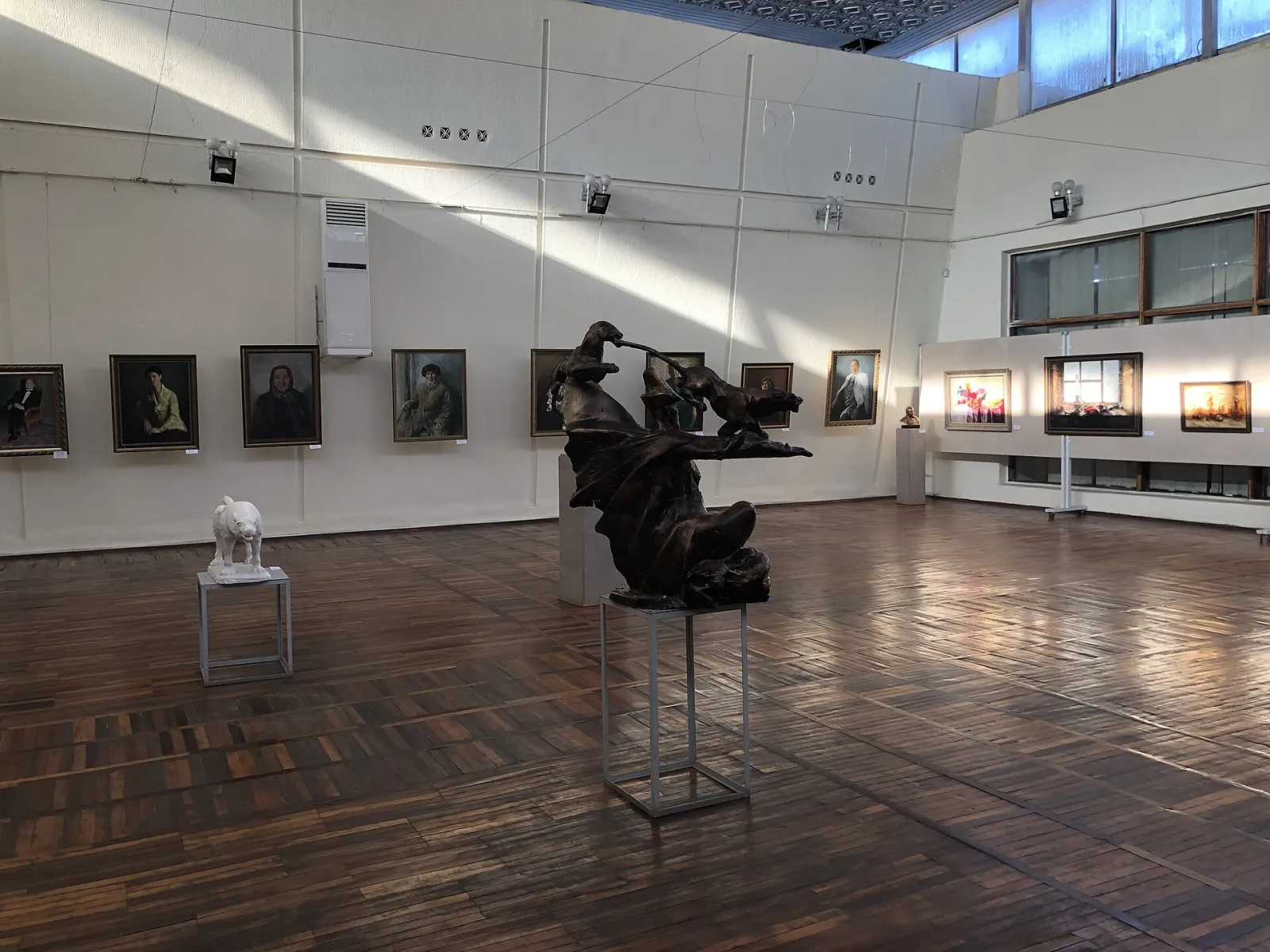 1/3. Painting and sculpture share the museum gallery Photo: Davide Mauro, Wikimedia Commons, CC BY-SA 4.0; edited for this site.
 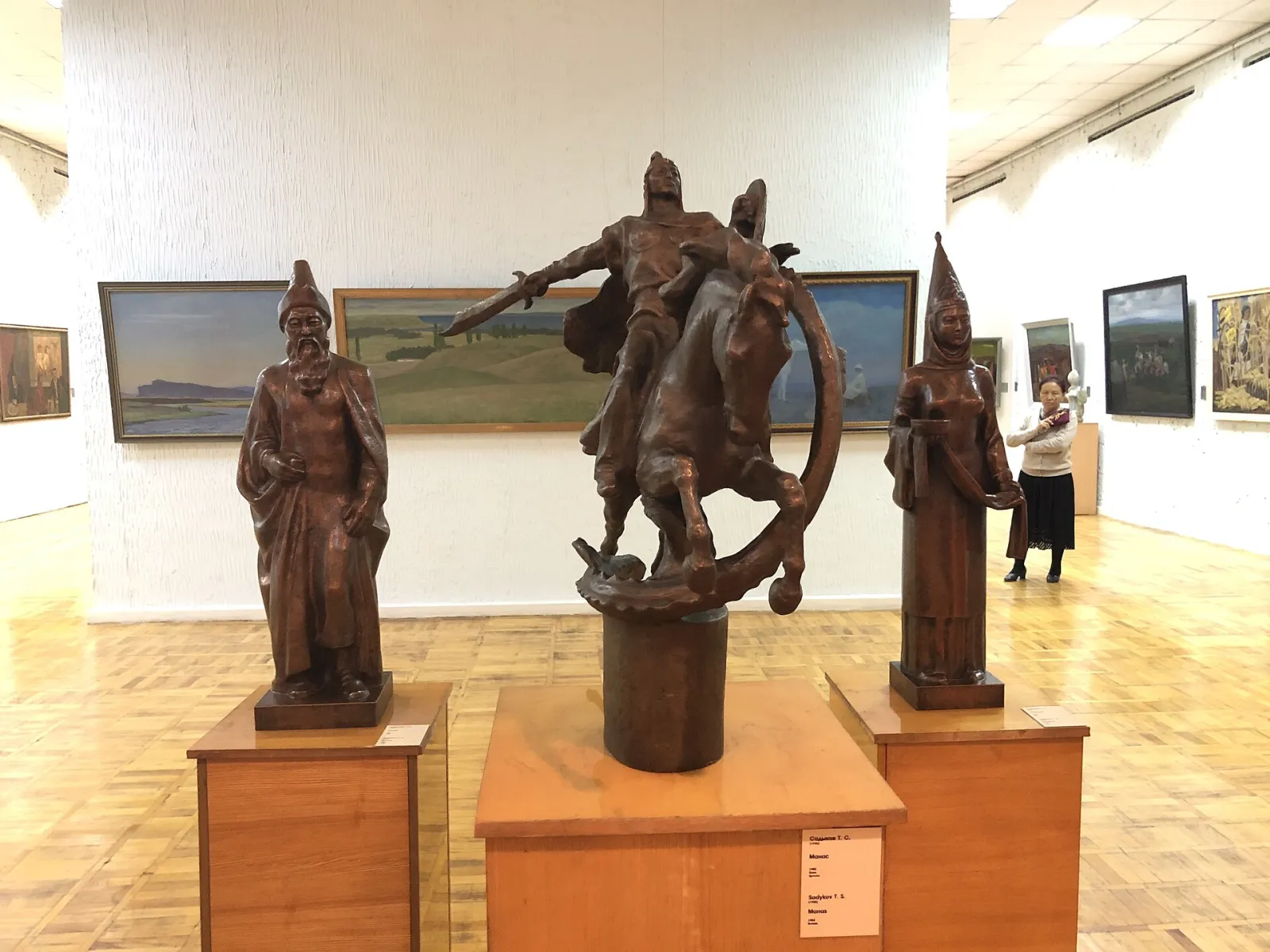 2/3. The museum spans several generations and media Photo: Davide Mauro, Wikimedia Commons, CC BY-SA 4.0; edited for this site.
 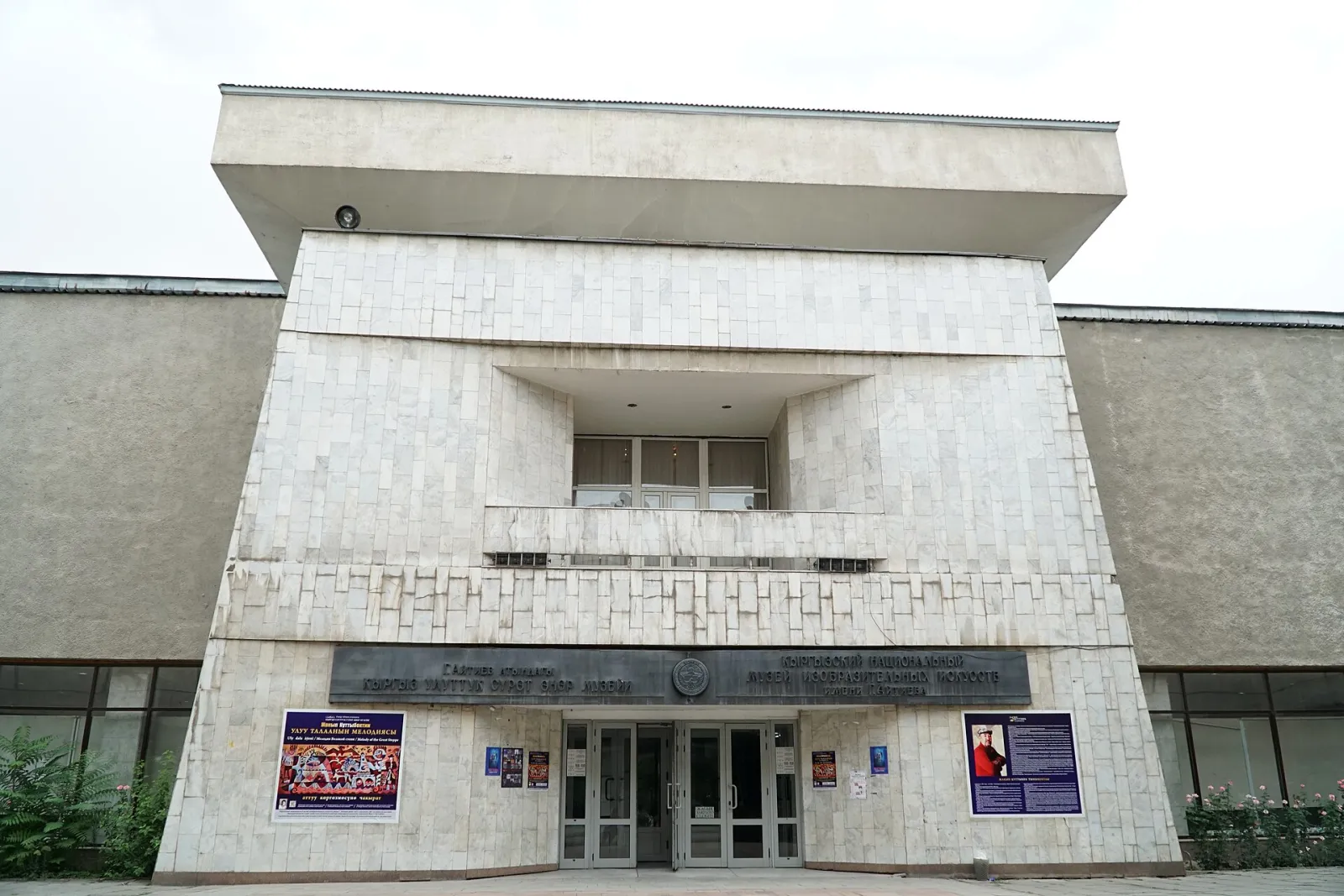 3/3. The Gapar Aitiev Museum in Bishkek Photo: Adam Harangozó, Wikimedia Commons, CC BY-SA 4.0; edited for this site.
 Where to see Aitiev’s work and studio
The principal collection belongs to the Gapar Aitiev Kyrgyz National Museum of Fine Arts in Bishkek. The museum’s online catalogue provides records for individual works with date, medium, dimensions and inventory number. A particular painting may be in storage or a temporary display, so it is best not to assume a permanent hanging.
A separate memorial studio stands at 78 Kasym Tynystanov Street. Aitiev worked in the two-storey space during the last years of his life. It preserves paintings, drawings, sculpture, catalogues, letters and the physical setting of his work. A small studio museum may change its hours, so confirm a visit through the Bishkek tourism portal.
The two museums answer different questions. The National Museum places Aitiev within Kyrgyzstan’s art history, among his predecessors and later generations. The studio restores the scale of a working life through tools, papers, pictures and an ordinary room in which art was made.
Frequently asked questions about Gapar Aitiev
Who was Gapar Aitiev?
Gapar Aitiev was a Kyrgyz painter, sculptor, stage designer and organiser of artistic life. He lived from 1912 to 1984 and ranks among the founders of professional visual art in Kyrgyzstan.
Which paintings by Gapar Aitiev are best known?
Frequently cited works include Collective Farm Yard, Noon on Issyk-Kul, the Kyrgyz Land series, Autumn in the Chüy Valley, The Outskirts of Andijan, Evening in Southern Kirghizia and Morning in the Mountains.
Where can I see Gapar Aitiev’s work?
The largest collection is held by the Gapar Aitiev Kyrgyz National Museum of Fine Arts in Bishkek. His memorial studio on Tynystanov Street preserves further works and personal archival material.
Why is the national art museum named after Aitiev?
Aitiev was one of the first professional Kyrgyz artists, a major landscape painter and a long-serving organiser of the republic’s artistic institutions. His name represents the formation of a national professional school, although the museum holds work by many artists.
Share on social media
If you found this guide useful, share it on social media. It takes a moment and helps more travellers discover the project. Thank you!
Anything to add?
Share your experience, leave a comment or suggest an improvement.