Contents:
- Why Sayakbay Karalaev matters
- An Issyk-Kul childhood and his first teachers
- 1916 and the road to public performance
- How an oral performance became a manuscript
- What 500,553 lines really means
- What sets Karalaev’s version apart
- How he performed Manas
- Beyond Manas
- Sayakbay and Chingiz Aitmatov
- Where to hear his actual voice
- The banknote, films and public memory
- A good way to begin
- Frequently asked questions
Why Sayakbay Karalaev matters
Sayakbay Karalaev is one of the performers without whom the scale of twentieth-century Kyrgyz oral tradition would be almost impossible to grasp today. He did not merely remember the sequence of events in Manas. In performance, he held together genealogies, recurring formulas, dozens of characters and several generations of story, then shaped that material into a living narrative.
His best-known legacy came from years of work between a performer and the scholars who recorded him. They captured a body of 500,553 verse lines. This is not a manuscript that Karalaev wrote quietly at a desk, nor is it a universal canonical text of the epic. It is a textual record of his version, which had previously existed through voice, memory, gesture and the response of listeners.
That is why this biography works best alongside our guide to the manaschi tradition and live performance. The other page explains the art form as a whole. Here the focus is one life and the demanding archival process that gave an immense oral narrative both written and recorded form.
An Issyk-Kul childhood and his first teachers
Sayakbay was born on 7 September 1894 at Semiz-Bel in what is now the Ton District. Biographies also mention Ak-Ölöng or, more broadly, the southern shore of Issyk-Kul. These names describe the same neighbouring landscape rather than clearly separate birthplaces, so Semiz-Bel in the Issyk-Kul region is the most useful formulation.
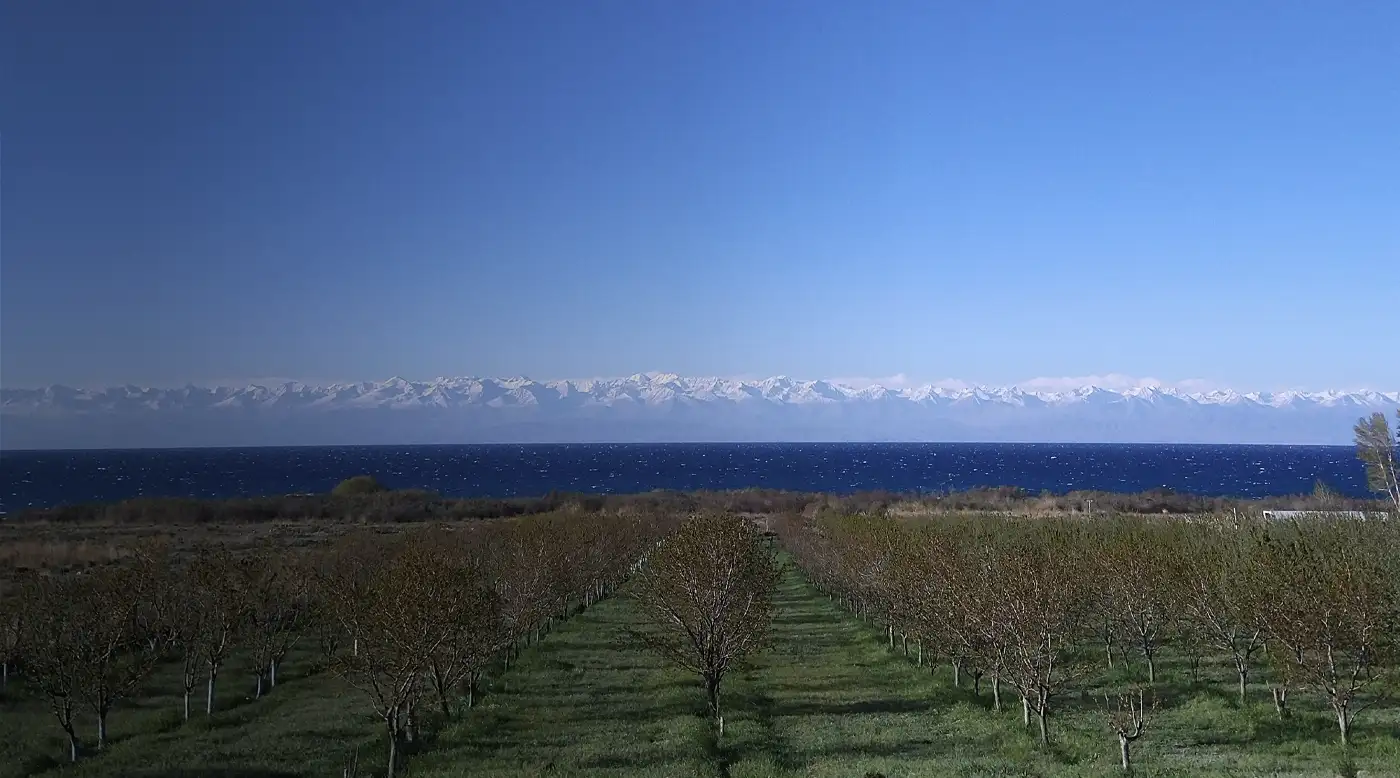
His first school was at home. His grandmother Dakysh told folktales, legends and episodes from Manas. The child heard not only plots but also the changes of voice, pause and direct address that make oral storytelling work. Karalaev later met the respected manaschi Choyuke Ömür uulu, who advised him on the architecture of a long performance, and he also named Akylbek among his teachers.
Traditional accounts include a visionary dream after which Sayakbay accepted the calling of a manaschi. Similar stories appear in many performers’ biographies. The dream matters as a cultural explanation of talent, but it cannot be verified in the same way as a recording date or a place of employment.
1916 and the road to public performance
Karalaev’s youth coincided with a violent rupture in local life. During the uprising and mass flight of 1916, his family travelled with refugees towards Sary-Jaz but, lacking transport, did not continue into China. In 1918 he joined a Red Guard detachment. Soviet biographies turned this period into a heroic set piece. For a modern reader, the essential fact is that several years of his youth unfolded amid armed groups and a radical political reordering of the region.
Afterwards he worked in the village councils of Maman and Yrdyk while continuing to perform epic episodes. Sources date his first independent recitations to 1918, sustained performances in his own manner to 1925, and broad recognition to 1930. These dates describe stages rather than contradictions: first excerpts, then long-form storytelling, and finally professional notice.
Karalaev did not grow up inside a sealed-off “ancient” world. His art emerged where family memory and apprenticeship met new Soviet cultural institutions and an audience moving from the yurt and village gathering to the club, stage and recording room.
How an oral performance became a manuscript
In 1930 Karalaev was invited to work with the Institute of Language and Literature. Systematic recording of his complete version began in 1935. The first part was finished in 1937, followed by Semetey, Seytek and stories about later generations. The project continued for years and depended on more than the reciter’s memory. It also required patient transcription, checking and editorial preparation.
Recording changes the nature of the material. During a live performance, a manaschi can enlarge a scene, shorten a transition, repeat a formula or respond to the room by altering the pace. A page freezes one moment in that process. It allows readers to count lines, compare episodes and prepare editions, but it does not invalidate Karalaev’s other performances or versions held by other reciters.
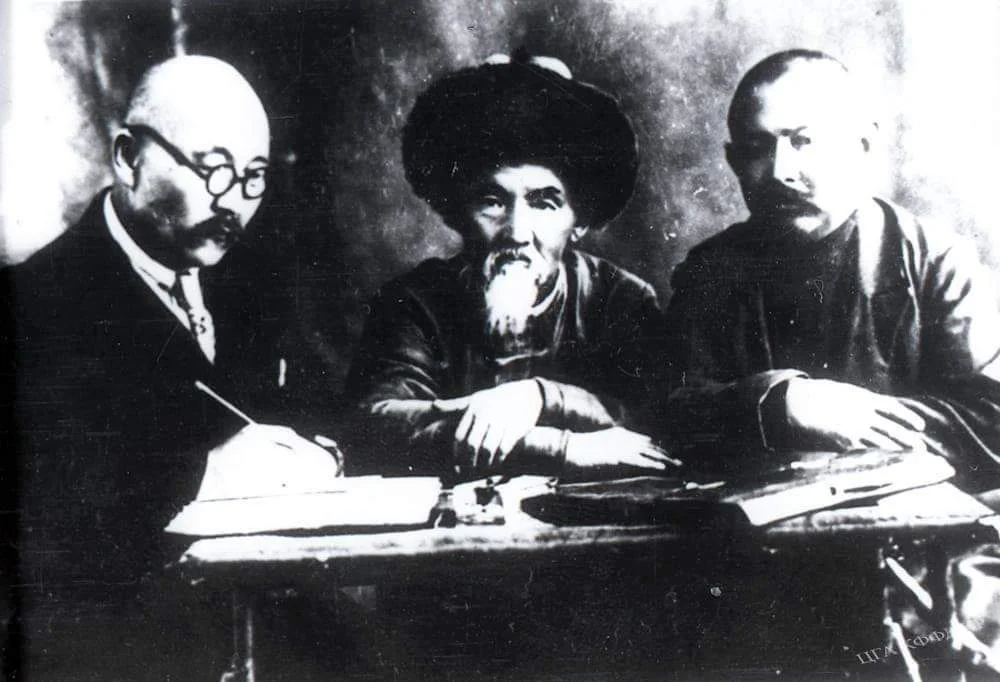 From left: Ybraiym Abdyrakhmanov, Togolok Moldo and Sayakbay Karalaev in the 1930s
A photograph from the 1930s captures this transitional world. At the same table sit Ybraiym Abdyrakhmanov, who recorded and organised oral heritage, the akyn and collector Togolok Moldo, and Sayakbay Karalaev. Oral culture is not surrendering to the book here. It is entering the archive through collaboration between bearers of the tradition and those who wrote it down.
What 500,553 lines really means
The National Bank of the Kyrgyz Republic gives the total length of Karalaev’s recorded version as 500,553 verse lines. Popular accounts often turn this figure into a contest with the Iliad, the Shahnameh or the Mahabharata. Such comparisons sound impressive, but they depend on the edition, the boundaries of the corpus and the method used to count a line.
The number matters for a different reason. It reveals the scale of sustained memory and the sheer duration of the archival effort. The corpus covers Manas, his son Semetey and his grandson Seytek, then continues with Kenen, Alymsaryk and Kulansaryk. “Trilogy” describes the foundation, but not the full range of the material recorded from Karalaev.
It would be equally misleading to say that he invented half a million lines from nothing or reproduced a fixed ancient text word for word. A manaschi inherits plots and formulas, learns from predecessors, absorbs what he hears and composes within the tradition whenever he performs.
What sets Karalaev’s version apart
Scholars emphasise its broad narrative coverage, extended descriptions and wealth of additional motifs. Karalaev develops character, ancestry, transitions and consequences in unusual detail. A familiar episode can acquire a new chain of images or a substantial side story in his telling.
That does not make his version “correct” and all others incomplete copies. Sagymbay Orozbakov's recorded version is valued for a different poetic organisation and performance lineage. It is more revealing to compare image, pace, composition and the episodes each master chooses to unfold than to name a winner.
Karalaev also carried continuations that survive only briefly, or not at all, in other large recordings. This points to a basic feature of oral epic: its boundaries are set not by one publisher’s volume but by the memory and creative practice of a particular bearer.
How he performed Manas
Contemporaries remembered Karalaev’s temperament as much as the length of his repertoire. He shifted speed, pitch and facial expression, carrying the tension of a scene into his posture and hands. Calm narration could turn into a battle cry, a lament or a rapid exchange between several characters.
This dramatic force did not mean that a manaschi simply acted out a prepared play. Karalaev remained the single narrator and never disappeared entirely behind a character. His task was to lead listeners through a vast sequence of scenes without losing the narrative thread, while retaining room to improvise.
In 1936 he joined the Kyrgyz State Philharmonic as a professional performer of Manas. He was named a People’s Artist of the Kirghiz SSR in 1939. The state stage widened his audience, but it also fixed a particular public image of the manaschi. Behind the honours lay craft: long sessions, repeated recording, different rooms and a lifetime spent returning to the same enormous story-world.
Beyond Manas
Karalaev knew and performed other layers of oral literature. A version of the heroic epic Er Töshtük was recorded from him and published in Kyrgyz and Russian. He also produced folktales, poems, stories and memoirs. Titles associated with him include Kanykeydin zhomogu, Taytoru, Bakytay balban, Tomor mergen and Unutulgus kündör.
These works prevent us from reducing him to the role of a human storage device for one epic. Karalaev could reshape oral composition into a short tale, a children’s book or a memoir. Every modern edition, however, adds another layer: the work of the recorder, editor, compiler and sometimes translator. A name on the cover does not erase the history of how a spoken work became a book.
Sayakbay and Chingiz Aitmatov
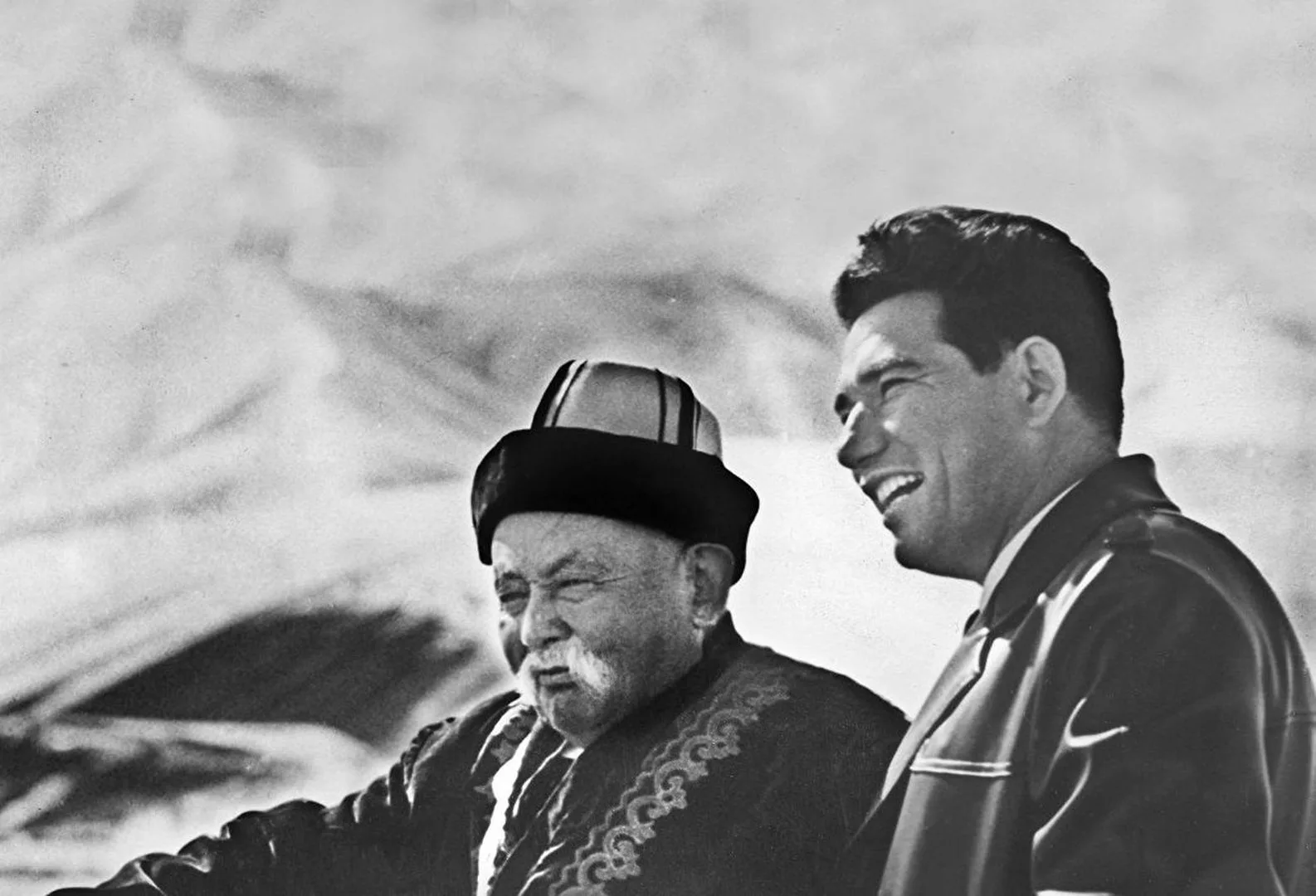 Sayakbay Karalaev with Chingiz Aitmatov, 1968. Photo: unknown photographer, Manas Ordo archive, Wikimedia Commons, CC BY-SA 4.0; edited for this site.
A series of photographs from 1968 records Karalaev in conversation with Chingiz Aitmatov against a mountain landscape. A still image cannot tell us what they said, so there is no need to invent a symbolic dialogue for them. What the photographs do show is oral and written literature meeting through living people rather than a textbook diagram.
Aitmatov later wrote about the scale of Karalaev’s memory, imagination and artistic intelligence. The label “Homer of the twentieth century” is often attached to him. It conveys admiration, but can also obscure what is specifically Kyrgyz about the art of the manaschi. Karalaev is better understood as a master of his own epic tradition, not a local equivalent of somebody else.
Where to hear his actual voice
Printed lines clarify the order of events, but the voice immediately reveals pace and physical effort. The National Academy of Sciences’ digital Manuscript Fund holds dozens of Karalaev recordings. One accessible example, Manas’s marriage to Kanykey, was recorded in 1960 and runs for 41 minutes and 43 seconds.
Even without Kyrgyz, you can hear breath, acceleration and the passage from narration into direct speech. A translation or short introduction is necessary for the details. A good first approach is to read a synopsis, listen for five or ten minutes, then return to the longer recording with the scene in mind.
Digitisation preserves a voice but cannot fully restore the event. The room, listeners, gestures and occasion remain outside the microphone. An archival recording and a present-day live manaschi performance therefore answer different questions.
The banknote, films and public memory
Karalaev’s portrait appears on the front of Kyrgyzstan’s 500 som banknote. The reverse shows the Manas mausoleum near Talas. The design connects a historical twentieth-century performer with an epic hero and a modern site of commemoration.
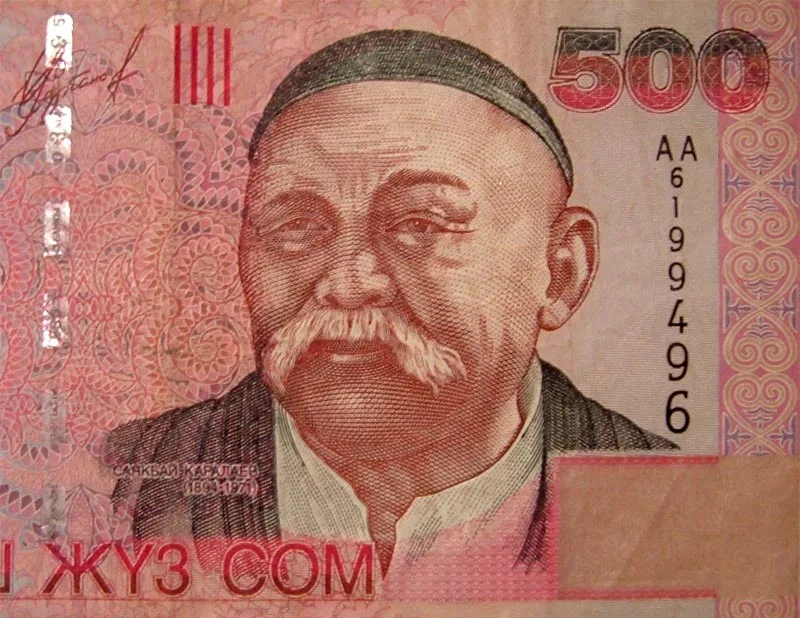 Sayakbay Karalaev on the 500 som banknote
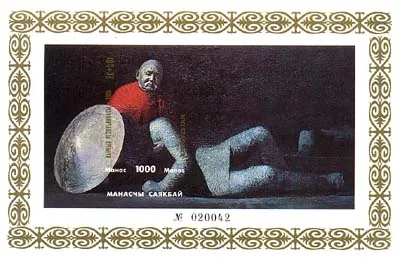 The 1995 stamp marking Karalaev’s centenary
Monuments to Karalaev stand in Bishkek and Balykchy. In 2017 Ernest Abdyjaparov released the feature film Sayakbay: Homer of the 20th Century. The film offers a vivid sense of period, but it is not a documentary source. Scenes, dialogue and transitions are shaped by drama.
If your route passes through Balykchy, the monument at the junction of Abdrakhmanov Street and Sayakbay Karalaev Boulevard can fit naturally into a journey around the western end of Issyk-Kul. Yet the essential memorial is not bronze. It lies in manuscripts, recorded voice and the continuing practice of today’s manaschi.
A good way to begin
Start with a short archival recording rather than trying to read half a million lines in sequence. Choose a self-contained episode, find a concise synopsis and listen for changes of voice. Then open the printed version of the same scene and notice the repetitions, direct speech and moments where a line on the page no longer carries the timbre of the performance.
Next, compare. Read one episode in Karalaev’s version and the same material in another recorded lineage, perhaps that of Sagymbay Orozbakov. The differences show why Manas survives not as one frozen text but as a system of stories, formulas and performance decisions.
Finally, hear a contemporary manaschi live. Karalaev’s legacy then stops looking like a sealed monument to the past. You can begin to recognise which techniques continue across generations and which belong to his own voice and historical moment.
Frequently asked questions about Sayakbay Karalaev
Who was Sayakbay Karalaev?
Sayakbay Karalaev was a Kyrgyz manaschi, storyteller, writer and performer of the Epic of Manas. The largest coherent body of twentieth-century Kyrgyz epic tradition was recorded from him.
When did Sayakbay Karalaev live?
He was born on 7 September 1894 at Semiz-Bel on the southern side of Issyk-Kul and died in Frunze on 7 May 1971.
How many lines of Manas did Sayakbay Karalaev know?
The corpus recorded from Karalaev contains 500,553 verse lines. The number belongs to a documented performance version, not to a single fixed text that every manaschi must repeat.
Did Sayakbay Karalaev write the Epic of Manas?
No. He inherited an oral tradition, learned from older performers and shaped his own version in performance. Researchers recorded his recitations and prepared textual editions.
Where can I hear Sayakbay Karalaev’s voice?
Digitised tape recordings are available through the online Manuscript Fund of Kyrgyzstan’s National Academy of Sciences. Its catalogue includes dozens of epic episodes and recollections.
Which banknote features Sayakbay Karalaev?
His portrait appears on the front of the 500 som banknote. The reverse shows the Manas mausoleum near Talas.
Share on social media
If you found this guide useful, share it on social media. It takes a moment and helps more travellers discover the project. Thank you!
Anything to add?
Share your experience, leave a comment or suggest an improvement.