Contents:
Why Aitmatov matters
Aitmatov brought Kyrgyz experience into world literature without reducing Kyrgyzstan to an exotic backdrop. His characters live in villages, on pastures, at remote railway stops and beside Issyk-Kul, yet face questions that travel easily across borders: whether one person can answer for another’s suffering, what remains when memory is erased, and where progress turns into destruction.
He emerged from within the Soviet system and became one of its most decorated writers. At the same time, his fiction exposed violence, bureaucratic indifference, pressure on women, environmental damage and the cost of forgetting. This is not the life of a dissident outside the state. Aitmatov held official positions and belonged to Soviet institutions; the tension between that career and the moral unease of his fiction should be examined rather than smoothed away.
His books appeared in more than 150 languages. That reach cannot be explained by one prize or successful film. The novellas are concise enough to enter another culture quickly, while their moral conflicts do not require readers to know Kyrgyz history in advance.
Childhood in Sheker and his father’s fate
Chingiz Torekulovich Aitmatov was born on 12 December 1928 in Sheker, in the Talas Region. His father, Torekul, was a Soviet party and state official. He was arrested in 1937 and executed during the Stalinist purges; for decades the family did not know where he had been buried.
The war interrupted Aitmatov’s schooling. As a teenager he served as secretary to the village council, preparing documents for local residents, and later collected taxes. These experiences should not be turned into a ready-made explanation for every book, but they gave him early knowledge of village life, official language and the way state decisions enter private lives.
The family’s uncertainty ended only after a secret burial site was found at Chong-Tash. Torekul Aitmatov was identified among the victims reburied at the Ata-Beyit memorial. When the writer died in 2008, he was buried at the same complex.
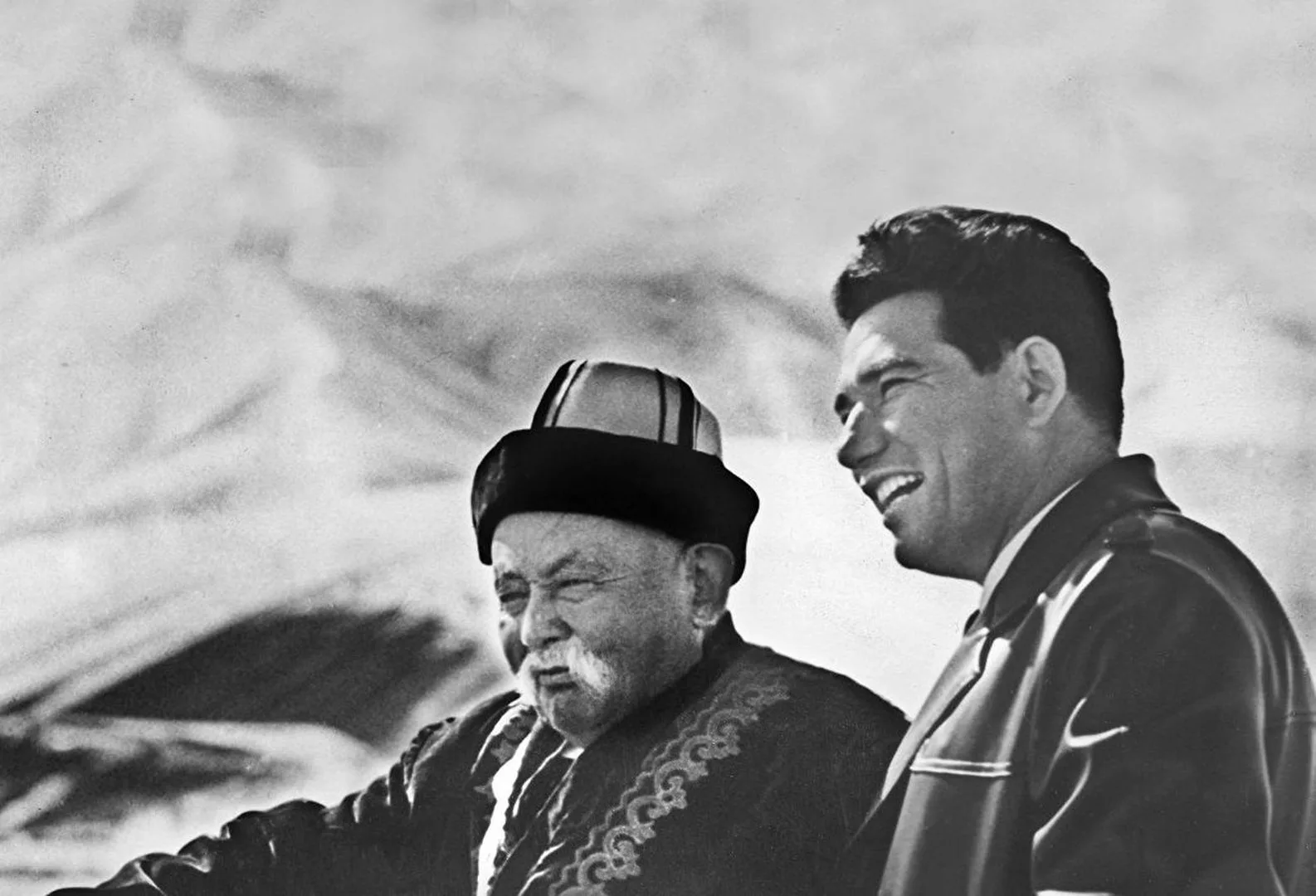 Sayakbay Karalaev and Chingiz Aitmatov, 1968. Photo: unknown photographer, Manas Ordo archive, Wikimedia Commons, CC BY-SA 4.0; edited for this site.
From animal husbandry to literature
Aitmatov’s first training was not literary. After a livestock college, he studied at the Kyrgyz Agricultural Institute in Frunze and graduated in 1953. He then worked in animal husbandry for several years. That practical knowledge stayed in the fiction: the stallion Gulsary, the maral deer of The White Ship and the wolves in The Scaffold are agents within the story rather than decorative symbols.
His first stories appeared in 1952. In 1956 he entered the Higher Literary Courses in Moscow and completed them in 1958. Jamila was published that same year. Louis Aragon’s French translation soon carried the short novella beyond a Soviet readership.
The First Teacher, Mother Earth, Farewell, Gulsary!, The White Ship and other novellas followed. His first large novel, The Day Lasts More Than a Hundred Years, appeared in 1980, followed by The Scaffold in 1986. The later books widened their geography and formal range while returning to memory, violence and responsibility.
Writing in two languages
Aitmatov worked in both Kyrgyz and Russian. He could compose an early text in Kyrgyz and translate it himself into Russian; later, Russian became the primary language of many works. The neat formula “Kyrgyz first, Russian later” remains incomplete because both languages shaped his literary imagination and readership.
Kyrgyz oral tradition entered Russian-language prose through narrative rhythm, embedded legends, recurring images and an understanding of memory as a living obligation. The photograph above with the manaschi Sayakbay Karalaev is a reminder that printed literature developed beside a continuing performance tradition. Our separate guide explains how manaschis perform the epic and why Manas has no single fixed version.
Where to start reading
Jamila. The shortest and most accessible entrance. A wartime village is seen through an adolescent narrator, while Jamila’s choice collides with the expectations of family and community. Begin here for the early Aitmatov in a clear, compact form.
The First Teacher. A novella about education, inherited authority and the cost of sudden change. It shows why schooling in Aitmatov is not only a source of knowledge but a route towards choosing another life.
Farewell, Gulsary! The bond between a man and his horse opens into a reckoning with an entire life. It suits readers interested in the meeting point between private fate and the Soviet system.
The White Ship. A darker story of childhood, myth and adult cruelty. The legend of the Horned Mother Deer is not decorative folklore; it becomes the moral measure of a world that the adults violate.
The Day Lasts More Than a Hundred Years. The novel combines a funeral journey across the steppe, twentieth-century history, the legend of the mankurt and science fiction. It works best after one or two novellas, when its recurring concerns are already visible.
The Scaffold. A late novel about faith, the drug trade, violence and ecological destruction. It is not the easiest first book, but it shows how widely Aitmatov expanded his conflicts during perestroika.
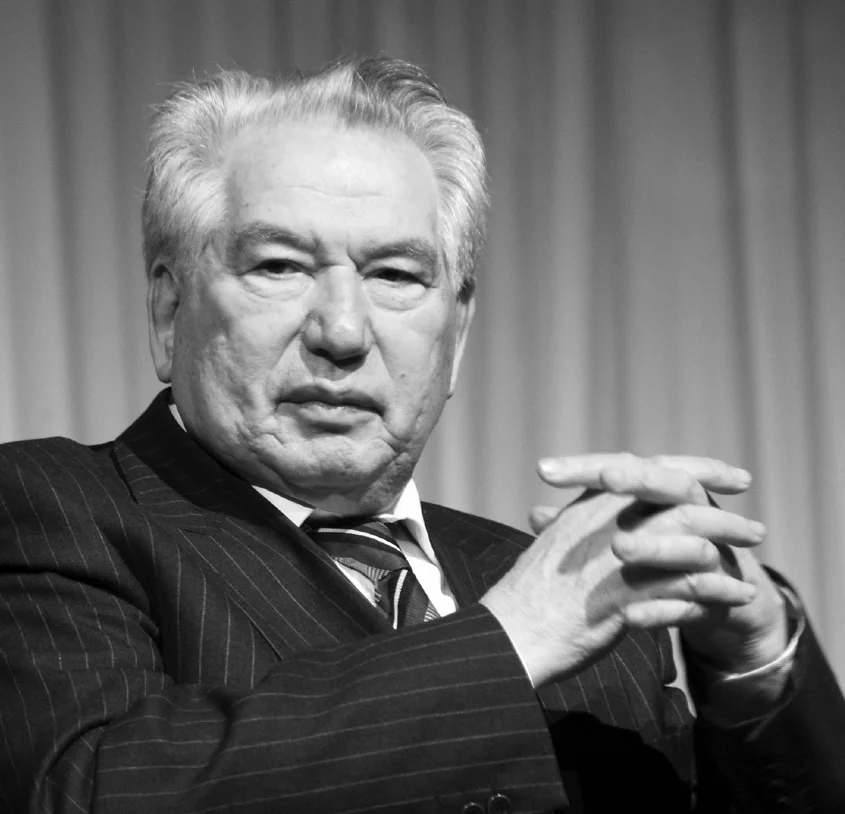 1/2. Chingiz Aitmatov, 2007 Photo: Elke Wetzig, Wikimedia Commons, CC BY-SA 3.0; edited for this site.
 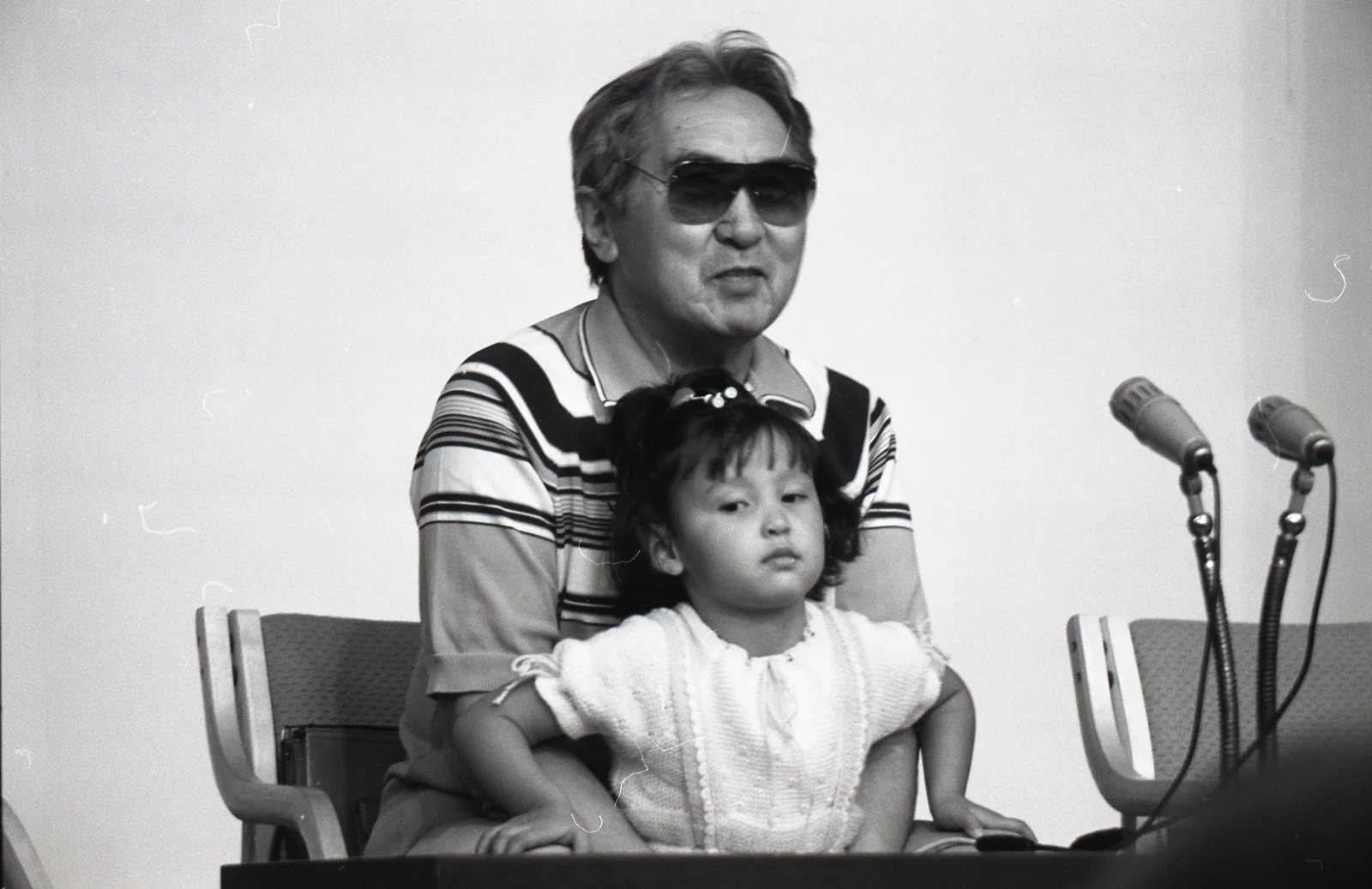 2/2. Chingiz Aitmatov in Frunze, 1987 Photo: Jaan Künnap, Wikimedia Commons, CC BY-SA 4.0; edited for this site.
 Themes that hold the work together
Memory as an action. A character preserves memory not simply by knowing the past, but by acting in relation to it. The mankurt became the most famous image of this theme, yet it also appears in family histories, duties towards the dead and returns to place.
Humans and the natural world. Animals often possess their own narrative line and value of life. A horse, deer or she-wolf can expose a human decision from an angle where familiar excuses no longer work.
Freedom of choice. Jamila, The First Teacher and the later novels ask in different ways whether a person may leave a role assigned by family, community or state. The answer is never a slogan: choice can liberate, but it also creates responsibility and consequences.
Myth beside modernity. Legend, epic and science fiction do not escape reality. They change the scale of an event and compare a present decision with a longer moral memory.
The United Nations in Kyrgyzstan has highlighted love and friendship, war and peace, poverty, social injustice and humanity’s relationship with nature across Aitmatov’s work. These concerns explain his international reach more clearly than the vague idea of “national colour”.
Aitmatov on screen
Aitmatov’s fiction became part of the rise of Kyrgyz cinema in the 1960s and 1970s. Andrei Konchalovsky directed The First Teacher, Larisa Shepitko adapted Camel’s Eye as Heat, and Bolot Shamshiev made The White Ship. The stories transferred powerfully to film because their landscapes, conflicts and physical details were already sharply drawn.
A screen adaptation is not a replacement for the book. Film fixes a character’s appearance and the rhythm of events; prose leaves more room for inward narration, shifting time and legend. A rewarding route is to read a short novella first and then compare the director’s choices.
Public life and diplomacy
Aitmatov was more than a novelist. He worked as a journalist, led cultural organisations, served in the Supreme Soviet, joined senior Soviet bodies and edited the journal Foreign Literature. In 1973 he signed a collective letter condemning Aleksandr Solzhenitsyn and Andrei Sakharov. The fact complicates any convenient portrait of a writer standing outside the system, and belongs in an honest account of his life.
In 1990 Aitmatov became Soviet ambassador to Luxembourg and briefly continued there as Russia’s representative after the USSR collapsed. He later represented Kyrgyzstan in the Benelux countries and France, as well as to the European Union, NATO and UNESCO. Diplomacy extended his long concern with cultural dialogue into formal public work.
His distinctions included the Lenin Prize, several USSR State Prizes, Hero of Socialist Labour and Hero of the Kyrgyz Republic. For a first encounter, the list matters less than reading one novella and seeing the literature for which the honours were awarded.
Memory and places
Aitmatov died in Nuremberg on 10 June 2008. He was buried at Ata-Beyit, beside the memorial to victims of repression and near his father’s grave. The location joins one family history to the history of the country without requiring a later invented symbolism.
Bishkek’s Chingiz Aitmatov House Museum preserves his study, library, manuscripts and personal belongings. It occupies a private home on controlled grounds, so visits require advance arrangement. At Issyk-Kul, the Rukh Ordo cultural centre includes him within a wider display of religion, literature and cultural dialogue. These sites approach memory differently and neither replaces the books.
Aitmatov’s centenary falls in 2028, and Kyrgyzstan has begun planning official commemorations. Such attention inevitably strengthens a public national image of the writer. It makes returning to the fiction especially useful, because his characters rarely fit a ceremonial formula.
The National Academy of Sciences of Kyrgyzstan publishes a detailed chronology. The United Nations in Kyrgyzstan offers a concise account of the themes that keep the books internationally relevant.
Frequently asked questions about Chingiz Aitmatov
Which languages did Chingiz Aitmatov write in?
Aitmatov wrote in Kyrgyz and Russian. He often composed early works in Kyrgyz and translated them into Russian himself; many later books were written primarily in Russian.
Which Aitmatov book should I read first?
Jamila is the most accessible starting point: short, direct and built around a clear conflict. The White Ship or Farewell, Gulsary! make good next steps before the larger novel The Day Lasts More Than a Hundred Years.
What is Aitmatov’s best-known work?
Jamila brought him international recognition. The White Ship and The Day Lasts More Than a Hundred Years, with its legend of the mankurt, are also among his most widely recognised works.
Did Chingiz Aitmatov win the Nobel Prize?
No. Aitmatov did not receive the Nobel Prize in Literature. His honours included the Lenin Prize, USSR State Prizes and the highest distinctions of Kyrgyzstan.
Where is Chingiz Aitmatov buried?
He is buried at the Ata-Beyit historical memorial complex near Bishkek, beside the memorial to victims of Stalinist repression and near the grave of his father, Torekul Aitmatov.
Share on social media
If you found this guide useful, share it on social media. It takes a moment and helps more travellers discover the project. Thank you!
Anything to add?
Share your experience, leave a comment or suggest an improvement.