Contents:
- Why Razzakov matters
- Koroson, the orphanage and Tashkent
- From teacher to economic planner
- Returning to Kyrgyzstan
- What the first secretary actually did
- Industry, energy and roads
- Universities, science and national cadres
- Achievement within the Soviet system
- Why he was removed in 1961
- Moscow and the return of his public memory
- Where to learn more today
- Frequently asked questions
Why Iskhak Razzakov matters
Razzakov took charge of the republic during the difficult transition from war to peace. The Kyrgyz SSR had to restore production, redirect factories from wartime demands and find engineers, teachers, doctors and researchers for a rapidly changing economy. He headed the republican government from 1945 to 1950, then held its most powerful party post from 1950 to 1961.
His significance lies in more than a list of factories and dams. Razzakov entered senior office as a professionally trained economic planner. He understood that a new plant required power, transport and people capable of operating it. Industry, higher education and the training of local specialists therefore became connected parts of his public legacy.
Independent Kyrgyzstan later turned Razzakov into an emblem of honest public service. That respect has clear roots, but the commemorative image can flatten a complicated period. He worked inside an authoritarian, centrally planned Soviet system and led its republican party organisation. A useful biography needs to recognise his competence while also restoring the contribution of thousands of workers and the political limits under which he governed.
Koroson, the orphanage and Tashkent
Iskhak Razzakov was born on 25 October 1910 in Koroson, near the coal-mining town of Sülüktü and today's border with Tajikistan. The village now lies in Leilek District, Batken Region. His father worked as a miner at the Sülüktü and Kokkin coalfields; his mother kept the household.
Razzakov's own autobiography records that his mother died in 1913 and his father in 1918. He had no siblings or close relative able to raise him. In 1918 he entered an orphanage in Khujand, where he completed primary school. Five years later he was transferred to the Namuna boarding school in Tashkent.
The KSTU scientific library preserves a small but revealing detail about his name. He was reportedly named Isak at birth, while Iskhak became fixed in later documents. Iskhak Razzakov is the form used in state records, archives and present-day commemoration.
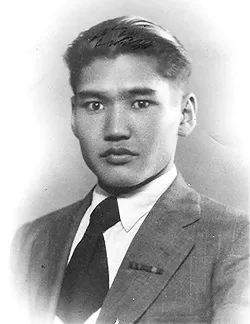 Iskhak Razzakov as a young man, before 1950
From teacher to economic planner
In 1925 Razzakov entered the Uzbek Men's Institute of Education in Tashkent. He graduated in December 1929 and stayed to teach social studies until July 1931. His first professional role was therefore in a classroom rather than a party office.
In August 1931 he began studying at the Moscow Planning Institute of the USSR State Planning Committee. His own autobiography says that he graduated in January 1936 after defending his diploma with the highest mark. Later short biographies sometimes give 1938, but the first-person document supports 1936.
He was assigned to the Uzbek SSR's planning commission and rose rapidly through its administration. By the end of the 1930s he had moved from specialist and deputy roles to leadership of the republican planning body. During the Second World War he served as people's commissar for education, deputy head of the Uzbek government and a secretary of the republic's Communist Party. By 1945 the former orphanage pupil had acquired experience in education, planning and senior administration.
Returning to Kyrgyzstan
In November 1945 Moscow sent Razzakov to the Kyrgyz SSR as chairman of the Council of People's Commissars. When Soviet commissariats became ministries in 1946, the office was renamed chairman of the Council of Ministers. In practical terms, he led the republican executive.
The immediate task was to turn a wartime economy back towards civilian needs. Existing enterprises required repair, coal and electricity production had to expand, and the republic needed housing, roads and qualified staff. Large projects depended on all-Union plans, equipment allocations and approval from central ministries in Moscow.
Razzakov did not personally build factories or single-handedly create a university. His role was to define republican priorities, argue for their place in the Union plan, assemble an administrative team and take responsibility for implementation. This is less romantic than saying one man “built everything”, but it describes how a capable leader could act in a planned economy.
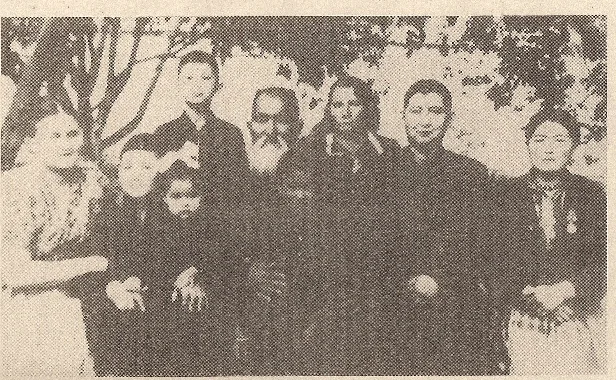 Iskhak Razzakov with his family in 1955
What the first secretary actually did
On 10 July 1950 Razzakov became first secretary of the Communist Party of Kirghizia. This office stood above the republican head of government. The first secretary shaped political and personnel policy, although the most important choices still depended on the central leadership of the Communist Party of the Soviet Union.
Razzakov was the first ethnic Kyrgyz to hold the post. The symbolism mattered, but the office was not equivalent to an elected national presidency. A party plenum chose the leader within a system that allowed neither free elections nor organised political competition.
His eleven-year tenure crossed two distinct political phases. Stalin's final years retained a rigid hierarchy and a culture marked by repression. After 1953 came rehabilitation, administrative reform and a cautious widening of the formal powers of Union republics. Razzakov had to work through both phases without escaping the party system itself.
Industry, energy and roads
The republic expanded its industrial base quickly under Razzakov. Official accounts name the Lebedinovka and Alamedin hydroelectric stations, Kyrgyzavtomash, the Frunze agricultural machinery plant, the Osh electromechanical plant, a shoe factory in Frunze, brickworks in Osh and Kyzyl-Kiya, the Kara-Suu oil plant and new coal mines.
Such lists need one important qualification. Engineers, miners, builders, factory managers, ministries and Union agencies created these projects. Razzakov's contribution lay in political advocacy and coordination at republican level. “Built during his leadership” is usually more accurate than assigning every dam or factory to a single person.
The Frunze-Osh road, now the Bishkek-Osh highway, occupies a special place in this legacy. In the 1950s the republic pressed for a direct internal road between north and south across the high passes. The route has since been rebuilt, tunnelled and resurfaced repeatedly, but the political demand for an internal connection between the two halves of the country belongs to Razzakov's era.
Dams, canals and power stations did more than improve production figures. They supplied cities and factories, expanded irrigated land and tied settlements to large state projects. Our guide to Kyrgyzstan's economy shows which modern sectors still rest on that Soviet infrastructure.
Universities, science and national cadres
Education was the most consistent thread in Razzakov's policy. The period saw the creation of Kyrgyz State University, the Academy of Sciences of the Kyrgyz SSR, Frunze Polytechnic Institute, an institute of physical culture, a women's teacher-training institute and regional pedagogical institutes. They did not all emerge from one order or in one year, but together they transformed the republic's capacity to train its own specialists.
Razzakov supported sending students from Kyrgyzstan to Moscow, Leningrad, Novosibirsk, Omsk and other academic centres. The point was not a ceremonial quota. Graduates were expected to return as engineers, researchers and lecturers able to staff the new institutions at home. Personnel policy connected an industrial construction site with the future independence of its workforce.
Cultural policy formed part of the same institution-building programme. The 1958 Kyrgyz art and literature festival in Moscow presented theatre, music, dance and writing to an all-Union audience. State support created opportunities, but it also worked as a gatekeeper: official institutions decided which artists and works received a stage, a commission or publication.
Achievement within the Soviet system
Modern commemoration often places a “national” Razzakov in opposition to an impersonal Soviet centre. The historical figure was more complicated. He was a senior member of the Soviet nomenklatura and leader of the republican party organisation. He implemented all-Union policy, participated in its personnel system and governed in a state that did not permit public opposition to the ruling party.
That does not make every leader interchangeable. His training in economics, experience in Uzbekistan, emphasis on local specialists and ability to negotiate with central ministries influenced republican priorities. Yet the achievements of 1945-1961 belong to the population and institutions of the republic as much as to its first secretary.
This context avoids two misleading portraits. Razzakov was not an independent reformer free of Soviet politics. Nor was he a passive official mechanically relaying every order. He was a strong republican leader with a real, but tightly bounded, field of action.
Why Iskhak Razzakov was removed in 1961
On 9 May 1961 the sixth plenum of the Central Committee of the Communist Party of Kirghizia removed Razzakov as first secretary and bureau member. The surviving extract cites “major errors and shortcomings” in the leadership of the party organisation, the economy and organisational work.
Later memorial narratives explain the dismissal almost entirely through his defence of the Kyrgyz language, national cadres and greater republican autonomy. Those policies were real and could bring conflict with Union ministries. Yet the short resolution does not identify one hidden cause, and removals at this level usually combined economic criticism, personnel struggles and a decision by the central leadership.
The honest conclusion is narrower: a party decision removed Razzakov after criticism of the republican leadership, while the precise balance between economic complaints, cadre policy and Moscow politics cannot be reduced to one heroic sentence. The KSTU digital collection places the plenum extract beside autobiographies and personnel records, allowing readers to compare later memory with primary documents.
Moscow and the return of his public memory
After his dismissal Razzakov moved to Moscow. He headed the food-industry department of the USSR State Economic Council, then worked in the State Planning Committee. He retired in 1967 and died in Moscow on 18 March 1979.
Independent Kyrgyzstan brought his memory back into public life. His remains were reburied in Bishkek in 2000. He was posthumously awarded the title Hero of the Kyrgyz Republic in 2010. The Kyrgyz State Technical University, streets, schools and museums now bear his name.
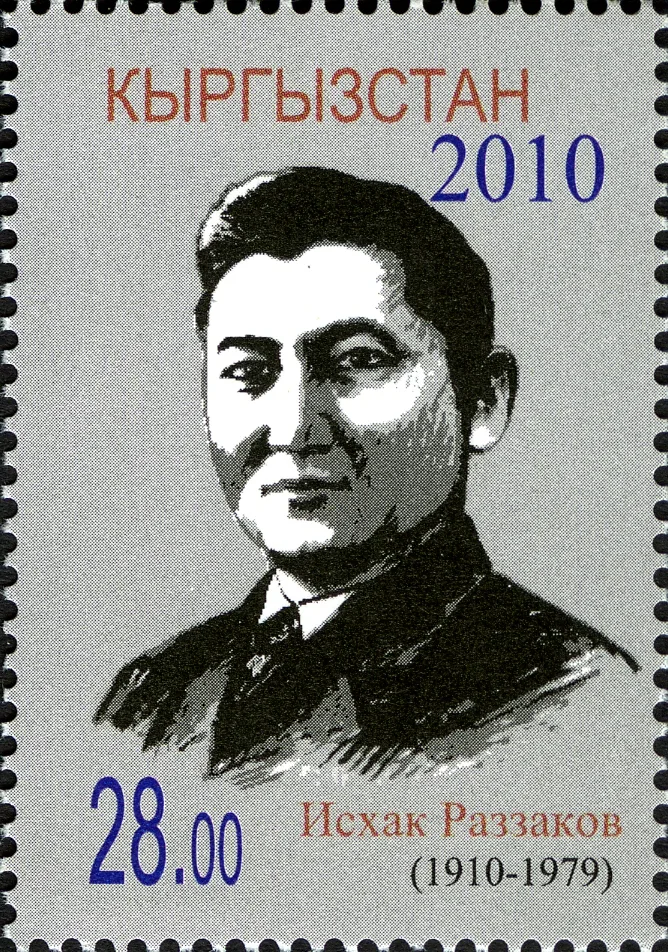 The stamp issued for Iskhak Razzakov's centenary in 2010
In 2022 the former town of Isfana was renamed Razzakov. A person's name thus entered addresses, bus timetables and maps across his home district. Our town guide explains why both names still appear and what travellers can see there.
Where to learn more about Razzakov today
The Iskhak Razzakov Memorial House Museum stands at 90 Chuikov Street in Bishkek. The house in which he lived from 1950 preserves books, furniture, clothes, decorations and personal possessions. Check the opening time before visiting, as small municipal museums can change their hours and tour arrangements.
Razzakov town has a history museum that connects his biography with the wider story of Leilek District. Visiting the region adds a physical landscape to the official career: coal towns, a border district and the long distance between Koroson and the educational centres where the orphaned boy eventually studied.
For further reading, the most useful starting point is the document collection published by Kyrgyzstan's Archival Service. It is a commemorative volume rather than the final critical biography, but it restores dates, official wording and records behind the national image.
Frequently asked questions about Iskhak Razzakov
Who was Iskhak Razzakov?
Iskhak Razzakov was a Soviet economist, government official and party leader. He headed the government of the Kyrgyz SSR from 1945 to 1950 and served as first secretary of the Communist Party of Kirghizia from 1950 to 1961.
Why is Iskhak Razzakov remembered in Kyrgyzstan?
His period in office is associated with post-war industry, new power and transport infrastructure, the creation of universities and the Academy of Sciences, and the training of Kyrgyz engineers, researchers and teachers.
Why was Razzakov removed from office?
A party plenum dismissed him in May 1961 for officially stated errors and shortcomings in leadership. Later accounts also connect the decision with disputes over national cadres and republican autonomy, but the surviving documents do not reduce it to one cause.
Why was Isfana renamed Razzakov?
Kyrgyzstan renamed Isfana in 2022 to honour Iskhak Razzakov, who was born in Leilek District. The older name still appears in timetables, historical captions and some maps.
Where is the Iskhak Razzakov House Museum?
The memorial museum is at 90 Chuikov Street in Bishkek. Confirm its opening hours and tour arrangements before visiting.
Share on social media
If you found this guide useful, share it on social media. It takes a moment and helps more travellers discover the project. Thank you!
Anything to add?
Share your experience, leave a comment or suggest an improvement.