Contents:
- Why Kurmanjan Datka matters
- Early life and Alymbek Datka
- What the title datka meant
- Power after her husband’s assassination
- The Russian conquest and the choice to negotiate
- Her sons, resistance and Kamchybek’s execution
- Mannerheim’s photographs
- Where biography ends and legend begins
- Memory and places
- Frequently asked questions
Why Kurmanjan Datka matters
Kurmanjan Datka entered history as the leader of the Alay Kyrgyz and a political intermediary between local clans, the Kokand Khanate, the Emirate of Bukhara and the Russian military administration. For a woman within the political order of nineteenth-century Central Asia, this degree of acknowledged authority was exceptional. Her influence survived the transfer of Alay to Russian imperial control.
The familiar label “Queen of Alay” makes the story memorable but can also mislead. Kurmanjan was not the crowned monarch of an independent state. She governed through clan relationships, personal authority and the title of datka. Russian officials used the language of queenship as an honorific for a woman they had to treat as a political counterpart.
Her life also resists a simple victory narrative. Her husband and eldest son opposed the Russian advance. Kurmanjan later chose negotiation and an end to armed resistance once the imbalance of military power had become clear. That decision can be judged in different ways, but it cannot be separated from the conditions of conquest.
Early life and Alymbek Datka
Kurmanjan Mamatbay kyzy was born in 1811 into a family of the Mungush clan. Later biographical tradition says that she left a first husband chosen by her family and returned to her parents. The episode became central to her modern image as a woman who defended her own agency, yet its details come from later retellings rather than contemporary records of her youth.
In 1832 she married Alymbek Datka, an influential Kyrgyz politician within the Kokand Khanate. He governed Andijan, took part in court politics and spent long periods away from Alay. Later accounts describe Kurmanjan as a trusted adviser who handled regional affairs during those absences.
This experience explains her position after his death more convincingly than the image of a “queen” appearing overnight. Kurmanjan already understood the region’s alliances, the ruler’s family, Kokand politics and the people on whom administration in Alay depended.
What the title datka meant
Datka was a high administrative and military title in the Kokand Khanate and the Emirate of Bukhara. It is sometimes translated as “general”, but that is only an approximation. A datka might command forces, govern territory, conduct negotiations and represent a population at the khan’s court.
After Alymbek’s death, Kurmanjan’s title was recognised by Emir Muzaffar of Bukhara and Khudayar Khan of Kokand. Her meeting with the emir took place in Osh, rather than in the high Alay as some dramatised versions suggest. Granting this status to a woman was rare and acknowledged influence she already possessed.
The title did not turn Alay into an independent kingdom. The region remained tied to Kokand, while Bukhara’s recognition reflected the struggle between the two powers. Kurmanjan worked inside a shifting political system in which formal authority depended on military force, alliances and agreements with local leaders.
Power after her husband’s assassination
Alymbek was assassinated in 1862 during another upheaval at the Kokand court. Kurmanjan then assumed leadership of the family and the Alay Kyrgyz. She had to manage relationships among clans while responding to demands from Kokand and Bukhara.
The Kokand Khanate was weakening rapidly. Khans followed one another, revolts spread through the Ferghana Valley, and the Russian Empire occupied cities and military positions to the north and west. A political decision in Alay could no longer remain a local matter; it immediately became part of a contest among several powers.
Kurmanjan maintained influence through relatives, supporters and negotiated relationships rather than a bureaucracy of her own. Her power was real, but it did not resemble a modern state administration. Keeping that distinction in view prevents a nineteenth-century biography from being recast as the story of a present-day president or monarch.
The Russian conquest and the choice to negotiate
In 1875-1876, a revolt against Khudayar Khan developed into war with the Russian Empire. Russian forces entered Alay after the abolition of the Kokand Khanate. Kurmanjan’s eldest son, Abdyldabek, continued to resist, then crossed the Pamirs into Afghanistan and died there in 1877.
Kurmanjan met General Mikhail Skobelev and agreed to end further fighting. Kyrgyz national memory often explains the decision as an attempt to prevent futile bloodshed. That interpretation needs context: she was choosing after military defeat, in the face of overwhelming Russian force and the disappearance of the political order in which she had operated.
The Russian administration retained a working relationship with Kurmanjan and used her authority to stabilise the region. She received honours, corresponded with officials and hosted travellers. Imperial respect did not make the new rule non-colonial; it showed how badly the administration needed a credible local intermediary.
Her sons, resistance and Kamchybek’s execution
The most painful episode of Kurmanjan’s later life concerned the prosecution of her family. In 1895, a Russian imperial military court sentenced her son Kamchybek to death in a case concerning the killing of customs guards. Other relatives received hard labour and exile. Kamchybek was hanged in a public square in Osh; some of the exiles later returned to Alay after petitions on their behalf.
A widely repeated story says Kurmanjan attended the execution and refused to organise a rescue because renewed violence would bring reprisals against her people. Modern retellings use the scene as the decisive proof of her statecraft. Ivan Yuvachev’s account published in 1907 gives a less polished version: Kurmanjan pleaded for clemency, met the prisoners and withdrew to Alay in mourning after the execution. It does not confirm every dramatic detail of the later legend.
The documented core is tragic enough without embellishment. An imperial military court executed Kamchybek, the family lost influence, and Kurmanjan tried to save other condemned relatives. The distinction between this record and the later exemplary tale deserves to remain visible.
Mannerheim’s photographs
In 1906, a year before Kurmanjan’s death, Carl Gustaf Emil Mannerheim’s expedition passed through Alay. He was then an officer of the Russian Empire travelling towards China; he later became Finland’s marshal and president. The French Orientalist Paul Pelliot accompanied part of the journey.
Mannerheim photographed Kurmanjan on horseback beside a yurt and during a meeting inside it. These images matter because they show neither a later painted portrait nor an idealised national symbol, but an elderly ruler within the landscape and material world of Alay. In the interior photograph she sits between members of the expedition and her grandson. The camera records an encounter between local political authority, European scholarship and imperial intelligence.
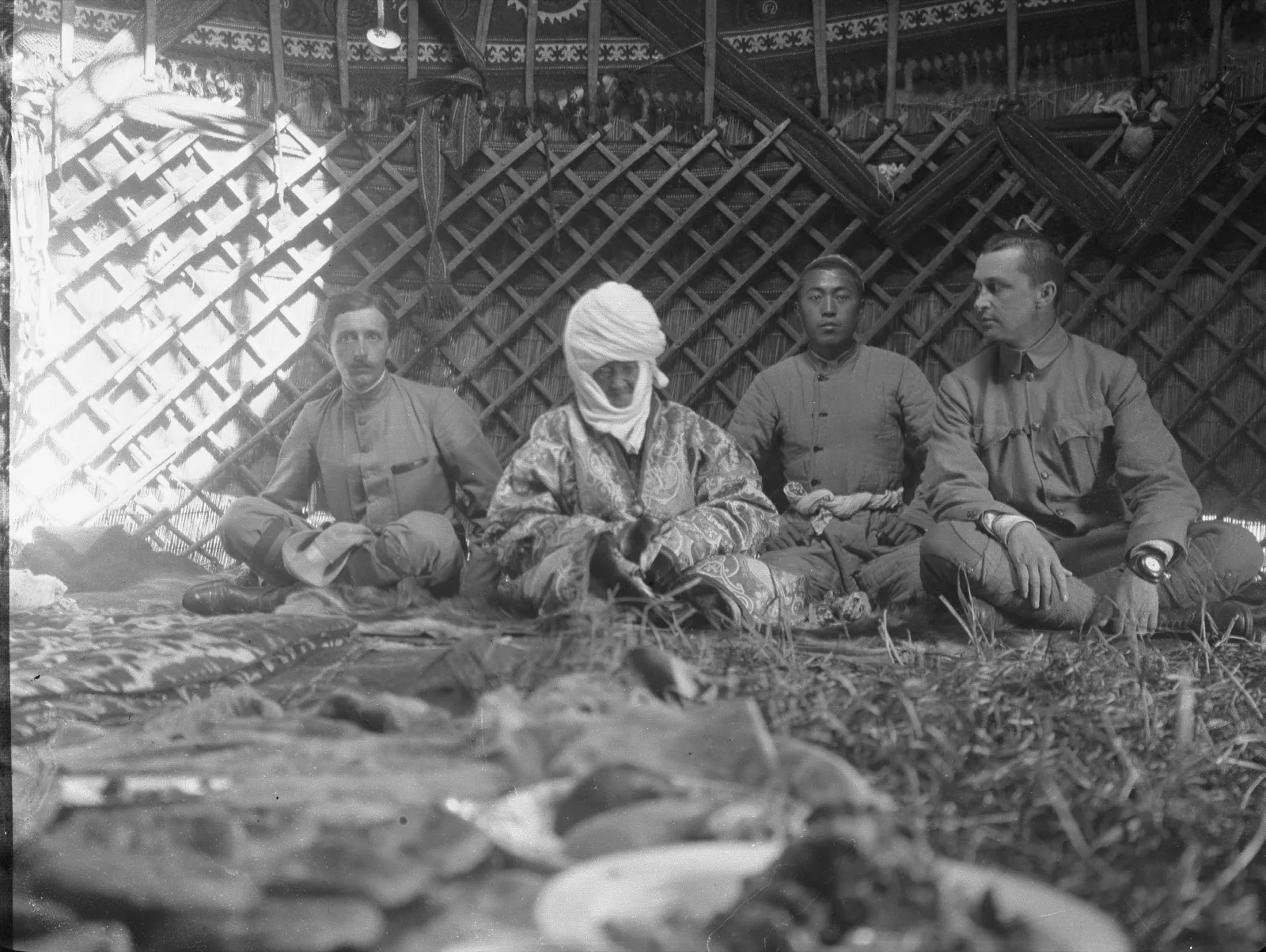 A meeting inside a yurt in Alay, 1906. Photo: Carl Gustaf Emil Mannerheim, Finnish Heritage Agency, Wikimedia Commons, CC BY 4.0; edited for this site.
Where biography ends and legend begins
“Queen of Alay”. The honorific conveys the scale of Kurmanjan’s authority, but it does not describe an official throne. “Leader of Alay” and “holder of the title datka” are historically more precise.
Leaving her first marriage. The story is well known and helps explain why Kurmanjan has become a symbol of women’s autonomy. Its details belong to later biographical tradition and should not be presented as a scene reconstructed from contemporary documents.
The poet Zynat. Some official biographies attribute poems signed Zynat to Kurmanjan. Kyrgyz historians dispute the attribution and associate the name with another author from the Kokand period. Until the manuscript evidence is settled, a poetic oeuvre cannot be treated as an established part of her biography.
Film in place of evidence. The feature film Kurmanjan Datka: Queen of the Mountains introduced the story to a new generation, but it compresses chronology and heightens dramatic scenes. It works as an entry point, while the political context should be checked separately. An interview with historian Tynchtykbek Tchoroev published by Radio Free Europe/Radio Liberty examines several disputed episodes.
Memory and places
Kurmanjan Datka’s portrait appears on the front of the 50 som banknote; the reverse shows the Uzgen architectural complex. The National Bank describes the current banknote series and its security features. A journey can connect the two designs in Uzgen, where the minaret and Karakhanid mausoleums still stand.
Osh has an equestrian monument to Kurmanjan, and streets and institutions across the country bear her name. A museum opened in Gulcha for the 180th anniversary of her birth, though opening arrangements should be checked locally before travelling. On the north shore of Issyk-Kul, the Kurmanjan Datka Centre of Nomadic Civilisation presents the wider material culture of nomadic life rather than serving as a complete biographical museum.
For travellers, the clearest geography of her memory lies in southern Kyrgyzstan: Osh, the road into Alay and Gulcha. The 1906 horseback photograph turns that landscape from a generic mountain background into the territory where Kurmanjan governed and made decisions during a transition between empires.
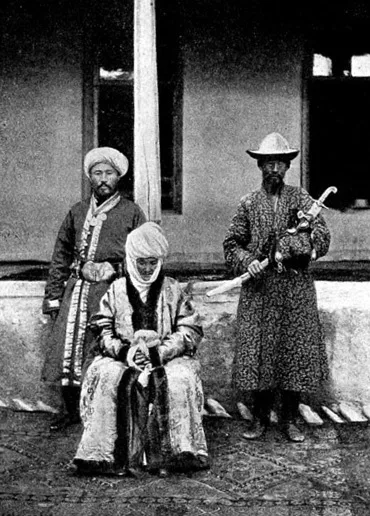 1/2. Kurmanjan Datka with her son Asanbek and an attendant, late nineteenth century Photo: unknown photographer, Istorichesky Vestnik, Wikimedia Commons, Public Domain Mark; edited for this site.
 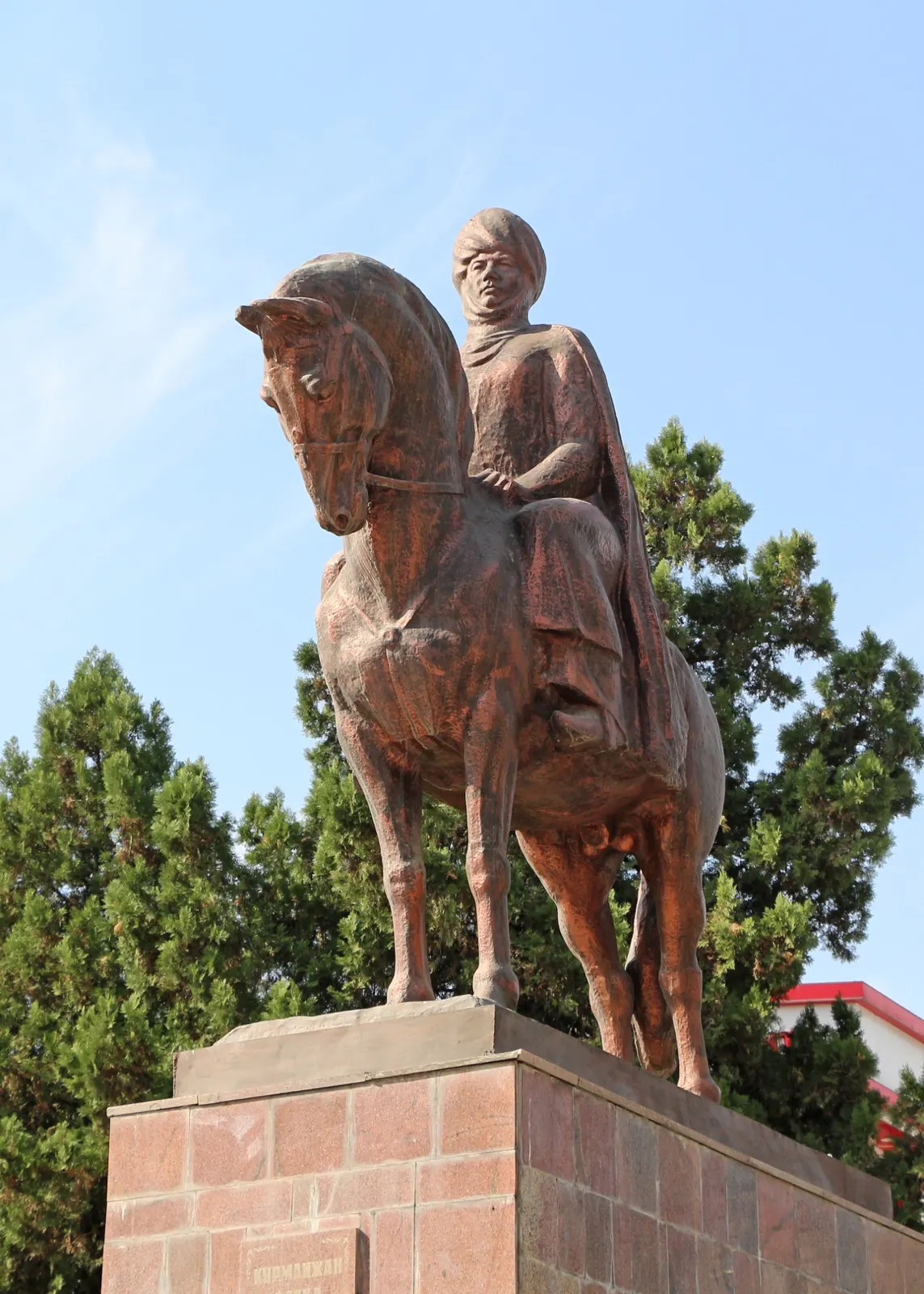 2/2. Monument to Kurmanjan Datka in Osh Photo: Bernard Gagnon, Wikimedia Commons, CC0 1.0; edited for this site.
 Frequently asked questions about Kurmanjan Datka
Who was Kurmanjan Datka?
Kurmanjan Datka was the leader of the Alay Kyrgyz and an influential intermediary in relations with the Kokand Khanate, the Emirate of Bukhara and the Russian Empire. She lived from 1811 to 1907.
What does the title datka mean?
Datka was a high administrative and military title in the Kokand Khanate and the Emirate of Bukhara. It is sometimes compared with a general or governor, although the duties varied by period and territory.
Why is Kurmanjan called the Queen of Alay?
Russian officials and later public memory used the name to express her exceptional authority in Alay. Kurmanjan was not the crowned monarch of a separate kingdom.
Who was Kurmanjan Datka’s husband?
Her husband was Alymbek Datka, an influential Kyrgyz politician in the Kokand Khanate. Kurmanjan assumed leadership in Alay after his assassination in 1862.
Who photographed Kurmanjan Datka?
Carl Gustaf Emil Mannerheim photographed her in 1906 while serving as a Russian imperial officer on an expedition across Asia. He later became Finland’s marshal and president.
Which banknote carries Kurmanjan Datka’s portrait?
Her portrait appears on the front of the 50 som banknote. The reverse of the current note shows the Uzgen architectural complex.
Share on social media
If you found this guide useful, share it on social media. It takes a moment and helps more travellers discover the project. Thank you!
Anything to add?
Share your experience, leave a comment or suggest an improvement.