Contents:
- Why Sagymbay Orozbakov matters
- Sagymbay or Sagynbay, 1867 or 1868
- Issyk-Kul, family and literacy
- How he became a manaschi
- Urkun and the life of a travelling performer
- More than Manas
- How the 1922 transcription began
- Who wrote the performance down
- What 180,378 lines actually means
- How his version differs from Sayakbay's
- Ten manuscripts and UNESCO
- Where to begin today
- Frequently asked questions
Why Sagymbay Orozbakov matters
Until the decade beginning in 1920, the great tellings of Manas lived primarily in performance. A manaschi could hold the main narrative, recurring formulas and hundreds of characters in memory, yet shape the pace, detail and transitions afresh for each audience. If a performer died without being recorded, his version disappeared with his voice.
Sagymbay became the first major manaschi whose performance was preserved through a planned, multi-year scholarly project. Between 1922 and 1926, collectors wrote down 180,378 lines from the first part of the epic trilogy. This is neither a book he composed at a desk nor the sole canon of Manas. It is the written trace of one immense performance tradition at the moment when oral art met the archive.
Our guide to the manaschi tradition explains how performers learn and work. This biography follows one individual: where he grew up, whom he listened to, how he performed, and why preserving his telling required four years, several collectors and repeated journeys across the highlands.
Sagymbay or Sagynbay, 1867 or 1868
English-language publications usually use Sagymbay Orozbakov, while Kyrgyz sources also write Sagynbay Orozbak uulu. UNESCO's international register uses Sagymbay Orozbakov. These forms refer to the same person and reflect the passage of a Kyrgyz name through Arabic, Cyrillic and Latin scripts.
Most current official Kyrgyz publications give 1867 as his year of birth. Some reference and educational works give 1868, and a few repeat plainly implausible later dates. No open civil record settles the matter beyond doubt, so this page uses 1867 while keeping the discrepancy visible.
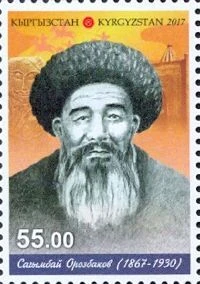 Stamp issued for Sagymbay Orozbakov's 150th anniversary
Sources place Kabyrga on different shores of Issyk-Kul: Manas Discovery describes the southern side, while a Bishkek municipal biography gives the northern shore. It is therefore safer to identify it simply as “the locality of Kabyrga by Issyk-Kul” without linking it to a present-day village.
Issyk-Kul, family and literacy
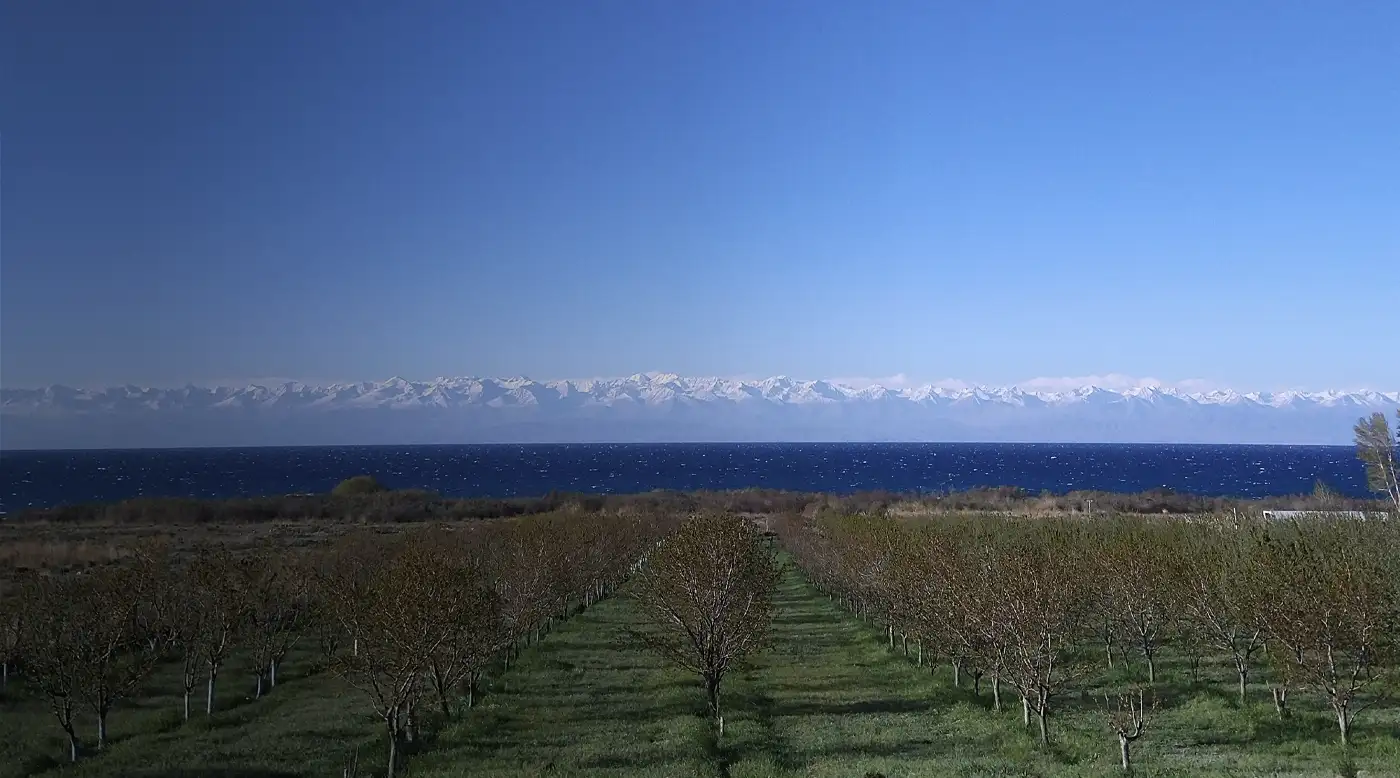 Issyk-Kul, where Sagymbay's story began
His father, Orozbak, was a musician who played the surnay or kerney. Sagymbay grew up in a culture where melody, rhythm and public performance belonged together. At about nine, he began learning to read the Arabic script with a mullah. Sources describe him as literate enough to read material in Arabic script; fluent writing is not documented.
After his father's death, the boy lived with his elder brother Alisher, who was also known as a storyteller. The family moved between Issyk-Kul, Kochkor and Kemin. His artistic education therefore did not belong to a single village: he encountered several local lineages and heard familiar episodes change in the hands of different masters.
Our route around Issyk-Kul and guide to Naryn help place these distances in the landscape. They are not a ready-made “Sagymbay trail”, but they show the scale between the lake shore, the Kochkor valley and the high summer pastures across which he travelled.
How Sagymbay became a manaschi
Before performing long epic cycles, Sagymbay composed lyrical and comic songs, laments and ceremonial announcements. Such work trained him to find words quickly, hold a crowd and adjust his tone to an occasion. He began telling Manas at about fifteen or sixteen, but this was not a sudden leap from silence to a finished monumental text.
Balyk, Naimanbay, Tynybek, Akylbek, Dyikanbay and Chonbash are all named among the older artists who influenced him. Sources disagree on whom to call his first teacher. Sagymbay heard a complete telling from Tynybek, may have learnt from his brother Alisher and absorbed techniques from several senior performers. It is more accurate to speak of a lineage than a single master.
Like many manaschi, Sagymbay explained his calling through a visionary dream. The account matters within the tradition: talent is understood not merely as technique but as a responsibility received from the epic's heroes. A biography cannot verify the dream as an event, but it can distinguish a culturally meaningful account from documented dates.
Urkun and the life of a travelling performer
During the mass flight of 1916, Sagymbay crossed into China with other refugees and returned a year or two later. Sources give both 1917 and 1918, while much of the detail survives only in later recollection. Urkun meant displacement, a dangerous journey and the collapse of ordinary ties.
Before and after those events, Sagymbay performed in Kochkor, Naryn, Kemin, the Chuy valley, around Issyk-Kul and beyond today's Kyrgyzstan. A manaschi might be invited for a winter gathering, a feast, a memorial meal or another major occasion. A recital could last for hours while listeners responded aloud, wept, argued and asked for a favourite scene to be expanded.
That audience shaped the telling. Sagymbay was not retrieving an immovable book from memory. He assembled an episode from inherited plots, formulas, descriptions and his experience of the people in front of him. Two performances of the same scene can therefore differ and still belong to the same distinctive version.
More than Manas
The fame of the great epic has obscured Sagymbay's other poetry. He created lyric songs, comic improvisations, laments and longer works about the society in which he lived. Sources single out a social and philosophical poem called Zaman.
This body of work shows an independent poet, not merely a human vessel for someone else's fixed text. A manaschi inherited characters and recurring episodes, but his command of language, structure and audience was creative. The same improvisational intelligence operated in a brief joke and a battle scene lasting several hours.
How the 1922 transcription began
Late in 1921, folklorist Kayum Miftakov heard Sagymbay near present-day Bokonbaevo and proposed recording his version. In the summer of 1922, he found the manaschi on the Solton-Sary jailoo in the Naryn region. The project belonged to a wider effort by new scholarly and educational institutions to collect oral literature.
Ybyrai Toichunov assisted with paper, ink and working conditions. Miftakov, Saparbay Sooronbaev and other collectors joined the project at its beginning, but Ybyraiym Abdrakhmanov wrote down most of the surviving text.
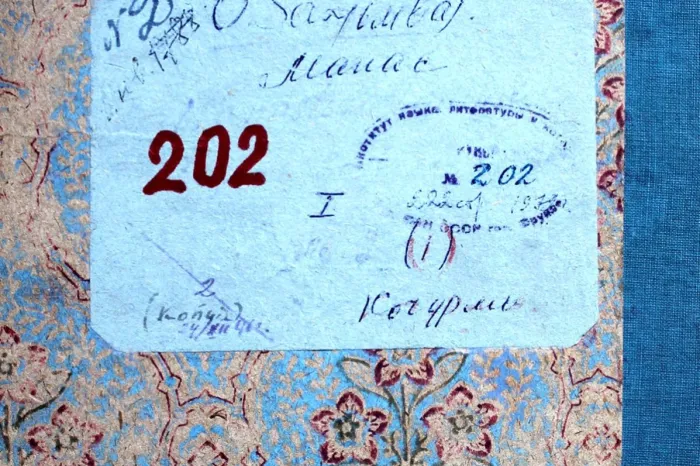 Cover of one of the ten manuscript books. Image: UNESCO, CC BY 3.0 IGO; edited for this site.
The start of the project did not mean that Sagymbay sat down with the outline of a future collected edition. The team followed him, secured paper, changed locations and arranged each continuation. Oral narration entered the manuscript slowly, in front of listeners and without sound-recording equipment.
Who wrote the performance down
Abdrakhmanov had to keep pace with the voice while preserving lineation, names, rare vocabulary and the order of each scene. The text was written in the Arabic script. Saparbay Sooronbaev helped copy the material and prepare a second set. “Sagymbay's version as transcribed by Abdrakhmanov” is therefore more precise than treating the physical handwriting as the performer's own manuscript.
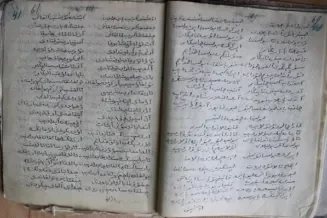 Arabic script in the manuscript of Sagymbay's version. Image: UNESCO, Abdyldazhan Akmataliev, CC BY 3.0 IGO; edited for this site.
Work continued with interruptions from the summer of 1922 until August 1926. Scholarly descriptions put the corpus at roughly 5,505 handwritten pages. Progress depended on the performer's health, household demands and the possibility of gathering another audience. The project ended not because the tradition had run out of material, but because Sagymbay's health declined.
Abdrakhmanov recalled that Sagymbay asked him about the continuity and artistic force of recently performed episodes. The detail matters: the recorder was not an invisible machine, and the manaschi understood that his voice was becoming a written text. He revisited its composition deliberately.
What 180,378 lines actually means
The figure of 180,378 belongs to the transcribed first part, Manas, which follows the central hero's life. Sagymbay knew continuations about Semetey and Seytek, but complete performances of those parts were not recorded. Calling the surviving corpus “Sagymbay's complete trilogy” is therefore inaccurate.
The large line count does not represent verbatim memorisation of a printed edition. A manaschi held the architecture of the plot, genealogies, characters, formulas and a wealth of self-contained scenes. In performance he expanded them in response to an audience and his own creative decisions.
Comparisons with the Iliad, Shahnameh or Mahabharata sound impressive but explain little. Different traditions and editors define a line and the boundaries of a corpus differently. Here the number is useful as a measure of one preserved version and of the labour required to write it down.
How his version differs from Sayakbay's
Sagymbay's version is valued for its poetic language, coherent architecture of the first part, finely worked domestic scenes and expansive battles. UNESCO describes it as classical and among the fullest, most artistically accomplished versions of Manas. That is an assessment of a particular corpus, not a declaration that all other tellings are secondary.
Collectors recorded 500,553 lines from Sayakbay Karalaev, covering Manas, Semetey, Seytek and stories about later generations. Sagymbay's surviving 180,378 lines cover only the first part. A direct contest between the totals therefore measures different degrees of preservation more than it measures memory or talent.
A more revealing comparison takes one shared episode and asks how each performer introduces a figure, chooses an image, accelerates the action and joins warfare to family life. The two versions then cease to be rivals and become distinct ways of extending the same tradition.
Ten manuscripts and UNESCO
The surviving collection consists of ten handwritten books held by the National Academy of Sciences of Kyrgyzstan. In 2023, UNESCO added them to the Memory of the World International Register. This was the first nomination submitted by Kyrgyzstan and inscribed in the programme's International Register.
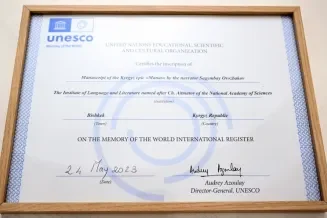 Memory of the World certificate, 2023. Image: UNESCO, CC BY 3.0 IGO; edited for this site.
The register entry recognises a specific documentary heritage from 1922-1926, not the abstract epic as a whole or the storyteller's biography. The living performance tradition of the Manas trilogy has had separate UNESCO intangible-heritage recognition since 2013. The two designations answer different questions: one concerns living practice, the other a defined group of documents.
The manuscripts survived Kyrgyz writing reforms from Arabic to Latin and then Cyrillic, ideological disputes over publishing the epic, and several generations of editorial work. Researchers can return to the recorded wording, inspect the original script and distinguish the performance from later printed revisions.
No sound recording or film of Sagymbay himself is known to survive. This makes his archive different from Sayakbay Karalaev's: Sagymbay's voice has to be approached through the rhythm of the manuscript, the recorders' recollections and the living practice of later manaschi.
Where to begin today
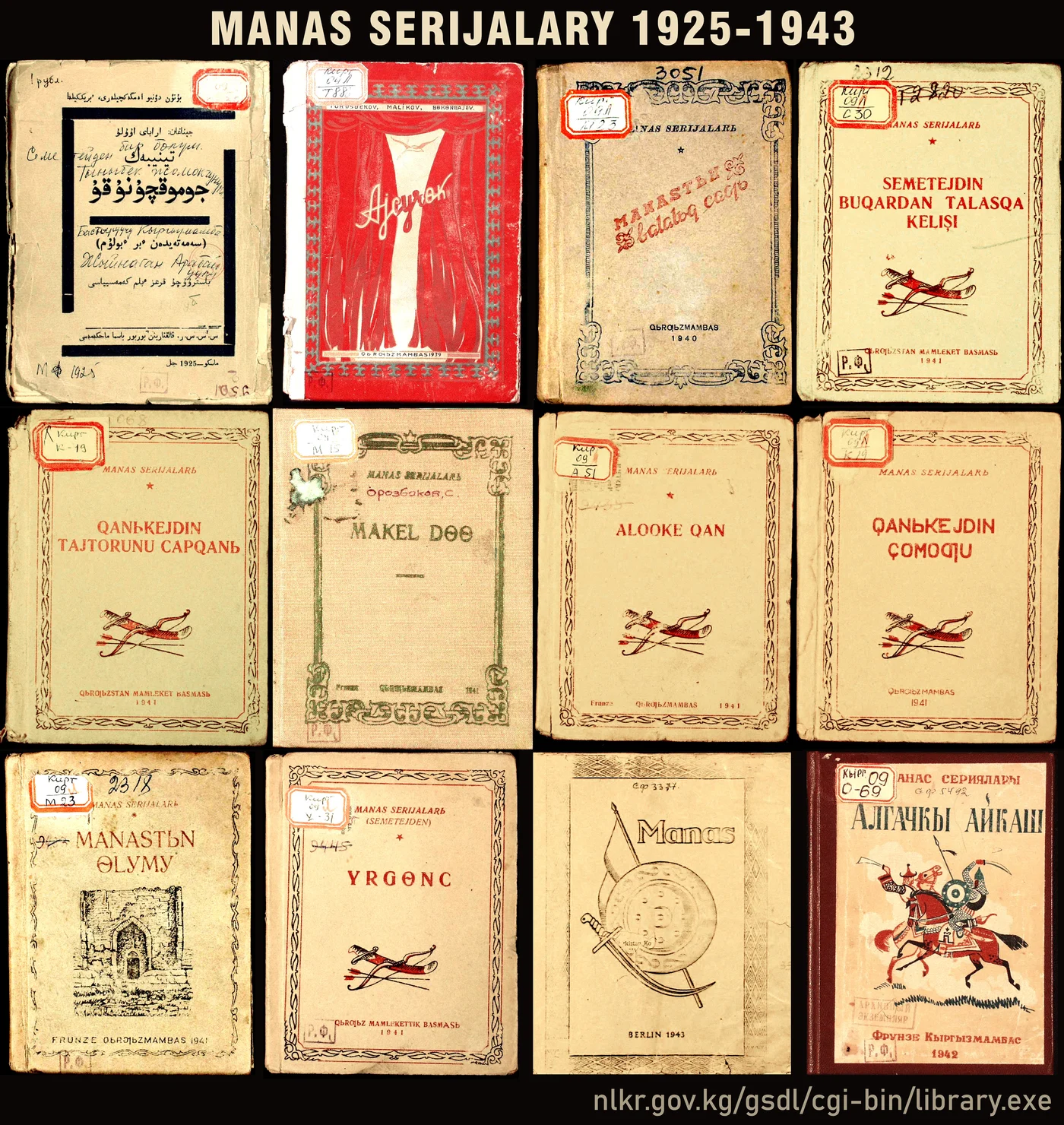 Editions of Manas from the first half of the twentieth century. Photo: Qyrgyz, Wikimedia Commons, CC BY-SA 4.0; edited for this site.
Do not begin by trying to read all 180 thousand lines in sequence. Choose a self-contained episode, perhaps the birth and childhood of Manas, Kokotoy's memorial feast or the Great Campaign. Read a concise synopsis first, then several pages of Sagymbay's version and the same scene from another performer.
UNESCO's Memory of the World page provides the essential archival context and manuscript images. The Kyrgyz Manas project offers a fuller biography, the history of the transcription and an account of Sagymbay's performance lineage. A three-volume Turkish translation appeared in 2025, showing how the manuscript continues to generate new scholarly editions and translations.
After reading, hear a living manaschi if you can. Breath, acceleration, gesture, pause and the response of listeners make immediately clear what a page leaves out. Sagymbay's manuscripts preserve an exceptional verbal corpus, but the craft behind it becomes fully legible beside a live performance.
Frequently asked questions about Sagymbay Orozbakov
Who was Sagymbay Orozbakov?
Sagymbay Orozbakov was a Kyrgyz manaschi, poet and improviser. Between 1922 and 1926, collectors transcribed 180,378 lines from his performance of the first part of Manas.
When was Sagymbay Orozbakov born?
Most current official Kyrgyz sources give 1867. Some reference works use 1868, so the discrepancy cannot be hidden entirely.
Did Sagymbay Orozbakov write the Epic of Manas?
No. He inherited an oral epic tradition and developed his own performance version. Ybyraiym Abdrakhmanov and other collectors wrote his recitations down by hand.
Who transcribed Sagymbay's version?
Folklorist Kayum Miftakov initiated the project, while Ybyraiym Abdrakhmanov wrote down most of the text between 1922 and 1926. Saparbay Sooronbaev helped prepare copies.
How many lines were recorded from Sagymbay Orozbakov?
The surviving transcription of the first part, Manas, contains 180,378 lines on about 5,505 handwritten pages. Complete tellings of Semetey and Seytek were not preserved from him.
Why are his manuscripts on UNESCO's register?
The ten books constitute Kyrgyzstan's first specially organised, multi-year transcription of a major Manas version. UNESCO inscribed this specific manuscript collection in the Memory of the World International Register in 2023.
How is Sagymbay different from Sayakbay Karalaev?
They were distinct manaschi with different poetics and performance lineages. Only the 180,378-line first part was transcribed from Sagymbay, while Sayakbay's 500,553-line corpus covers several generations of the epic.
Share on social media
If you found this guide useful, share it on social media. It takes a moment and helps more travellers discover the project. Thank you!
Anything to add?
Share your experience, leave a comment or suggest an improvement.