Contents:
- Who is a manaschi?
- What a live performance sounds like
- Why versions differ
- Manas, Semetey and Seytek
- Sagymbay Orozbakov and Sayakbay Karalaev
- Four ways to encounter the epic
- Where to hear a manaschi
- Do you need a translation?
- Listening and filming etiquette
- What to ask in advance
- What to combine it with
- Frequently asked questions
Confirm the format first: an event listing may prominently mention Manas but turn out to be a live manaschi recital, a competition, a lecture or a staged play. These are four different experiences.
Who is a manaschi?
Manaschi is the Kyrgyz name for a performer of the Manas epic. The narrator carries its plot, genealogies, recurring images and verbal formulae in memory, then shapes an episode for a particular audience and occasion. The craft is closer to live oral composition than to reading a book aloud.
A manaschi is not automatically an akyn, actor or komuz player. One person may practise more than one art, but the terms describe different traditions. Manas is generally performed solo and does not require continuous accompaniment on the komuz.
Women and men of different ages continue the tradition. Performers learn from elders, listen to other narrators and spend years developing breath, pace, imagery and transitions. Tradition bearers also speak of a calling revealed in a prophetic dream. This belief is culturally important, but it is not a biographical formula that applies to every manaschi.
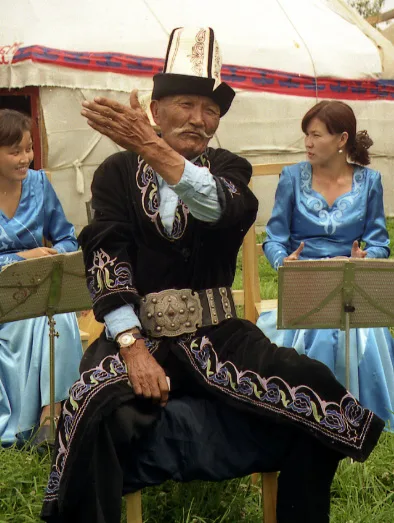 A manaschi performing beside a yurt in Karakol, 2002. Photo: SiGarb, Wikimedia Commons, public domain; edited for this site.
What a live performance sounds like
The manaschi's main instrument is the voice. Calm narration can turn within seconds into rapid recitative, a battle cry, a lament or a hero's quiet reply. Words carry only part of the scene: posture, gaze, hands and breath change with the action.
Even without Kyrgyz, listeners can often sense danger, argument, a horse charge or loss. Details of the plot will escape you, yet the form itself explains why a written synopsis cannot replace a performance. UNESCO notes that an uninterrupted telling can last up to 13 hours on exceptional occasions. Festival and visitor programmes are usually much shorter.
The narrator also works with the room. Silence leaves space to stretch a scene, laughter supports a comic passage, and people moving or talking can break the rhythm. A strong performance does not demand solemn stiffness, but it does need attention.
Why versions differ
There is no single script that every manaschi must repeat word for word. Oral transmission preserves major characters, story arcs and recognisable formulae while allowing changes in sequence, detail, dialogue and intonation. A version reflects a performer's lineage, teachers and individual style.
A printed edition captures one version at one moment. It lets researchers study language and compare episodes, but it does not invalidate other tellings. Before a performance, “Which text is the correct one?” is therefore less useful than asking whose version or which episode you will hear.
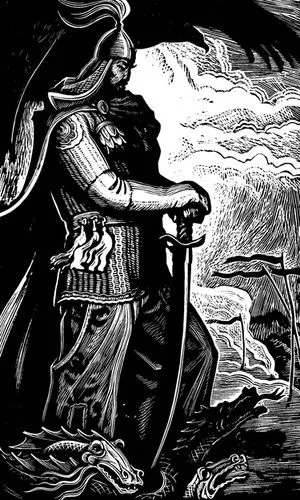 Illustration for the Manas epic, 1973. Image: Theodor Gertsen, Wikimedia Commons, CC BY-SA 4.0; edited for this site.
Manas, Semetey and Seytek
Manas, Semetey and Seytek form an epic trilogy about three generations. The first part centres on Manas, the second continues through his son Semetey, and the third through his grandson Seytek. Together they connect campaigns, family conflicts, alliances, losses and returns.
A performer does not have to cover the entire sequence in one sitting. A manaschi may specialise in one part of the trilogy or choose a self-contained episode. For a first encounter, a short scene with a clear introduction is more rewarding than a long recital with no context.
In 2013, the Kyrgyz epic trilogy was inscribed on the Representative List of the Intangible Cultural Heritage of Humanity. UNESCO's entry highlights oral transmission, distinctive rhythm and performance at public gatherings.
Sagymbay Orozbakov and Sayakbay Karalaev
Sagymbay Orozbakov and Sayakbay Karalaev are among the best-known twentieth-century manaschi. Their versions were recorded and published, making it possible to see how differently two masters could shape the same epic inheritance.
Orozbakov's version was written down between 1922 and 1926. Ten manuscript books preserving his telling were added to UNESCO's Memory of the World Register in 2023. Their value lies in recording one master's performance, not in declaring a single canon.
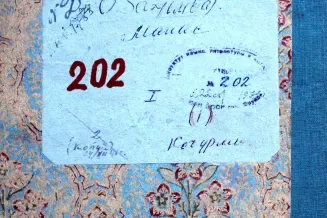 Cover of a manuscript of Sagymbay Orozbakov's version. Image: UNESCO, CC BY 3.0 IGO; edited for this site.
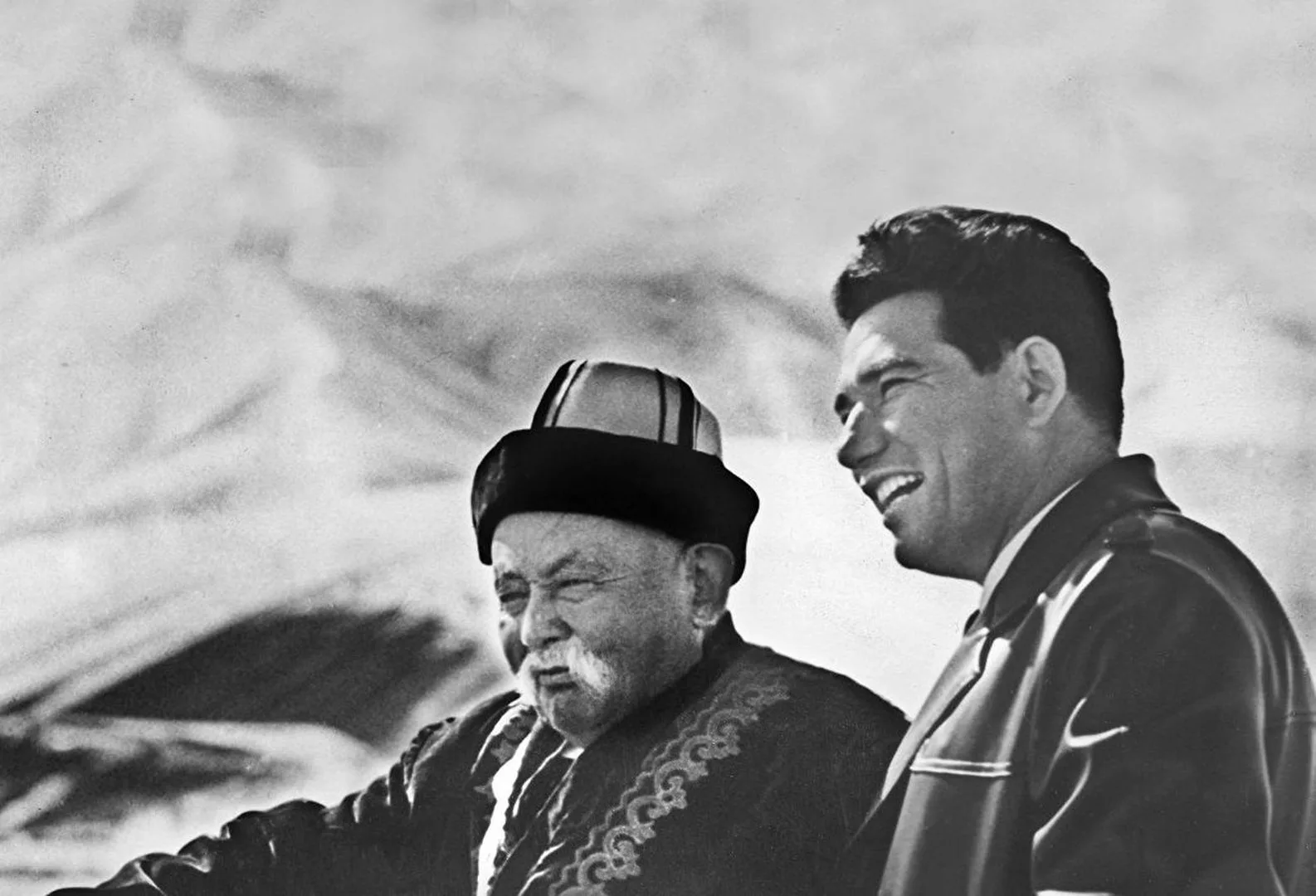 Sayakbay Karalaev and Chingiz Aitmatov, 1968. Photo: unknown photographer, Manas Ordo archive, Wikimedia Commons, CC BY-SA 4.0; edited for this site.
Karalaev's portrait appears on Kyrgyzstan's 500-som banknote. This places a manaschi in everyday visual culture: people may recognise his face long before they hear an extended live performance.
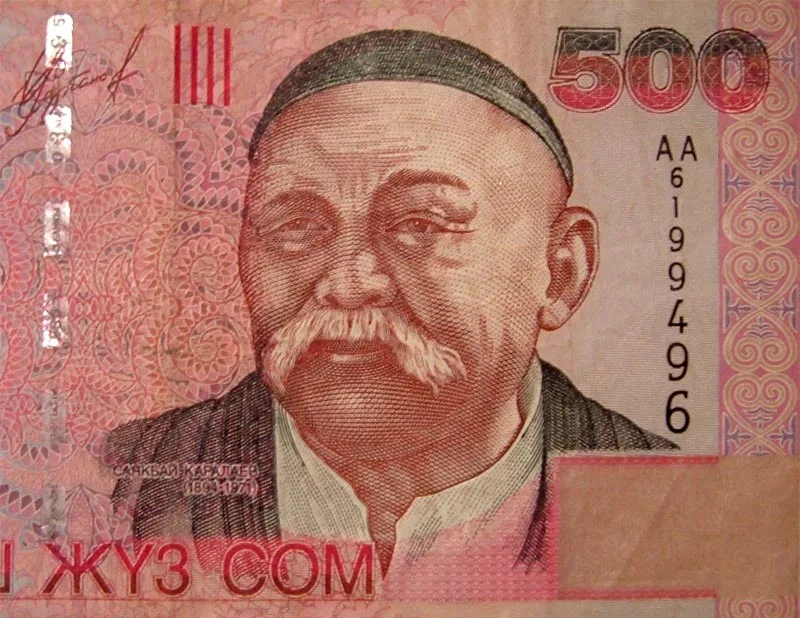 Sayakbay Karalaev on the 500-som banknote. Image: Hux, Wikimedia Commons; design by the National Bank of the Kyrgyz Republic, public domain; edited for this site.
Four ways to encounter the epic
A manaschi recital
- The narrator performs an episode in Kyrgyz.
- Rhythm, voice and gesture matter as much as a plot summary.
- Choose this if you want to hear the oral tradition itself.
A manaschi contest
- Several performers take turns presenting separate passages.
- You can compare pace and style, although each slot is time-limited.
- Check whether the event is open to spectators.
A theatre production
- Actors, scenery and direction turn the story into a staged work.
- The production may draw on one particular version.
- It introduces the plot but may not include a manaschi recital.
A talk with a short excerpt
- A host explains the characters and places the scene in the trilogy.
- A short performance is followed by questions.
- This is the easiest format if you do not speak Kyrgyz.
Where to hear a manaschi
In Bishkek, check programmes at the National Manas Theatre, cultural centres, the philharmonic, museums and city festivals. Events become more common around 4 December, the Day of the Manas Epic. Performers and public access change from year to year, so a current programme is more useful than an old report about a past concert.
In Talas, the epic is closely associated with the Manas Ordo complex and regional cultural programmes. A visit to the complex does not guarantee a performance. If hearing a manaschi matters to your trip, contact the venue or a local organiser in advance and confirm the performer, language, duration and price.
Short recitals also appear at ethnographic festivals, public holidays, school and university contests, yurt camps and visitor programmes. In a tour description, look for the narrator's name or the explicit phrase “live manaschi performance”, not just the word Manas.
A useful check: ask the organiser for a current poster or a two-sentence programme description. It quickly separates a recital from a lecture or play.
Do you need a translation?
A manaschi performs in Kyrgyz. Full simultaneous translation makes it harder to hear the voice and rhythm, while a literal line-by-line rendering cannot preserve the verbal formulae. For a first visit, ask for a concise introduction before the performance: who is present, what has already happened and which conflict to follow.
After the excerpt, an interpreter can unpack a few important lines and explain the audience's reaction. For a programme longer than an hour, ask how it is divided and whether there is a break. A 15 to 30-minute recital with context is often more rewarding for a child or first-time listener than a long performance with no guidance.
Listening and filming etiquette
-
Arrive before it begins
Find the room, settle your coat and choose a seat before the narrator establishes the rhythm.
-
Silence screens and flashes
Put your phone on silent. A bright screen or flash is visible to the performer and everyone nearby.
-
Agree on recording
Ask beforehand whether you may film, publish an excerpt or take a close portrait. The venue and performer may set different conditions.
-
Do not interrupt an episode
Save questions, requests to repeat a line and translation discussions until the selected passage is complete.
-
Thank and credit the performer
If you post a photograph or note, confirm the manaschi's name and the venue spelling.
What to ask in advance
- Who is performing: the manaschi's name and lineage, if stated.
- What you will hear: the part of the trilogy and the episode's title or short synopsis.
- How long it lasts: the recital itself, introduction and discussion.
- How translation works: an opening summary, subtitles, printed notes or a discussion afterwards.
- Whether registration is required: some contests and educational events are not open to walk-in visitors.
- Whether recording is allowed: ask separately about video, audio, flash and publication.
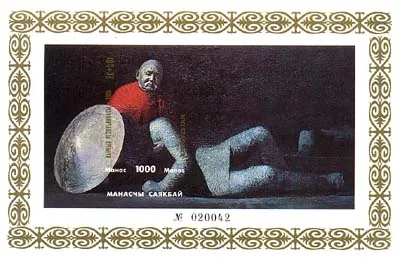 Postage stamp marking the centenary of Sayakbay Karalaev, 1995. Image: Kyrgyzstan Post, Wikimedia Commons, public domain; edited for this site.
What to combine it with
In Bishkek, continue the subject through museums and programmes on Kyrgyz culture. In the Talas region, Manas Ordo adds geographical and memorial context. Do not squeeze a long performance between two tours: leave time afterwards for questions and a quiet pause.
Manaschi show how heritage exists through practice. You can see the same principle in the work of berkutchi, traditional archery and the making of an ak-kalpak: a museum object explains form, while meeting a practitioner reveals skill, decisions and the living transfer of knowledge.
Frequently asked questions
Does a manaschi memorise the whole epic?
A manaschi holds plots, formulae and long passages in memory, but a live performance is not a word-for-word repetition of one book. The narrator shapes composition, pace and intonation for the episode and audience.
Do I need to speak Kyrgyz?
Not to hear the rhythm, voice and gesture. To follow the story, ask for a short synopsis before the recital and an explanation afterwards. Whispered line-by-line translation usually gets in the way.
Is Manas performed with a komuz?
Manas is generally performed solo without obligatory instrumental accompaniment. A komuz may appear elsewhere in the programme, but it is not required for every manaschi recital.
How long does a performance last?
A festival excerpt may take a few minutes, an interpreted session about an hour, and an extended traditional recital much longer. UNESCO mentions uninterrupted tellings of up to 13 hours, but this is not a standard visitor format.
Where am I guaranteed to hear a manaschi?
There is no universal daily schedule. Check current programmes at the National Manas Theatre, cultural institutions, Manas Ordo and festivals, then confirm the exact format with the organiser.
May I film the performance?
Only after checking with the performer or venue. Permission to take photographs does not automatically include a long video recording or publication of the sound.
Share on social media
If you found this guide useful, share it on social media. It takes a moment and helps more travellers discover the project. Thank you!
Anything to add?
Share your experience, leave a comment or suggest an improvement.