Contents:
Why Togolok Moldo matters
Togolok Moldo worked at the meeting point of two literary worlds. As an akyn and Manas reciter, he performed for listeners and carried stories, songs, proverbs and epic episodes in memory. As a literate author and collector, he also wrote down his own work and material drawn from oral tradition. Those manuscripts allowed later scholars to study more than second-hand recollections of a vanished performance.
No single label covers his career. He wrote lyric and satirical verse, worked with fables and longer poems, recited epic narratives and collected folklore. Many visitors first meet his name on a banknote or a Bishkek street sign. The biography behind that familiar portrait is about literacy becoming a tool for preserving the spoken word.
He was born on 10 June 1860 and died on 4 January 1942. During that lifetime, Naryn and the Chuy Valley passed through the late Russian imperial period, the upheaval of 1916, revolution and the formation of the Soviet republic. His pre-revolutionary and Soviet-era works therefore belong to different political settings. Reading them in sequence is more useful than forcing his life into one tidy ideological story.
His name and pen name
The poet’s name is given as Bayymbet Abdrakhman uulu. Russian-language sources from the Soviet period commonly render it as Bayymbet Abdrakhmanov or Abdyrakhmanov. He was born in Kurtka, in what is now the Ak-Talaa District of Naryn Region.
A formative figure in his childhood was Muzooke, an older relative, komuz player and teller of epic narratives. He introduced Bayymbet to folktales and episodes from Manas, Kurmanbek, Er Toshtuk, Janyl Myrza and other cycles. According to the National Bank’s biographical note, Bayymbet began composing and writing down poetry at about fourteen.
His pen name refers to both appearance and literacy. Togolok is usually connected with his stocky build and round face; in this context, moldo identified a man who could read and write. A literal English translation misses some of the social meaning, but it explains how a nickname became his lasting literary name.
From oral performance to manuscript
While living in the Chuy Valley, Bayymbet encountered Kyrgyz and Kazakh improvising poets, read classical Persianate and Turkic authors, and learnt epic narration from the manaschi Tynybek. In that environment, a narrative did not exist as one final edition. A performer retained its plot, formulas and imagery, then assembled the telling anew for each audience.
Togolok Moldo transferred part of that living material to paper. He recorded his own version of Semetey and collected legends, proverbs and sayings. The National Academy of Sciences lists a separate 680-page edition of Manas in Togolok Moldo’s version. It should be understood as one performer’s coherent tradition, not as a corrected master text of the epic.
The distinction remains useful today. Our guide to Manas reciters explains why the epic has no single immutable wording. Togolok Moldo’s life shows the next stage: how one performer’s version could become a manuscript, an archive object and eventually a printed book.
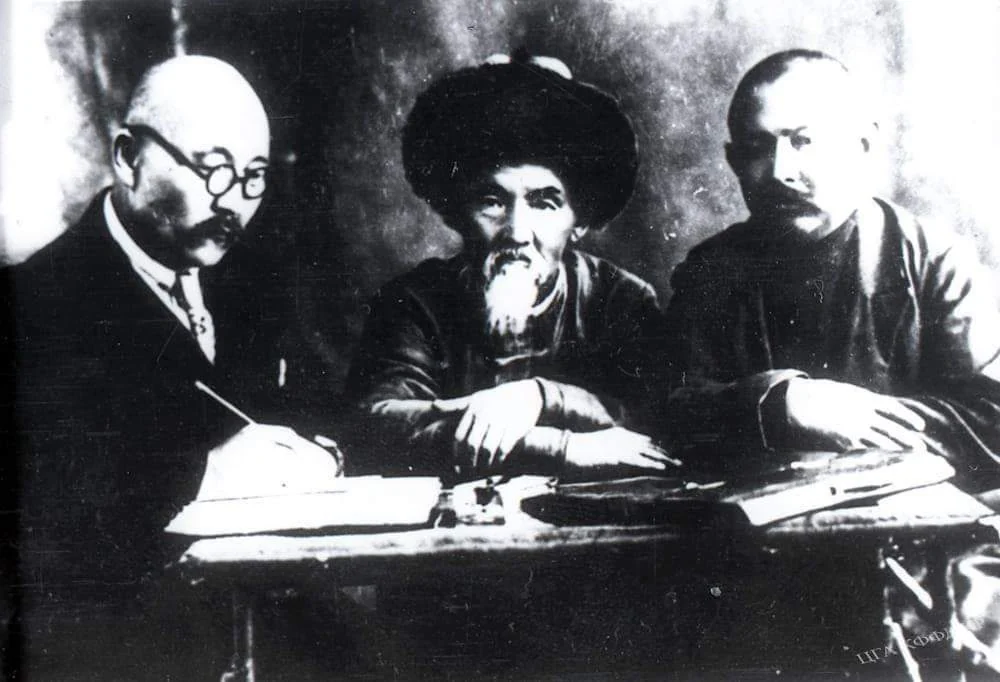
Togolok Moldo sits in the centre of this 1930s photograph. Ybraiym Abdyrakhmanov, identified in the archive caption as his personal secretary, is on the left; the manaschi Sayakbay Karalayev is on the right. The image brings together people through whom oral performance entered twentieth-century archives.
What he wrote
His early work included love poetry and verses addressing women’s position within customary society. The National Bank biography lists Black-Eyed, Tolgonai, a young man’s address to a woman, a woman’s answering address and the longer poem Urpukan. Titles vary in Russian and English translation, so readers should always check which Kyrgyz edition a translation follows.
Another strand of his writing used satire and allegory. Kyrgyz school literature places works such as Kemchontoy and Kushtardyn angemesi alongside animal fables and poems that expose greed, vanity or injustice through argument and comic exaggeration. The form allowed an ethical point to emerge through action rather than a dry lesson.
Soviet criticism often divided the corpus into writing produced before and after the revolution, stressing social protest in one period and support for the new order in the other. That framework is now part of the history of how Togolok Moldo was edited and canonised. It helps explain official publication, but it should not flatten the variety of his genres and audiences.
Publication and later life
Togolok Moldo’s work began to appear in print in 1925. One of the first publications was Nasyat, often translated as Instruction or Counsel. Print changed the conditions of reception: writing rooted in performance could now reach a reader without the akyn being present.
He joined the Writers’ Union of Kyrgyzstan in 1938. In 1939 he took part in the first Decade of Kyrgyz Art and Literature in Moscow and received the Order of the Badge of Honour. These facts place him inside the Soviet cultural system, which preserved manuscripts and supported new editions while also constructing an official image of the “people’s akyn”.
Togolok Moldo died in 1942 in his home region. The portrait used at the top of this page was made a year before his death. It is more revealing than a later idealised likeness: it shows the elderly individual whose handwritten work would continue through institutes, school curricula and modern editions.
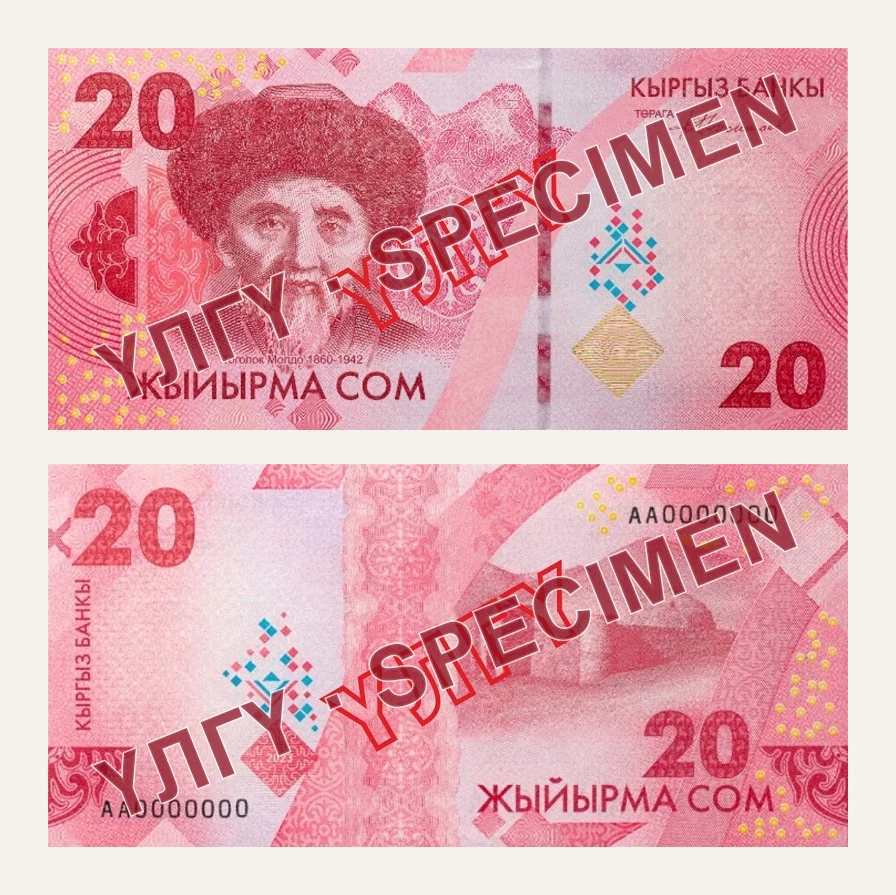
The portrait on 20 som
Togolok Moldo appears on the front of Kyrgyzstan’s current 20 som banknote. The reverse shows the Tash Rabat caravanserai in Naryn Region. A separate guide explains the 20 som design, its issues and security features.
His name also appears on streets, schools and settlements, and a monument stands in Bishkek. Such public commemoration makes a person recognisable while compressing a complicated life into a handful of symbols. The banknote is a good starting point, but the manuscripts explain why his work became part of national memory.
Where to begin reading
A short genre is the easiest entry. The fables reveal his satirical voice, lyric poetry shows how he handles direct address, and an epic variant demands more time and some understanding of performance practice. If you rely on translation, check the translator and source edition: two books with the same English title may not reproduce the same Kyrgyz text.
The next useful comparison is with Toktogul Satylganov and Sayakbay Karalayev. Toktogul opens another path into akyn improvisation and komuz culture, while Karalayev shows the scale of twentieth-century Manas performance. Our article on the komuz introduces the musical setting in which many songs and improvised verses circulated.
The National Bank of the Kyrgyz Republic publishes a detailed biographical note. The National Academy of Sciences lists academic editions of Manas variants, including Togolok Moldo’s.
Frequently asked questions about Togolok Moldo
What was Togolok Moldo’s real name?
His name was Bayymbet Abdrakhman uulu. Russian-language sources commonly use the forms Bayymbet Abdrakhmanov and Bayymbet Abdyrakhmanov.
Who was Togolok Moldo?
He was a Kyrgyz akyn, written poet, Manas reciter and collector of folklore. He performed oral narratives while also recording his own writing and epic variants.
What does the name Togolok Moldo mean?
The pen name is usually linked to his stocky, round-faced appearance and his literacy. In this biographical context, moldo referred to a man able to read and write.
Which banknote features Togolok Moldo?
His portrait appears on the front of Kyrgyzstan’s 20 som banknote. The reverse of the current issue depicts the Tash Rabat caravanserai.
Share on social media
If you found this guide useful, share it on social media. It takes a moment and helps more travellers discover the project. Thank you!
Anything to add?
Share your experience, leave a comment or suggest an improvement.