Contents:
- What can actually be known about Yusuf
- Why his name has so many forms
- Balasagun, Kashgar and the Khass Hajib title
- What Kutadgu Bilig means
- Four characters and four principles
- What the poem tells a ruler
- Language and poetic form
- Three manuscripts, no original
- Why the banknote is not a true portrait
- Balasagun, Burana and modern remembrance
- A good way to begin reading
- Frequently asked questions
What can actually be known about Yusuf
This medieval life does not come with the archive that readers expect from a modern biography. There is no birth record, personal correspondence, contemporary portrait or continuous record of court service. Most information about Yusuf comes from Kutadgu Bilig itself and from two prefaces added later, one in prose and one in verse. The responsible approach is therefore to work with a handful of firm points rather than fill every gap.
The author came from Balasagun, a centre of the Karakhanid realm. He completed his book in Kashgar in the Islamic year 462, corresponding to 1069-1070, and presented it to a ruler. He then received the title Khass Hajib, a senior court office. These details run through the manuscript tradition and fit the political setting in which the work was composed.
Modern biographies often give a birth year of 1015, 1018 or about 1019, and 1077 as the year of death. These are estimates or products of later tradition rather than fully documented dates. Detailed claims about formal study in Bukhara, Farab and several other cities deserve the same caution. The work proves that its author was highly educated; it cannot provide a complete itinerary of his education.
Why his name has so many forms
Yusuf Balasaguni is the most familiar academic English form. Kyrgyz uses Zhusup Balasagyn, Turkish scholarship often has Yusuf Has Hacib, and older English works may write Yūsuf Khāṣṣ Ḥājib. These are not different people. They reflect the passage of a medieval name through Arabic, Turkic, Cyrillic and Latin scripts.
Balasaguni means “of Balasagun”. Khass Hajib is neither a family name nor a birth name. It was the title of a court officer close to the ruler, concerned with access, ceremony and the movement of petitions through the palace. Yusuf devotes considerable attention to the qualities required of such a servant, which makes the award particularly fitting.
Balasagun, Kashgar and the Khass Hajib title
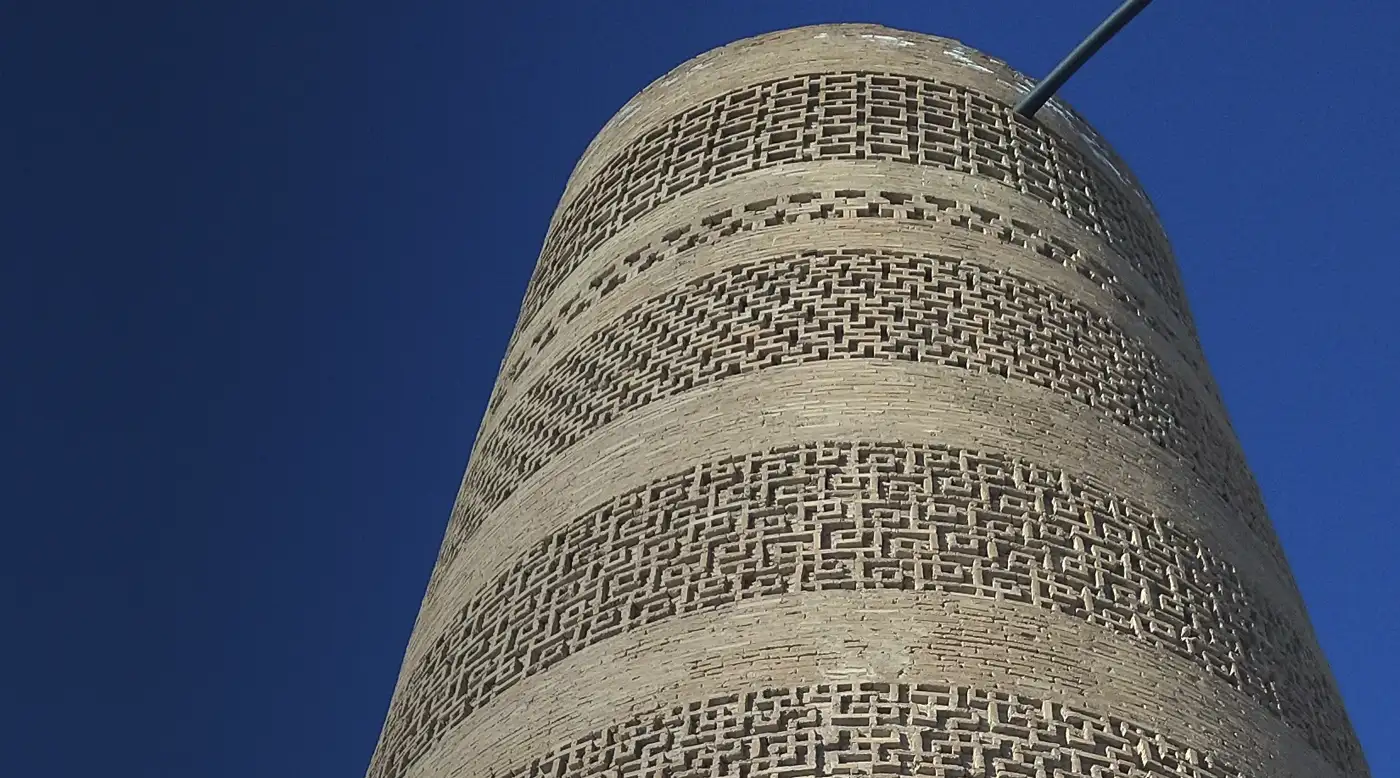 Burana Tower and the site of Balasagun
Balasagun stood in the Chüy Valley and was one of the political and cultural centres of the Karakhanids in the tenth and eleventh centuries. The settlement around Burana Tower is widely identified with the city and now forms part of UNESCO’s serial Silk Roads World Heritage site. Our separate guide to Burana and Balasagun explains what survives and how to explore the complex.
Kashgar lay at the other end of the eastern Karakhanid world. Yusuf completed the manuscript there and presented it to Tavghach Uluq Bughra Khan. This was not a solitary philosopher writing beyond politics. He was an educated court author addressing power in a language that power understood: counsel, poetic narrative, official roles and the consequences of human choices.
The movement between the two cities matters more than a modern argument over which nation “owns” him. The Karakhanid realm long predates the present borders of Kyrgyzstan, China, Uzbekistan and Kazakhstan. Balasaguni belongs profoundly to Kyrgyzstan’s cultural history, but he did not inhabit the national categories of the twenty-first century.
What Kutadgu Bilig means
The title appears in English as The Wisdom of Royal Glory, Wisdom Which Brings Good Fortune and Knowledge for Happiness. The difference is meaningful rather than careless. The word kut gathers together happiness, grace, fortune and the legitimacy that attends rule, while bilig means knowledge. A translator has to decide whether the title points first towards personal fulfilment or the conditions of good government.
The work belongs to the “mirror for princes” tradition. Such books asked what makes a good ruler, how officials should be chosen, what destroys trust and why private discipline matters to public order. Yet Kutadgu Bilig is not merely a checklist. Its principles emerge from meetings, questions and arguments in which every neat answer opens another difficulty.
Calling it a constitution, a modern administration manual or a novel flattens the work. Yusuf describes an ideal order for his own age, combining Inner Asian ideas of rulership with Islamic ethics and with literary forms circulating across the wider intellectual world of Central Asia.
Four characters and four principles
The poem turns on four speakers. The ruler Kün Togdi represents just law. His name evokes the rising sun: justice should cast the same light on everyone. The vizier Ay Toldi embodies kut, fortune and worldly happiness. Like the moon, fortune waxes and wanes, so no position at court is permanently secure.
Ögdülmish, the vizier’s son, stands for intellect and acquired knowledge. He answers the ruler’s practical questions: whom to appoint, what makes a good commander, secretary, treasurer or ambassador, and how to deal with scholars, craftspeople and farmers. Odgurmish, a relative of Ögdülmish and a recluse, represents life’s end, restraint and the limits of worldly desire.
These people are more than labels in an allegorical diagram. They visit, argue, persuade and redirect the conversation. Political philosophy becomes a drama of judgement: justice needs fortune, fortune requires intelligence, and every achievement remains limited by time and death.
What the poem tells a ruler
The central proposition is both clear and demanding: power cannot rest on force alone. A ruler must uphold just law, listen to informed counsel, master anger and understand the obligations that join a court to the wider community. Yusuf does not speak only of abstract virtue. He describes the skills of particular offices and the damage caused by a poor appointment.
Individual chapters consider the vizier, commander, hajib, ambassador, confidential secretary, treasurer, cook and cupbearer. The discussion then extends to scholars, doctors, poets, farmers, herders, artisans and the poor. This range makes the poem a valuable source for social history, although its ordered society is an author’s ideal rather than a transparent record of everyday life in the eleventh century.
A second tension runs between service in the world and withdrawal from it. Ögdülmish argues for intelligent participation; Odgurmish insists that office, wealth and fame come to an end. Yusuf refuses to dissolve the tension into a slogan. He asks the ruler to remember death while continuing to accept responsibility for the living.
Language and poetic form
Kutadgu Bilig was written in Karakhanid Turkic, conventionally placed within the Middle Turkic period. It is not modern Kyrgyz, Turkish or Uyghur, even though several Turkic-speaking cultures recognise a shared inheritance in it. This historical distance helps explain the variety of modern titles, spellings and claims surrounding the author.
The main text uses rhymed couplets and the quantitative metre known as aruz. The standard critical edition numbers 6,645 couplets, but totals vary when prefaces and appended passages are counted in different ways. Any spectacular claim about the exact number of “lines” should therefore name the edition and its method of counting.
Verse is doing intellectual work. Rhythm carries an extended argument, parallel structures connect a claim to its example, and compact formulations make advice memorable. A prose summary can explain the subjects, but it cannot reproduce the way form holds the book together.
Three manuscripts, no original
Yusuf’s own copy has not survived. The text is reconstructed from three later manuscripts: Fergana, Cairo and Herat, the last better known as the Vienna manuscript because of its present home. Centuries of copying stand between the composition and every surviving witness.
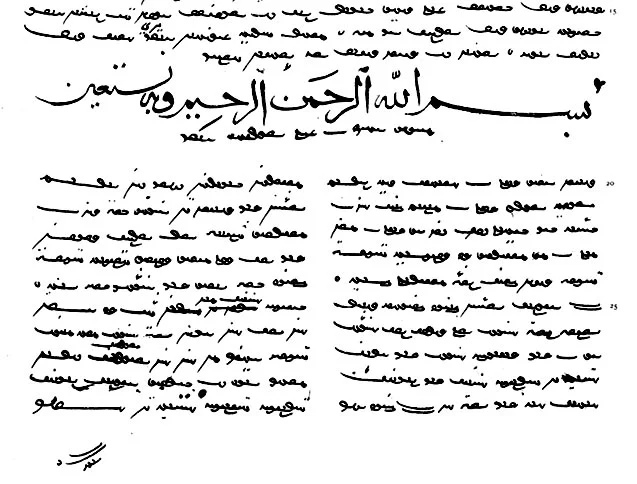 A page of the Vienna manuscript, copied in the Old Uyghur script in 1439
The Vienna manuscript was copied at Herat in 1439 in the Old Uyghur script from an exemplar written in Arabic letters. The Fergana and Cairo manuscripts use Arabic script. Each has omissions, variant readings and a distinct history of ownership. An editor cannot select one “true photograph” of the poem; the work has to be recovered by comparing all the evidence.
That is why an academic study of the three manuscripts and their owners is more useful than the appealing story of a miraculously preserved original. Reşit Rahmeti Arat’s twentieth-century critical edition drew on all three witnesses and became the basis for many modern translations.
Why the banknote is not a true portrait
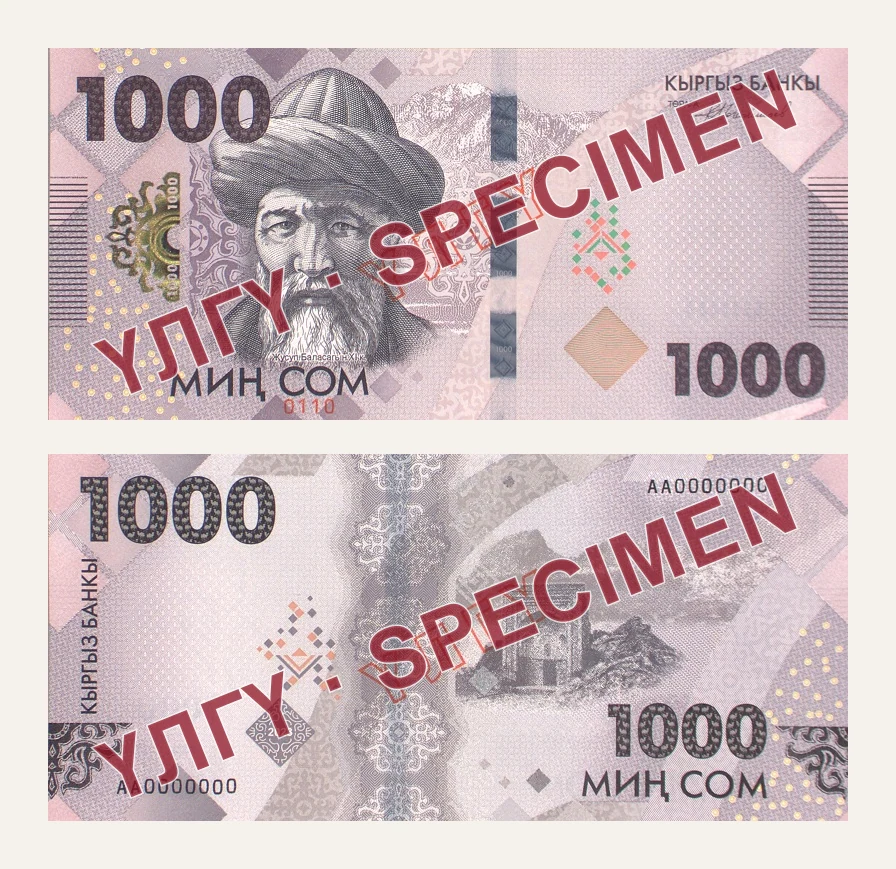 Yusuf Balasaguni on the 1,000 som banknote
Yusuf appears on the front of Kyrgyzstan’s 1,000 som banknote. The reverse shows Takhti-Suleiman, today’s Sulaiman-Too in Osh. The portrait identifies the national series and expresses Yusuf’s place in public memory, but it cannot tell us what he looked like.
No contemporary portrait or reliable physical description survives. The face on the note is a modern commemorative image and should be read as one reads a monument: evidence of later remembrance, not visual evidence from the eleventh century. That is why this page uses a manuscript as its cover rather than pretend that a modern reconstruction is a photograph.
The reverse of the banknote opens a different historical landscape. Our walking route on Sulaiman-Too covers the sacred mountain, museum and views over Osh without folding them into the poet’s biography.
Balasagun, Burana and modern remembrance
For a traveller, the nearest physical link to Yusuf’s world lies in a landscape rather than a face. From Tokmok, Burana is an easy trip. You can climb the minaret and walk the earthworks of the former city. Few complete structures remain above ground, but the size of the site makes it easier to imagine the network of trade, worship and court culture in which a book like Kutadgu Bilig became possible.
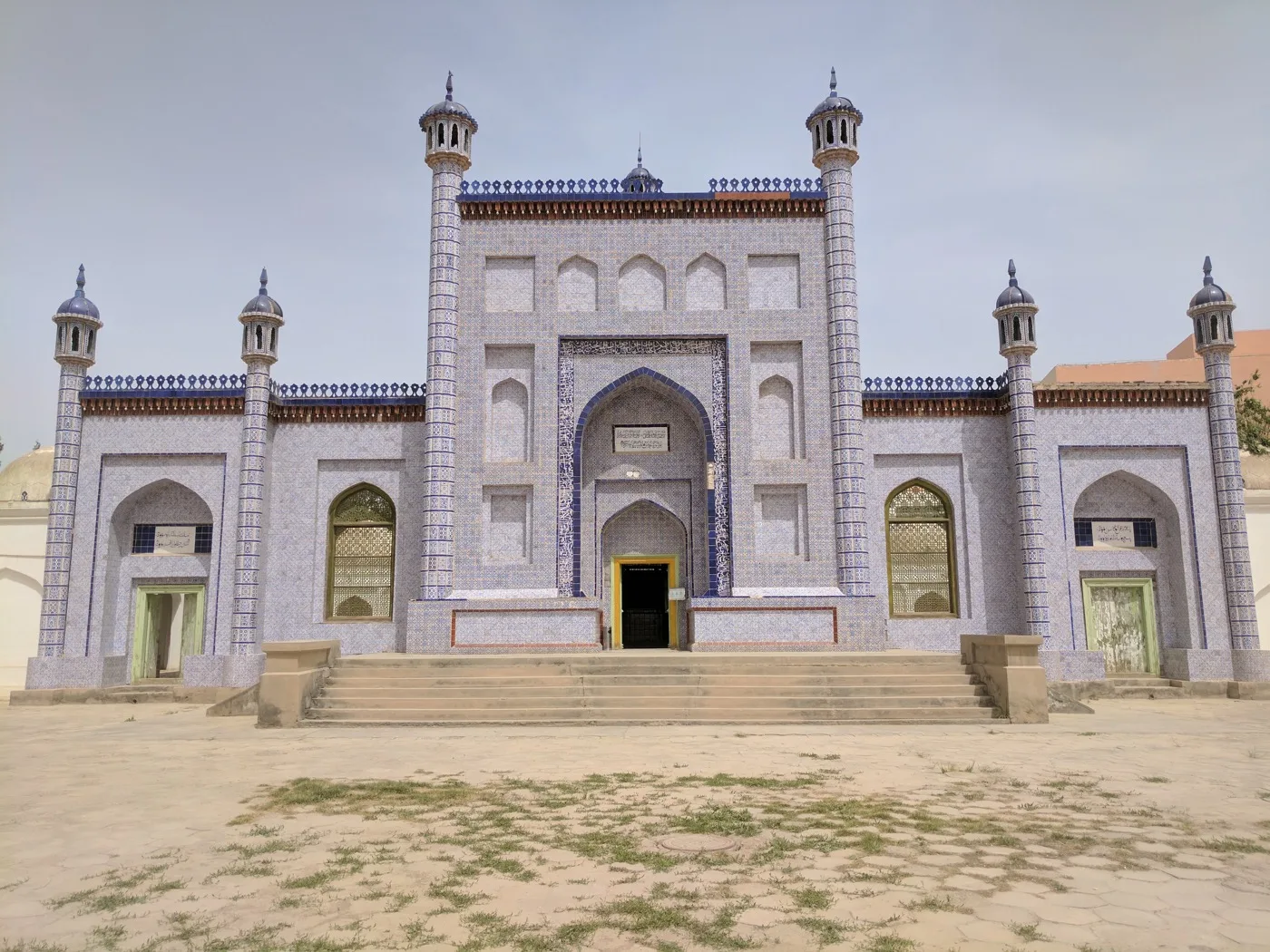 The mausoleum dedicated to Yusuf Khass Hajib in Kashgar. Photo: Voidvector, Wikimedia Commons, CC BY-SA 4.0; edited for this site.
Kashgar has a mausoleum dedicated to Yusuf Khass Hajib. It is an important place of remembrance, but the present building cannot by itself prove that an eleventh-century burial has been archaeologically identified. This distinction respects the memorial without turning devotion into documentary evidence.
Universities, streets and institutions carry Balasaguni’s name, and his face circulates on money. Commemoration makes him visible, but it can also seal a writer inside the bronze image of an all-purpose sage. Reading restores a more interesting person: an author who stages disagreement, distrusts permanent fortune and expects rulers to answer to justice.
A good way to begin reading
Do not begin by trying to read the whole poem without a guide. Choose a translation with a useful introduction and notes, then read the scene that introduces the four central figures. Follow it with one practical sequence about the ruler, ambassador, scholar or artisan. This reveals how allegory becomes an account of everyday responsibility.
Compare a short passage in two translations. Variants in names, title and key concepts expose the distance between Karakhanid Turkic and a modern language. If a version sounds completely contemporary, the notes should show which choices the translator has made.
For the political and cultural setting, the Encyclopaedia Iranica overview of the Karakhanids is a useful next step. Burana then stops being an isolated tower: manuscript, eleventh-century court and the present Chüy Valley begin to share one historical frame.
Frequently asked questions about Yusuf Balasaguni
Who was Yusuf Balasaguni?
Yusuf Balasaguni was an eleventh-century Turkic poet and thinker from Balasagun, best known as the author of Kutadgu Bilig. He received the title Khass Hajib after presenting the work to a Karakhanid ruler.
When did Yusuf Balasaguni live?
He lived in the eleventh century and completed Kutadgu Bilig in 1069-1070. Exact years of birth and death are not documented; dates around 1019 and 1077 are reconstructions.
What does Kutadgu Bilig mean?
The title joins ideas of fortune, grace or happiness with knowledge. It is variously translated as Wisdom of Royal Glory, Knowledge for Happiness and Wisdom Which Brings Good Fortune.
What language did Yusuf use?
He wrote in Karakhanid Turkic, a literary language of the Middle Turkic period. It should not be equated directly with one modern Turkic language.
Does Yusuf’s original manuscript survive?
No. The text is reconstructed from three later manuscripts known as the Fergana, Cairo and Herat or Vienna copies.
Is the portrait on the 1,000 som note authentic?
It is a modern commemorative image. No reliable contemporary portrait or description of Yusuf’s appearance is known.
Share on social media
If you found this guide useful, share it on social media. It takes a moment and helps more travellers discover the project. Thank you!
Anything to add?
Share your experience, leave a comment or suggest an improvement.