Contents:
Which Sulaiman-Too route should you take?
The main option crosses the mountain in one direction. Start at the gentler southwest entrance, climb to the cave museum, stay on the equipped route to Babur's prayer cell on the eastern peak, then descend the steep staircase towards the main museum complex. Allow between one and a half and two and a half hours without entering the museum, or half a day if you see the exhibition and linger at the viewpoints.
The short option begins at the eastern entrance. The stairs to Babur's prayer cell and the viewpoint take roughly 20-30 minutes each way, after which you return the same way. This route is shorter but distinctly steeper and will not suit anyone who struggles with long flights of steps.
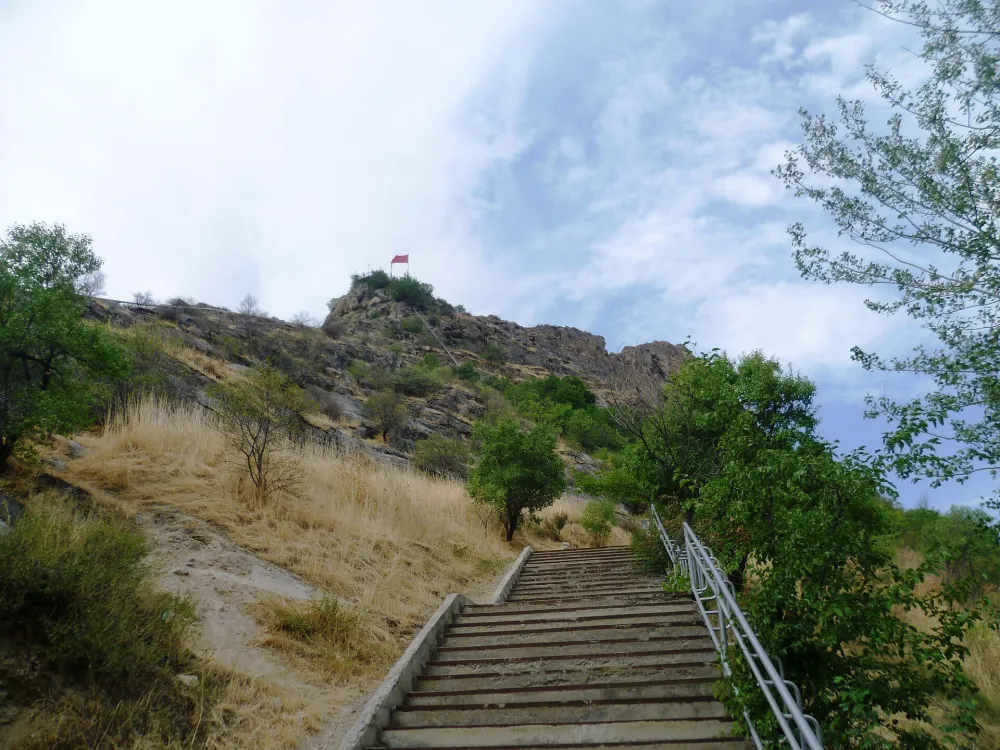 1/3. Climbing the equipped section of the route Photo: Radosław Botev, Fundacja Nomos, CC BY 3.0 PL; edited for this site.
 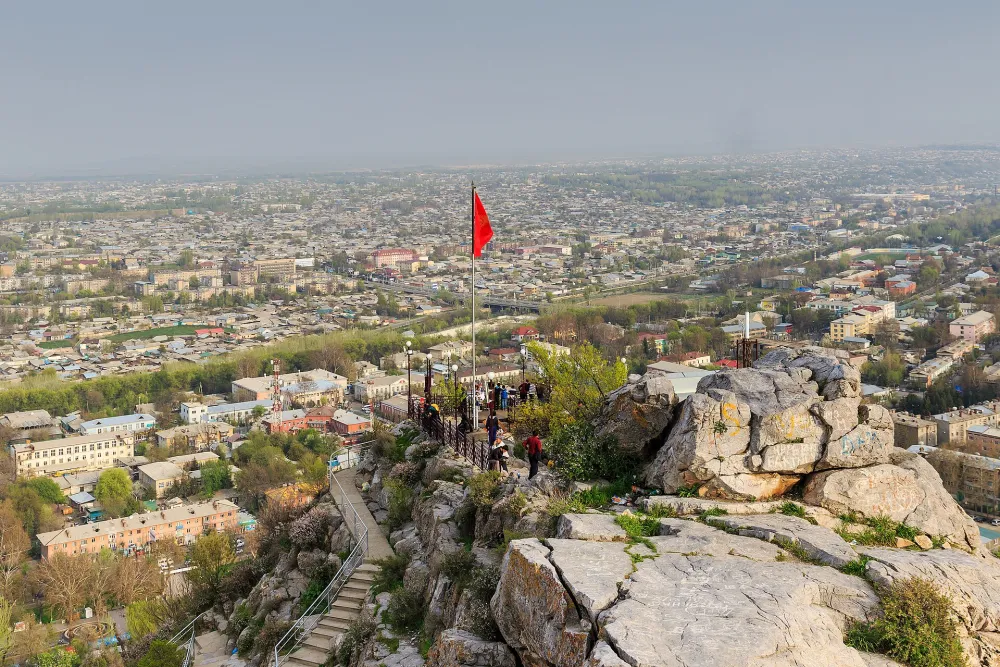 2/3. Osh from the mountain Photo: A.Savin, Wikipedia, Free Art License; edited for this site.
 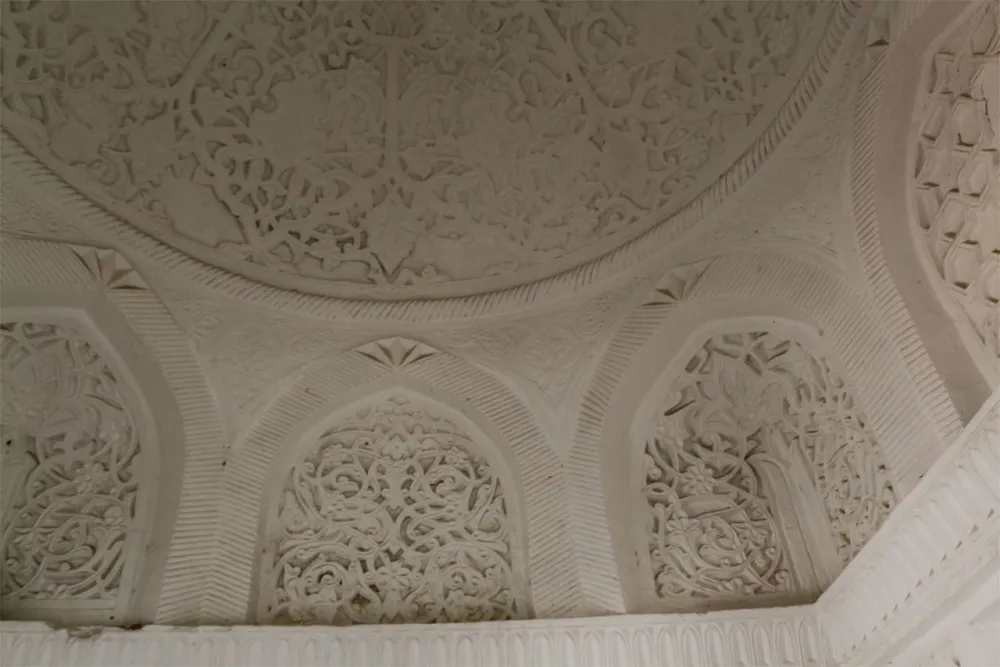 3/3. Babur's prayer cell Photo: Navbahor Imomova, Wikimedia Commons, CC0 1.0; edited for this site.
 Where to start and finish
For a traverse, start in the southwest near the junction of Gapar Aitiev and Rustaveli streets. Use the coordinates above: a generic Sulaiman-Too search may send you to the eastern museum or another point around the foot of the mountain. The walk finishes on the eastern side, near the National Historical and Archaeological Museum and Kurmanjan Datka Street.
This is not a loop. If you leave a car at the southwest entrance, either walk back the same way or plan a short taxi ride from the eastern exit. Both entrances are easy to reach separately from central Osh.
The route step by step
Southwest entrance and cave museum. Beyond the gate, the exposed slope rises at a gentler angle. Follow the main path and signs for the Museum of Spiritual Culture. Set aside separate time if you want to go inside; our guide to the Sulaiman-Too cave museum covers the exhibition and the Rushan-Unkur cave.
Crossing to the eastern peak. Beyond the museum, remain on the permitted equipped route. The path crosses open rock and viewpoints before reaching the first eastern peak and Babur's prayer cell, also known as Takht-i-Sulaiman.
Eastern descent. A long staircase drops from the prayer cell. Give way to oncoming visitors on narrow sections and do not climb over barriers for a photograph. At the eastern foot, you can end the walk or visit the main museum complex.
Do not treat every side path as an extension of the walk. The network of pilgrimage paths, caves and rocky outcrops is much wider than the equipped visitor route. Without a local guide, do not enter unsigned caves, follow exposed ridges or use the cemetery on the southern slope as a shortcut.
What you will see on Sulaiman-Too
The height opens an almost circular view over Osh, making its older quarters, newer districts and the green line of the Ak-Buura easier to read than from street level. The two architectural markers are the circular façade of the cave museum and the small restored prayer cell associated with Babur above the eastern slope. Takhti-Suleiman, the historic name used for Sulaiman-Too, appears on the reverse of the 1,000 som banknote.
UNESCO inscribed Sulaiman-Too on the World Heritage List in 2009. The property includes all 5 peaks, ancient paths, 101 recorded petroglyph locations and 17 sacred places that remain in use. Do not expect to identify every carving unaided: many surfaces are difficult to read without a specialist, and touching them hastens their decay.
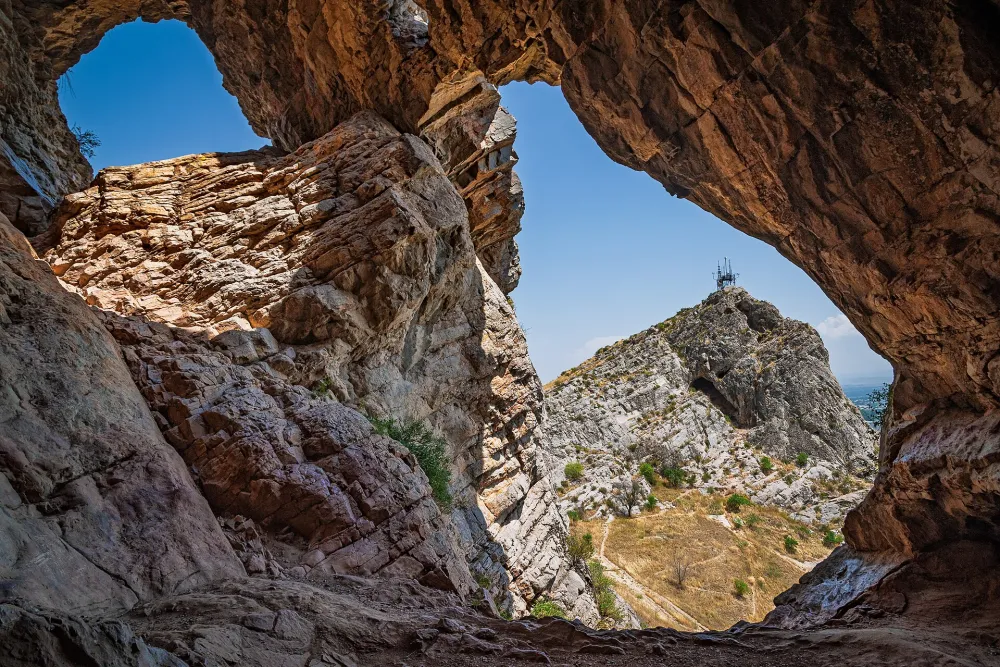 1/2. Caves and rocky terrain on the mountain Photo: Nefesh03, Wikimedia Commons, CC BY-SA 4.0; edited for this site.
 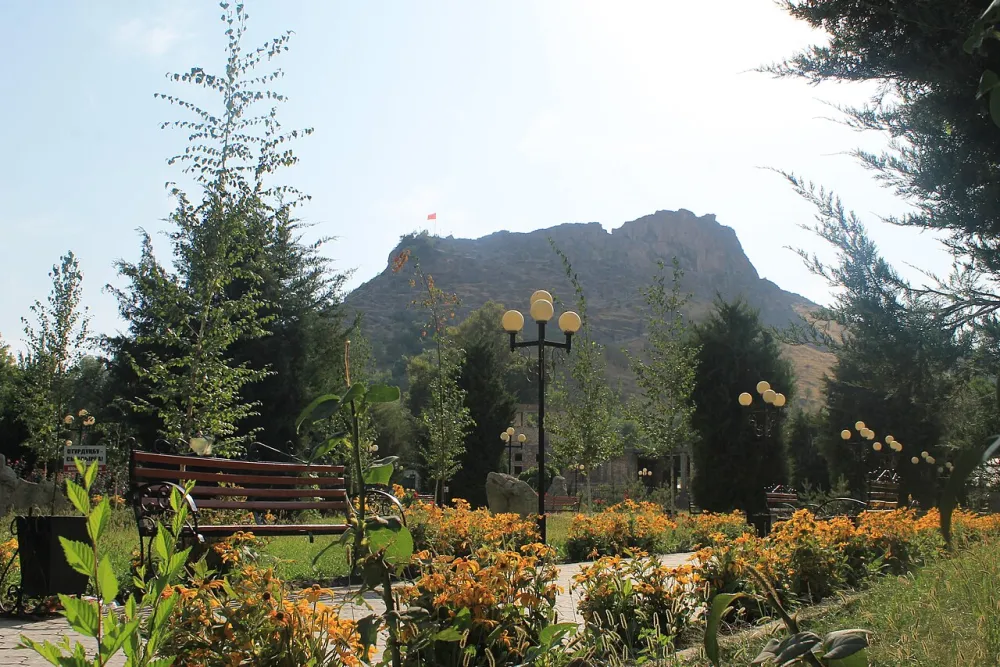 2/2. The sacred mountain in the cityscape Photo: Erkinorozov, Wikimedia Commons, CC BY-SA 4.0; edited for this site.
 When to go and what to carry
In warm weather, set out in the morning or towards evening. There is almost no shade on the exposed rock, which stores the heat. Starting too late is unhelpful as well: entrances and museums may close before you finish.
Wear closed shoes with grippy soles and carry water, a hat and sun protection. Polished rock and steps become slippery after rain; postpone the climb in ice, strong wind or a thunderstorm. Our guide to active travel in Kyrgyzstan covers general mountain preparation.
Etiquette at a sacred site
Sulaiman-Too remains an active pilgrimage site. Covered shoulders and knees show respect and provide useful sun protection. Do not photograph people at prayer without permission, lower your voice near sacred places and give way on narrow stairs.
Do not write on the rock, touch petroglyphs, take stones or cross barriers. Local traditions associate particular rocks and caves with healing and fertility. These are religious beliefs, not medical treatments.
Checks before setting out
In March 2026, Osh city authorities presented a project to renew roads, steps, gates and museum buildings around Sulaiman-Too. Individual approaches may therefore change. On the day of your walk, check which entrance is open, whether your chosen section is accessible, museum hours, tickets and any temporary barriers.
Save both endpoints offline, tell someone your plan and remain on the equipped route. In a life-threatening emergency, call 112.
Share on social media
If you found this guide useful, share it on social media. It takes a moment and helps more travellers discover the project. Thank you!
Anything to add?
Share your experience, leave a comment or suggest an improvement.