Contents:
Which of the two museums do you want?
The main historical and archaeological museum is at 18a Kurmanjan Datka Street, on the eastern foot of Sulaiman-Too. Its galleries range across the natural and human history of southern Kyrgyzstan, from geology and archaeology to ethnography, documents and art. Choose it for a broad regional overview.
The Museum of Spiritual Culture occupies the Rushan-Unkur cave on the southern slope. Its circular glass front is the conspicuous museum facade seen from across Osh. The cave display is narrower, dealing with belief, pilgrimage and ritual culture, and reaching it involves a climb.
The official word “complex” causes much of the confusion. The institution looks after a collection and several associated sites, but visitors do not enter all of them through one gate. Show a driver the map pin and ask for the main museum on Kurmanjan Datka rather than saying only “Sulaiman-Too Museum”.
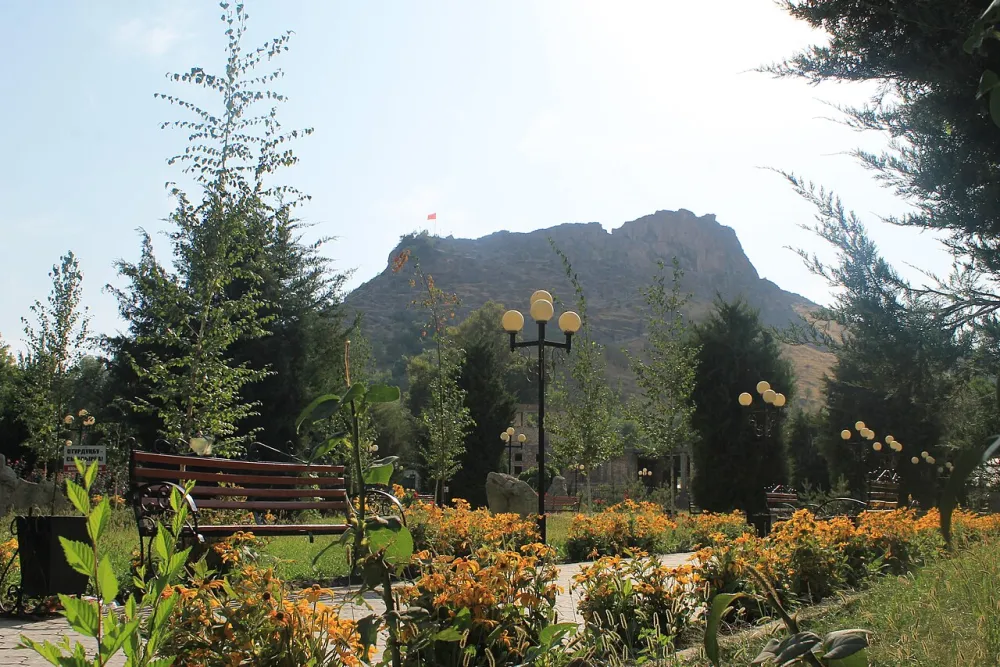 1/2. The sacred mountain in the centre of Osh Photo: Erkinorozov, Wikimedia Commons, CC BY-SA 4.0; edited for this site.
 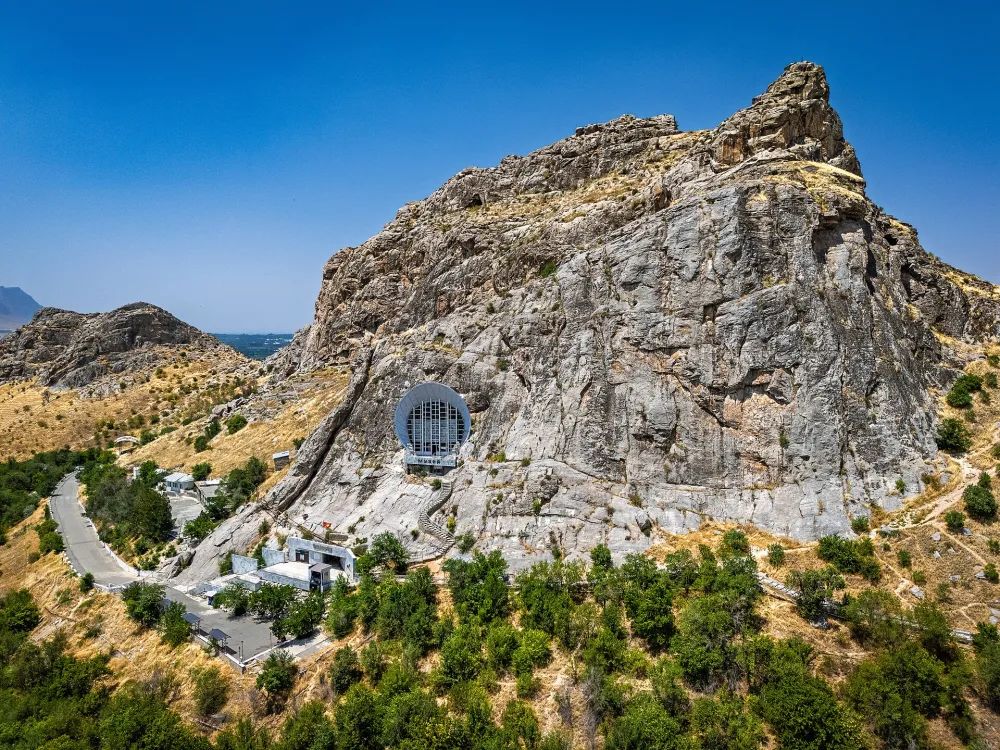 2/2. The cave museum is on another part of the mountain Photo: Nefesh03, Wikimedia Commons, CC BY-SA 4.0; edited for this site.
 What the main museum holds
The complex holds more than 33,000 objects. Osh's official visitor guide lists 6,694 archaeological objects, 3,702 ethnographic pieces, 19,852 documents and photographs, and 1,196 works of craft, applied art, painting, sculpture and graphic art.
That number describes the collection, not the contents of the cases. Only part of the holdings can appear in the permanent galleries at one time. Objects move into temporary exhibitions, conservation and research, so a collection inventory should never be read as a promise that a particular piece will be on display.
The natural south. Geological and natural-history sections introduce the meeting of the Fergana Valley and the Alay foothills. The point is larger than a row of minerals or mounted animals: landscape shaped settlement, farming, trade and the routes into the mountains.
Archaeology and history. The chronology begins in the Stone Age and continues through ancient settlements, medieval Osh and more recent periods. For a traveller, it connects sites that otherwise sit as isolated map pins: Sulaiman-Too, the Ak-Buura settlement, Uzgen and Osh's older quarters.
Ethnography and visual records. Dress, craft, household objects, photographs and documents bring everyday life into the account. A label giving a place, date and acquisition history can be more revealing than a decorative reconstruction of an entire room.
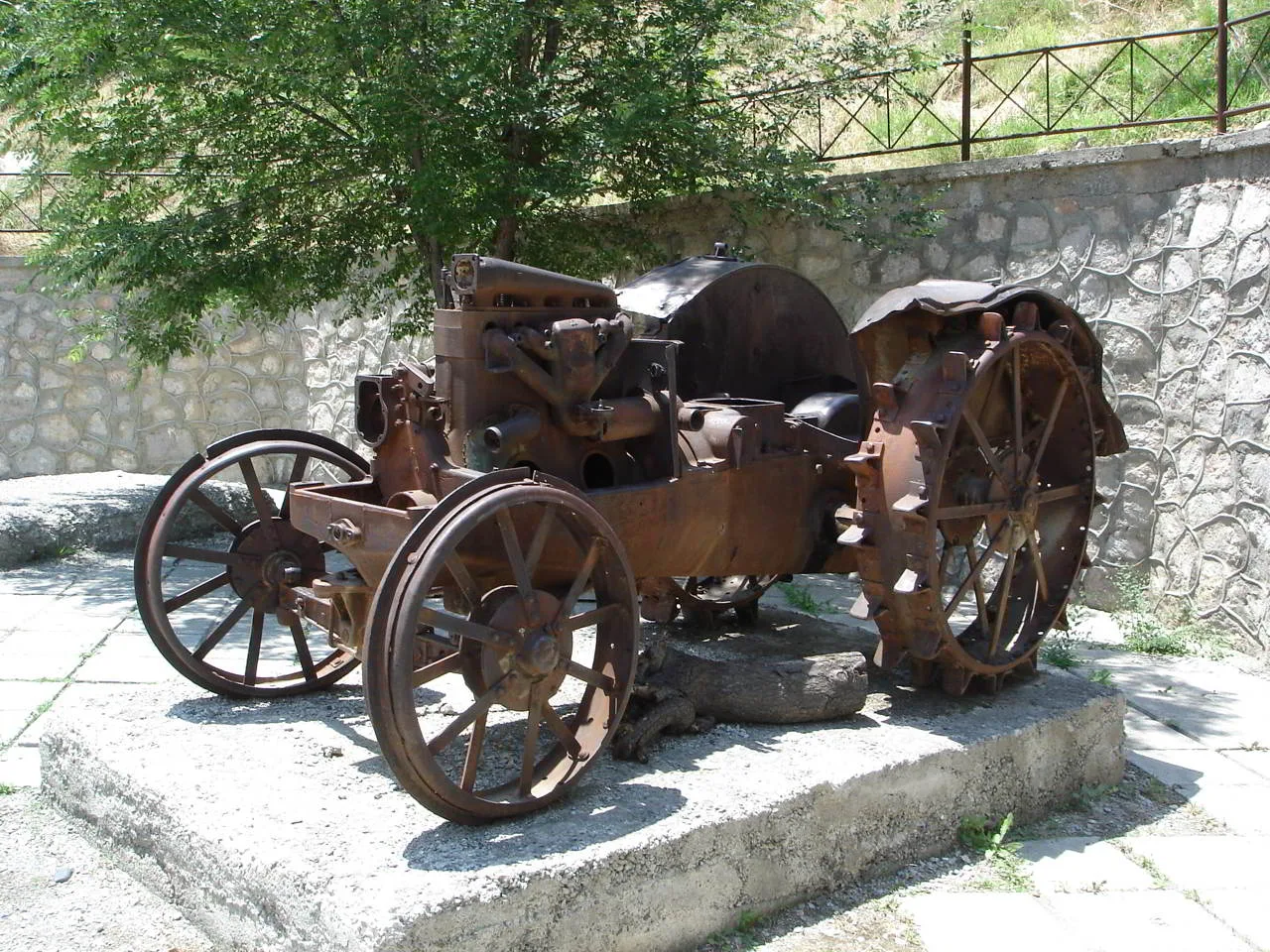 1/2. Object on the outdoor display, 2012 Photo: AmanovDmitry, Wikimedia Commons, CC BY 3.0; edited for this site.
 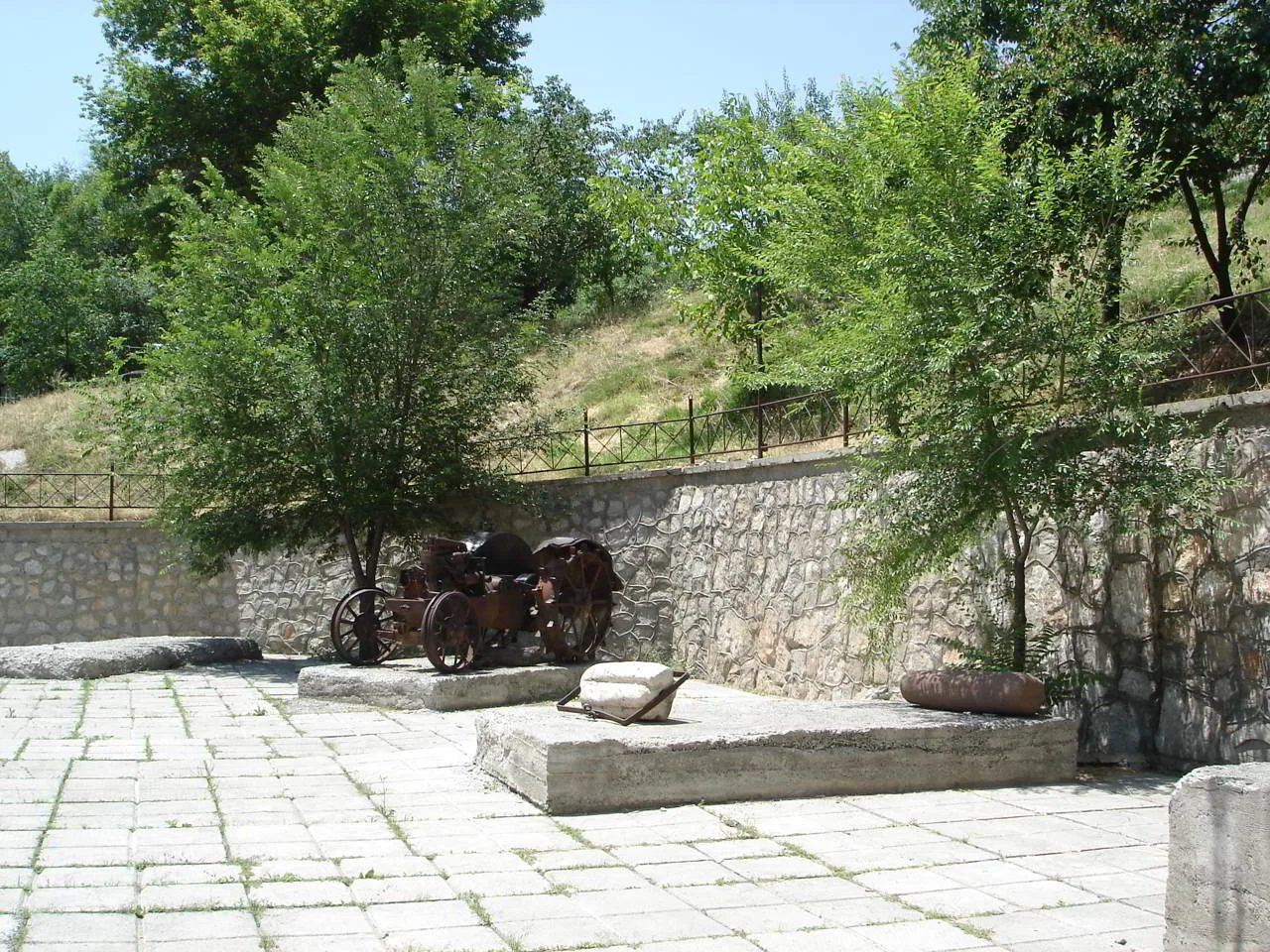 2/2. Outdoor museum courtyard, 2012 Photo: AmanovDmitry, Wikimedia Commons, CC BY 3.0; edited for this site.
 How one museum became a large complex
Osh began collecting museum material before the institution formally opened. It became the Osh Regional Museum of Local History on 15 May 1949. In 1964 the museum moved into the Ravat Abdullah Khan Mosque at the foot of Sulaiman-Too, drawing its work ever closer to the mountain.
The cave complex was assigned to the museum in 1978. In 1982 it became a combined historical and cultural reserve museum responsible for monuments on the mountain and other sites in southern Kyrgyzstan. A purpose-built main building opened at the eastern foot on 4 October 2000 for Osh's 3,000th-anniversary celebrations. Its two principal exhibition sections covered 1,100 square metres.
The current national name dates from 2004. It captures two different jobs: presenting a museum collection and helping to protect a large historical and archaeological landscape. Buildings, monuments, stores and protected ground may therefore belong to the same institution even though they cannot be visited like rooms in a single conventional museum.
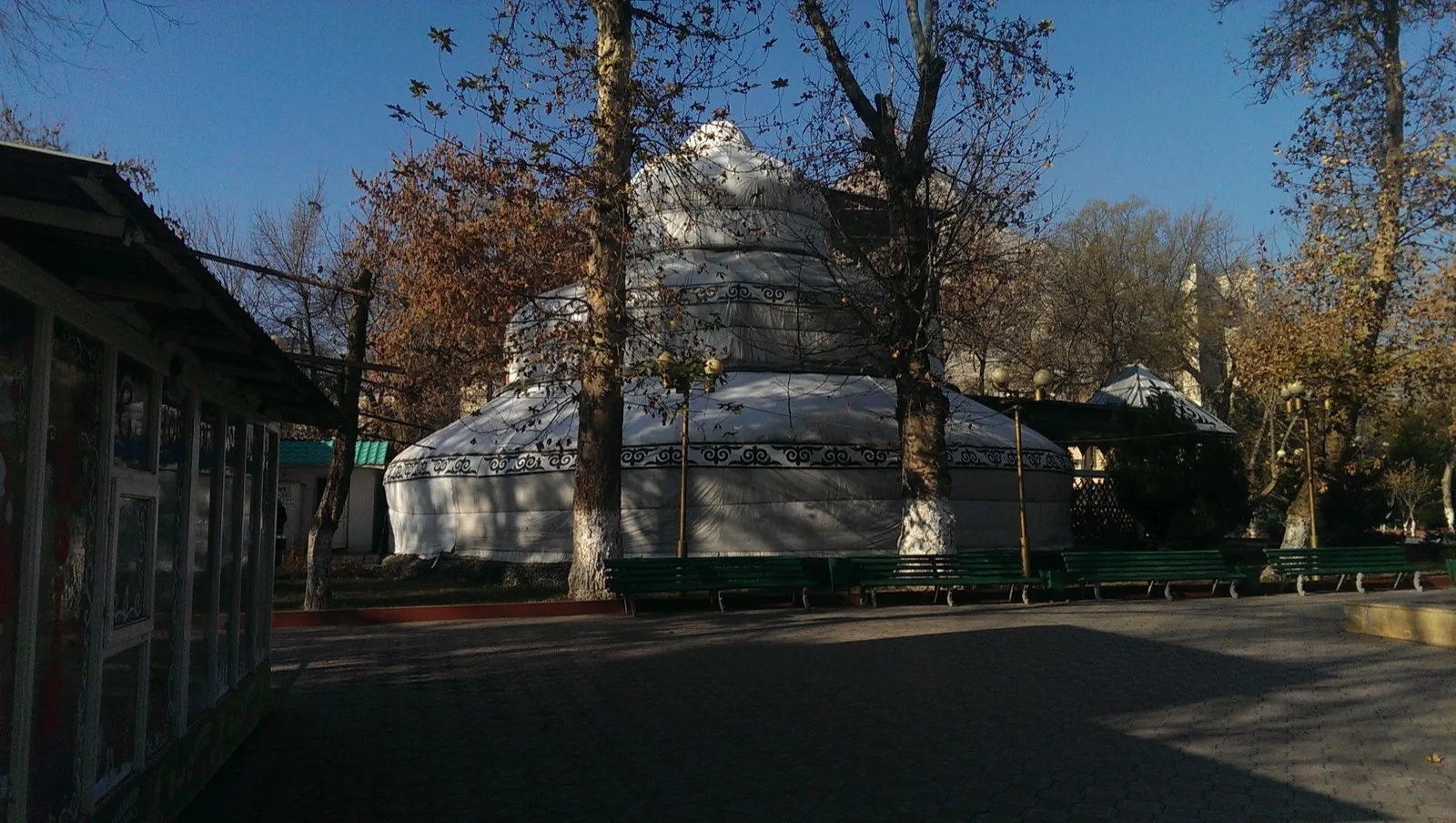 The three-tier yurt on the museum grounds in 2018. Photo: Arth, Wikimedia Commons, CC BY-SA 4.0; edited for this site.
Following renovation work in 2025, the yurt's ground floor displayed nineteenth- and twentieth-century ethnographic objects from the museum stores. A visitor information centre occupied the second level and a souvenir shop the third. Uses can change, so treat the yurt as an additional venue rather than a substitute for the main historical galleries.
Connecting the displays with the sacred mountain
Sulaiman-Too joined the UNESCO World Heritage List in 2009. Its five summits and slopes contain 101 recorded locations with petroglyphs, while 17 sacred places remain in use. The mountain's importance lies in the combination of landform, old paths, rock art, mosques and continuing pilgrimage.
The museum supplies a chronology for that landscape. A case may contain an archaeological object, map or old photograph, but its relationship with a findspot or path becomes clearer outside. The reverse is also true: without historical context, a petroglyph, mausoleum and modern reconstruction can blur into one vaguely “ancient” layer.
Let the weather decide the order. In hot months, follow the Sulaiman-Too walking route early and descend to the main museum as the rock heats up. On a cool day, start indoors and climb with a better grasp of the periods and place names.
How to approach the collection
Do not try to read every introductory panel. Find the plan first and choose three threads: the region's natural setting, archaeology and everyday culture. Within each thread, stop at a handful of objects with informative labels.
Compare the date of an object, the date when it entered the museum and the period reconstructed around it. Those three times are not necessarily the same. Archaeological labels deserve particular attention: a precise findspot and excavation context separate evidence from an attractive but unproven story.
If guided tours are available, ask about language and duration before paying. A good guide is most useful in the archaeology section and when explaining how the institution's scattered sites fit together. Keep at least fifteen minutes afterwards to revisit one gallery alone.
Address, hours, tickets and renovation
The main museum is at 18a Kurmanjan Datka Street, Osh, on the eastern foot of Sulaiman-Too. It is walkable from central Osh or a short taxi ride away. Give the driver the coordinates 40.529971, 72.792848 to avoid being taken to the cave museum entrance.
Map listings currently give an indicative schedule of 09:00-18:00 from Tuesday to Sunday, with Monday closed. No current official admission price is available online. Long-published museum numbers are +996 3222 2-29-68, +996 3222 2-71-23 and +996 3222 7-38-21.
Check access on the day. A tender for the first stage of a major renovation was issued on 14 August 2026, with bids due on 28 September. The project covers roads, stairs, gates and museum buildings, so individual venues and entrances may close or move once work begins. The current procurement stage is published by ARIS.
At the ticket desk, confirm whether the main galleries, yurt and the route you want towards the mountain are open. Ask whether a guided tour is included and whether photography is allowed. The building at the foot is potentially easier than the cave or mountain paths for visitors with limited mobility, but step-free access and an accessible toilet still require direct confirmation.
The institution's history, broad collection and the distinction between its visitor sites are set out in the official Osh visitor guide.
How long to allow
Main galleries only
- Choose archaeology and one ethnographic section.
- Ask which temporary exhibitions are currently open.
- Look around the courtyard and yurt if they are accessible.
Museum with a guide
- Connect the natural south with Osh and Sulaiman-Too.
- Ask for the provenance of a few archaeological objects.
- Return alone to the section that interested you most.
Museum and sacred mountain
- Start on the mountain before the heat, or indoors in cool weather.
- Do not rush both museums and the full walking route.
- Keep time in reserve for entrances altered by renovation work.
What to see nearby
The Mausoleum of Asaf ibn Burkhiya, the Ravat Abdullah Khan Mosque and several mountain entrances lie around the foot of Sulaiman-Too. They belong to different periods and some remain active religious sites, so museum etiquette does not replace respect for living places of worship.
For a first day in the city, combine the main museum with the centre, Ak-Buura River and Jayma Bazaar. Our Osh guide gives these stops a practical order. If time is tight, choose the museum that matches your interest: a broad history of the south in the main building or religious culture in the cave.
Our guide to museums in Kyrgyzstan collects further in-depth pages and helps compare national, regional, memorial and archaeological collections.
Frequently asked questions
Are the main Sulaiman-Too museum and the cave museum the same place?
They belong to the same wider museum complex but have separate entrances and displays. The main historical and archaeological building is at 18a Kurmanjan Datka Street on the eastern foot. The Museum of Spiritual Culture occupies the Rushan-Unkur cave on the southern slope.
What can I see in the main museum?
The holdings exceed 33,000 objects covering archaeology, ethnography, nature, history, documents, photography and art from southern Kyrgyzstan. Only part of the collection appears in the permanent galleries.
What are the opening hours?
Public map listings currently show 09:00-18:00 from Tuesday to Sunday, with Monday closed. The 2026-2028 renovation may change hours and entrances, so check on the day of your visit.
How much is admission?
A current official ticket price is not available in open sources. Confirm admission, guided-tour charges and children's rates directly before visiting.
Is the museum suitable for someone who finds stairs difficult?
The main building at the foot is generally a more practical choice than the mountain route or cave museum, but step-free entry, an accessible toilet and open paths should be confirmed in advance. Associated sites on the slope involve stairs and uneven ground.
Share on social media
If you found this guide useful, share it on social media. It takes a moment and helps more travellers discover the project. Thank you!
Anything to add?
Share your experience, leave a comment or suggest an improvement.