Contents:
The game in one line: choose a non-empty house on your side, sow its korgools one by one anticlockwise, then inspect the house where the final korgool lands. That last landing can make a capture, create a tuz or simply end the turn.
Reading the board
Each player controls a row of nine small pits, known as houses, and one larger scoring store, the kazan. Houses are numbered 1 to 9 from left to right as their owner sees them. The far row therefore looks reversed when you sit opposite it.
Every house starts with nine korgools. That makes 162 playing pieces in total, 81 for each side, while both kazans begin empty. A home set can use stones, beads, nuts or seeds, provided that all pieces are similar and easy to count at speed.
Nine houses
- You may move from any non-empty house on your own side.
- Numbering makes it possible to record games and calculate the final landing house.
- House 9 is called ooz and can never become a tuz.
The kazan
- Captured korgools go into your kazan.
- Pieces in a kazan are out of play and are never sown again.
- Collecting 82 wins; 81 each is a draw.
162 korgools
- Modern sets use wooden, plastic or other small balls.
- Pieces should be similar in size and quick to count.
- Historically, people could improvise the board in the ground and play with whatever small objects were available.
Toguz korgool
Starting position
Each player has nine houses with nine korgools in every house. The two kazans in the centre start empty.
Moves run anticlockwise
How a move works
-
Choose a house on your side
It must contain at least one korgool. You can never begin a move from the opponent’s row.
-
Pick up every korgool
If there is more than one, return the first to the same house and sow the rest one by one into the following houses.
-
Continue anticlockwise
After your ninth house, sowing crosses to the opponent’s first house and continues along the far row.
-
Treat a single korgool differently
If the chosen house held only one piece, leave that house empty and move the piece directly to the next house.
-
Inspect the last house
The destination of the final korgool determines whether you capture, establish a tuz or simply pass the turn.
During a first game, say the sequence aloud: “one stays here, then two, three, four”. It is slower than silent play, but it prevents the two most common mechanical mistakes: skipping a house and dropping two korgools into one pit.
Captures and the tuz
A regular capture occurs when your last korgool lands on the opponent’s side and makes the number in that house even. Move the entire contents of that house to your kazan. An odd total stays on the board. An even total in one of your own houses does not produce a capture.
A tuz is created when the last korgool lands in an opponent’s house that previously held two, bringing the total to exactly three. You capture those three, declare the house as your tuz and mark it clearly. Every korgool that later enters that house goes straight to your kazan.
- Each player may establish only one tuz in a game.
- House 9 can never be a tuz.
- You cannot claim a tuz in the house with the same number as the opponent’s existing tuz.
- Once declared, a tuz cannot be moved to another house.
A tuz does not grant an extra turn. It changes the long-term value of one house. Strong play weighs the immediate capture of three against all the future traffic that might pass through that pit.
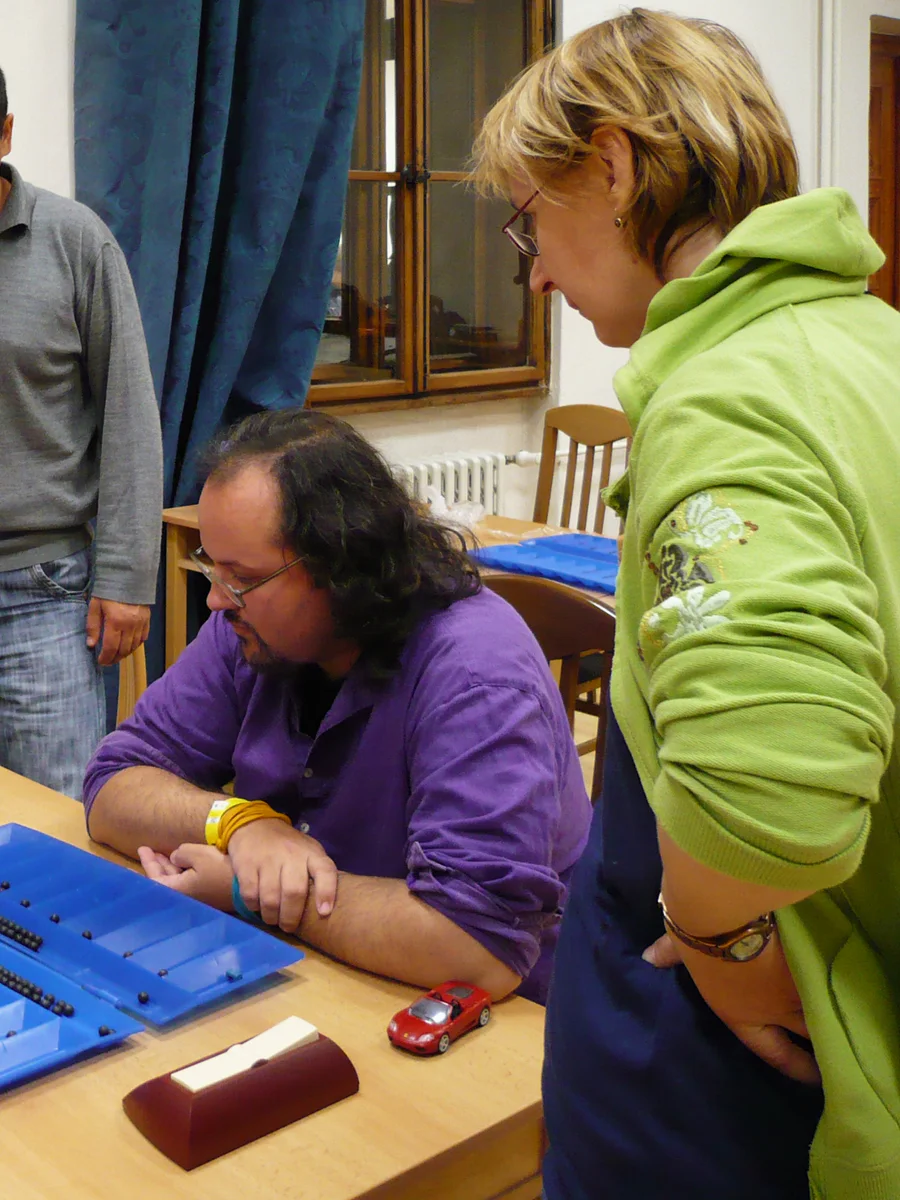 1/4. A player and spectators examine the position Photo: Matěj Baťha, Wikimedia Commons, CC BY-SA 3.0; edited for this site.
 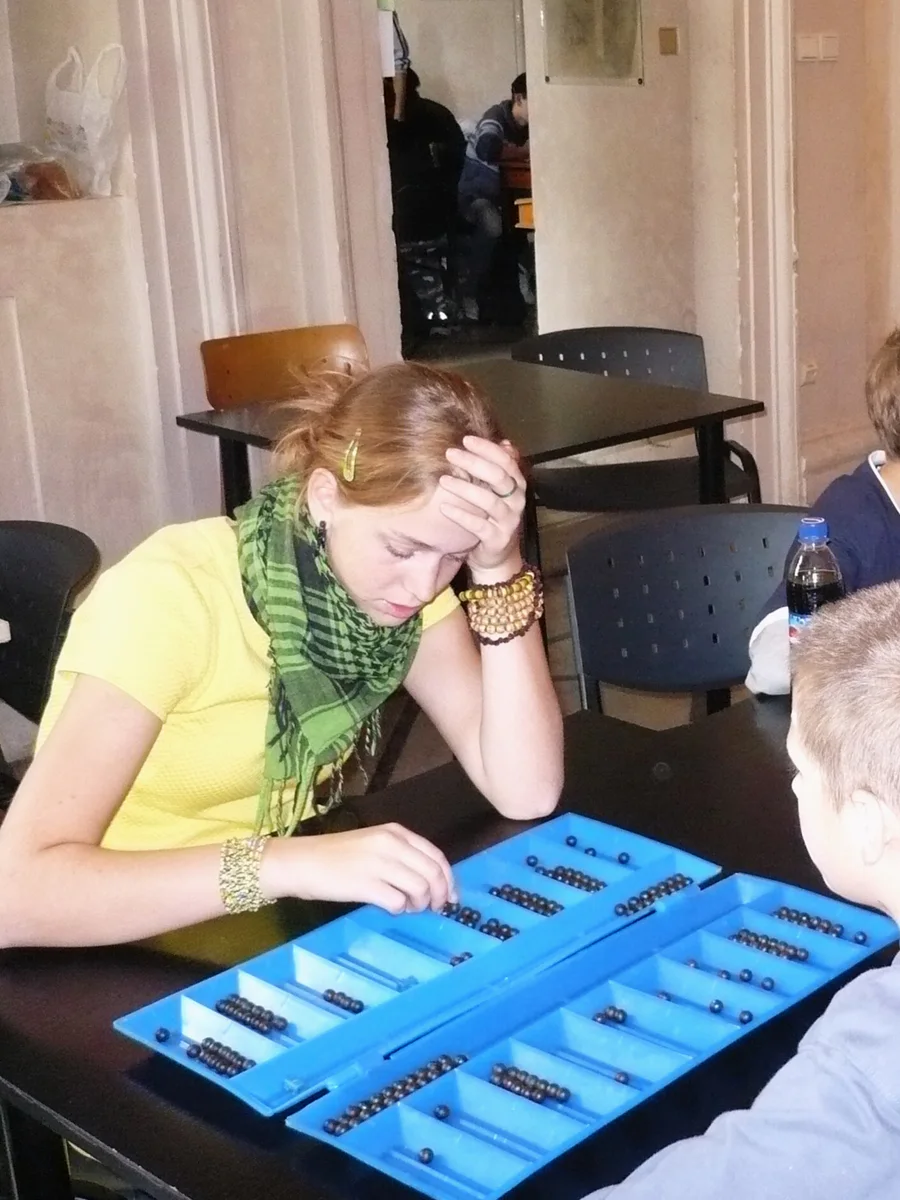 2/4. Counting a position during play Photo: Matěj Baťha, Wikimedia Commons, CC BY-SA 3.0; edited for this site.
 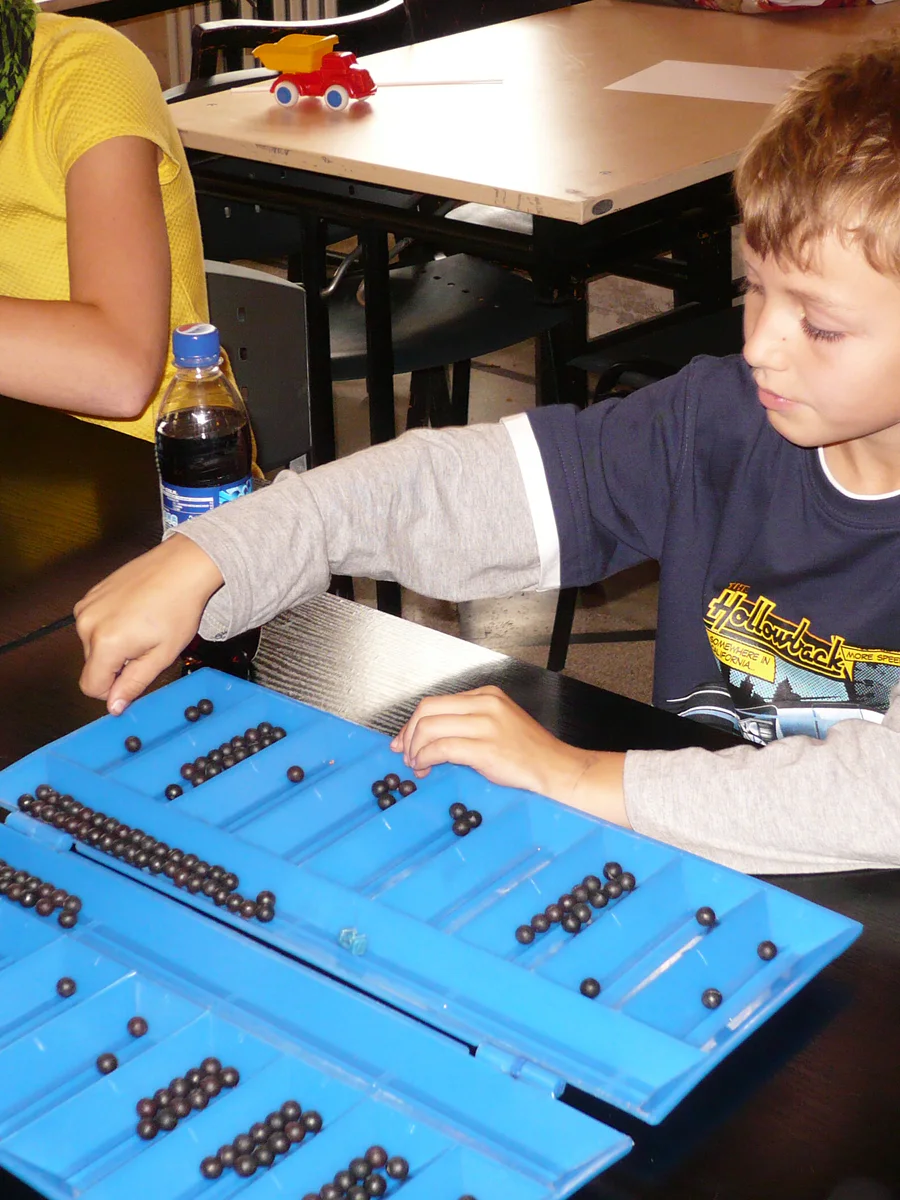 3/4. Korgools are sown one at a time Photo: Matěj Baťha, Wikimedia Commons, CC BY-SA 3.0; edited for this site.
 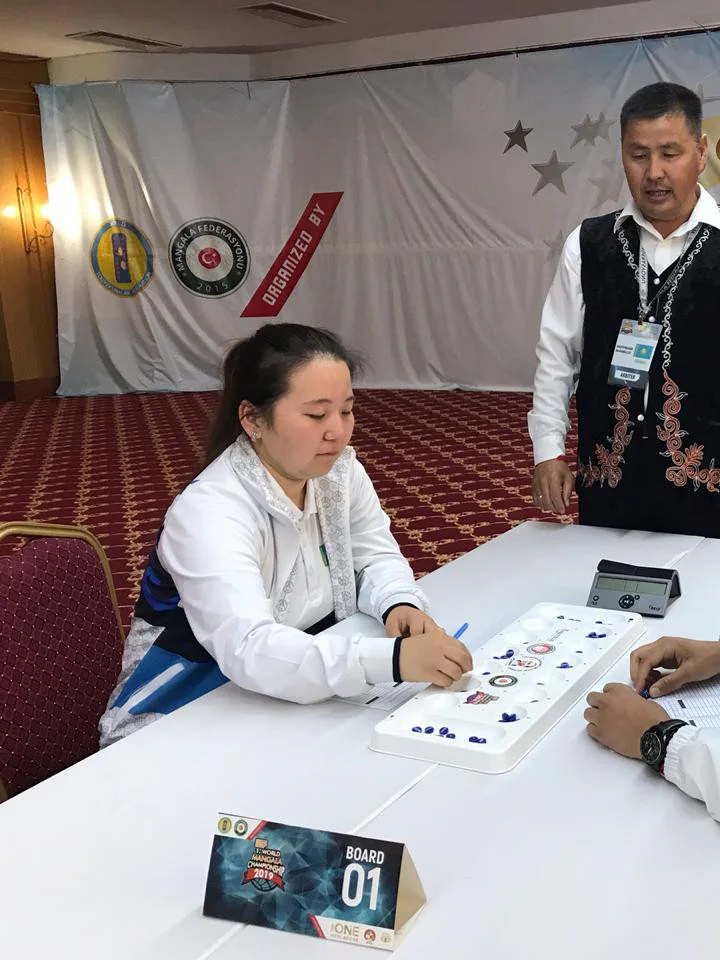 4/4. A game at the 2019 world championship Photo: Eurasian National University, Wikimedia Commons, CC0; edited for this site.
 How the game ends
The game finishes as soon as one player has collected 82 korgools, or when a player has no korgools left on their side and therefore no legal move. In the second case, the opponent transfers every piece remaining on their own side into their kazan before the final count.
A total of 82 or more wins. A final score of 81:81 is a draw. The threshold is easy to remember: the full set contains 162 pieces, so victory requires half plus one.
What a beginner should count
The first level of calculation is simply finding the final landing house reliably. When a starting house contains more than one korgool, the last piece lands a number of steps equal to the pile size minus one further around the circuit. A single korgool always moves exactly one house ahead.
Where does the last piece land?
- Check whether it remains on your side or crosses to the opponent.
- Count the resulting total in the destination house.
- Notice even totals and positions that become exactly three.
What do you leave behind?
- An empty house can break a useful sequence of future moves.
- A large pile reaches far, but also gives your opponent a clear target to calculate.
- Check whether your move prepares an easy even capture on the next turn.
How does the balance change?
- Count both kazans, not just the pieces still in play.
- Watch which side is likely to run out of legal moves first.
- Do not trade lasting initiative for a small capture by default.
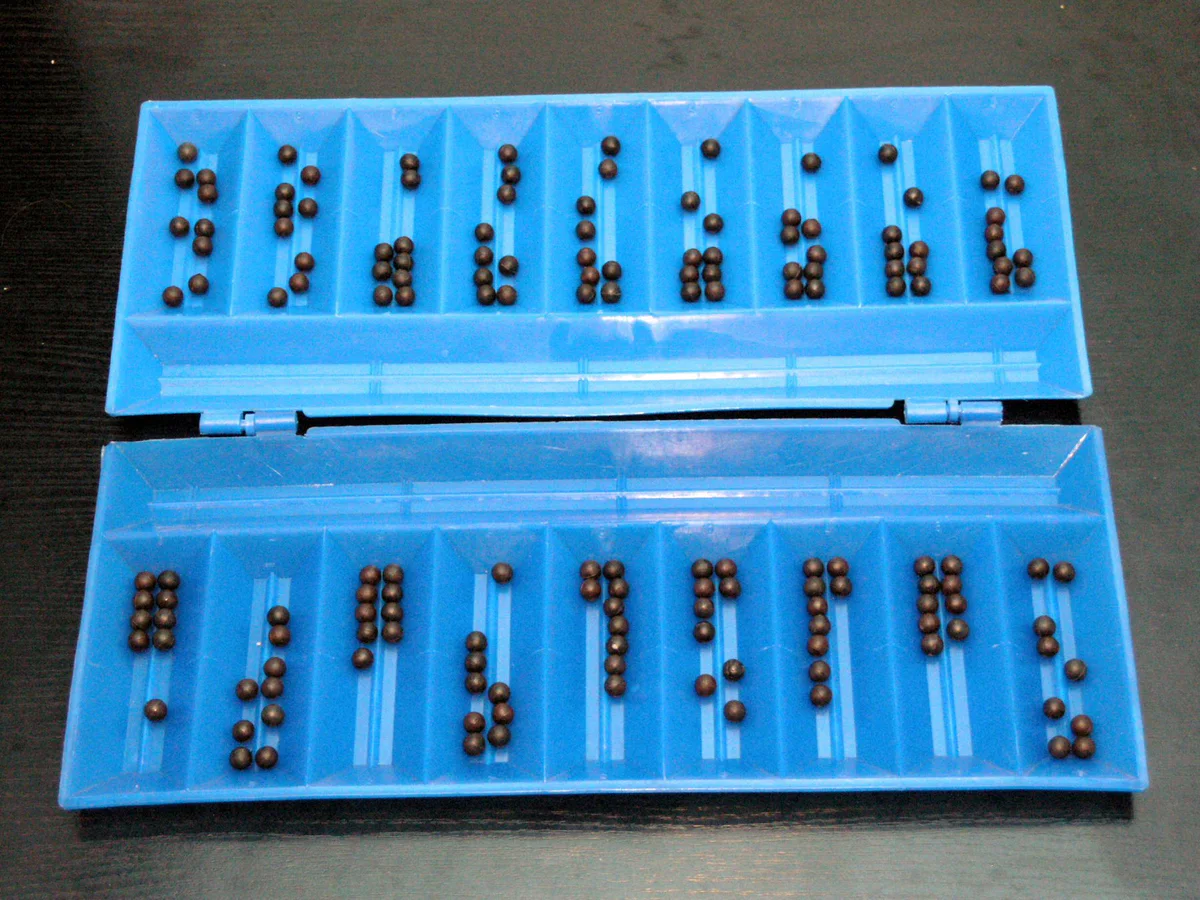
A position after several moves. Photo: Matěj Baťha, Wikimedia Commons, CC BY-SA 2.5; edited for this site.
Running your first game
- Place nine korgools in each of the 18 houses and confirm the total before starting.
- Sit opposite each other and agree which row belongs to which player.
- Play the first few turns without a clock and say the sowing direction aloud.
- After each move, check only the final house and any transfer to the kazan together.
- Mark a tuz with a token that cannot be mistaken for a korgool.
- Record at least the starting house and the number captured. A short note makes errors much easier to trace.
One slow game with mistakes corrected is more useful than five abandoned openings. If the sowing goes wrong, restore the position from your notes or agree to take the move back. Arguing from memory teaches little about calculation.
Tournament play and notation
Competitive games use clocks, and players may record moves on a scoresheet. Time control, pairings, number of rounds and result procedures belong to the event regulations. There is no need to impose all of that on a first game at home.
Toguz korgool is a living mind sport, taught in schools and clubs and played in city, national and international competitions. The name togyzqumalaq is more common in Kazakhstan. The games are closely related, but competitors should follow the terminology and rules published by their organiser.
Where to watch or try it
In Bishkek, toguz korgool appears in school leagues, youth sports schools, university clubs and municipal holiday programmes. Most regular sessions are designed for enrolled students, so ask in advance whether visitors may observe or arrange an introductory game with a coach.
At a festival, look for a demonstration or workshop area as well as the formal tournament. You cannot simply take a seat at a registered competition table, while an open board is intended for beginners. Ask which language the explanation uses, how long the session lasts and whether participants, especially children, are comfortable being photographed.
The nearest major date: the official 2026 World Nomad Games calendar lists toguz korgool for 2 September at the Eurasia Hotel in the Issyk-Kul region. Recheck the time, admission and any changes on the event page before travelling.
For self-guided learning, use the profile site’s English game guide alongside a physical set. An app can check the mechanics, but a real board makes the count, the distance of a move and a sowing error immediately visible.
Living heritage and board craft
In 2020, UNESCO inscribed the shared element “Togyzqumalaq, Toguz Korgool, Mangala/Göçürme” on the Representative List of the Intangible Cultural Heritage of Humanity for Kazakhstan, Kyrgyzstan and Türkiye. The wording recognises a family of related games as well as differences in local rules, transmission and board design.
People learn through family play, school lessons, clubs and tournaments. A board may be carved from wood, assembled from simple containers or improvised as holes in the ground. An ornate set belongs to a craft tradition, but beautiful carving does not alter the mathematics of the game.
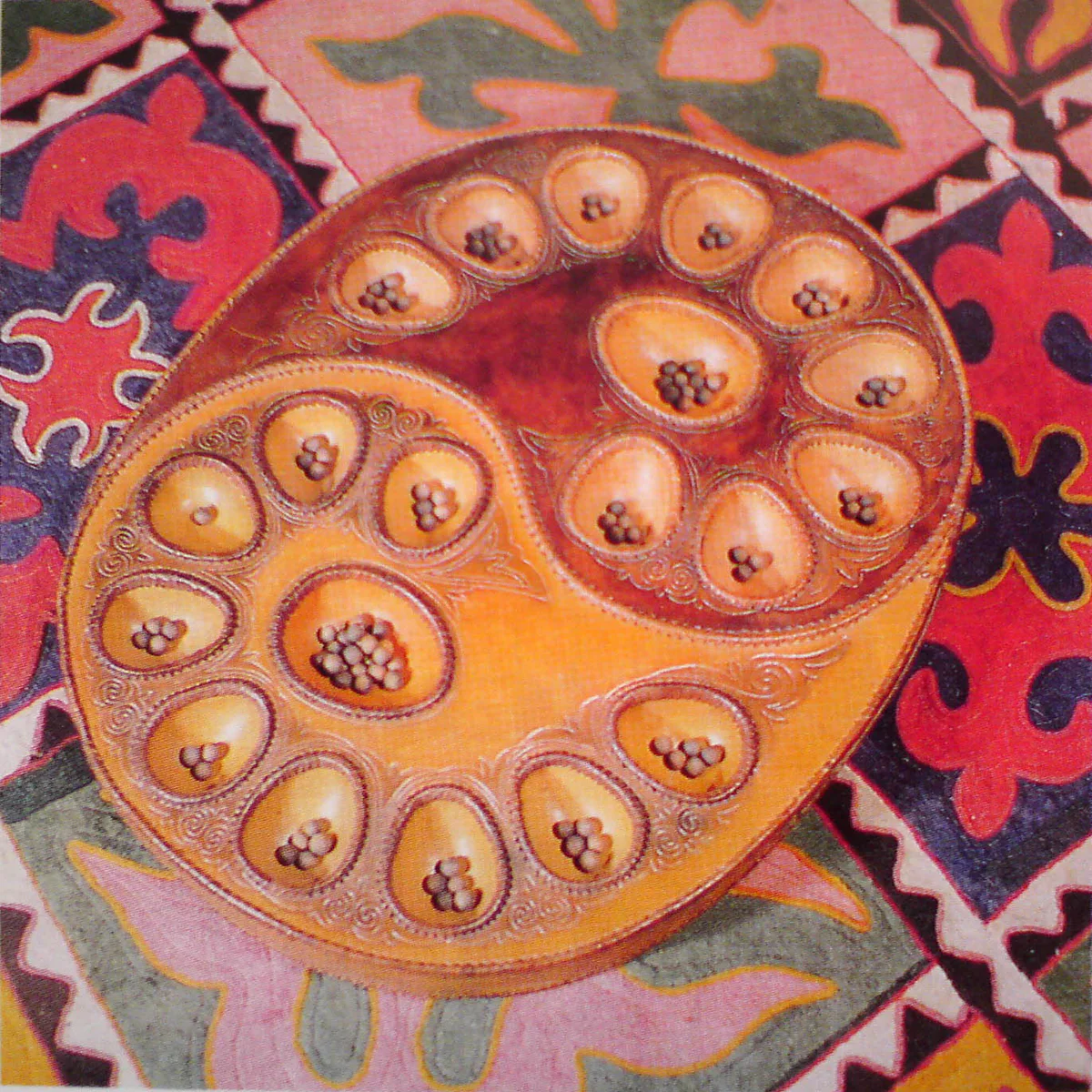
A decorative wooden toguz korgool board. Photo: Arthoum, Wikimedia Commons, CC BY-SA 3.0; edited for this site.
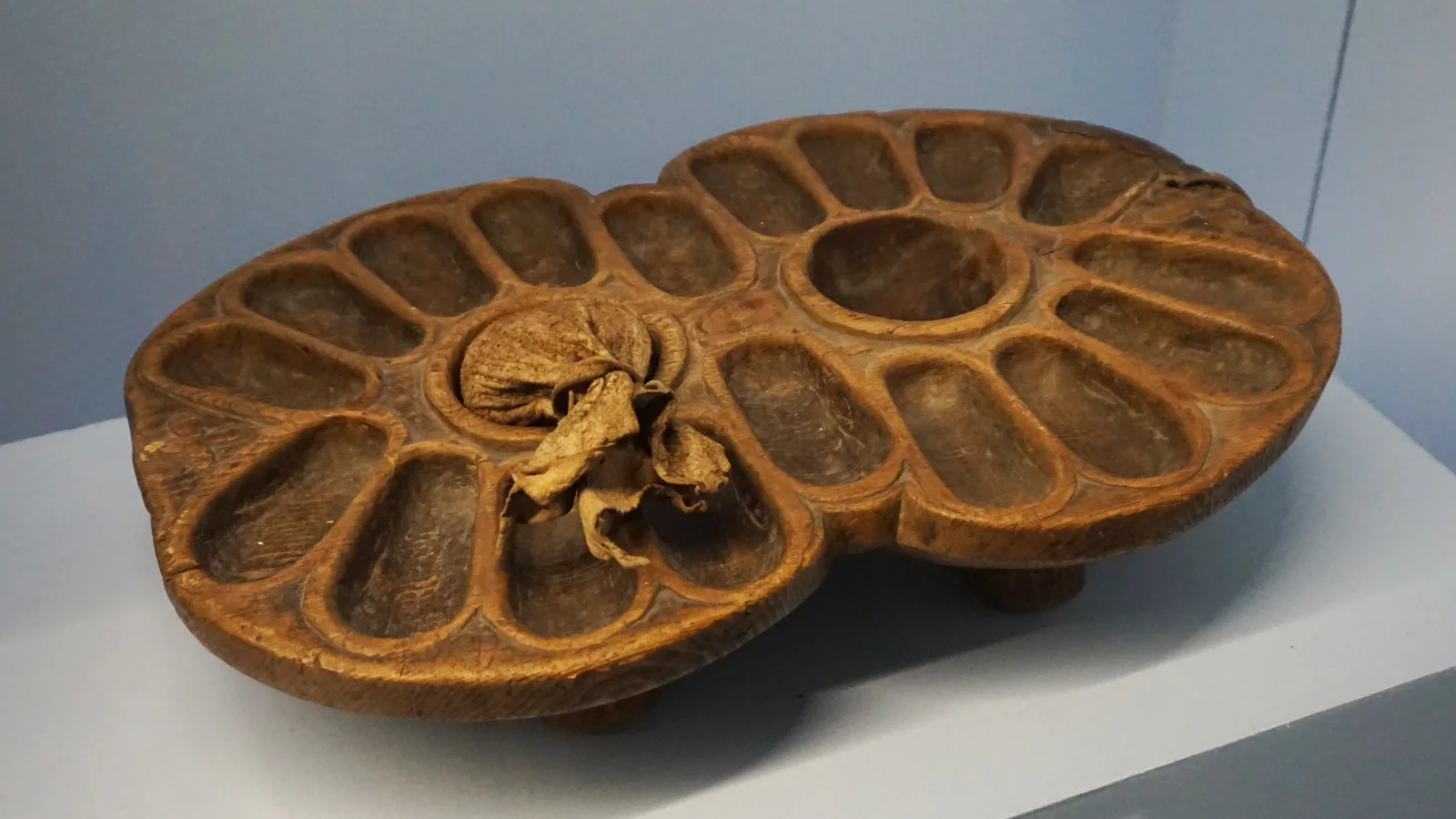
Mukhtar Auezov’s togyzqumalaq board, early twentieth century. Photo: Bekbal, Wikimedia Commons, CC BY-SA 4.0; edited for this site.
Where to go next
Our guide to Kyrgyz culture places toguz korgool alongside oral traditions, music, crafts and contemporary practice. For a sharp contrast, read how mounted kok boru and traditional archery work. All three have competitive forms, but demand entirely different spaces, training and approaches to safety.
Frequently asked questions about toguz korgool
How many korgools do you need?
A complete set contains 162 korgools. Each of the 18 houses starts with nine, while the two kazans begin empty.
How many korgools win the game?
A player wins with 82 or more. If both players finish with 81, the game is a draw.
When can I capture the opponent’s korgools?
If the final korgool of your move lands in an opponent’s house and makes its total even, move the whole contents of that house into your kazan. The same rule does not apply on your own side.
What is a tuz?
A tuz is an opponent’s house where your final korgool brings the total to exactly three. You capture those three, and every future korgool that enters the tuz goes to your kazan. Each player may have only one tuz.
Can house 9 become a tuz?
No. House 9 can never be a tuz. You also cannot claim a tuz in the house with the same number as the opponent’s tuz.
Can I use an ordinary mancala board?
Only if it has two rows of nine houses and two separate kazans. Many other mancala games use a different number of pits, starting pieces and capture rules.
Share on social media
If you found this guide useful, share it on social media. It takes a moment and helps more travellers discover the project. Thank you!
Anything to add?
Share your experience, leave a comment or suggest an improvement.