Contents:
- Why Alykul Osmonov matters
- Childhood and the editorial world
- Finding a voice of his own
- Why Makhabat marked a turning point
- Issyk-Kul in his life and poetry
- Translation as a school of poetry
- Illness and the final years
- Copyright and reading the poems
- Two house museums and a library
- Osmonov on the 200 som note
- Where to begin reading
- Frequently asked questions
Why Alykul Osmonov matters
Alykul Osmonov lived for only thirty-five years, yet he changed what a poem in Kyrgyz could hold. Public themes remained part of his work, but the decisive event in a mature poem was often inward: love, solitude, the fear created by illness, the pleasure of returning to a lake, or a small change in light and weather.
He worked across several literary forms. Osmonov wrote lyrics and long poems, tried drama, translated Rustaveli, Pushkin and Shakespeare, and produced books for children. His place in Kyrgyz literature therefore rests on more than a handful of familiar lines about Issyk-Kul. He tested how Kyrgyz verse could sustain a novel in verse, a dramatic exchange, a demanding stanza and an intimate confession.
The brevity of his life became central to his posthumous image, but it does not explain the craft. The more revealing story is a development: newspaper verse, the discipline of translation, dissatisfaction with early books and a powerful new phase in the mid-1940s.
Childhood and the editorial world
Osmonov was born on 21 March 1915 in Kaptal-Aryk, in what is now the Chüy region. Orphaned young, he grew up in children's homes in Pishpek and Tokmok. This belongs to the biography, but it should not be turned into a universal explanation for his poetry. Loss was one subject among many, not a code that unlocks every page.
He graduated from a teacher-training college in Frunze in 1933. During the first half of the decade he worked for the magazine Chabuul and the newspaper Leninchil Zhash. An editorial office offered a demanding daily apprenticeship: short deadlines, fixed space, the political vocabulary of the period and constant exposure to other writers' sentences.
The newspaper Sabattuu Bol printed his first known poem, “Kyzyl Zhük”, in 1930. His debut collection, Taŋdagy Yrlar, followed in 1935, then Zhyldyzduu Zhashtyk and Cholponstan. These books made him visible, but the voice now associated with Osmonov was still being formed.
Finding a voice of his own
Early Soviet publishing expected poems about labour, collective life, political heroes and a new social order. Osmonov learned to write inside that shared language, as did most of his generation. Later he judged the first collections severely and did not treat them as the summit of his work.
The change was gradual. A line no longer existed simply to deliver a slogan; it began to turn on an observation or an unresolved feeling. Landscape stopped functioning as scenery. Wind, water, a night sky or the movement of a bird could alter the speaker's state of mind and the direction of the poem.
This was not a retreat from history. War, work and country remained present, but they stood beside doubt, vulnerability and private memory. That wider emotional range is what separates a living writer from the simplified portrait supplied by a school textbook.
Why Makhabat marked a turning point
The collection Makhabat appeared in 1945. The title is usually rendered as Love, although the book is not the record of a single romance. Love becomes a way to see another person, a homeland, nature and the limits of one's own life. In Osmonov's development, this is where technique and an unmistakably personal cadence come together.
Works associated with this phase include “Menin Zhyldyzym”, “Turnalar”, “Kara Köpölök”, “Tabiyat zhana Muzyka” and “Men Kördüm Ak Kuunun Uchkanın”. English and Russian titles vary widely, so readers searching for a poem should keep the Kyrgyz title beside any translation.
Not every part of the oeuvre has aged in the same way. Early ideological verse, dramatic experiments and mature lyrics answer different needs. Recognising those differences does not diminish Osmonov. It restores the working writer who discarded weak solutions, revised his practice and looked for a more exact form.
Issyk-Kul in his life and poetry
Osmonov often stayed by Issyk-Kul because of his lung disease. In late November 1944 he began a large cycle on the shore, continuing the work into early March 1945. The cycle became one of the foundations of Makhabat. This was sustained work over several months, not a single legendary night of inspiration.
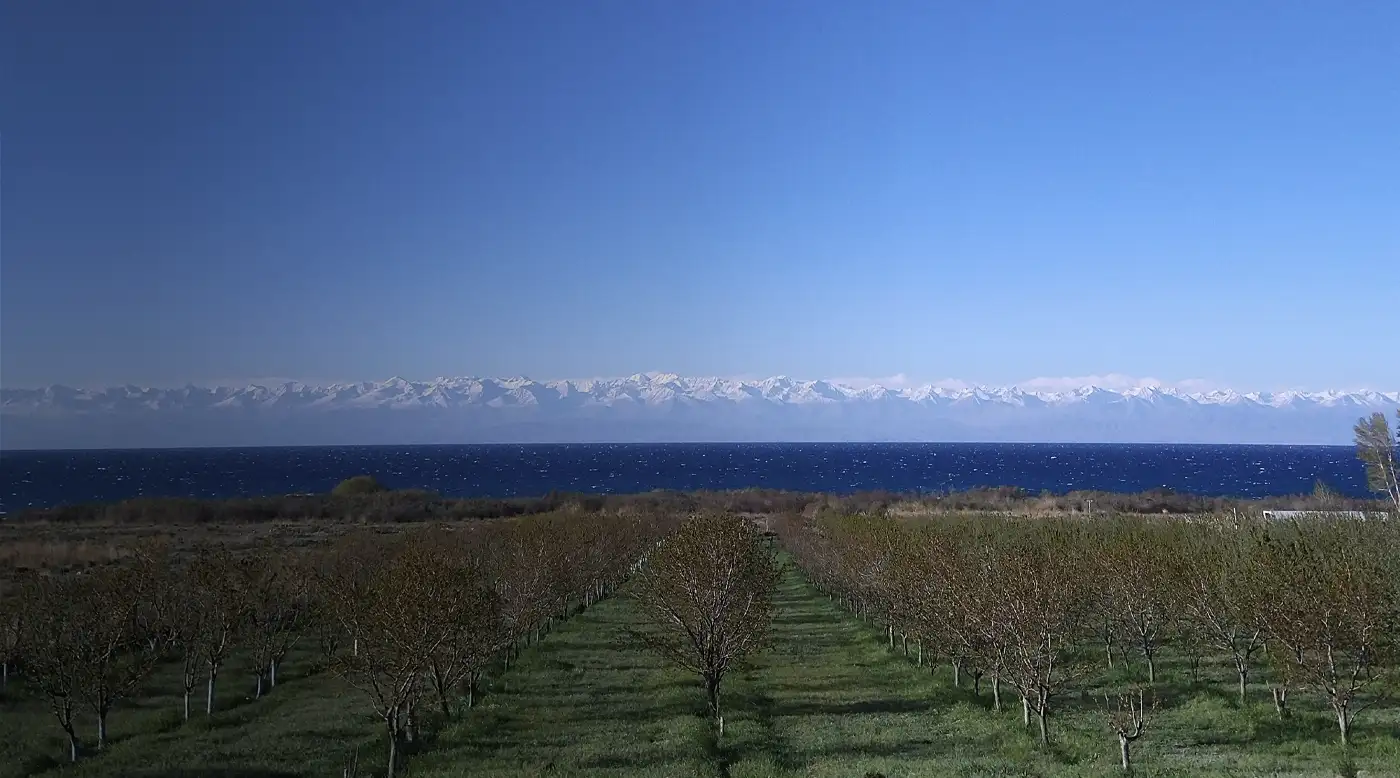
In his poetry the lake is both a physical landscape and a partner in thought. Light shifts, wind rises, and water holds a nearby shore apart from distant mountains. Distance becomes a way to speak about home, love and time. A map and a photograph enrich the reading, but not every image in a poem should be forced onto one exact point on the shore.
Our practical Issyk-Kul guide deals with roads, seasons and the choice of shore. The guide to Cholpon-Ata introduces the town where Osmonov's memory now sits beside the life of a modern resort.
Translation as a school of poetry
Osmonov's Kyrgyz version of Shota Rustaveli's The Knight in the Panther's Skin appeared in 1940. He also worked on Pushkin's Eugene Onegin, Shakespeare's Othello and Twelfth Night, Krylov's fables and books for children. Translation occupied years of his life rather than the intervals between original poems.
The task expanded the demands placed on written Kyrgyz verse. A translator had to sustain a long stanza, carry a plot for hundreds of pages, make dramatic speech sound alive and preserve musical movement. For Osmonov, translation became a laboratory for rhythm, syntax and the resources of a literary language.
Older reference books routinely call the Rustaveli version a masterpiece. More recent criticism offers a better conversation: it recognises the version's force and popularity while examining omissions, shifts of meaning and liberties taken with the source. That approach shows a translator making difficult choices instead of repeating a commemorative label.
Osmonov also wanted his own work to travel. Late in life he prepared literal Russian versions for a first Russian-language volume and sent the manuscript to the Soviet Writer publishing house. He did not merely wait for others to translate him after death; he participated in moving his work into a second literary system.
Illness and the final years
Osmonov suffered from tuberculosis. The disease restricted his daily life and encouraged stays in a more suitable climate, yet he continued to write, translate and assemble books. It is tempting to read every late poem as a medical document. That flattens the work: illness sharpened his sense of time, but image, rhythm and structure remained deliberate artistic choices.
He died in Frunze on 12 December 1950, aged thirty-five. Later editions combined published texts with work left in manuscript, while literary memory developed the familiar figure of the solitary lyric poet. Bibliography reveals a more complicated person: editor, dramatist, translator, children's writer and an author who thought carefully about how his work would reach readers.
Copyright and reading the poems
Kyrgyzstan's general copyright term is the author's life plus fifty years, counted from 1 January of the following year. Works by Osmonov that were published during his lifetime therefore entered the public domain in Kyrgyzstan on 1 January 2001. Attribution, the author's name and the integrity of a work remain protected without a time limit.
That does not make every modern edition free to copy. A new translation, scholarly notes, the selection and arrangement of a volume, cover design and photographs may each carry separate rights. A work first published after an author's death can also follow a different term. Rules in another country may not match those in Kyrgyzstan.
For this reason, a biography is better served by accurate titles and editorial context than by long blocks of verse. The current Kyrgyz legislation can be checked through WIPO Lex.
Two house museums and a library
Two separate house museums bear Osmonov's name. The Bishkek house belongs to the final stage of his life and reopened after extensive renovation on 4 November 2024. It is a modest home inside a rapidly changing urban block, so the contrast between the memorial and new high-rises is visible before a visitor enters.
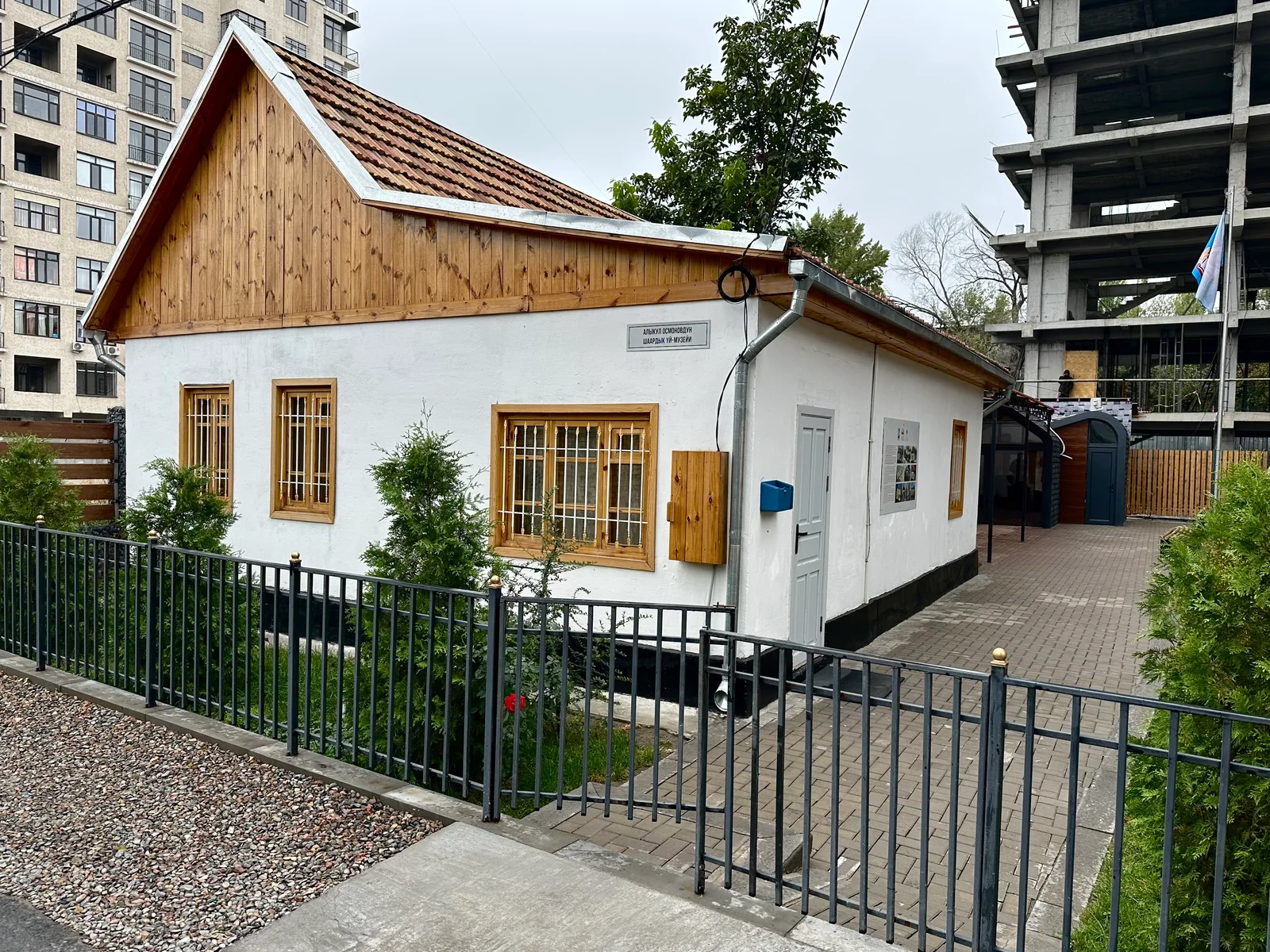 Alykul Osmonov House Museum in Bishkek after restoration. Photo: Incall, Wikimedia Commons, CC BY-SA 4.0; edited for this site.
Cholpon-Ata has a different museum in a house where the poet lived and worked by the lake between 1945 and 1950. It opened on 12 December 2009. The two sites are complementary: one preserves his last Bishkek address, while the other holds the memory of the Issyk-Kul period.
In 2015 the National Library of the Kyrgyz Republic was named after Osmonov. His legacy is present there not only as commemoration, but through books, bibliographies and access to printed editions. Our overview of museums in Kyrgyzstan helps place literary sites within a wider trip.
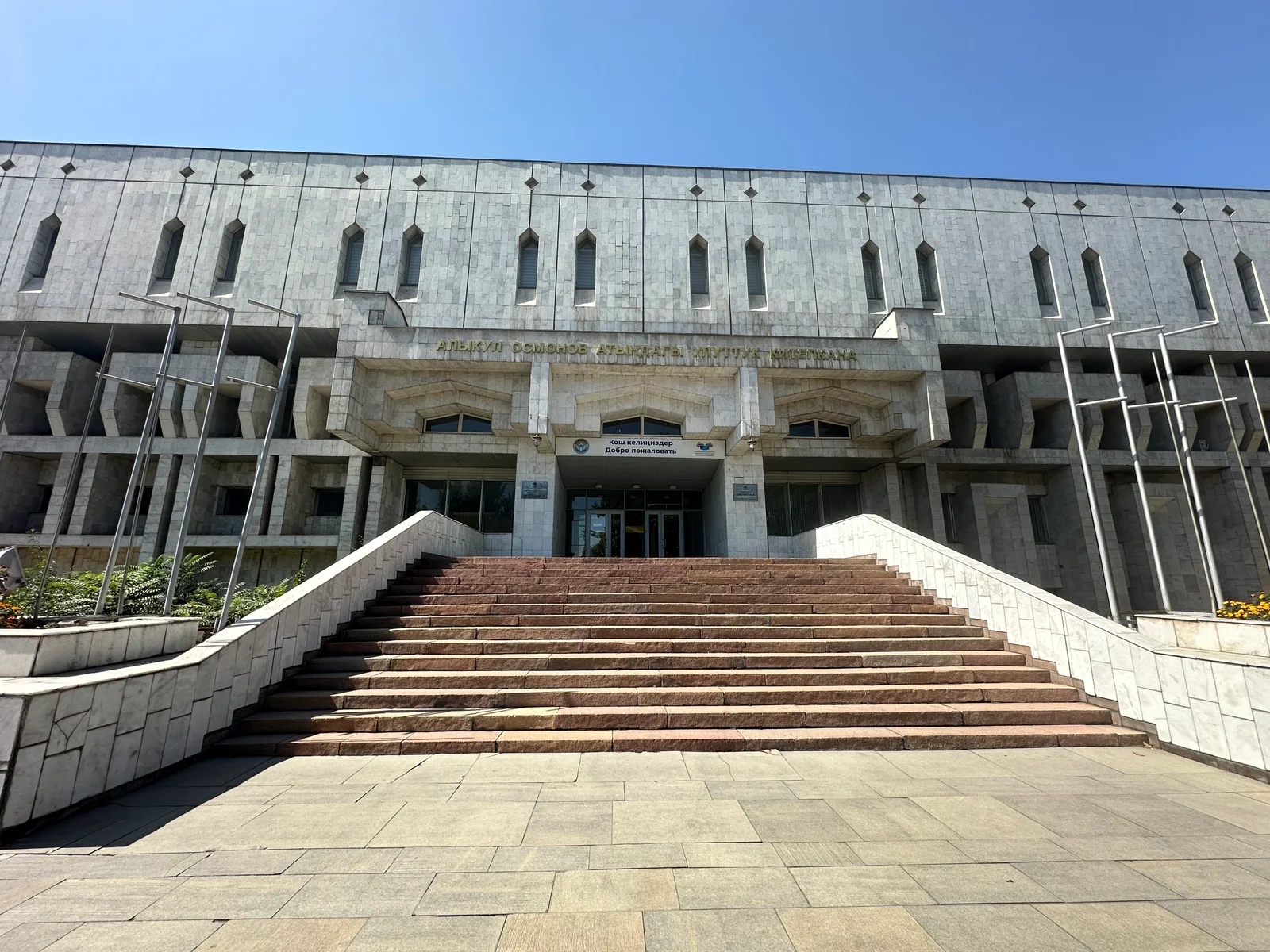 The Alykul Osmonov National Library in Bishkek. Photo: Incall, Wikimedia Commons, CC BY-SA 4.0; edited for this site.
Alykul Osmonov on the 200 som note
Osmonov's portrait appears on the front of the current 200 som banknote. The reverse shows Issyk-Kul and the surrounding mountains. The pairing is deliberate: the currency fixes the same connection between poet and lake that readers encounter in his mature lyrics.

In 2014 the National Bank issued a centenary version limited to 3,000 notes. It retained legal-tender status even though an individual note could acquire a collector's value above its face value. The current series, dimensions and security features are covered in our guide to the 200 som banknote.
Where to begin reading
Do not start by forcing your way through collected works in order. Choose several poems from the Makhabat period, then an Issyk-Kul group, and finally compare a passage from his Rustaveli or Pushkin with another version. The three steps reveal the lyric voice, the handling of landscape and the translator's craft.
In English or Russian, always note the translator's name. One version may preserve meaning, another rhythm or density of image, and none is automatically identical to the Kyrgyz poem. Kyrgyz readers can begin with the digitised first volume of the 1964 collected works.
A useful next comparison is Chingiz Aitmatov. The two lives show different moments in twentieth-century Kyrgyz literature: Osmonov enlarges the possibilities of lyric verse and translation, while Aitmatov builds prose for both Kyrgyz and international readerships.
Frequently asked questions about Alykul Osmonov
Who was Alykul Osmonov?
Alykul Osmonov was a Kyrgyz poet, dramatist and translator. His mature lyrics, the collection Makhabat and his translations of world literature expanded the possibilities of written Kyrgyz poetry.
When did Alykul Osmonov live?
He was born on 21 March 1915 in Kaptal-Aryk and died in Frunze on 12 December 1950. He was thirty-five years old.
What did Alykul Osmonov translate?
His major translations included Shota Rustaveli's The Knight in the Panther's Skin, Pushkin's Eugene Onegin, Shakespeare's Othello and Twelfth Night, Krylov's fables and children's literature.
Why is Alykul Osmonov associated with Issyk-Kul?
He stayed by the lake for health reasons and worked there on a large group of mature poems from late 1944 into early 1945. Issyk-Kul became one of the central images of his poetry.
Which banknote features Alykul Osmonov?
His portrait is on the front of Kyrgyzstan's 200 som banknote. The reverse depicts Issyk-Kul and the mountains around it.
Share on social media
If you found this guide useful, share it on social media. It takes a moment and helps more travellers discover the project. Thank you!
Anything to add?
Share your experience, leave a comment or suggest an improvement.