Contents:
Why visit Uzgen
Uzgen is an easy half-day or full-day trip from Osh. Its medieval ensemble stands close to the centre of the modern town, with the bazaar and teahouses nearby. One compact visit can cover Karakhanid architecture, a busy southern market and lunch made with the rice grown around town. The minaret and mausoleums appear on the reverse of the 50 som banknote.
The monuments reward a slower look. Each mausoleum portal uses a different arrangement of carved terracotta, while the minaret's brickwork changes from band to band. You can register the whole complex in an hour, but the detail can comfortably keep you twice as long.
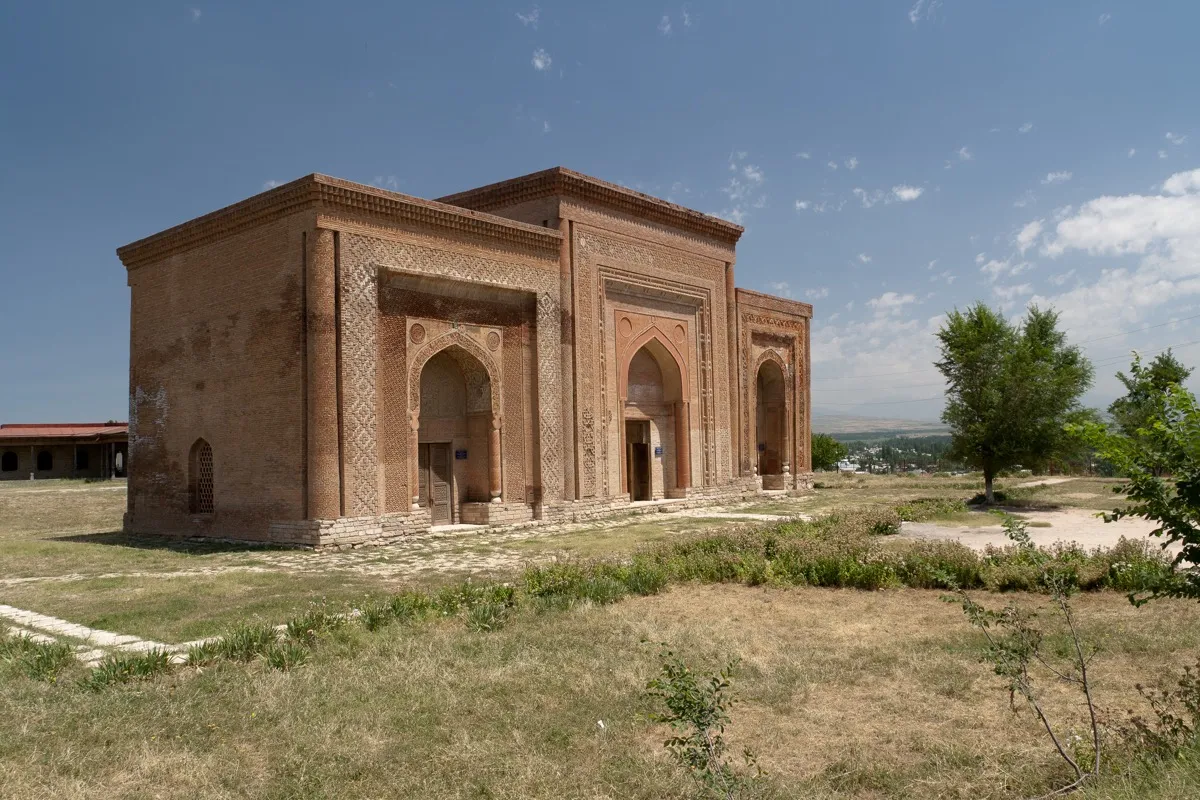 1/2. The Uzgen mausoleums Photo: Ekrem Canli, Wikimedia Commons, CC BY-SA 3.0; edited for this site.
 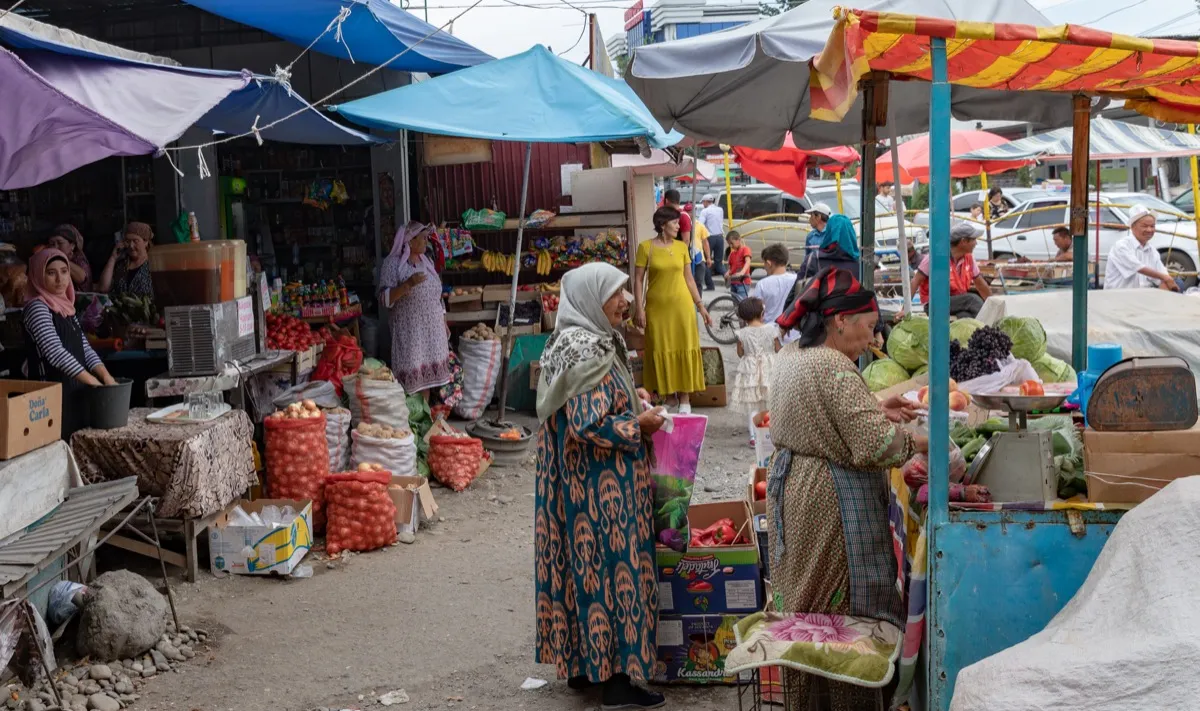 2/2. Uzgen bazaar Photo: Ninara, Wikimedia Commons, CC BY 2.0; edited for this site.
 Keep the scale sensible. Uzgen does not need a multi-day expedition. A calm day out from Osh works better than squeezing the monuments into a long transfer across southern Kyrgyzstan.
Understanding the town and its name
The Kyrgyz name is commonly rendered as Özgön in Latin script, while Russian and most English-language maps use Uzgen. Both forms refer to the same district-level town in Osh Region. When arranging a ride, show the exact pin as well as the name: the surrounding district is also called Uzgen.
The modern town occupies part of a much larger settlement beside the Kara-Darya River. Traces of the citadel and the shahristans, the fortified quarters of the medieval city, survive but are harder to read because later streets and buildings cross the site. Start at the museum complex, then walk towards the bazaar and central streets.
Distances in the centre are short, although pavements and crossings vary. Save an offline map, cross busy roads at clear points and do not assume that the straight line on a screen is a usable pedestrian route.
The minaret and three mausoleums
The minaret dates to the middle of the eleventh century. An octagonal base supports its tapering shaft, whose patterned brickwork creates distinct horizontal bands. The three mausoleums stand shoulder to shoulder. The earliest was built around the turn of the eleventh and twelfth centuries, while surviving inscriptions include the dates 1152, 1186 and 1187.
Begin at the edge of the grounds, where you can see the full line of portals. Then move closer for the inscriptions, plant forms and geometric grids cut into terracotta and plaster. Do not touch the relief or lean against the masonry for a photograph. These surfaces have lasted for centuries but remain vulnerable.
Opening hours, access to individual rooms and the climb inside the minaret can change. Ask at the ticket office rather than building your day around the viewpoint. If the staircase is open, leave a bulky bag below: the passage is steep, narrow and awkward when people meet.
Uzgen's precise UNESCO status
Kyrgyzstan protects the ensemble as a monument of national importance. In 2022, the Cabinet of Ministers established the separate Özgön State Historical and Cultural Museum-Reserve, bringing the minaret, three mausoleums and parts of the medieval settlement under its care.
The UNESCO position was clear in August 2026. Uzgen formed part of the transnational nomination “Silk Roads: Fergana-Syrdarya Corridor”, but it was not yet a World Heritage Site. At session 48, the committee deferred examination of the nomination and requested substantial revision. Calling the complex “UNESCO-listed” still goes beyond its official status.
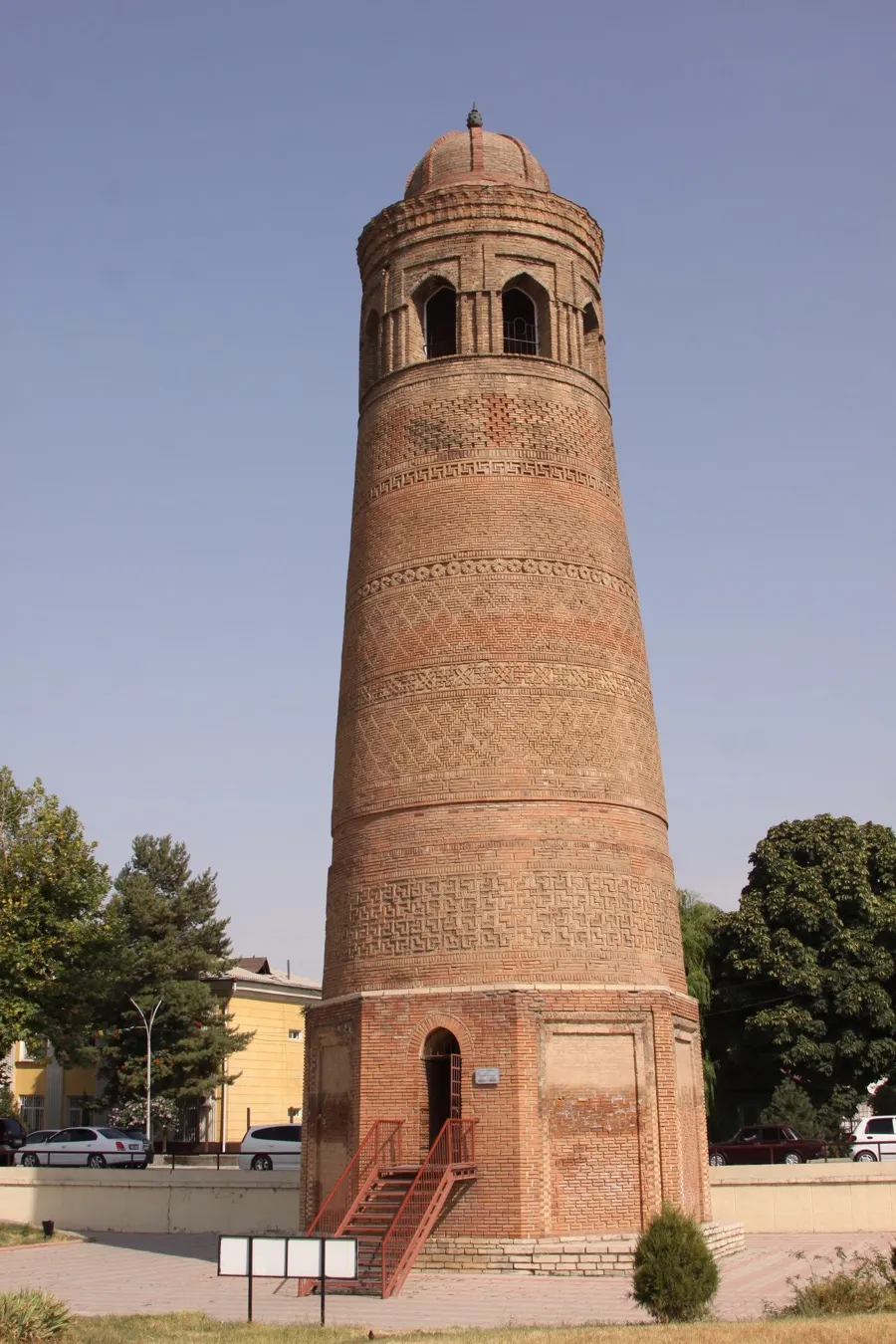 1/2. Uzgen minaret Photo: JohnNewton8, Wikimedia Commons, CC BY-SA 4.0; edited for this site.
 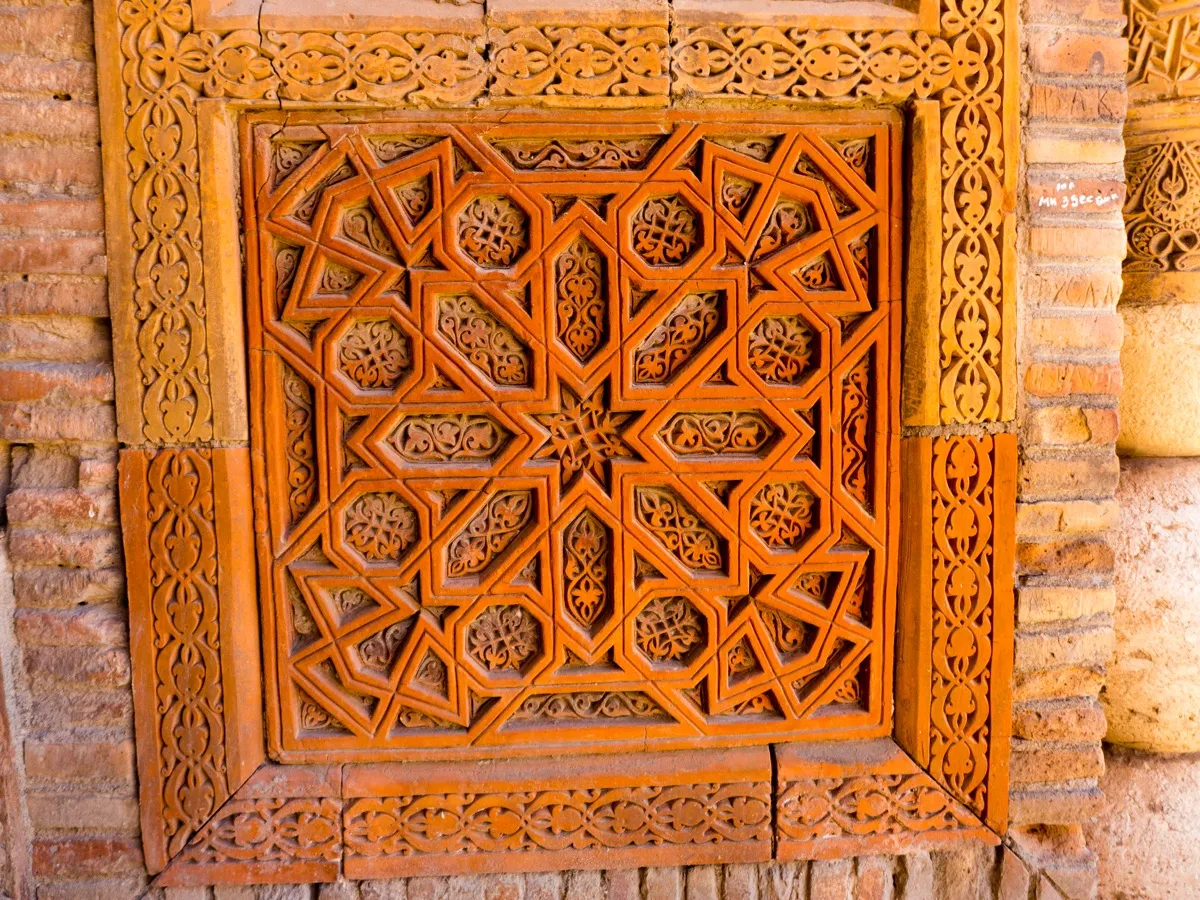 2/2. Terracotta ornament Photo: Fabienkhan, Wikimedia Commons, CC BY-SA 4.0; edited for this site.
 The bazaar and Uzgen rice
The central bazaar brings the modern town into focus. Stalls sell vegetables, fruit, dried fruit, flatbread, spices and sacks of local rice. Mornings offer a wider choice and less summer heat. Carry small notes, agree the price before weighing and ask before photographing people.
Uzgen rice is grown in the valleys of the Kara-Darya, Kara-Kulja and Tar rivers. The name covers several local varieties, so the colour and shape of the grain differ from one sack to another. For the journey home, choose a dry, labelled and undamaged package. Our guide to souvenirs from Kyrgyzstan covers the practical checks for edible gifts.
Teahouses are the place to look for plov, samsa and the cooking of southern Kyrgyzstan. Ask which rice has been used if that matters to you: “Uzgen” on a menu does not guarantee one fixed recipe. Our guide to Kyrgyz food gives the broader context, including the Uzbek, Uyghur and Dungan influences that are especially visible in the south.
Getting there from Osh and moving around
The monuments are about 55 kilometres from Osh by paved road. Marshrutkas and shared taxis run towards Uzgen through the day, but their departure point and the last convenient return can move. Check both with your accommodation in the morning and pin the place where the return vehicles leave.
Allow roughly an hour and a half each way, including a margin for loading, stops and urban traffic. A private car becomes more useful for a family or if you have arranged a visit to a rice mill. Agree waiting time and the return journey before setting off.
The museum complex, bazaar and central streets are close enough to explore on foot. Use a local taxi for the outer neighbourhoods and name a specific landmark rather than the district alone. The main intercity options are explained in our guide to transport in Kyrgyzstan.
Half-day and full-day itineraries
Half a day. Leave Osh in the morning, see the minaret and mausoleums first, then walk through the bazaar and have lunch in the centre. Confirm your return stop before wandering. About 4-5 hours in town gives this plan room to breathe and does not depend on the minaret being open.
A full day. Slow down at the complex, add the central streets and browse the market without watching the clock. Include a rice mill only when a visit has been arranged in advance. It is a working private business, not a museum with guaranteed public hours.
Avoid combining Uzgen, a long walk around Osh and a late transfer to Jalal-Abad on the same day. If the town is one stop on a through journey, keep a daylight margin and confirm your onward car before you start sightseeing.
When to visit, where to stay and what comes next
The museum complex is a year-round destination, but spring and autumn are easiest for walking. Summer heat builds quickly in the open courtyards, so start early and carry water, a hat and sun protection. In winter, short daylight makes an early departure from Osh particularly worthwhile.
Most travellers will find it simpler to sleep in Osh and visit with a light day bag. A night in Uzgen makes sense before an early onward journey or as part of a pre-arranged local programme. Before booking, check the exact address, hot water, seasonal heating or air conditioning and luggage storage.
From Uzgen, return to Osh or continue towards Jalal-Abad. On any through journey, confirm the transfer point and final leg. A destination name displayed in a windscreen does not necessarily mean that the car follows the route that suits your itinerary.
Share on social media
If you found this guide useful, share it on social media. It takes a moment and helps more travellers discover the project. Thank you!
Anything to add?
Share your experience, leave a comment or suggest an improvement.