Contents:
- Why Kozhomkul matters
- His name, dates and Suusamyr
- What is known about his wrestling
- How tall was Kozhomkul?
- Work in village councils and agriculture
- The horse, the stones and other legends
- Did he wrestle Baluan Sholak?
- The village, museum, tournament and monument
- How to see the geography of his life
- Frequently asked questions
Why Kozhomkul matters
Kozhomkul entered Kyrgyzstan's history as a balban from the Suusamyr Valley. He wrestled at traditional contests, became famous among Kyrgyz and Kazakh communities, and later became the subject of stories in which a man carries a horse across a pass, lifts enormous stones and bends iron with his hands.
Those stories can easily obscure the other half of his biography. During the decades from 1920 to 1940, Kozhomkul headed a local committee of poor peasants, worked in a district land department, chaired village councils and managed farms. He received the Order of the Red Banner of Labour. Popular memory preserved the strongman, but the documentary record also reveals a rural organiser.
His biography is therefore best read in two layers. The first consists of dates, public posts, awards and official decisions commemorating his name. The second lives in oral tradition. It explains how people wanted to remember Kozhomkul, but cannot replace a measurement record, a sporting results sheet or an archival case file.
His name, dates and Suusamyr
Kaba Uulu means "son of Kaba". It is a Kyrgyz patronymic, not a surname in the modern European sense.
The Kyrgyz Encyclopedia gives his lifespan as 1888-1955. Some archival and anniversary publications give 1889 as his year of birth, while the exact dates of his death vary even more. No publicly available birth record resolves the disagreement. The most honest short form is therefore 1888-1955, with a note that 1889 also appears in the sources.
Sources identify his birthplace as Keng-Suu or Joo-Jürök in the Suusamyr Valley. Modern administrative precision creates false certainty here: the names of local tracts, winter camps and later villages do not always correspond. The central fact is secure. Kozhomkul grew up and spent most of his life in Suusamyr, a high-altitude valley between northern and southern Kyrgyzstan.
His father, Kaba, also entered local memory as a strong man. Family stories help explain an environment in which physical endurance was not a stage performance but part of pastoral work, travel across mountain passes and contests held at large gatherings.
What is known about his wrestling
The word balban means a wrestler and is also an honorific for an accomplished strongman. Kozhomkul competed before the familiar system of weight classes, federation rankings and video records of every bout. A contest might take place at a festival, memorial gathering, fair or large toi, and its rules depended on the location.
Later biographies agree that he became famous while still young and that his reputation spread beyond Suusamyr. No open list of opponents, dates and results has survived, however. The claim that he "never lost a single bout" belongs to the hero's remembered image, not to verifiable sporting statistics.
Modern alysh shows one form of belt wrestling, but it does not justify retrospectively assigning Kozhomkul to a specific discipline or giving him an official title. His world of competition was broader than a modern rulebook.
How tall was Kozhomkul?
The most popular figure, 2.36 metres, is repeated in reference notes, school texts and tourist stories. The same Kyrgyz Encyclopedia gives a different pair of measurements: a height of 1.97 metres and a weight of 164 kilograms, with 2.36 metres and 203 kilograms as an alternative. Both sets cannot be treated as precise measurements taken at the same age.
Surviving clothes, shoes and photographs confirm his unusually large build, but they do not settle the dispute to the nearest centimetre. Comparing an object with a visitor depends on its cut, the viewing angle and the museum label. A responsible biography therefore presents the range of versions instead of choosing the most impressive one.
Size became part of the language of remembrance. As stories moved further from eyewitnesses, the numbers grew larger and more exact. That does not make the entire image fictional, but it does show why measurements must be separated from legend.
Work in village councils and agriculture
After Soviet power was established, Kozhomkul took part in local government. In the middle of the decade beginning in 1920, he headed the Suusamyr committee of poor peasants, then worked in the land department of Kara-Balta District. During the decades from 1930 to 1940, he led several village councils and farms in Suusamyr, Jumgal and Sokuluk.
Sources differ slightly on the dates and even on the specialisation of his last farm, variously describing it as a sheep or horse enterprise. The consistent core is that Kozhomkul spent many years working in agriculture and local administration. According to an official anniversary biography, the first school at the 8 March collective farm was built on his initiative.
Later publications also report that he was arrested in 1937 and held for about a year. No publicly accessible case card or precise charge has been found, so a detailed dramatic account would be speculation. It is only safe to say that the episode became established in family and official biographical tradition.
The Order of the Red Banner of Labour recognised his public and agricultural work, not a legendary sporting record. The award brings Kozhomkul out of the realm of a folkloric giant and back into the history of a particular region and its institutions.
The horse, the stones and other legends
The best-known story says that Kozhomkul's horse became exhausted on the way across Too-Ashuu, so he carried the animal on his shoulders. Other tales credit him with moving a 635-kilogram stone about one hundred metres, rescuing a bull or camel and breaking horseshoes with one hand.
Even official anniversary speeches call these stories angyz, meaning legends. The stone may have been weighed later, but that does not prove how or how far it was moved decades earlier. No travel log or photograph documents the story of the horse.
The legends mean more than a display of muscle. His strength almost always solves a shared problem: opening a route, saving an animal, helping a farm or defending the community's dignity. That is how Kozhomkul was remembered, and the horse on his shoulders became the hero's defining visual symbol.
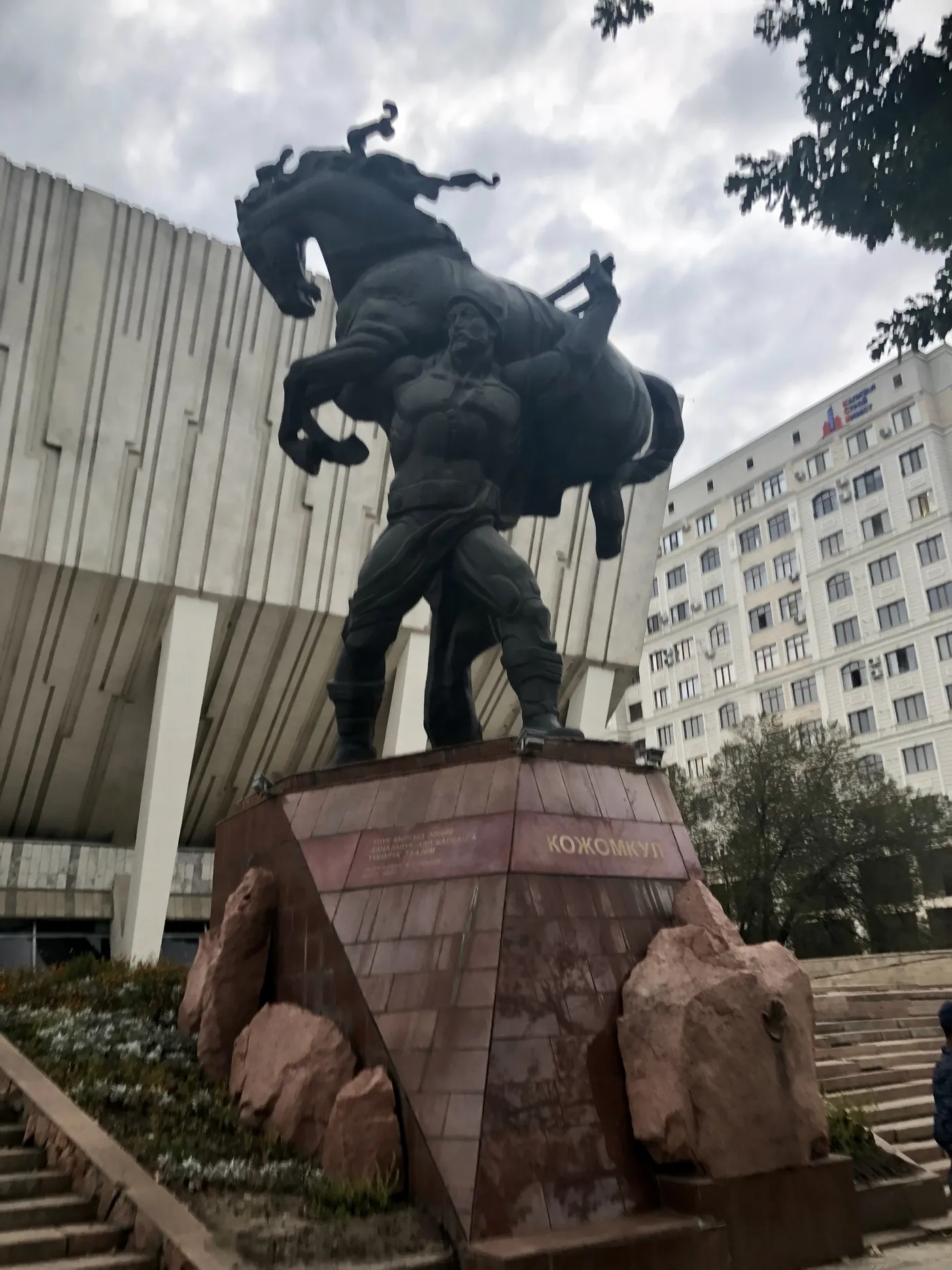 The monument turns the oral legend of the horse into an urban symbol. Photo: Davide Mauro, Wikimedia Commons, CC BY-SA 4.0; edited for this site.
Did he wrestle Baluan Sholak?
One popular story says that Kozhomkul defeated the Kazakh singer and wrestler Baluan Sholak. The tale emphasises the connection between neighbouring peoples and places two strongmen in the same scene. The problem begins when the legend is assigned a precise year and result.
Baluan Sholak died in 1919, while some later versions place the bout in the middle of the decade beginning in 1920. Other retellings put another Kazakh wrestler, Kazhymukan Munaitpasov, alongside Kozhomkul. Such a meeting is chronologically possible, but no results record confirms it either.
A specific victory therefore cannot be claimed. Oral tradition may have combined people with similar names, different encounters and famous Kazakh strongmen. Historical caution does not diminish the Kyrgyz-Kazakh sporting connection. It simply preserves the line between that relationship and a compelling scene without a reliable date.
The village, museum, tournament and monument
A small family museum devoted to Kozhomkul opened in Suusamyr in 1989. It preserves personal possessions, clothing and material about the balban. In 1992, the village of Vosmoye Marta was officially renamed Kozhomkul. The two dates are often confused, although the museum predates the official decision on the village's name.
The museum has no consistently published opening hours. A 2023 interview with its curator says that the family maintains the collection and lacks stable funding. If the museum is the purpose of your journey, arrange the visit in advance through local contacts.
A wrestling memorial event has carried Kozhomkul's name since 1962. In 1993, the Sports Palace in Bishkek was named after him, and the monument with the horse was installed outside the building. In 2013, Kyrgyz Post issued a stamp for the 125-year anniversary of the balban's birth. Its portrait and the monument are combined in this page's cover image.
How to see the geography of his life
Suusamyr lies on the road between Bishkek and southern Kyrgyzstan. Our practical guide to the Bishkek-Osh road explains the route across Too-Ashuu, through the high valley and onwards to the climb over Ala-Bel. It conveys the scale of the landscape in which stories of passes, horse herds and stones arose.
A biographical journey connects two different places of memory. The monument and Sports Palace in Bishkek show the official image of Kozhomkul. His family museum, local stories and the landscape of his life remain in the village named after him. Neither replaces the other: the city monument explains the symbol, while Suusamyr returns him to a place and a working life.
Our other biographies are collected in Notable People of Kyrgyzstan. Kozhomkul occupies a distinctive place among them: fewer written records survive about him than about politicians and writers, but his story reveals with unusual clarity how a society turns a real person into a folk hero.
Frequently asked questions about Kozhomkul Kaba Uulu
Who was Kozhomkul Kaba Uulu?
Kozhomkul Kaba Uulu was a Kyrgyz balban from the Suusamyr Valley and a local leader. During the 1920s, 1930s and 1940s, he worked in committees, village councils and farms, and later became the subject of legends about extraordinary strength.
When did Kozhomkul live?
The Kyrgyz Encyclopedia gives his lifespan as 1888-1955. Some publications give 1889 as his year of birth, so an exact date cannot be asserted without new archival evidence.
How tall was Kozhomkul?
Sources disagree. The Kyrgyz Encyclopedia gives a height of 1.97 metres and an alternative figure of 2.36 metres. No primary measurement record has been found in the public domain.
Did Kozhomkul really carry a horse across Too-Ashuu?
This is the main oral legend about Kozhomkul and is commemorated by the monument in Bishkek. There is no documentary evidence for the event, so it should be understood as part of popular memory rather than as a measured record.
Did Kozhomkul defeat Baluan Sholak?
No reliable record of a bout has been found. Some later versions conflict with Baluan Sholak's death in 1919, so the story may combine different encounters, names and oral narratives.
Where is the Kozhomkul museum?
The family museum is in the village of Kozhomkul in the Suusamyr Valley. No stable opening hours are published, so arrange a visit in advance through local contacts.
Share on social media
If you found this guide useful, share it on social media. It takes a moment and helps more travellers discover the project. Thank you!
Anything to add?
Share your experience, leave a comment or suggest an improvement.