Contents:
- Why Arabaev matters
- Why his name has several spellings
- Kochkor, village schools and study abroad
- The 1911 primer
- New-method schooling and Urkun
- From Alash to Soviet institutions
- Textbooks, the alphabet and Erkin-Too
- The systematic recording of Manas
- The Mountain Region and the Letter of Thirty
- Arrest, death and rehabilitation
- What survives of Arabaev’s work
- Frequently asked questions
Why Ishenaly Arabaev matters
At the beginning of the twentieth century, a Kyrgyz child had few opportunities to study in a language they understood. Schools, trained teachers, textbooks and a stable written standard were all scarce. Arabaev worked on every part of that problem: he taught, opened schools, wrote primers, prepared manuals for adults and teachers, served on scholarly commissions and helped put Kyrgyz books into print.
It is tempting to say that he “created Kyrgyz writing”, but the phrase hides a longer tradition and a collective effort. Educators and linguists including Kasym Tynystanov, Husein Karasaev and Bazarkul Daniyarov also shaped the language of the classroom. What makes Arabaev distinctive is that he began before the revolution and repeatedly tested editorial ideas in an actual school.
His political life formed a second strand. He raised the plight of refugees after the 1916 Urkun, joined public movements in Semirechye and supported a separate Kyrgyz territorial unit. Modern Kyrgyzstan therefore remembers him both as an educator and as one of the people involved in building the republic’s institutions.
Ishenaly or Eshenaly: why the name varies
Russian-language reference works and the university in Bishkek use “Ishenaly Arabaev”. The Kyrgyz Encyclopedia notes that the form closer to his own name is “Eshenaly”. His publications and later biographies also contain Ishenaaly, Eshenaaly, Eshen Arabai uulu and other spellings. The variants reflect movement between Arabic, Latin and Cyrillic scripts, as well as Russian administrative spelling.
This page uses the form most readers are likely to search for in English. A different spelling in an archive catalogue or an old title page normally refers to the same person.
Kochkor, village schools and study far from home
Arabaev was born in 1882 in Kün-Batysh, a village in the Kochkor valley of present-day Naryn Region. He learned to read from local teachers, completed a Russian-native school in 1900 and then spent almost a decade teaching in Kochkor and neighbouring districts.
To continue his education, he travelled far beyond the valley. The most firmly documented route took him through the Husainiya madrasa in Orenburg to the Galiya madrasa in Ufa. Galiya combined Islamic learning with history, geography, natural science and the reformist teaching methods associated with Jadid education.
Sources differ slightly on the end date: academic studies give 1913, while the Kyrgyz Encyclopedia places his return after graduation in 1914. The important point is the practical outcome. He came home as an experienced teacher familiar with new-method schools and the lively Turkic-language publishing world of the Volga-Ural cities.
The 1911 primer for Kyrgyz and Kazakh children
While studying in Ufa, Arabaev worked with Kazakh educator Khafiz Sarsekeev on Alip-bee zhaki töto okuu. Published by the Shark press in 1911, the primer moved pupils from letters to syllables, words and connected reading. It addressed Kyrgyz and Kazakh children who spoke closely related languages and then shared an Arabic-based script.
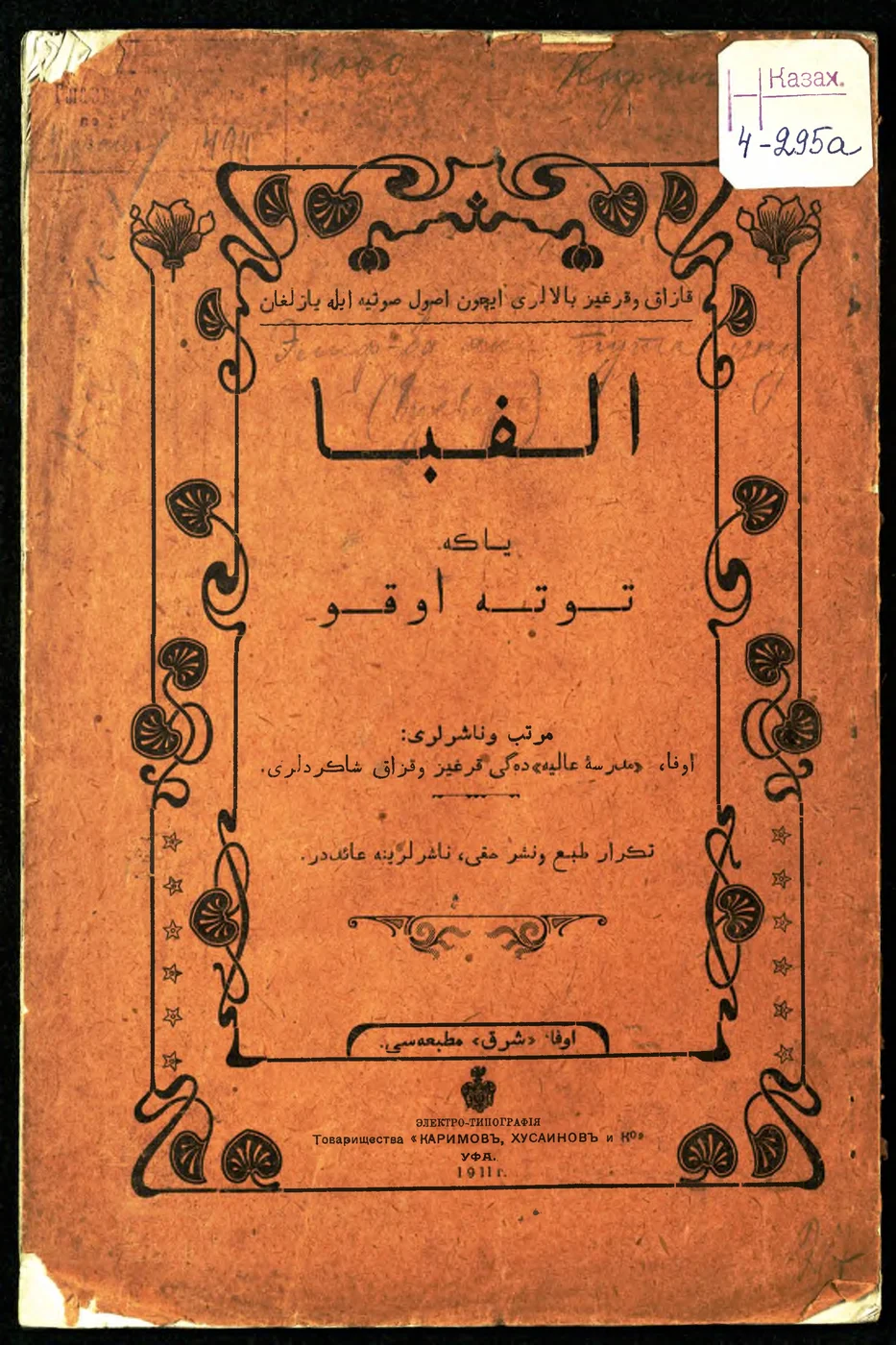
For decades the book was known mainly through bibliographic descriptions and later copies. An original survives in the National Library of Russia in Saint Petersburg. In 2026 researchers in Ufa issued a facsimile, allowing the early primer to be studied as a complete document rather than reconstructed from references.
Arabaev also wrote a preface and helped publish Moldo Kylych’s Kyssa-i-Zilzala in Kazan in 1911, one of the earliest Kyrgyz books printed in Arabic script. His 1912 Zhazuu örnöktörü then supplied rules and models for handwriting. The sequence was deliberate: a primer introduced reading, a literary text gave readers something substantial to read, and a writing manual developed the corresponding skill.
A new-method school and the rupture of Urkun
After returning home, Arabaev taught in the present-day Ton district and the Naryn valley. Classes in Toguz-Bulak initially met in a yurt erected for the purpose; a school later operated in Tört-Kül. New-method education meant more than a different building. Arithmetic, geography, history and natural science appeared alongside religious subjects, supported by classroom exercises and a planned sequence of books.
The Urkun of 1916 broke that work apart. After the imperial army crushed the uprising, Arabaev fled to China with other residents and returned in 1917. He pressed the new authorities to assist refugees and help families still across the border return. Popular biographies sometimes attach enormous totals to his work, but repatriation involved the refugees themselves, local committees and several layers of the Turkestan administration. It cannot honestly be credited to one man.
From Alash to Soviet institutions
In 1917 Arabaev took part in organising a Kyrgyz branch of the Alash movement. For parts of the educated elite in Semirechye, its programme offered a language for discussing self-government, education and the rights of the peoples of the former empire. The political landscape changed quickly after Soviet power was established, and the Alash structures disappeared.
Between 1918 and 1924 Arabaev worked in Soviet and educational institutions in Semirechye and the Turkestan ASSR, served in the Koshchu union and attended the Ninth All-Russian Congress of Soviets. This was not a neat conversion from one ideology to another. Early Soviet institutions needed locally educated specialists, while those specialists tried to preserve schools, publishing and political representation inside the new order.
Textbooks, the alphabet and the first Kyrgyz newspaper
During the 1920s Arabaev led educational and scholarly work for Kyrgyz schools. His output included primers published in 1924 and 1925, Zhazuu zholunda saamalik for teachers, adult literacy material, a method for teaching arithmetic, a natural-science textbook and guidance for collectors of folklore. The new written language was being used to explain a whole curriculum, not merely in language exercises.
Alphabet and spelling reform belonged to commissions rather than a single inventor. Arabaev helped adapt Arabic writing to Kyrgyz sounds, discussed terminology and tested decisions through textbooks. Schools later moved first to Latin and then to Cyrillic. His exact alphabet did not survive those changes, but the underlying principle of clear instruction in Kyrgyz did.
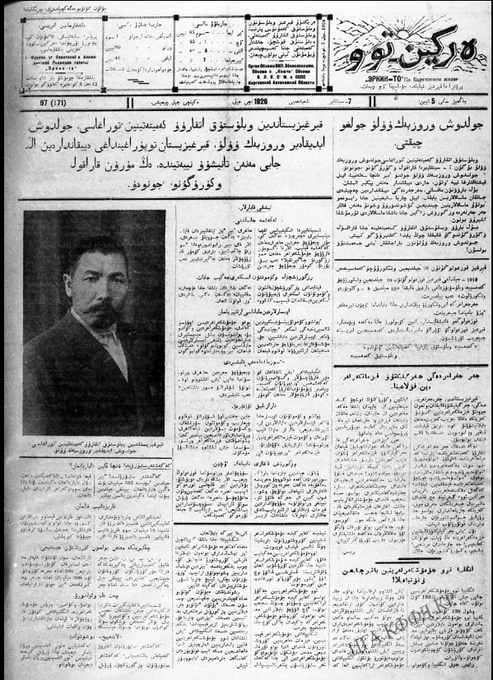
The first issue of the Kyrgyz newspaper Erkin-Too appeared in Tashkent on 7 November 1924. Arabaev helped establish it and contributed an article explaining a name that brought together freedom and the mountains. The newspaper served at once as a news source, a home for new literature and reading material for people acquiring literacy.
How the systematic recording of Manas began
Arabaev did not see print as a replacement for oral culture. In 1922 he helped organise the expedition that began recording Sagymbay Orozbakov's version of the epic. Trained collectors, especially Ybraiym Abdrakhmanov, wrote down the performance over several years, preserving one of the largest Manas corpora.
That organisational role should not be confused with authorship. Arabaev did not compose or rewrite Sagymbay’s performance. He helped locate the performer, arrange the work, secure paper and specialists, and create an institutional future for the manuscripts. Our separate guide to the manaschi tradition explains how the epic lives in performance.
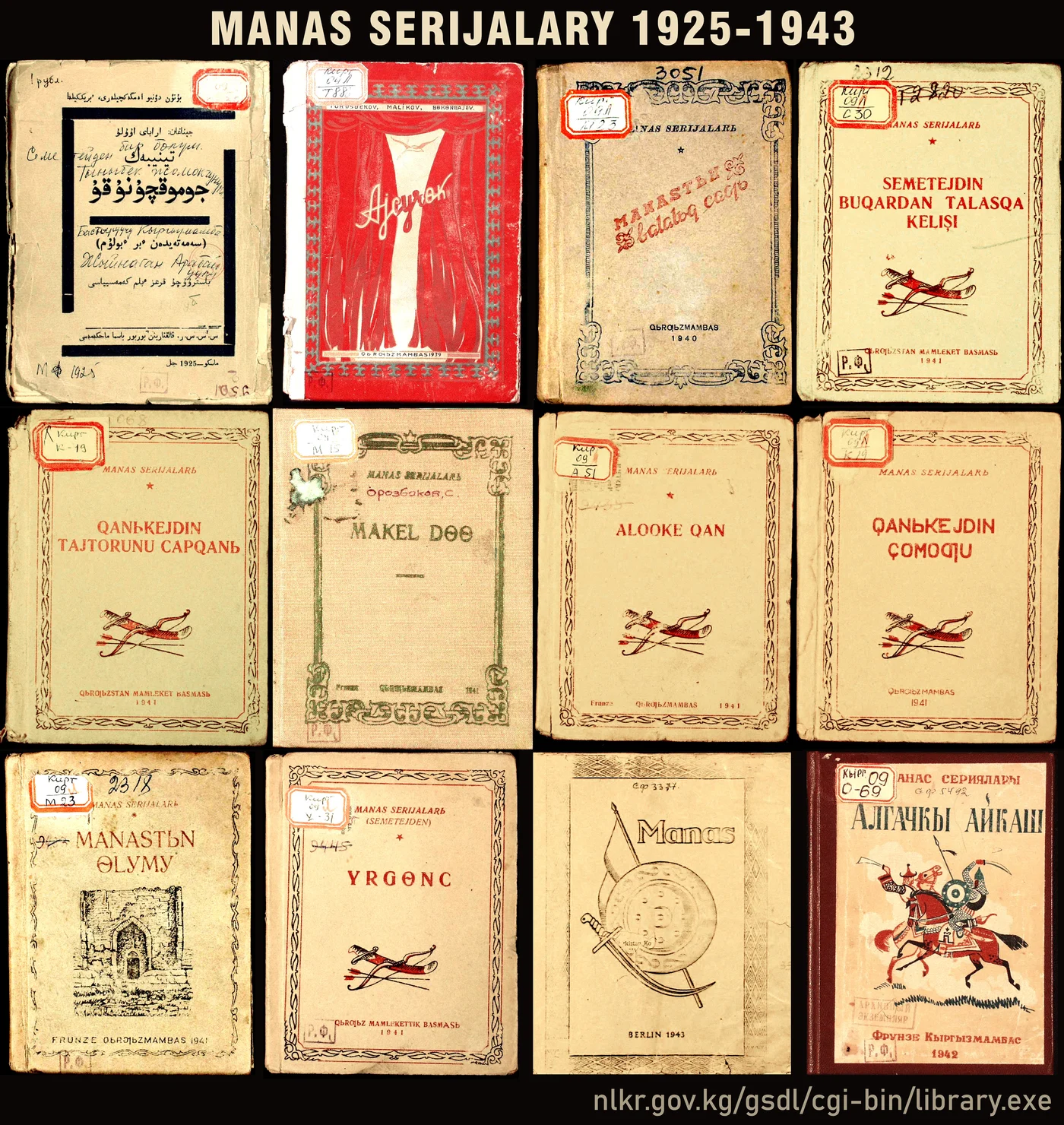 Editions of the Manas epic from the first half of the twentieth century.. Photo: Qyrgyz, Wikimedia Commons, CC BY-SA 4.0; edited for this site.
The Mountain Region, autonomy and the Letter of Thirty
In the early 1920s Arabaev joined those campaigning to unite Kyrgyz districts in a separate Mountain Kyrgyz Region. The first project failed amid political conflict and resistance within the party apparatus. National-territorial delimitation in 1924 produced a different route: the Kara-Kyrgyz Autonomous Region came into being.
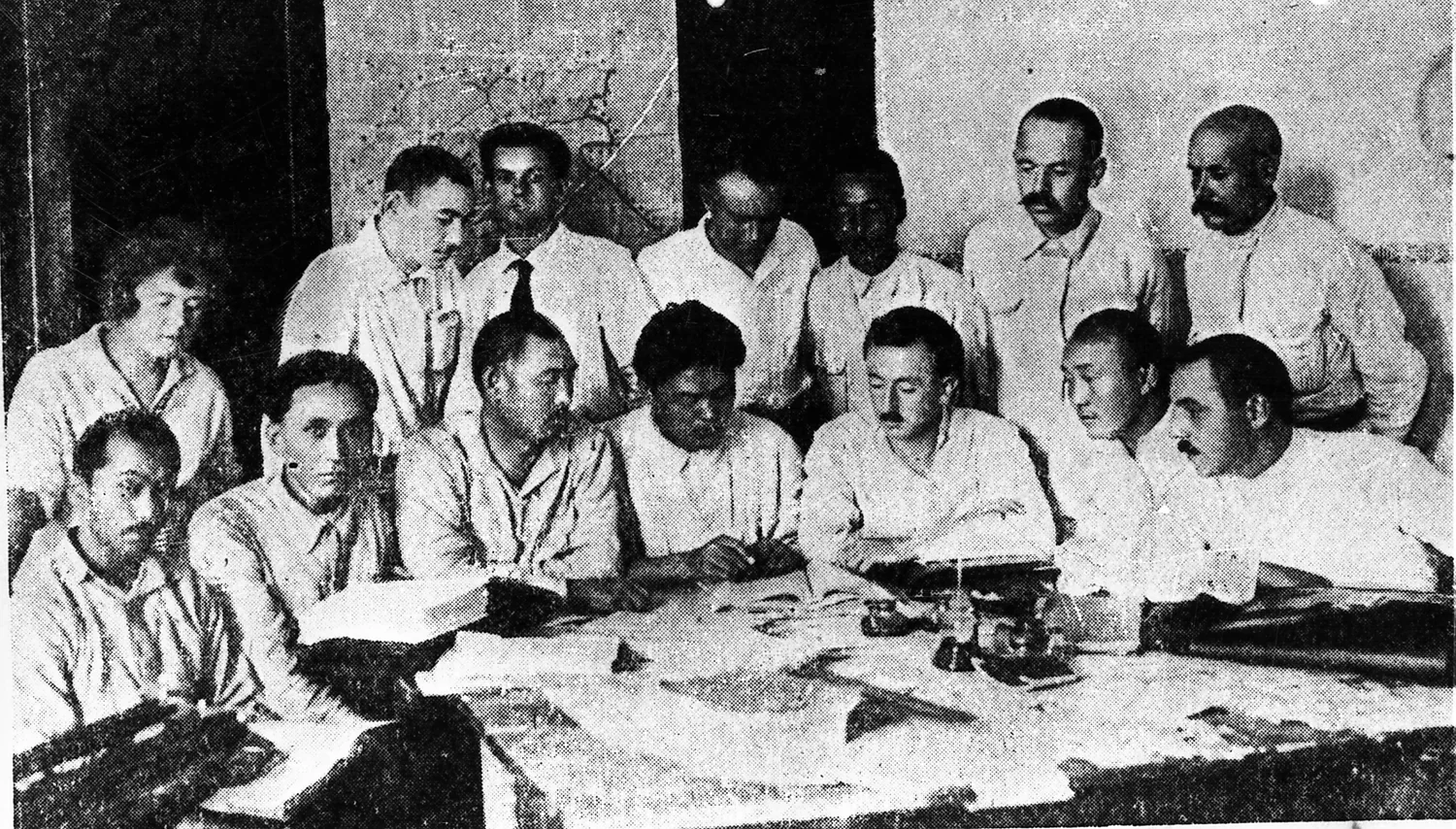
The archive photograph shows the Kyrgyz Bureau of the delimitation commission at work. Ishenaly Arabaev and the young Yusup Abdrakhmanov are among the figures in the front row. It is a useful corrective to heroic portraits: borders, institutions, budgets and links between northern and southern districts were negotiated by a group around a table.
In 1925 Arabaev was among the authors of the so-called Letter of Thirty, which criticised the conduct of the regional party leadership and the concentration of decisions inside a narrow apparatus. It was not a programme for leaving the Soviet Union. Local intellectuals were disputing who would govern the new region and whether its institutions could respond to local conditions.
Arrest, death in prison and rehabilitation
Arabaev was arrested on political charges on 11 May 1933 and transferred from Frunze to a prison in Tashkent. He was found dead in his cell on 7 June. Official reference works establish death in custody; later accounts add details about his final interrogation. The accessible record does not securely establish the immediate cause, so a specific murder scenario should not be presented as settled fact.
He was fully rehabilitated in 1958. By then his books had long vanished from the classroom, the writing system had changed twice and his name had spent decades outside the approved history of education. Legal rehabilitation restored his status, but the publication of his work and the search for early editions are still continuing.
What survives of Arabaev’s work
The Kyrgyz State University in Bishkek now bears his name, and a monument stands outside it. Yet his legacy is easier to recognise in the relationship between teacher, textbook and language. Arabaev wanted a school to address children in words they understood and to introduce them to the wider world, rather than stopping at the mechanical memorisation of letters.
In 2024 the state named Arabaev among five “founding fathers of modern Kyrgyz statehood”. This is a modern act of commemoration, not an office he held in life. Historically, his place is best understood as part of a collective effort alongside Abdykerim Sydykov, Imanaly Aidarbekov, Abdykadyr Orozbekov, Yusup Abdrakhmanov and others.
The Kyrgyz Encyclopedia provides a concise official chronology, while the National Library of Kyrgyzstan lists his educational and political work. Our Kyrgyz-language section follows the later changes of alphabet and the language travellers encounter today.
Frequently asked questions about Ishenaly Arabaev
Who was Ishenaly Arabaev?
Ishenaly Arabaev was a Kyrgyz educator, teacher, publisher and political figure. He opened schools, wrote primers and textbooks, helped establish Kyrgyz-language publishing, organised the recording of Manas and supported projects for Kyrgyz autonomy.
Did Arabaev write the first Kyrgyz primer?
In 1911 Ishenaly Arabaev and Kazakh educator Khafiz Sarsekeev jointly published a primer for Kyrgyz and Kazakh children in Ufa. Arabaev later prepared a separate Kyrgyz primer for schools in 1924.
Why is his name written Ishenaly and Eshenaly?
His name passed through different languages and scripts. The Kyrgyz Encyclopedia considers Eshenaly closer to the historical form, while Ishenaly is established in Russian and in the official name of the university in Bishkek.
How was Arabaev connected with Manas?
He helped organise the expedition that began the systematic recording of Sagymbay Orozbakov’s version in 1922. Collectors wrote down the performance; Arabaev provided the organisational and scholarly framework.
How did Ishenaly Arabaev die?
He was arrested on 11 May 1933, transferred to Tashkent and found dead in his prison cell on 7 June. The available evidence confirms death in custody but does not establish the immediate cause with enough certainty.
When was Arabaev rehabilitated?
Ishenaly Arabaev was fully rehabilitated in 1958. His work later returned to the history of Kyrgyz education and publishing, and a state university in Bishkek now bears his name.
Share on social media
If you found this guide useful, share it on social media. It takes a moment and helps more travellers discover the project. Thank you!
Anything to add?
Share your experience, leave a comment or suggest an improvement.