Contents:
What is kurut?
Kurut begins with süzmö, often written suzma, a thick cultured milk mixture from which most of the whey has been removed. It is salted, shaped into balls, discs or small cylinders and dried. The result is a hard snack with pronounced acidity and a salty flavour.
Kurut is not made only in Kyrgyzstan. Related products occur throughout Central Asia, but size, shape, saltiness and dryness vary even between neighbouring families. One kurut is easy to bite, another must be sucked for a long time and a third is crumbled into hot water.
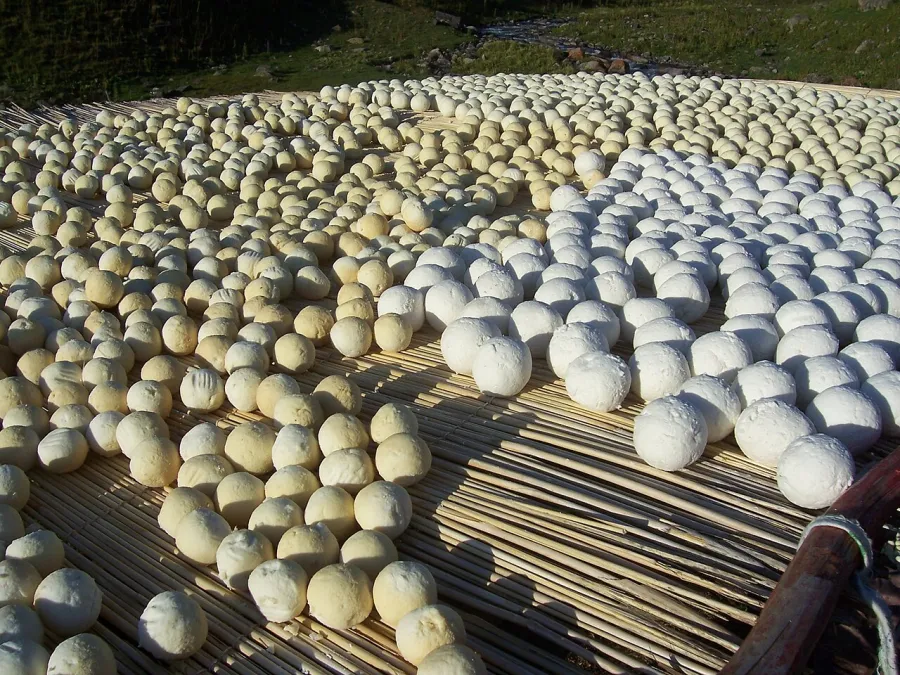 1/3. Kurut drying on a rack Photo: Paul Munhoven, Wikimedia Commons, CC BY-SA 3.0; edited for this site.
 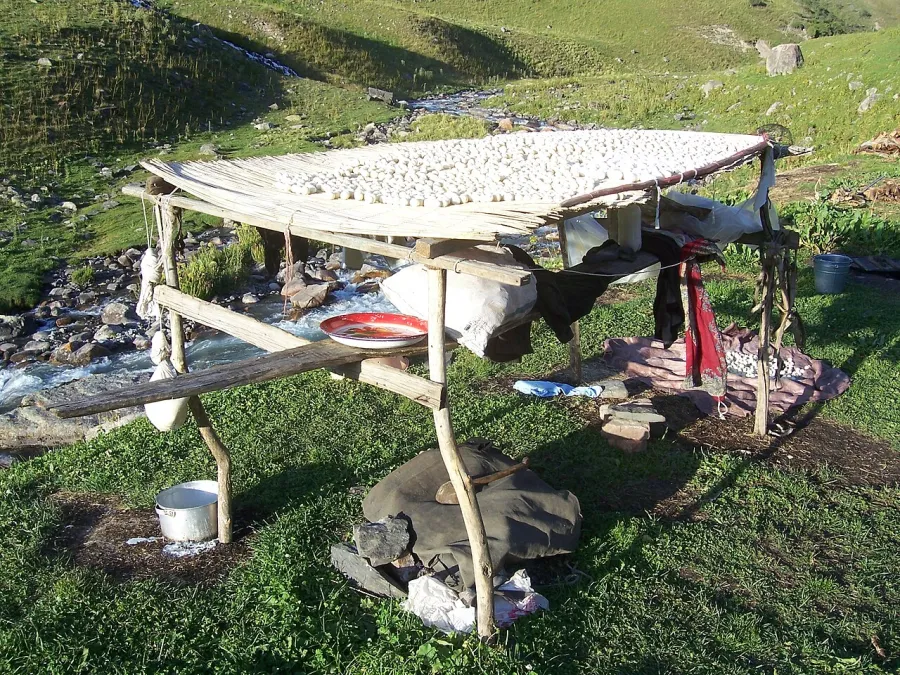 2/3. Drying rack beside a stream Photo: Paul Munhoven, Wikimedia Commons, CC BY-SA 3.0; edited for this site.
 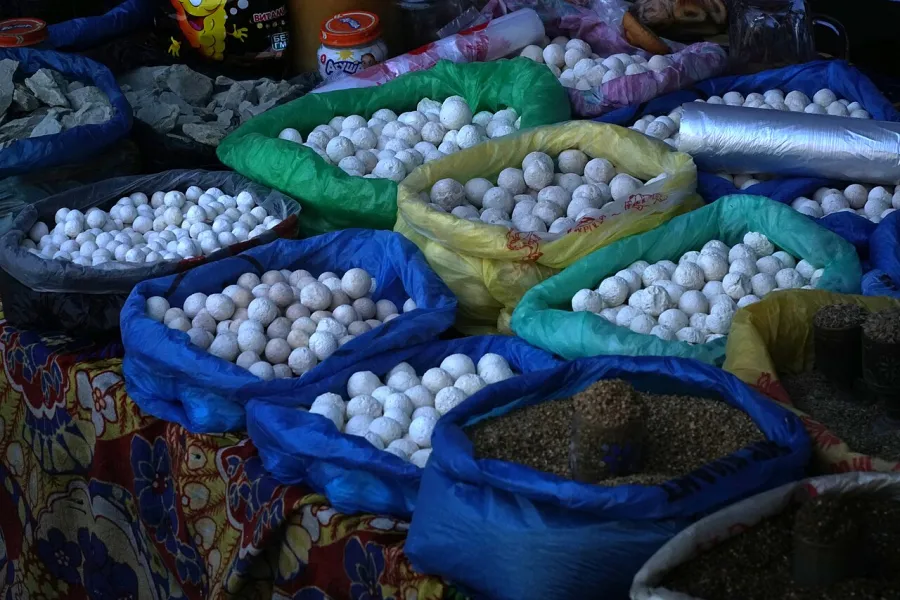 3/3. Kurut at Osh market Photo: Adam Harangozó, Wikimedia Commons, CC BY-SA 4.0; edited for this site.
 The white balls at a market are sometimes mistaken for sweets. It is a memorable error: classic kurut is not sweet, but tangy and distinctly salty. Pepper, herbs, a smoked flavour or a soft centre appear in versions on sale. These additions alter a particular recipe without defining the product.
How kurut is made
The process does not begin with milk powder or cheese. Pasteurised milk is cultured, then the fermented mixture is strained through cloth. The resulting suzma is mixed with salt, shaped and dried. Traditional households leave it in the air, while commercial producers use equipment that controls temperature, humidity and cleanliness.
Academic descriptions of Kyrgyz dairy products most often name cow's or sheep's milk as the raw material. Check the packaging of a particular kurut: a market vendor may not always state the type of milk, amount of salt or additives. The words “homemade” and “natural” say nothing by themselves about hygiene.
Drying concentrates the flavour and salt, but does not give every homemade ball an unlimited shelf life. Moist kurut spoils faster than a fully dried product. A factory use-by date applies only to sealed packaging stored under the producer's stated conditions.
How to choose and eat kurut
For a first taste, choose a small ball of medium hardness. Do not try to bite an extremely dry kurut immediately: it can damage a filling or sensitive tooth. Break off thin pieces, let them dissolve in your mouth or ask the seller for a softer version.
A good product smells cleanly of fermented milk. Damp patches, mould, a rancid smell or damaged packaging are reasons not to buy. Choose loose kurut from a stall where it is protected from dust and direct sun. A sealed factory packet with a production date and storage instructions is more convenient for a journey.
Kurut is eaten by itself, crumbled into dishes or dissolved in hot water. Its flavour shows why it rarely needs extra salt. To continue exploring Kyrgyz fermented milk products, try the softer, drinkable chalap.
Kurut contains milk proteins and a great deal of salt. It is unsuitable for anyone with a milk allergy, and people restricting sodium should discuss portion size with a doctor. Lactose content depends on the ingredients and process, so fermentation does not guarantee tolerance.
Homemade kurut in a dehydrator
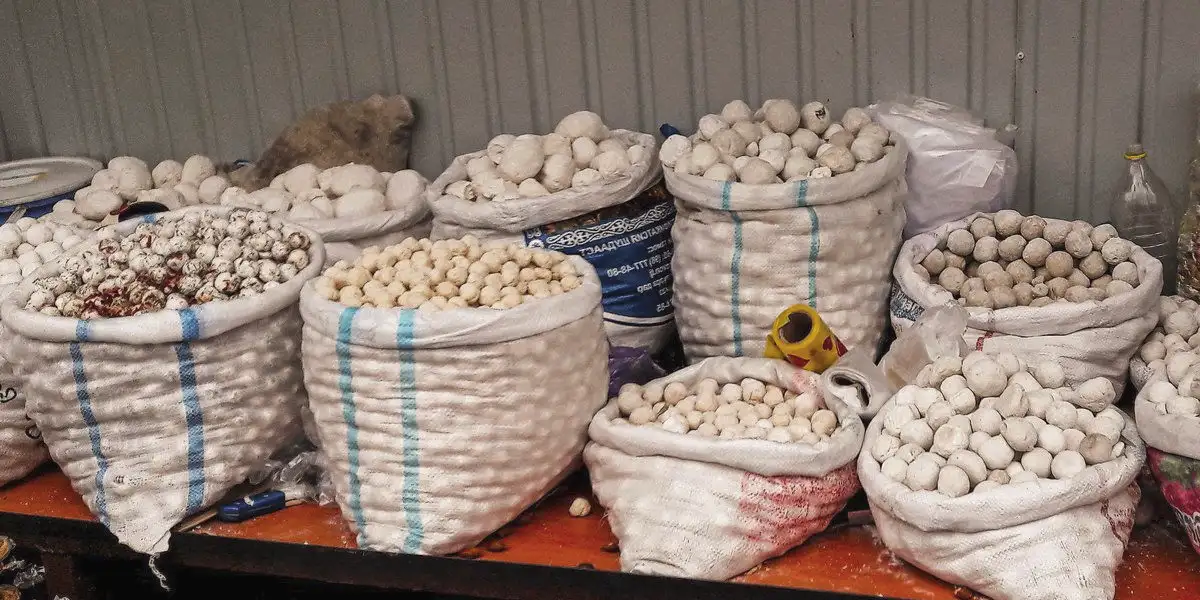
A controlled home version made from plain pasteurised yoghurt. Strain it only in the refrigerator, dry it in a dehydrator or oven and refrigerate the finished kurut: without measuring moisture, it cannot be treated as a long-life product.
Cuisine: Kyrgyz. Total time: 36 hours.
Ingredients:
- 2 kg plain yoghurt made from pasteurised milk, with no sugar or additives
- 1 level tsp fine salt
- ground red pepper, optional
Method:
Step 1. Set a colander over a deep bowl and line it with a clean, closely woven cloth. Add the yoghurt, cover and leave to strain in the refrigerator for 12-18 hours.
Step 2. Weigh the thick suzma. Add the level teaspoon of fine salt and mix thoroughly. If you wish, separate part of the suzma and add a little pepper.
Step 3. With clean, damp hands, shape small balls about 2 cm in diameter. Larger balls dry more slowly and unevenly.
Step 4. Arrange the balls on the dehydrator racks. Dry at 55-60°C until firm, changing the position of the racks according to the appliance instructions. Small balls usually need 10-16 hours.
Step 5. If using an oven, choose its lowest setting, no higher than 60°C, with convection. Leave the door ajar only if the oven instructions permit it.
Step 6. Cool the kurut completely. Transfer to a clean sealed container and refrigerate. Discard it if it develops an unusual smell, coating or softness.
Share on social media
If you found this guide useful, share it on social media. It takes a moment and helps more travellers discover the project. Thank you!
Anything to add?
Share your experience, leave a comment or suggest an improvement.