Contents:
Choosing the right site
The label "petroglyphs" covers three very different travel experiences. At Cholpon-Ata, the boulders lie in an open field beside a resort town. On Sulaiman-Too, rock art belongs to a living sacred landscape within Osh. Saimaluu-Tash sits high in the mountains and needs dedicated expedition-style planning.
Cholpon-Ata
- A practical first encounter without a multi-day trek.
- The open, stony field calls for closed shoes, water and sun protection.
- Easy to combine with the town and the north shore of Issyk-Kul.
Sulaiman-Too
- The petroglyphs form one part of a much larger World Heritage property.
- The mountain remains a place of pilgrimage as well as an archaeological site.
- The established route includes stairs, caves and exposed slopes.
Saimaluu-Tash
- The high-altitude complex is normally accessible during a short summer window.
- You need a local organiser, weather margin and suitable fitness.
- This is a journey in its own right, not a quick roadside detour.
What is a petroglyph?
A petroglyph is an image made directly on a rock surface. Its maker pecked, incised or abraded the darker outer layer to create a line or filled shape. The same carving can look striking in low side light and almost disappear under a midday sun.
Kyrgyzstan's rock art includes wild and domestic animals, hunters, chariots, signs, human-like figures and scenes that cannot be interpreted confidently without context. Similar motifs occur in different periods, and a later image may have been placed over an earlier one.
Specialists date individual groups by examining technique, superimposition, style, archaeological setting and parallels with dated material. A sign may give a broad period for a site, but visitors cannot reliably date a particular carving from the colour of its line.
Saimaluu-Tash: a major high mountain complex
Saimaluu-Tash lies in Toguz-Toroo District in Jalal-Abad Region. Its UNESCO Tentative List entry records roughly 10,000 stones bearing images. The earliest groups are assigned to the third and early second millennia BCE, while the place continued to be used over many centuries.
Use the status accurately. Saimaluu-Tash is on UNESCO's Tentative List, not on the World Heritage List. A state nature park protects both the archaeological complex and its high mountain setting.
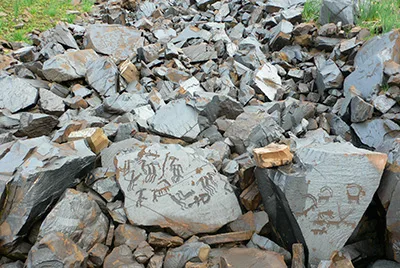 Petroglyphs among the scree at Saimaluu-Tash. Photo: Sraosha 9, Wikimedia Commons, public domain; edited for this site.
Altitude and snow create a short visiting season. Local organisers commonly plan journeys in July and August, but weather can still close the approach. Travel normally runs through Kazarman, with transport, a camp, horses or the walking section agreed in advance. Mobile coverage and a quick return cannot be assumed.
Do not apply the pace of a museum visit to Saimaluu-Tash. Thin air, the climb, a cold night and the long approach all require spare time. Ask your local organiser about trail conditions, sleeping arrangements, drinking water, warm equipment and the response to thunderstorms or fresh snow.
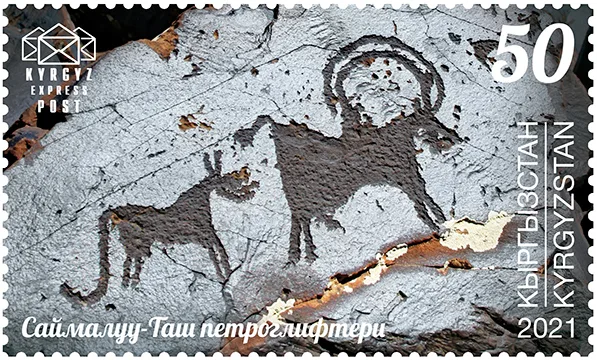 1/3. The 2021 stamp series inspired by Saimaluu-Tash Photo: official Kyrgyz postage issue, author unknown, public domain; edited for this site.
 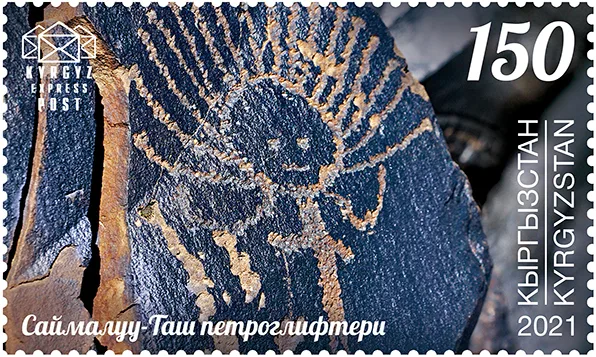 2/3. Animal figures in a postage miniature Photo: official Kyrgyz postage issue, author unknown, public domain; edited for this site.
 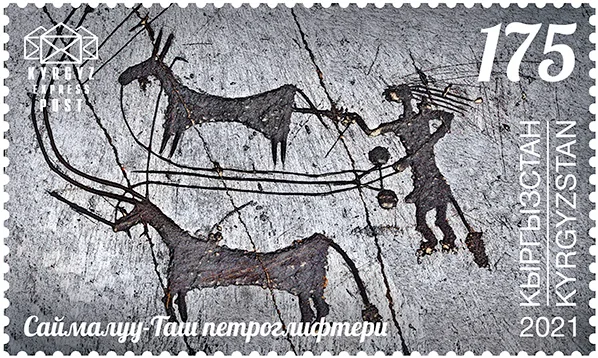 3/3. The third design in the 2021 series Photo: official Kyrgyz postage issue, author unknown, public domain; edited for this site.
 These are illustrations, not photographs of the rocks. The 2021 stamps show how Saimaluu-Tash motifs entered contemporary Kyrgyz visual culture. A carving on the actual scree may be far less distinct.
Cholpon-Ata: rock art beside the resort
Cholpon-Ata suits travellers who want to see rock art without a high-altitude trek. Boulders are scattered across open ground below the mountains. It is a good place to practise noticing pecked outlines under changing light, compare ibex figures and inspect the surface from a safe distance.
Our separate guide to the Cholpon-Ata petroglyph museum covers the route, landmarks, timing and practical details. Add it to a day in Cholpon-Ata or to a longer circuit around Issyk-Kul.
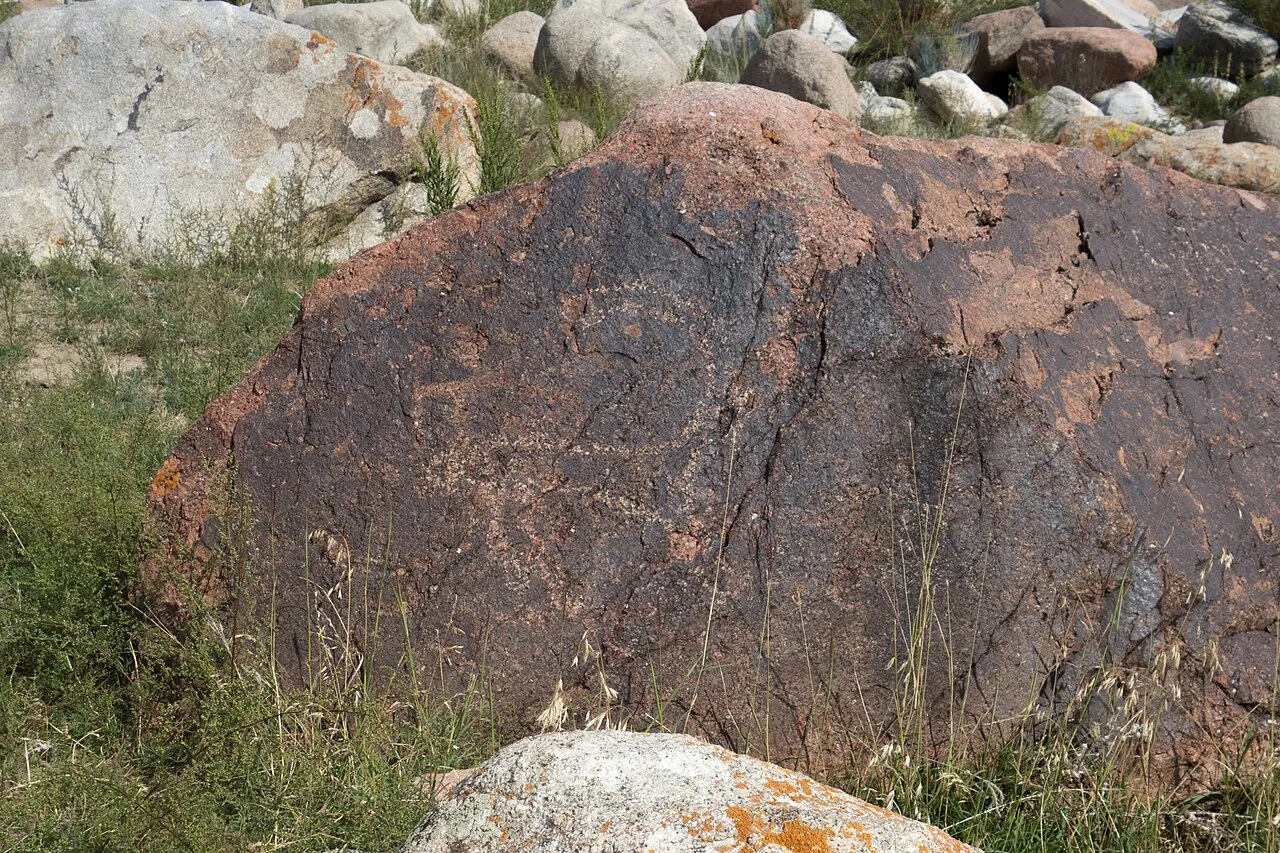 An ibex carving at Cholpon-Ata. Photo: Zde, Wikimedia Commons, CC BY-SA 4.0; edited for this site.
Sulaiman-Too: rock art in a sacred landscape
Sulaiman-Too rises from the centre of Osh. UNESCO inscribed the mountain on the World Heritage List in 2009. The property includes five peaks, old paths, 101 recorded petroglyph locations and 17 sacred places that remain in use.
Archaeology and pilgrimage meet here. Not every rock-art location is open or legible without a specialist. On a first visit, follow the established Sulaiman-Too walking route, read the signs and resist following an unmarked trail towards a promising rock face.
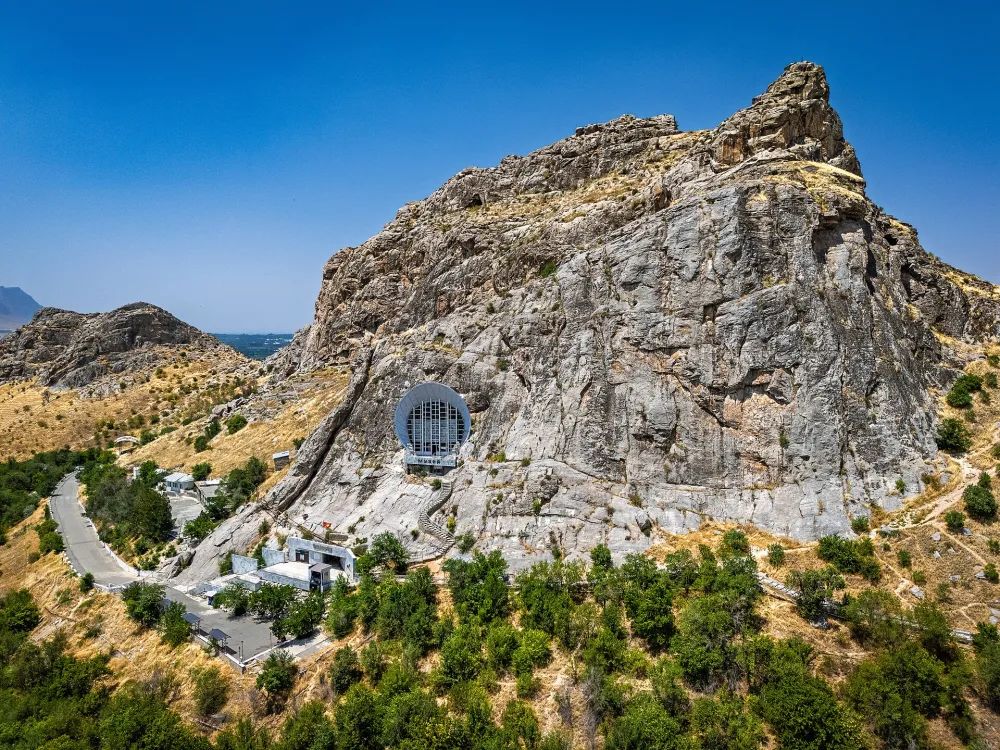 1/2. The sacred mountain within the city Photo: Nefesh03, Wikimedia Commons, CC BY-SA 4.0; edited for this site.
 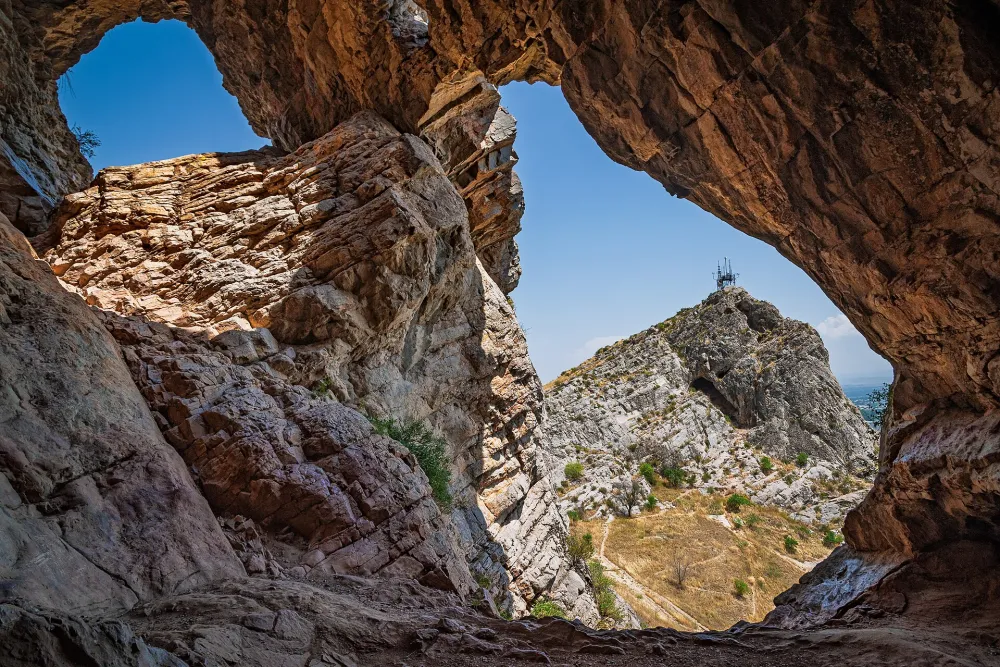 2/2. Caves and rock terrain on Sulaiman-Too Photo: Nefesh03, Wikimedia Commons, CC BY-SA 4.0; edited for this site.
 How to look at rock art
Begin with the surface rather than hunting for the most famous scene. Step back, change your angle and look for side light. A petroglyph often reads as a difference in texture: pecked points form the outline while the darker rock coating survives around them.
Name only what you can actually see first: four legs, horns, a body line or a cluster of marks. Then read the museum label or listen to a specialist. This order keeps observation separate from interpretation and discourages a convenient modern story from being projected onto every sign.
Binoculars or a moderate camera zoom reveal a distant surface without approaching fragile rock. Lines tend to flatten at midday and become clearer in morning or late-afternoon light. On Sulaiman-Too, respect opening times and do not remain on the slopes after dark.
Protecting the stones
- Do not wet a carving. Water briefly increases contrast but alters the surface and carries salts and dirt.
- Do not trace the lines. Chalk, charcoal, paint and other pigments remain in microscopic cracks.
- Do not rub the rock. Paper, fabric and tools can all abrade the outer layer.
- Do not step on decorated slabs. Pressure can enlarge a fracture without creating an immediate visible chip.
- Do not move stones. Their position relative to the terrain and neighbouring surfaces is archaeological evidence.
- Never add a name. Modern graffiti destroys the ancient surface; it does not become another historical layer.
Pre-trip checklist
- Choose the site according to your time, fitness and altitude experience.
- Check the season, weather, road condition and visiting hours.
- For Saimaluu-Tash, arrange a local organiser, transport, accommodation and a spare day in advance.
- Carry closed shoes, water, a hat, sun protection and warm layers appropriate to the altitude.
- Download an offline map, but stay on the permitted path and follow ranger instructions.
- Observe and photograph without touching the surface.
Rock art makes most sense as part of its landscape. After Cholpon-Ata, continue along the north shore of Issyk-Kul. In Osh, connect the mountain with the Sulaiman-Too museum. Before a high-altitude journey, review Kyrgyzstan's climate and seasons.
Share on social media
If you found this guide useful, share it on social media. It takes a moment and helps more travellers discover the project. Thank you!
Anything to add?
Share your experience, leave a comment or suggest an improvement.