Contents:
The essential check before buying: ask the seller to name the technique, unroll the entire rug and inspect both sides. Perfect geometry does not prove that a piece is handmade, and a little asymmetry is not automatically a defect.
The difference between shyrdak and ala kiyiz
Shyrdak
- The design is cut through two contrasting layers of finished felt.
- The pieces are swapped, stitched, often outlined with cord and then quilted.
- Edges are crisp, while seams and quilting form part of the construction.
Ala kiyiz
- Coloured loose wool is arranged on a wool base before felting.
- Water, warmth and pressure bind the motif and background into one cloth.
- The edge of the design is usually softer, without an appliqué seam around it.
The names describe how the textile is made, not merely how it looks. Contemporary makers may add embroidery, cord or decorative stitching to either base, and a complex wall hanging can combine several methods. If the technique matters to you, ask “How was this pattern made?” rather than “Is this authentic?”.
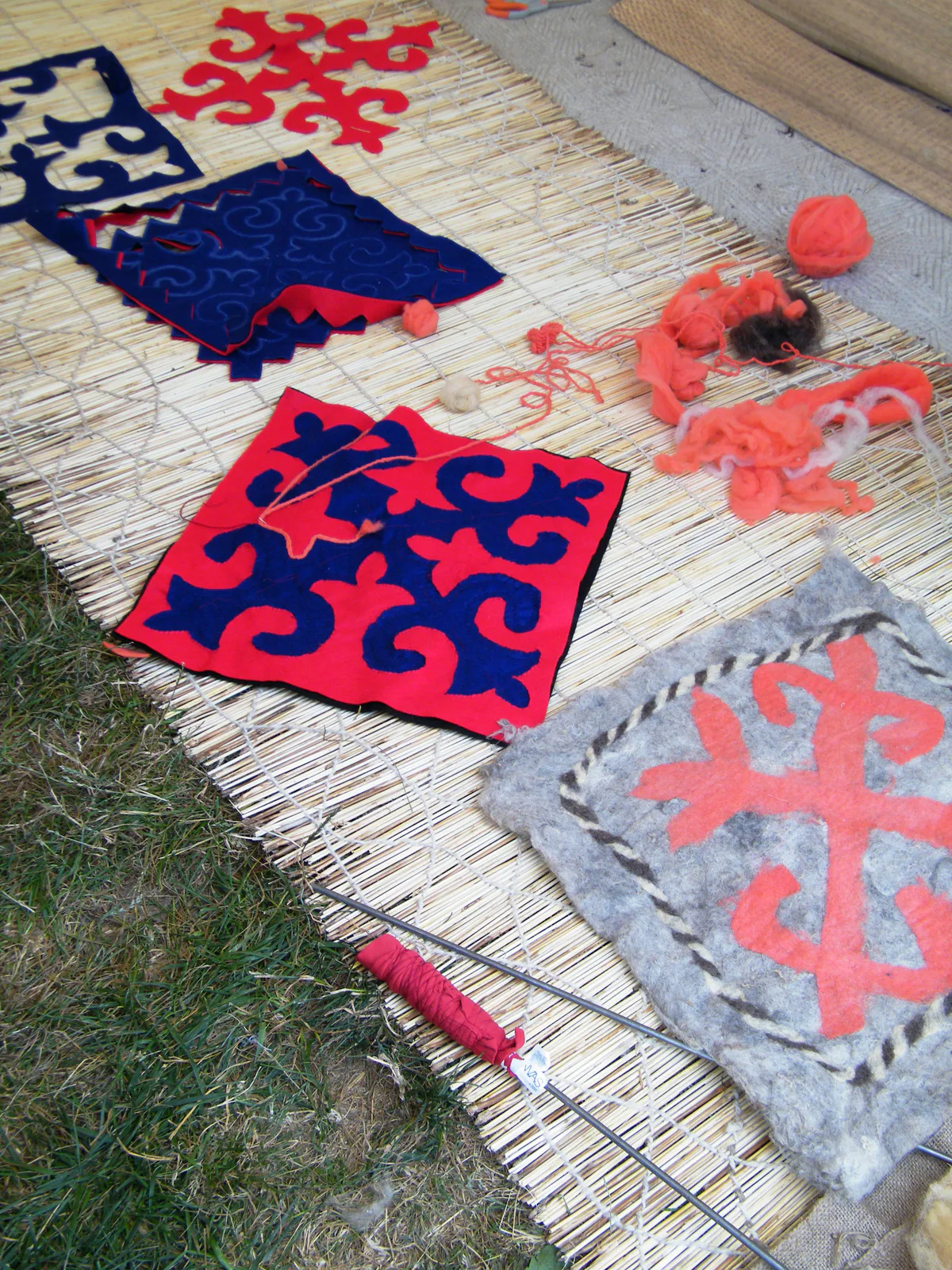 1/3. Cutting and stitching shyrdak pieces Photo: Sarah Stierch, Wikimedia Commons, CC BY 4.0; edited for this site.
 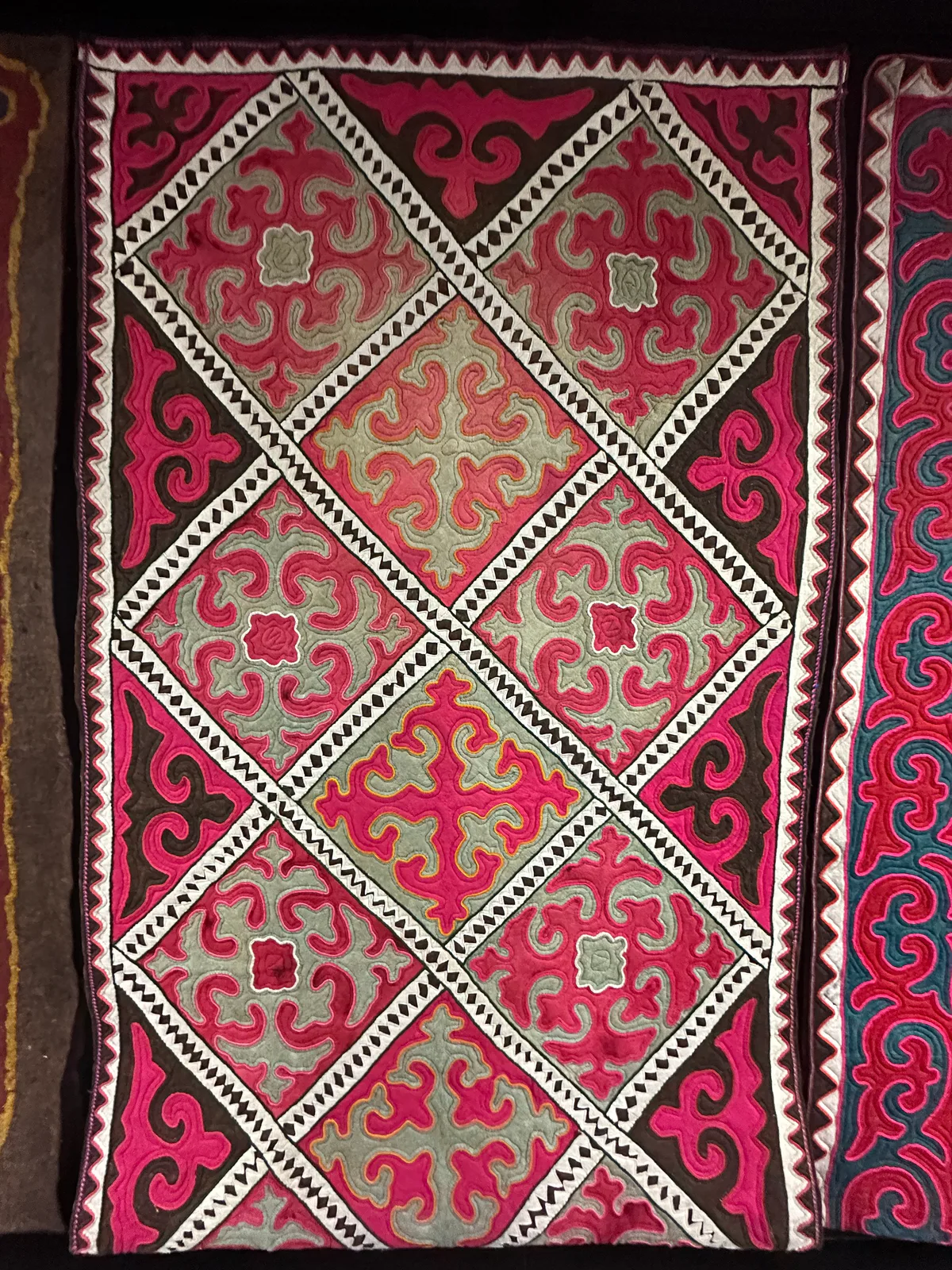 2/3. The crisp edge of a stitched felt design Photo: Incall, Wikimedia Commons, CC BY-SA 4.0; edited for this site.
 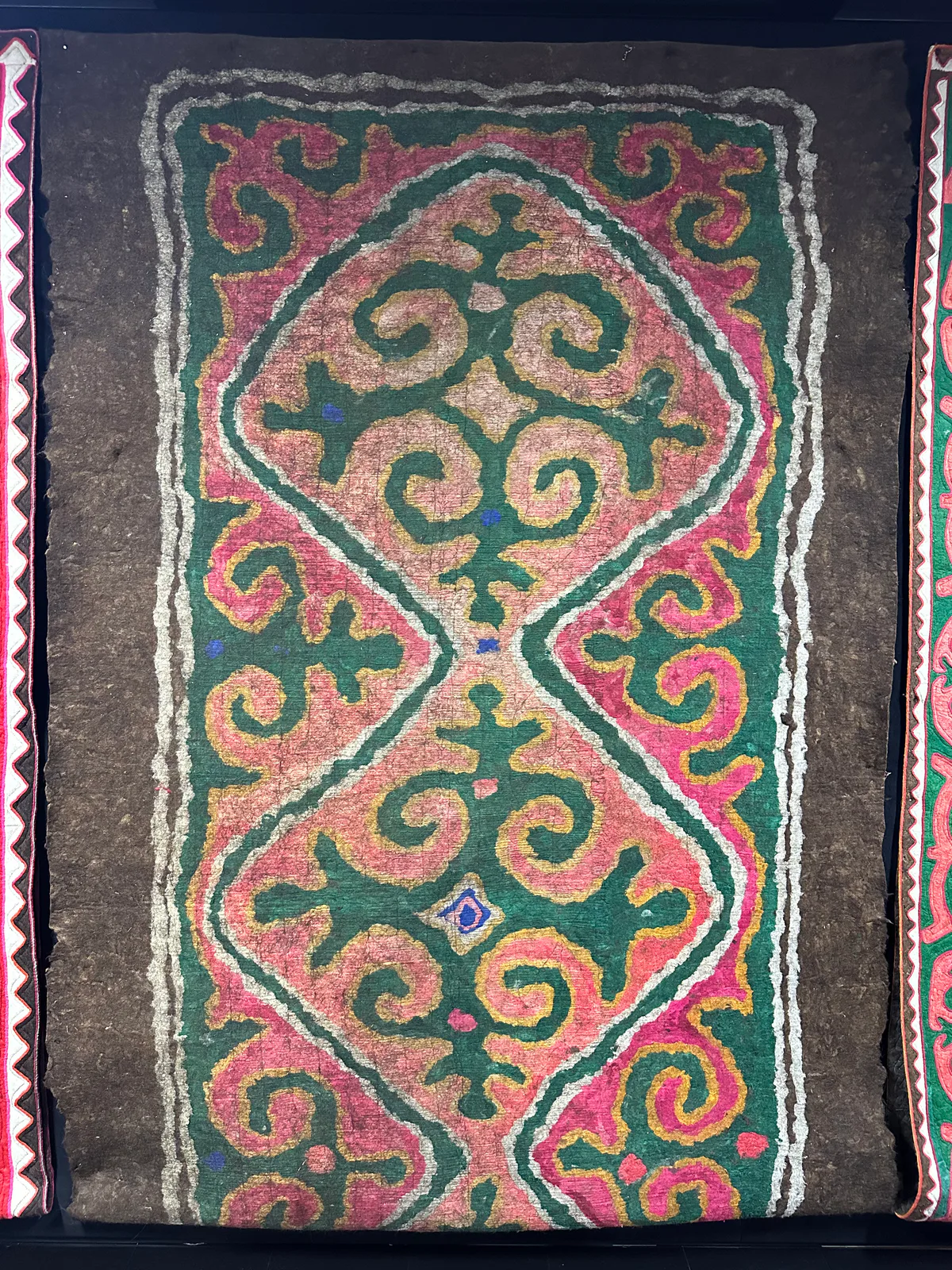 3/3. Ala kiyiz: the design is felted into the base Photo: Incall, Wikimedia Commons, CC BY-SA 4.0; edited for this site.
 How wool becomes felt
Both techniques begin with sheep’s wool. The fibres are sorted, cleaned and opened, then laid in even layers on a reed mat. Hot water and a soapy solution let the fibres move, while repeated rolling and pressure lock them together into a dense non-woven cloth.
Thickness and strength depend on the quantity of wool, the consistency of the layout and the amount of felting. Weak felt shows light through thin patches, separates easily and stretches at the edge. Well-made felt remains flexible but does not come apart when the surface is gently pulled between your fingers.
Large rugs were traditionally a communal undertaking. UNESCO’s description of the practice records an experienced older craftswoman supervising the design while others prepared the wool and pressed the felt. Workshops today may be organised differently, but several people still make the scale and physical work easier to manage.
How a shyrdak is made
-
Prepare the backing and coloured felt
Dense felt for the base and thinner coloured sheets are made first. The upper layers must withstand cutting and repeated stitching.
-
Pair contrasting colours
Two layers are placed together and the ornament is marked out. One cut produces matching positive and negative shapes.
-
Exchange the cut pieces
A shape from one colour is fitted into the other background. The same cutting can produce two colour-reversed compositions with very little waste.
-
Join the mosaic and define the outline
The pieces are sewn together and the junction is often covered with twisted cord. It sharpens the design and protects the seam.
-
Attach the top and quilt the rug
The mosaic is fixed to a lower layer, finished with a border and quilted. This gives the rug more body and stability.
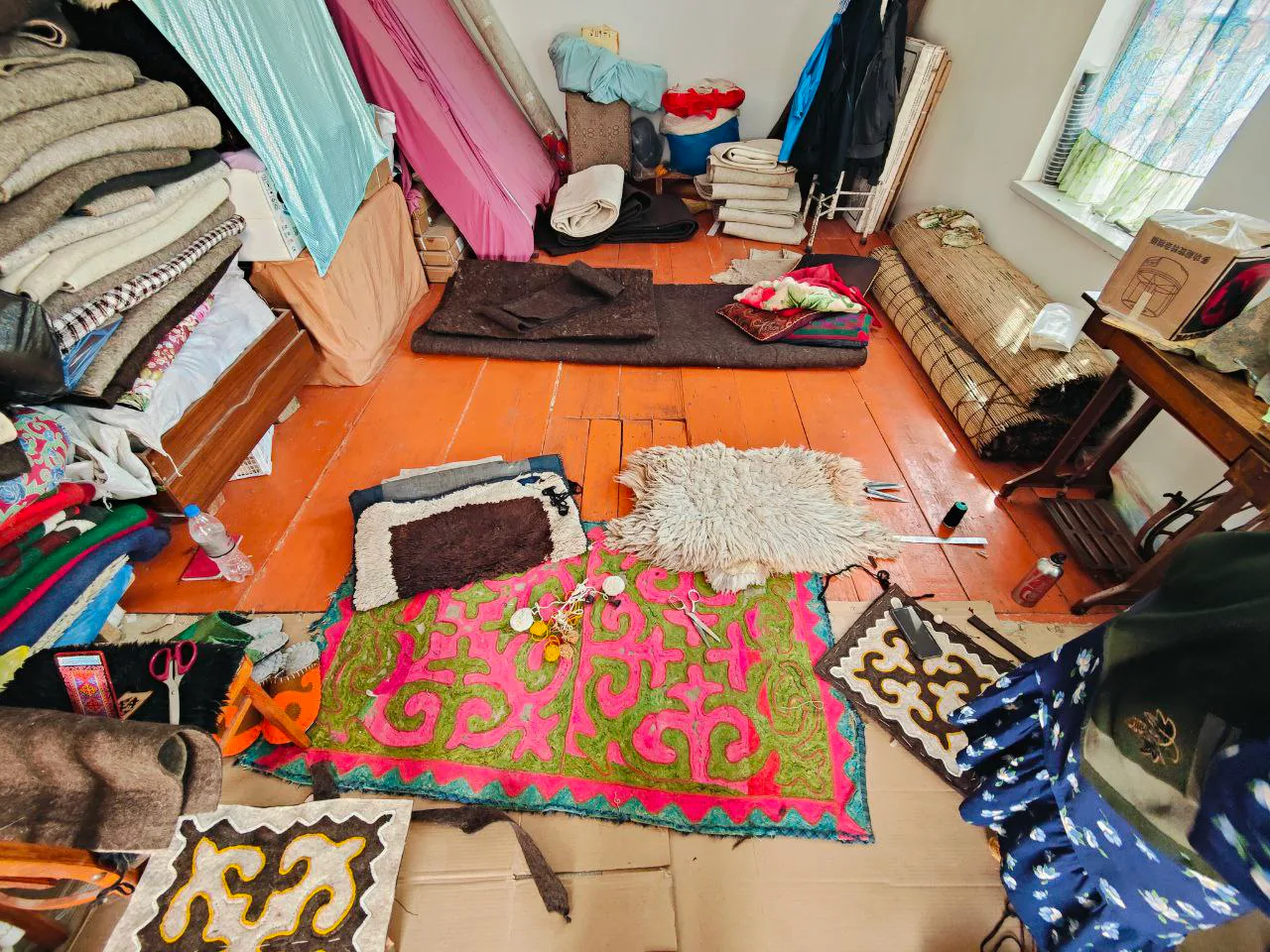 Shyrdak maker Ainagul apa’s studio in Kochkor, 2025. Photo: Adamboluu, Wikimedia Commons, CC BY-SA 4.0; edited for this site.
The paired cut is easiest to see in two rugs with the same design but reversed motif and background colours. This is a practical result of economical cutting, not proof that every pair carries a fixed symbolic meaning. A maker can use the two halves in separate pieces, change the borders or combine them with new sections.
How an ala kiyiz is made
The maker first lays out the wool for the base, then draws the ornament on top with loose strands of coloured wool. At this stage the line looks raised and imprecise. The whole layout is moistened, rolled into a mat and worked for a long time. The coloured fibres migrate into the base until pattern and background become a single cloth.
The design can shift, blur or mix slightly along its edge. That is part of the character of wet felting, not necessarily a mistake. Structural problems look different: the motif peels away, the felt parts to reveal a thin patch, the edge remains loose, or the rug contains damp and musty areas.
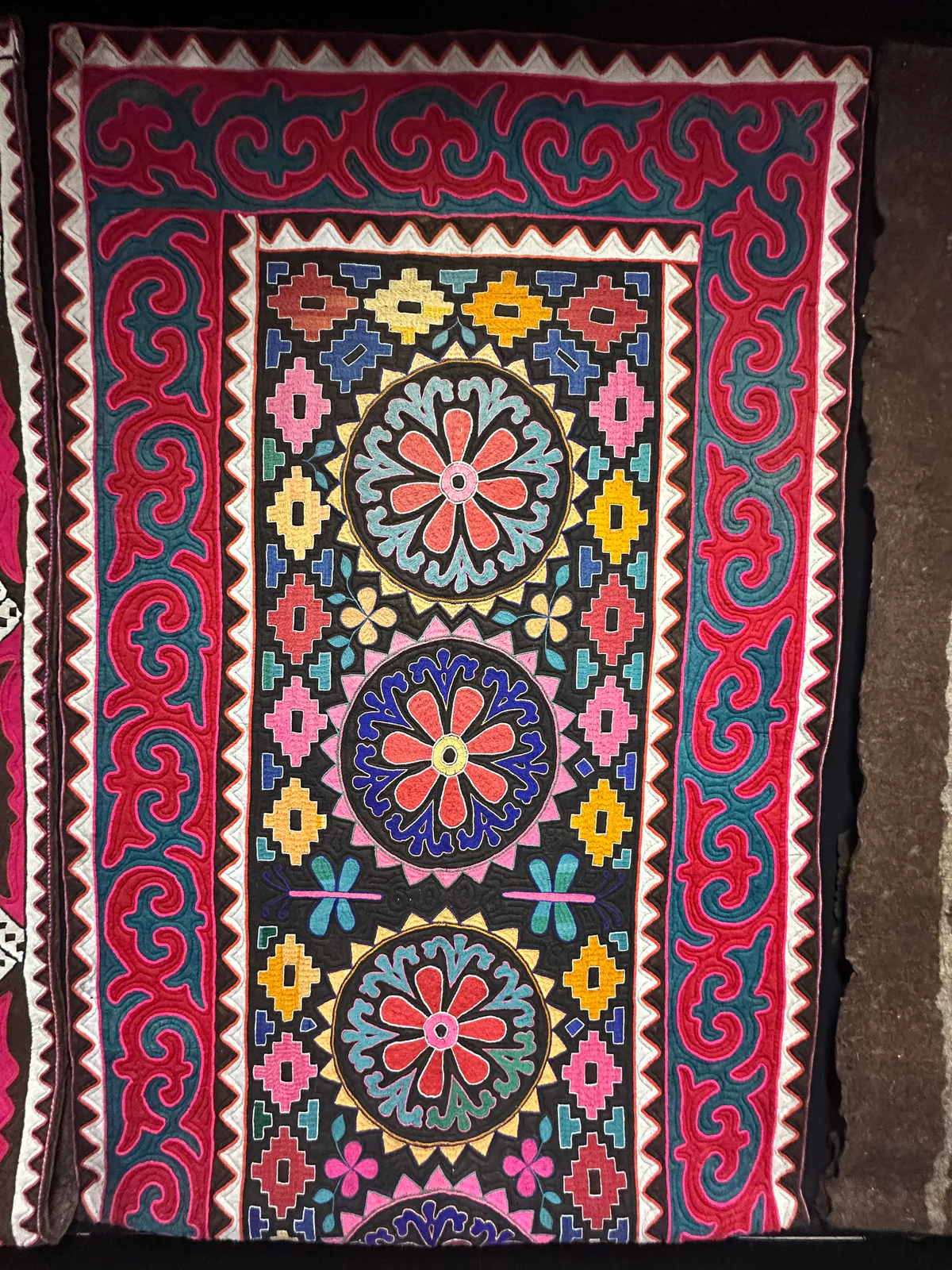 A contemporary felt panel combining several finishing methods. Photo: Incall, Wikimedia Commons, CC BY-SA 4.0; edited for this site.
How to look at the ornament
Designs are built from repeats, reflections, curls, horn-like forms, diamonds, triangles and borders. A motif can pass between families, change in the hands of different makers and acquire a new explanation. There is no universal chart that translates every Kyrgyz rug without error.
Ask the maker what a particular motif is called, where the composition came from and what it means in this piece. The honest answer may be a family sample, a favourite colour scheme, an older teacher’s pattern or a new variation. That is more useful than a seller’s universal tale about a “secret ancient symbol”.
Choosing a workshop
Felt workshops and demonstrations can be found in Bishkek, Kochkor and parts of Naryn and Issyk-Kul regions. Schedules, languages and formats change, so arrange the visit in advance. “Masterclass” may mean making a small key ring, or it may mean several hours beside a large piece of felt.
- Ask whether the session covers shyrdak, ala kiyiz or modern needle felting.
- Confirm the duration, language and group size.
- Find out whether you will handle wool, cut pieces or only watch.
- Check whether a small finished sample is included.
- Ask permission before photographing people or private workspaces.
A complete full-size rug cannot be made during a short visitor session. A good demonstration shows one stage honestly and explains which parts were prepared earlier and how much work remains.
Inspecting a rug before you buy
Unroll the whole piece
- Check that it lies flat rather than twisting like a propeller.
- Compare the density at the centre, corners and border by touch and against light.
- A mild wool smell is normal; dampness and mould are not.
Inspect the seams
- Look at the mosaic joins, outlining cord, quilting and reverse side.
- Thread should not unravel and the upper pieces should not lift from the base.
- Ask which stitches were made by hand and where a machine was used.
Test how the fibres hold
- The motif should be felted into the background, not printed or glued on top.
- Rub gently; heavy shedding or peeling needs an explanation.
- Inspect thin spots and edges, which tend to wear first.
A machine-made item is not inherently bad, but the seller should name the material and process accurately. Woven pile, a rubber backing, a printed motif or a label listing polyester or acrylic indicate a different product rather than a traditional wool felt rug.
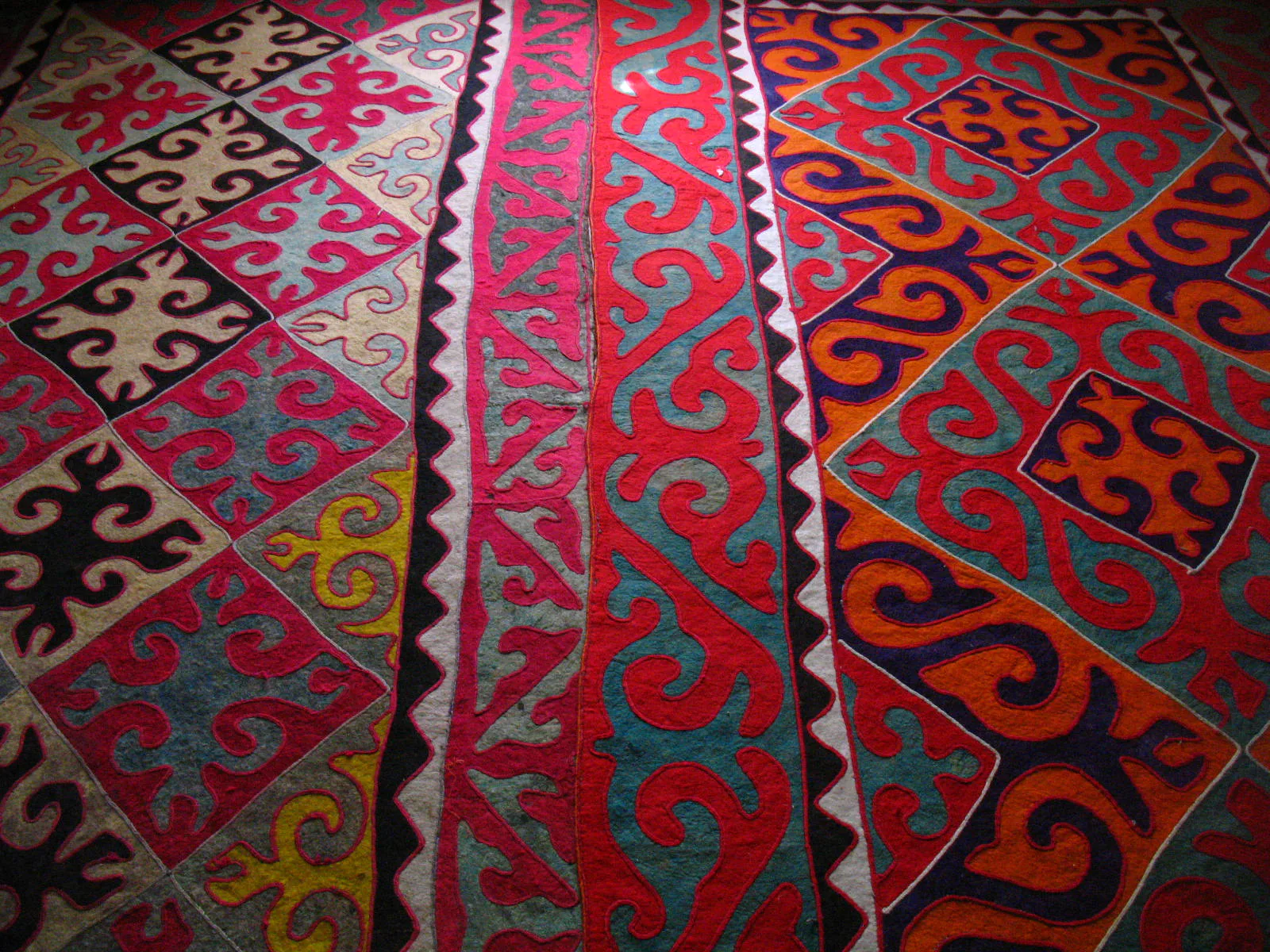 Shyrdaks in a home in Kyzyl-Jar, Aksy District, 2008. Photo: Firespeaker, Wikimedia Commons, CC BY-SA 3.0; edited for this site.
Transport and care
Measure and weigh a large rug before paying. For the journey, roll it without a sharp fold, wrap it in a breathable covering and keep it dry. Airline allowances differ, so compare the finished roll with your carrier’s current baggage rules.
Do not seal damp felt in plastic when you get home. Let it dry fully in moving air and away from intense heat. Cleaning depends on the dyes, construction and age of the piece. Ask the maker to write down their advice and test any product on an inconspicuous area first.
Keep the receipt, workshop name, fibre content and measurements. Our guide to souvenirs from Kyrgyzstan also covers packing, provenance and extra caution around leather, bone, feathers and other animal materials.
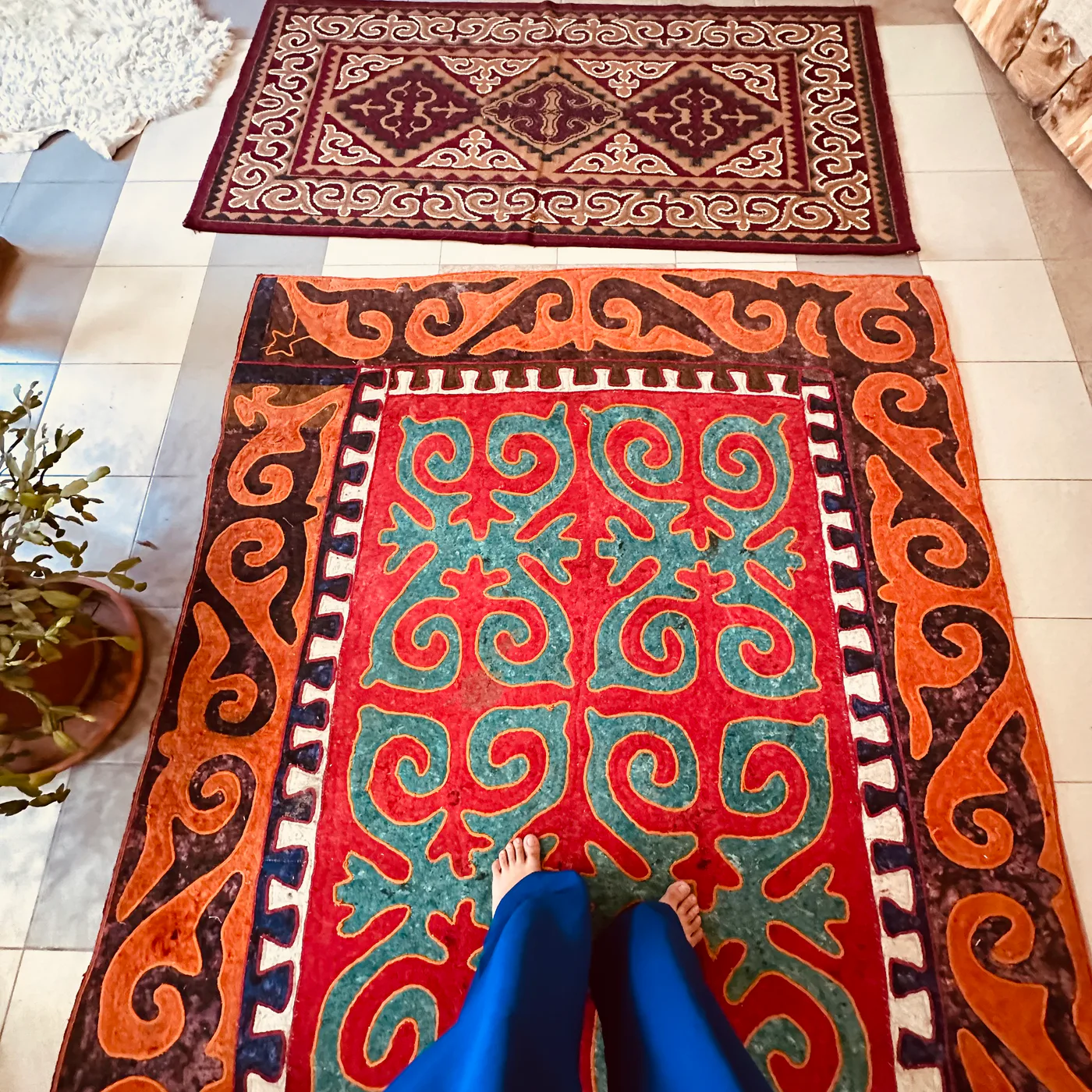 Two contemporary Kyrgyz shyrdaks. Photo: Ada Awa, Wikimedia Commons, CC BY-SA 2.0; edited for this site.
Why UNESCO lists the craft
In 2012, the art of ala kiyiz and shyrdak was placed on UNESCO’s List of Intangible Cultural Heritage in Need of Urgent Safeguarding. The nomination recorded declining numbers of skilled practitioners, limited interest among some younger people, competition from inexpensive synthetic carpets and difficulty obtaining good raw materials.
The status protects knowledge, technique, ornament, collective work and transmission. It does not make every contemporary rug a museum object. Buying from an identifiable maker, attending a workshop that explains its process honestly and recording the story of a particular piece support a living practice more directly than a souvenir with an invented legend.
What to see next
Start with the construction of a Kyrgyz yurt. Felt rugs insulated and decorated the living space, and seeing them in a yurt makes their scale and purpose easier to grasp. Then visit a workshop and compare the finished cloth with loose wool, a reed mat, templates, cutting tools, thread and cord.
White felt is also used for the ak-kalpak, though a hat requires a different thickness, cut and finish from a floor rug. Continue through our overview of Kyrgyz culture for music, epic performance, games and other crafts.
Frequently asked questions
Are shyrdak and ala kiyiz the same thing?
No. A shyrdak is assembled from pieces cut out of finished felt, attached to a backing and quilted. In an ala kiyiz, the coloured design is felted together with the wool background as one cloth.
What is the quickest way to tell them apart?
Look at the outline. A shyrdak usually shows crisp joins, cord and quilting. In an ala kiyiz, the coloured fibres merge into the background and the edge looks softer. Contemporary pieces may combine methods, so ask the maker for a final confirmation.
Does an uneven pattern mean poor quality?
Not necessarily. Slight asymmetry is natural in handwork and wet felting. Loose edges, failing seams, a peeling design, dampness, mould or major differences in density are more useful warning signs.
Can I wash a felt rug at home?
There is no single safe wash cycle. Water, friction and temperature can alter size and colour. Ask the maker for instructions, consider the dyes and construction, and test any treatment on a hidden area first.
How long does a large shyrdak take to make?
It depends on size, complexity, whether the felt is already prepared and how many people are working. A short visitor workshop demonstrates only one stage; a complete rug takes considerably longer.
Where can I watch felt rugs being made?
Workshops and demonstrations operate in Bishkek, Kochkor and parts of Naryn and Issyk-Kul regions. Confirm the current schedule, technique, duration, language and hands-on element before travelling.
Share on social media
If you found this guide useful, share it on social media. It takes a moment and helps more travellers discover the project. Thank you!
Anything to add?
Share your experience, leave a comment or suggest an improvement.