Contents:
Checked on 28 August 2026. Exchange rates, fees, ATM limits and foreign-card acceptance change. Check your bank's terms before departure and read the amount on the screen or rate board before approving a transaction.
Understanding the Kyrgyz som
The currency code for the som is KGS, and one som is divided into 100 tyiyn. Prices in Kyrgyzstan are stated in som, which is also the practical currency for everyday shopping, transport and services.
Everyday circulation mainly uses KGS 20, 50, 100, 200, 500, 1,000 and 5,000 notes, together with the commemorative KGS 2,000 note. KGS 1, 5 and 10 notes have not been withdrawn and remain legal tender, although they are rarely seen. Legal coins are 10 and 50 tyiyn and KGS 1, 3, 5 and 10. The same denomination may have more than one design because several issues remain in use.
Banknotes
Coins
The commemorative 2,000-som banknote is also legal tender. Use the National Bank's security guidance, not the colours in this diagram, when checking a real note. About the 2,000 som banknote.
Why notes look different. The National Bank updates series and security features while retaining the main colour of each denomination. An older design is not automatically an invalid note.
Who is pictured on Kyrgyzstan’s banknotes?
Our denomination-by-denomination series explains the person or figure on the front, the reverse design, the status of the issue and several practical security features.
- 1 som: Abdylas Maldybaev
- 5 som: Bubusara Beyshenalieva
- 10 som: Kasym Tynystanov
- 20 som: Togolok Moldo
- 50 som: Kurmanjan Datka
- 100 som: Toktogul Satylganov
- 200 som: Alykul Osmonov
- 500 som: Sayakbay Karalaev
- 1,000 som: Yusuf Balasaguni
- 2,000 som: Manas
- 5,000 som: Suimenkul Chokmorov
How to combine cards and cash
Most journeys are easiest with three layers: a primary bank card, cash in som for daily spending and a separate backup. The card reduces the amount in your wallet, cash covers places without a terminal or connection, and the backup helps when an ATM declines the first card.
Your main card. Use it at hotels, supermarkets, larger cafés and other urban businesses when the terminal supports your payment network. Ask whether the terminal accepts an international card before relying on it.
Cash in som. Keep it for markets, small shops, some guesthouses, drivers and expenses on the road. Away from larger settlements, the next working ATM may be well beyond your route.
A separate reserve. Store a second card and part of your cash away from your everyday wallet. The right amount depends on the route: a city weekend and a multi-day journey to a high-altitude lake need different plans.
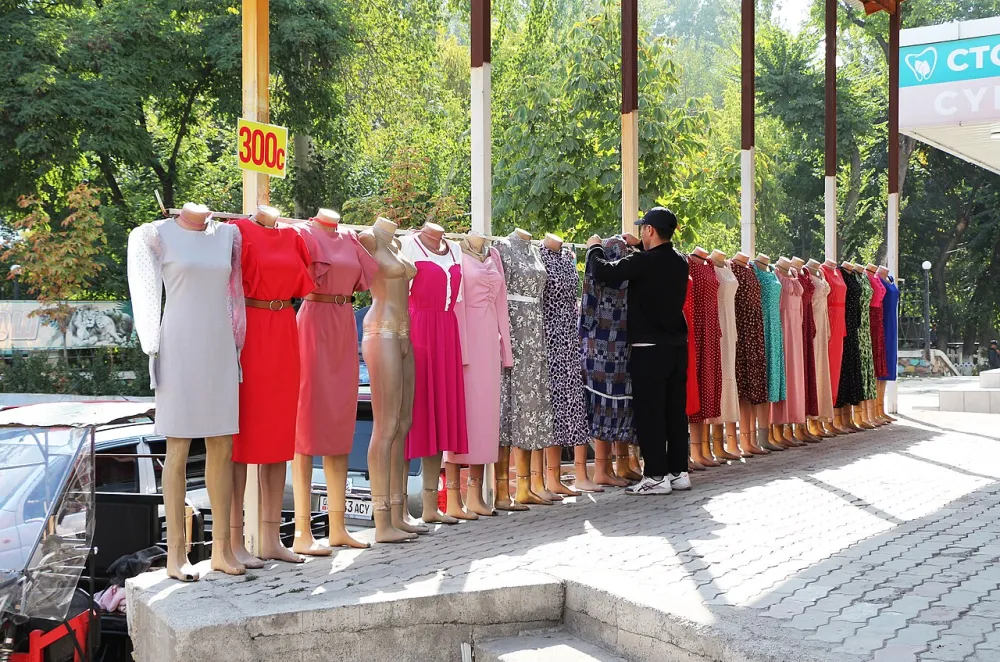 A price sign at Jayma Bazaar in Osh: markets remain one of the situations where cash is particularly useful. Photo: Bgag, Wikimedia Commons, CC0 1.0; edited for this site.
Where cards and QR payments work
International credit and debit cards are more useful in Bishkek, Osh and other larger cities. A small shop, family-run guesthouse or remote petrol station may have no terminal. Even a supported card can be declined by the issuer, terminal or connection, so a payment-network sticker is not a guarantee.
Before departure, enable overseas use, review daily limits and make sure you know the PIN. Store your bank's contact details separately from the card. If a payment fails, do not submit it repeatedly: check the banking app and notifications first, then use another method.
Cards issued by Russian banks. Visa and Mastercard cards issued by Russian banks do not work abroad. Do not rely on a Mir card without checking the specific Kyrgyz bank: intersystem processing through Elkart remains suspended, while individual banks may make their own arrangements. Bring another means of payment.
Apple Pay has been officially available in Kyrgyzstan since July 2026, including for foreign travellers. Actual payment still depends on the issuing bank, network and terminal; the service does not make an unsupported card work.
QR payments are common, but they normally depend on Kyrgyz banking apps and local payment infrastructure. A QR sign tells you that the merchant accepts this method; it does not guarantee that an overseas banking app is compatible. Ask before committing to a purchase.
Where to exchange foreign currency
Use a bank or a licensed exchange office. A legitimate office must display its licence, opening hours and a board with buy and sell rates. The cashier completes the transaction at the displayed rate and must issue a cash receipt; a separate certificate is available on request.
US dollars and euros are the simplest cash currencies to exchange in larger settlements. Since 6 July 2026, a different rate based only on the denomination or issue year of a still-valid note has been prohibited. A commission may apply to damage listed in the rules and to US dollar notes issued in 2006 or earlier. Ask about it before handing over the money.
Bring photo ID: identification is mandatory from the equivalent of KGS 100,000. Calculate the expected amount on your phone, count the som at the counter and retain the receipt. If the cashier quotes a rate that differs from the board or introduces a condition only after taking your money, stop the transaction and use another licensed office.
Use the National Bank's official exchange-rate page as a reference. It is an accounting rate, not an offer to buy or sell cash at that figure. Banks and exchange offices set their own buy and sell rates.
How to read an exchange board
The column names are written from the exchange office's point of view. “Buy” means that the office buys foreign currency from you and gives you som. “Sell” means that the office sells foreign currency to you in return for som.
What the two USD rates mean
You hand over USD 100 and receive KGS 8,710. The buy rate applies.
You buy USD 100 and pay KGS 8,760. The sell rate applies.
When cash must be declared
Declare the full amount when a one-time import or export of cash and travellers’ cheques exceeds the equivalent of USD 10,000 per person. Above USD 100,000, carry documents proving the source of funds. The threshold covers the combined equivalent in every currency, so calculate it before crossing the border and retain the declaration.
How to use an ATM
ATMs are easier to find in cities and district centres. Withdraw the required cash before continuing to villages, gorges or high-altitude routes. On a circuit around Issyk-Kul, larger towns including Karakol are sensible places to replenish your reserve.
The ATM operator, your own bank or both may charge a fee. Per-transaction limits also vary by machine and card. Before confirming, read the total, any fee and the debit currency. If the terms are unclear, cancel before cash is dispensed and try a machine attached to another bank branch.
Withdraw som, collect the card before leaving the machine and count the cash immediately. Test a new card with a small transaction in town rather than discovering an incompatibility on the morning of a mountain departure.
Three sample trips
Your actual budget depends on accommodation, transport and services paid in advance. These examples show where to replenish cash and when a route is likely to shift from card payments to cash.
A card and a modest cash reserve
- Pay for the hotel and larger purchases by card when the terminal accepts it.
- Keep som for markets, small purchases, some transport and a fallback.
- Store a second card separately and test it before the trip.
Replenish cash in the towns
- Withdraw or exchange money before leaving Bishkek, Balykchy, Cholpon-Ata or Karakol.
- Ask the guesthouse how it accepts payment and whether a cash deposit is required.
- Do not postpone the ATM stop until a small village, beach or gorge.
Cash for the whole section plus a reserve
- Add accommodation, food, transport, entrance fees and one unexpected extra day.
- Agree the payment currency and timing with the driver, guide and guesthouse in advance.
- Split the money between your everyday wallet and a reserve that stays out of sight.
Money checklist before a route
- Tell your bank about the trip if required and enable overseas transactions.
- Check limits, cash-withdrawal fees and currency conversion for every card.
- Carry a second card and store it separately.
- Bring clean US dollars or euros if you plan to exchange cash.
- If you carry more than the equivalent of USD 10,000, prepare a passenger declaration for the full amount.
- Obtain som from a licensed exchange office or a bank ATM.
- Break a large banknote in town before visiting a market, boarding a minibus or checking into a small guesthouse.
- Before going into the mountains, budget for the entire ATM-free section and add a reserve.
- Keep receipts and notifications until each transaction appears in your banking app.
Once the money plan is ready, check the entry documents, choose suitable transport in Kyrgyzstan and mark the larger settlements along your chosen route. Our overview of Kyrgyzstan's economy explains how cash, markets, banks, remittances and major construction projects fit together.
Share on social media
If you found this guide useful, share it on social media. It takes a moment and helps more travellers discover the project. Thank you!
Anything to add?
Share your experience, leave a comment or suggest an improvement.