Contents:
The one detail you must save: photograph the sector, row, container number and seller's contact before you leave with a purchase. “The blue shop by a turning” is almost useless in a market this large.
When Dordoy is worth the trip
Dordoy lies north of central Bishkek and combines wholesale and retail trade. People come for clothes, shoes, fabrics, bags, home textiles and everyday goods. Its strength is not a single unique shop but the chance to compare many sellers within the same category.
The journey makes sense when you need several items, an awkward size, inexpensive gear for a season or supplies for a group. For one postcard, a small felt piece or a quiet conversation with a craft maker, use our souvenir guide instead. Dordoy is busy, extensive and best approached with a purpose.
Compare three sellers
- Show a photograph or state the exact model, size and material.
- Compare like with like rather than similar-looking products of different quality.
- Once you have three prices, return to the best balance of condition and cost.
Ask for the unit price first
- Inspect each item before assembling a bundle.
- Ask for both the unit price and the total for the set.
- Do not add things you do not need merely to earn a small discount.
Write a specification
- Record the model, colour, size run and quantity.
- Open several packages from the batch, not only the display sample.
- Agree on paperwork, completeness and how defects will be handled before paying.
How the bazaar is organised
Dordoy is not a single shopping centre with one information desk. It is a network of markets, sectors, vehicle lanes and rows of shipping containers. The lower container commonly serves as the shop, while the upper one is storage. Signs, banks, cafés, gates and the mosque are useful landmarks, but you need a precise reference if you want to find a seller again.
Drop a pin where the taxi leaves you. Photograph the sector name, row sign and container number. Do not assume that the drop-off point will be obvious to a return driver: Dordoy has several approaches, and a car waiting on the other side can be surprisingly far away.
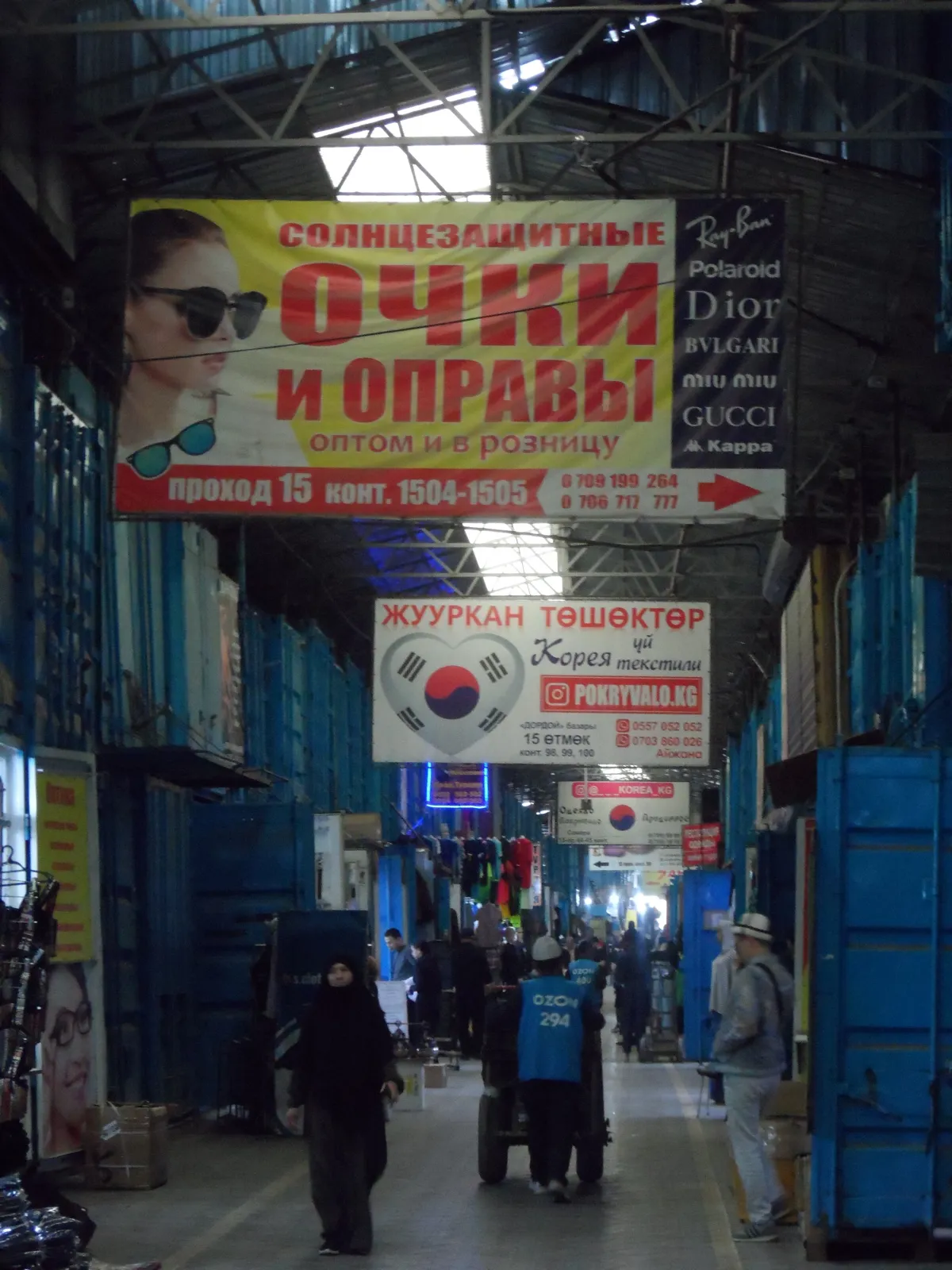 1/3. A container row inside Dordoy, 2024 Photo: Dzum Visken, Wikimedia Commons, CC BY 4.0; edited for this site.
 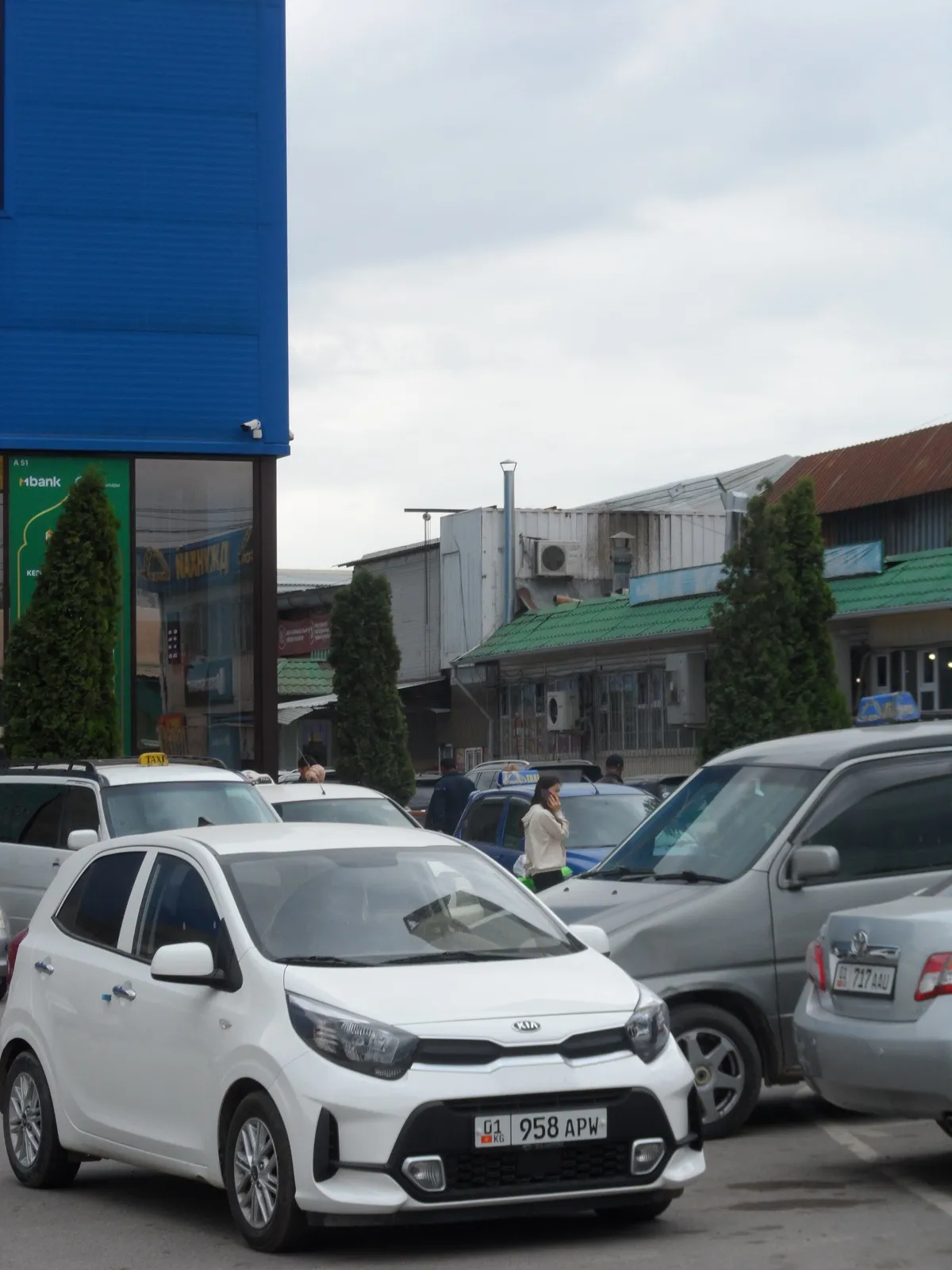 2/3. Landmarks in a central part of the bazaar, 2024 Photo: Dzum Visken, Wikimedia Commons, CC BY 4.0; edited for this site.
 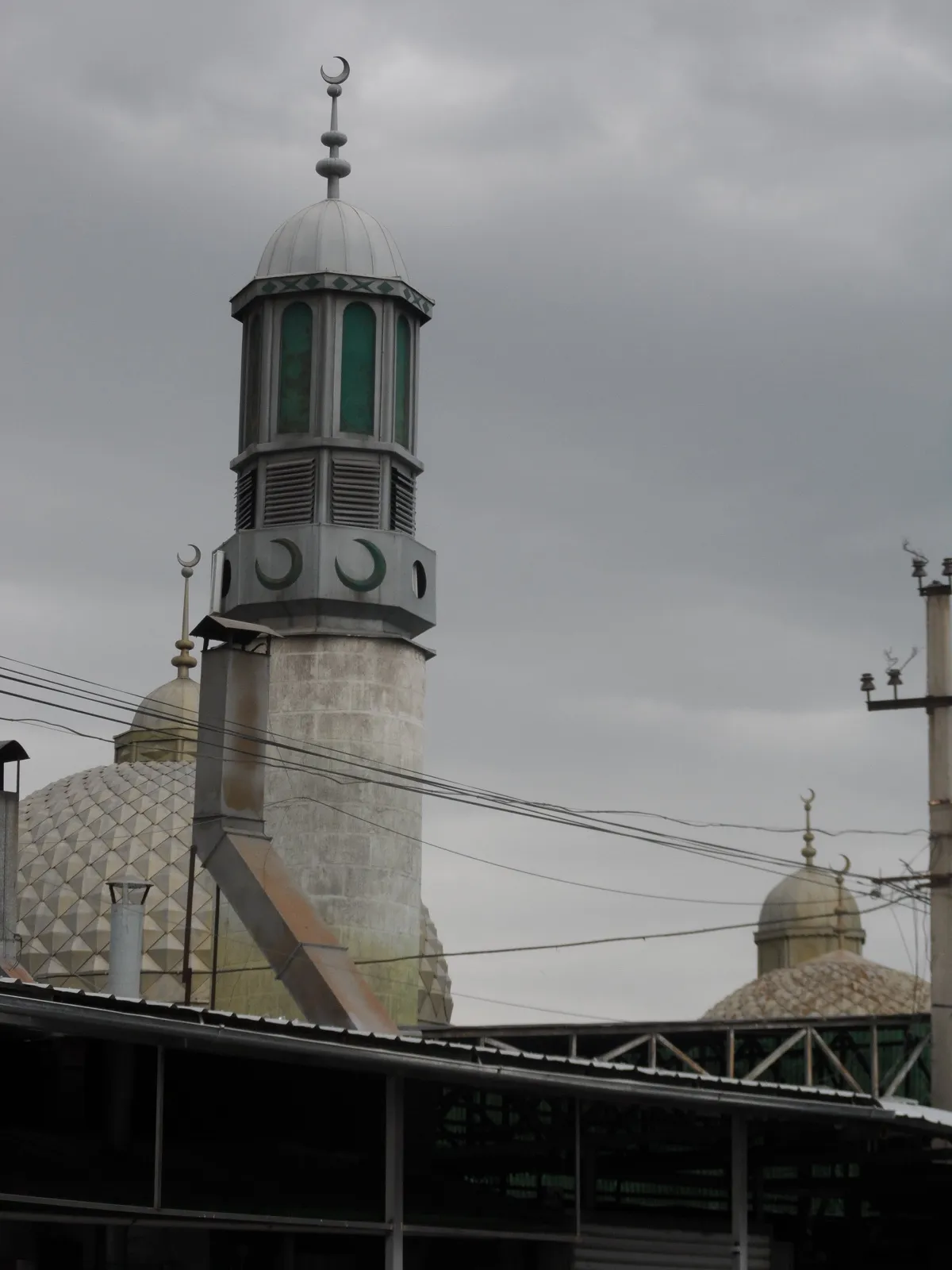 3/3. The mosque is a prominent landmark, 2024 Photo: Dzum Visken, Wikimedia Commons, CC BY 4.0; edited for this site.
 Do not walk the entire perimeter to “see everything first”. Find the sector for your category, compare several rows there and only then decide whether another sector is necessary. A simple first-visit route works best: entrance, product category, break point, return meeting point.
What to buy at Dordoy
Stock changes with seasons and shipments. A single row may contain locally made products, factory goods from abroad, unbranded items, genuine labels and copies. Price alone proves nothing about origin. If authenticity matters, inspect the labelling, request documentation and compare the model with the brand's official catalogue before you visit.
Choose clothes and footwear by their actual fit, not only the size printed on the label. Manufacturers use different size charts. On a jacket, test the zip, seams, lining and movement over a warm layer. With shoes, inspect the complete pair for matching size, colour, sole and bonding.
A written list makes travel purchases much easier. Replace “warm jumper” with a size range, preferred material, hood requirement and maximum price. The seller can understand a precise request quickly, and you are less likely to forget an important detail after seeing ten similar options.
How to compare prices and bargain
Ask the price before giving a long explanation of your budget. Then establish whether it applies to one item, a set or a wholesale quantity. If the product suits you, try “Is that your final price?” or “How much if I take two?”. Productive bargaining is usually tied to quantity and a willingness to buy now.
In Kyrgyz, “How much is this?” is “Bul kancha turat?” and “Can you make it cheaper?” is “Arzandatasizby?”. Russian is widely used at Dordoy, so you do not need an elaborate phrasebook. A few polite words are still appreciated; our language guide has more useful phrases.
Compare prices only after checking the specification. Two nearly identical jackets may differ in fabric, insulation, hardware and included pieces. Write a price down or ask the seller to type it into a calculator if you did not hear it clearly. Drama and an invented walk-away waste time; a calm, specific question works better.
What to check before paying
-
Repeat the agreement
Confirm the price, quantity, size, colour and contents. Calculate the total yourself when buying several pieces.
-
Inspect the item you will take
Check seams, zips, buttons, soles, stains, chips and both halves of a pair. Do not rely on the display sample.
-
Open the packaging
Look inside the box or bag before paying. Confirm the model, size and every promised component.
-
Keep a trace of the purchase
Ask for a receipt or other proof, photograph the row and container, save the seller’s number and record any agreed exchange terms.
If you are being rushed: finish the inspection or walk away. Once you have left, it is much harder to show that a box contained the wrong size or that part of a set was missing.
Payment, receipts and returns
Cash in Kyrgyz som remains the most predictable payment method. Cards and local QR transfers are not available at every stall, and a foreign card may fail at a particular terminal. Withdraw money in town, keep smaller notes handy and do not reveal your entire cash reserve at the counter. Our guide to money in Kyrgyzstan covers notes, ATMs and exchange offices.
For a retail purchase, ask for a cash-register receipt or another document linking the seller, item and payment. Consumer law requires a seller to accept goods reported as defective for a quality check, but resolving a problem in practice still means finding the same seller and proving the purchase. A row photograph, contact number and receipt matter as much as a verbal promise. Check the exact conditions and exceptions in the current consumer law.
An exchange of non-defective goods, perhaps because the size is wrong, depends on the product category, time limit, condition and applicable rules. Ask before paying and have an important promise written on the receipt or in a message. For a large order, agree separately on how defects are counted and who pays for transport.
Safety and breaks
Dordoy calls for the normal precautions of any large, crowded market. Carry a closed bag in front, put your phone away after checking the map, avoid an external wallet pocket and divide cash between two places. Count change away from the pedestrian flow.
If you lose your bearings, return to the last sign or landmark you photographed. Do not walk, study the map and count money at the same time. If visiting with a child, choose a meeting place in advance and put an adult's phone number in the child's pocket.
Food and everyday services are available, but their distance from you depends on the sector. Bring water and stop before fatigue begins to shape your decisions. Browse our guide to Kyrgyz food in advance: recognising a dish from a photograph is easier than discussing an unfamiliar name in a noisy aisle.
When to go and how to get there
For a first visit, choose a morning from Tuesday to Sunday. You will have time to compare goods and return to a seller on the same day. Hours vary by sector and stall. Bishkek's municipality also schedules sanitation days at city markets twice a month, on alternate Mondays. Check the date in the latest municipal notices and confirm the relevant sector before setting off.
A taxi is the simplest option on a first visit. Give the driver a specific entrance or landmark and save the drop-off point. For the return, choose somewhere a car can actually reach rather than the middle of a trading aisle. City buses cost less, but route numbers and alignments change, so build the journey in a current map app on the day.
Why Dordoy matters
The market emerged in December 1991, when the collapse of the former supply system coincided with the growth of private trade. Dordoy gradually became a hub from which goods moved around Kyrgyzstan and into the wider Central Asian region. Its container architecture reflected the business: a lower unit could work as a shop, the upper unit as storage, with transport and financial services developing alongside.
The archive photographs below were taken in September 2007. They document the rows, clothing, home textiles and international trading links of that period, but they are not a map of the market today. Signs, access roads, stock and the organisation of individual areas have changed since then.
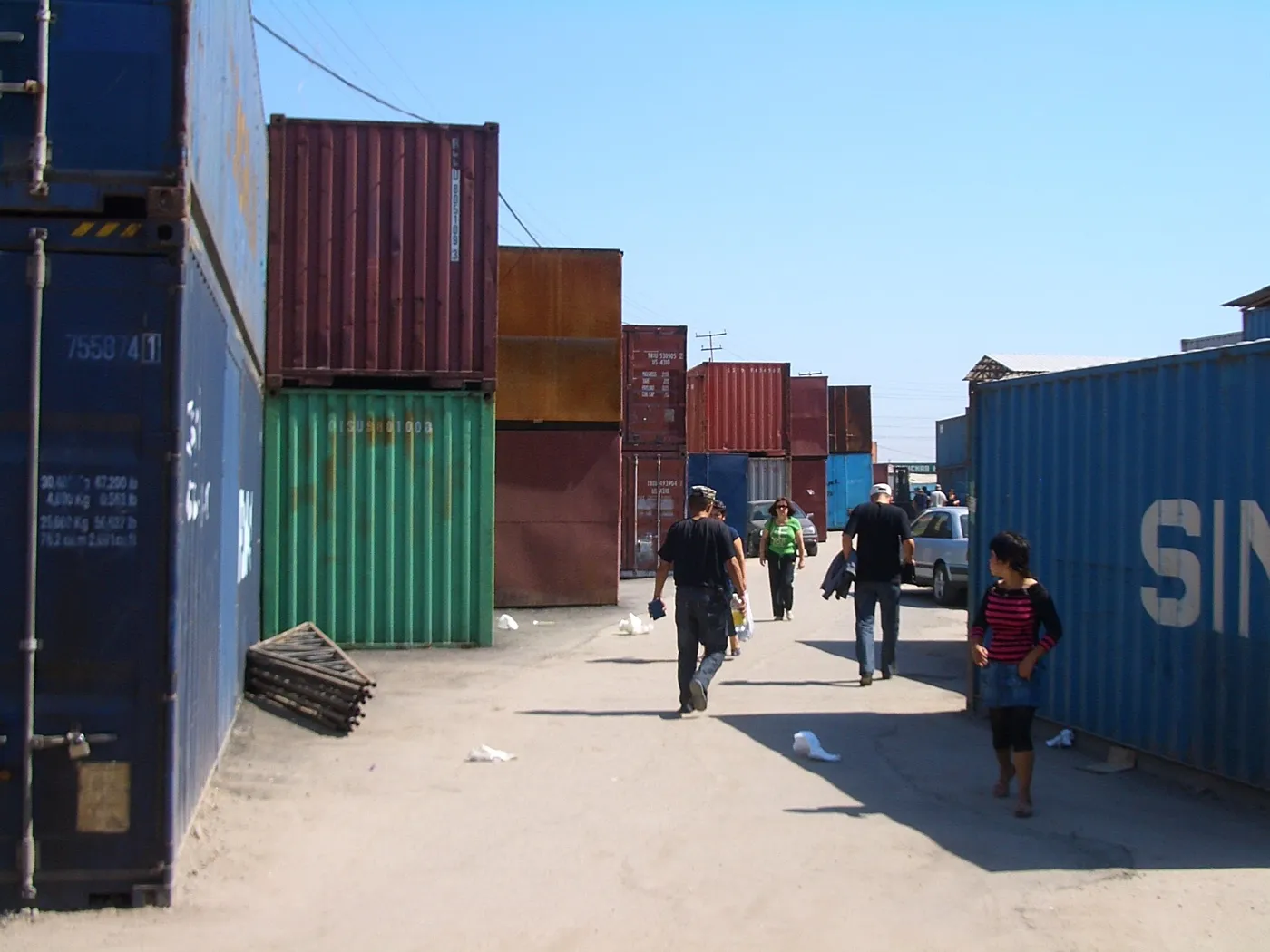 1/4. Archive view of a container row, 2007 Photo: Vmenkov, Wikimedia Commons, CC BY-SA 3.0; edited for this site.
 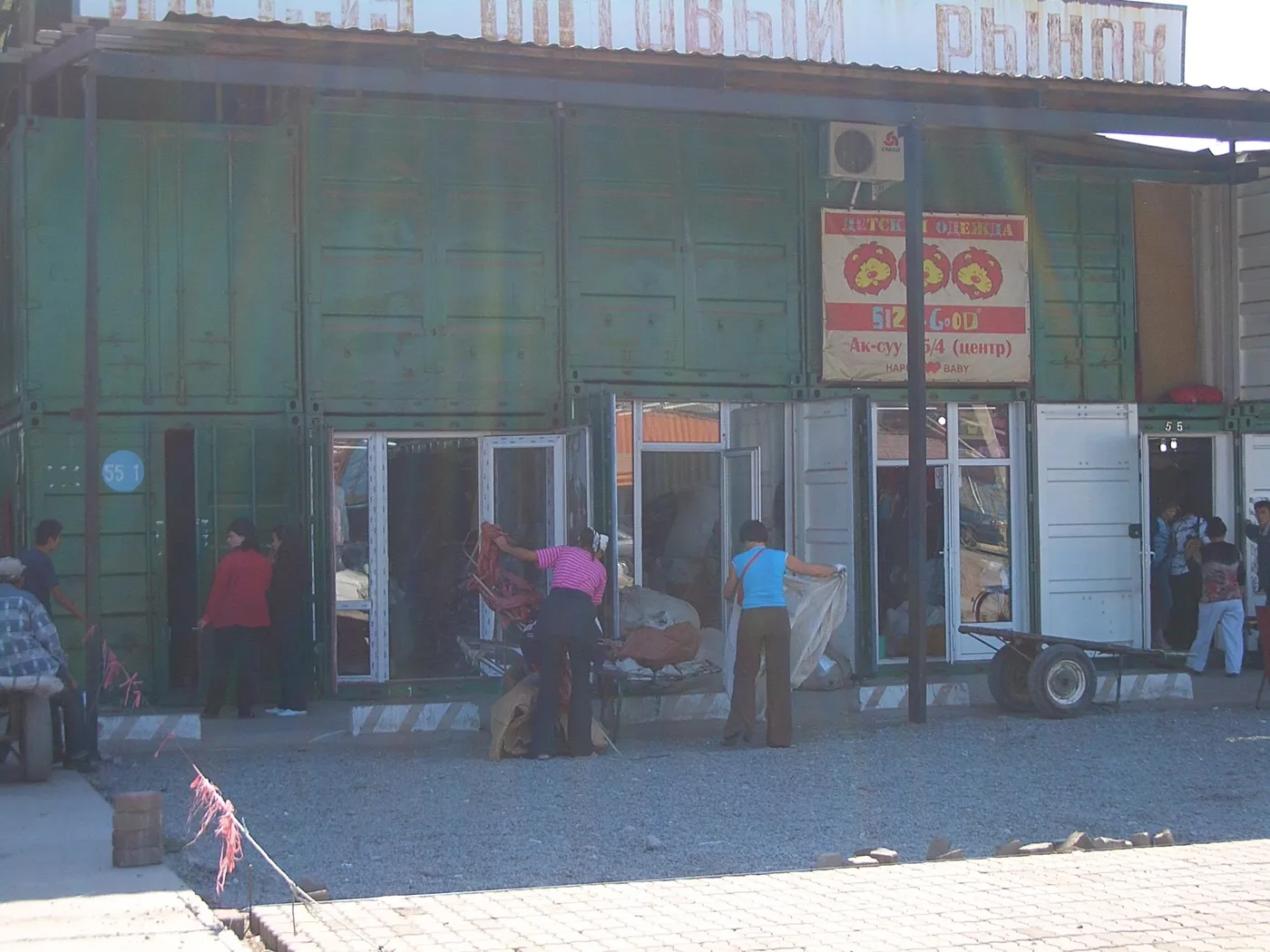 2/4. Clothing trade at Dordoy, 2007 Photo: Vmenkov, Wikimedia Commons, CC BY-SA 3.0; edited for this site.
 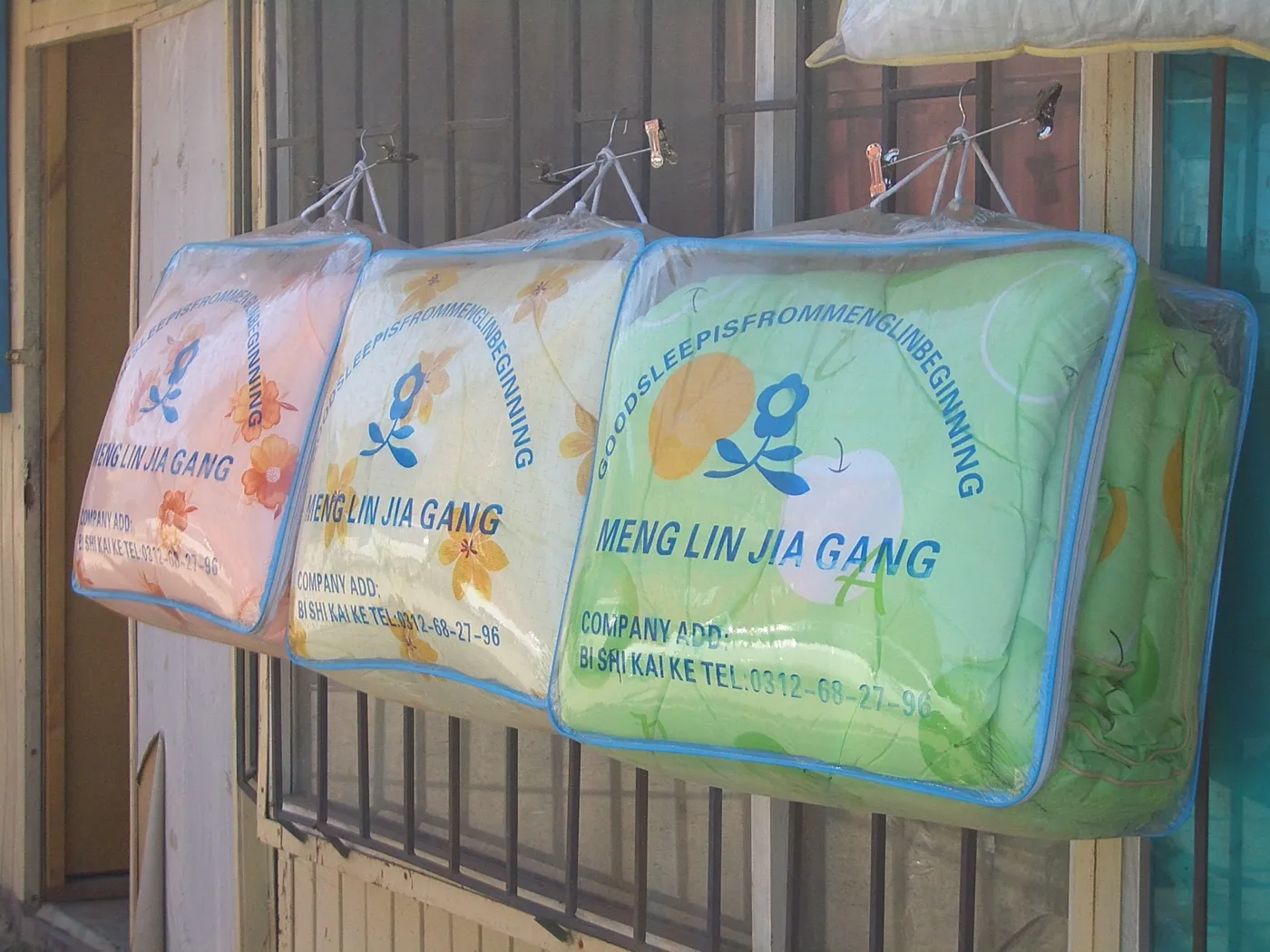 3/4. Home textiles and packaging, 2007 Photo: Vmenkov, Wikimedia Commons, CC BY-SA 3.0; edited for this site.
 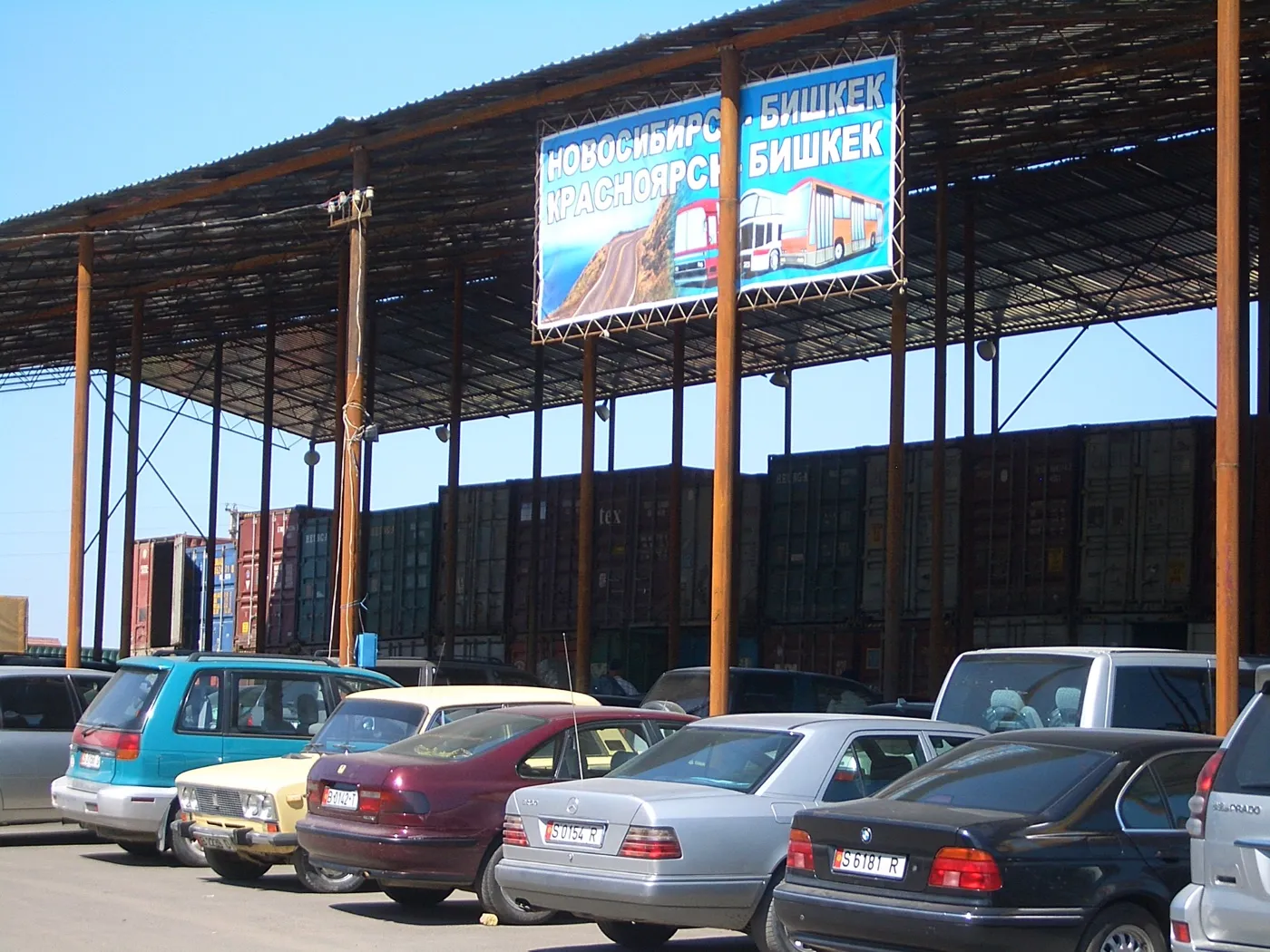 4/4. The market’s transport links, archive image from 2007 Photo: Vmenkov, Wikimedia Commons, CC BY-SA 3.0; edited for this site.
 For a traveller, Dordoy is interesting as working urban infrastructure rather than a museum of trade. Visit with a defined task and respect for people working amid customers, deliveries and traffic. The history explains the scale, but a successful purchase still begins with a short list and a careful inspection.
Frequently asked questions about Dordoy Bazaar
Which day is best for Dordoy Bazaar?
For a first visit, choose a morning from Tuesday to Sunday. City markets have sanitation days on two Mondays each month, and hours vary by sector, so check the date before travelling.
Can I buy retail at Dordoy?
Yes. Dordoy serves both wholesale and retail customers. Ask separately for the price of one item and the price from several units.
Can I pay by card?
Sometimes, but not at every seller. Cash in Kyrgyz som is the most predictable option. A foreign card or local QR transfer cannot be assumed to work at a particular stall.
Do I have to bargain?
No, although bargaining is common, especially for several items. Inspect the goods and establish the unit price first, then ask calmly for a final price or a bundle discount.
How much time should I allow?
Allow two to three hours to find one category and compare several sellers. A larger order or several product categories can easily take half a day.
How can I find a seller again?
Before paying, photograph the sector name, row and container number, save the seller’s phone number and ask for proof of purchase. A photograph of the item alone is not enough to relocate the stall.
Share on social media
If you found this guide useful, share it on social media. It takes a moment and helps more travellers discover the project. Thank you!
Anything to add?
Share your experience, leave a comment or suggest an improvement.