Contents:
Checked on 28 August 2026. The Ministry of Transport publishes a consolidated timetable, but it does not confirm a free seat in a particular vehicle. Recheck the service, fare, boarding point and luggage conditions immediately before travel.
How to choose a bus, marshrutka or shared taxi
Start with the constraint that matters most: a fixed departure, quick vehicle fill-up, room for a large backpack or an orderly station booking. The word “marshrutka” does not define the service on its own. It may refer to a scheduled minibus, an interval service or a vehicle that waits for passengers.
Bus or scheduled minibus
- Useful when the timetable includes the destination and departure you need.
- A ticket office makes the boarding point, ticket and luggage terms easier to confirm.
- Recheck before leaving: a timetable does not guarantee an available seat.
Marshrutka
- Ask whether it leaves at a fixed time, at intervals or when seats are filled.
- Confirm the exact final stop, not just the name of the town.
- Show any large luggage before buying your seat.
Shared taxi
- Useful when the terms are agreed before boarding and the driver gives a clear end point.
- Confirm the fare per passenger, the number of seats sold and the luggage arrangement.
- Do not rely on an exact time if the car leaves only when it fills.
If arrival is tied to an international flight, permit or tour start, compare the road journey with a domestic flight. Leaving earlier is often more useful than a promised short journey time.
How to find the bus station or boarding point
The Ministry of Transport’s official consolidated timetable groups routes by bus-station branch. Use it as the first check: find your origin and destination, then confirm the details with the ticket office or operator the day before travel.
Do not choose a location solely because an old article or map calls it “the bus station”. Long-distance, regional and suburban vehicles may use different sites in one city, while shared taxis may gather elsewhere. Ask for a pin marking the entrance or platform and save it offline.
Give both ends of the route and the region when asking. Similar names can cause expensive mistakes: Karakol and Kara-Kul are in different parts of the country. A useful question is: “Where exactly does the vehicle to [town and region] leave, where is the ticket office, and where should I wait for the driver?”
Departure by timetable or when seats fill
For a scheduled bus or minibus, use the published time or interval as the starting point. Arrive early enough to find the platform, buy the ticket and load your luggage. If the ticket office gives a different time, its same-day information matters more than an older online table.
For a marshrutka or shared taxi, ask directly: “Does it leave at a fixed time or when the seats are filled?” In the second case, nobody can honestly promise a departure minute. Do not place that journey immediately before the final connection or the closing time of your accommodation.
Also ask whether the vehicle is direct. “To Naryn” might mean a terminus in the city, a transfer along the way or a seat only as far as an intermediate stop. The sign on the vehicle and the driver’s answer should match your plan.
How to agree a shared-taxi fare
Before loading your bags, agree five points: whether the price is per passenger or for the whole car, how many seats will be sold, any luggage charge, planned stops and the exact drop-off point. Repeat the total aloud. If two people want more room, ask whether you are buying an extra seat or hiring the entire vehicle.
At a station, use the ticket office when it handles your service. For an informal departure, establish the payment method and prepare sensible change. Our guide to money and currency exchange explains where to break a large note before travelling. Never leave your passport with a driver or intermediary as security.
Travelling with a suitcase or large backpack
Show all your luggage before paying. A small vehicle may not have room for a suitcase, while a large backpack may go in the boot or on the roof. Ask whether transport is included in the fare and whether you can reach the bag at an intermediate stop.
Keep documents, money, your phone, medication and fragile electronics with you. Add your name and contact number to the bag. Roof luggage needs a waterproof cover; tuck away loose straps and check that the load is secured before departure.
If you have a bicycle, skis, a pushchair or several large pieces, agree them with the particular vehicle in advance. Saying only “I have luggage” does not describe the load or reserve space.
Night services and mountain roads
The official tables include evening and night departures on some long routes. A night service preserves daylight hours but makes it harder to assess the driver, road and arrival point. Before boarding, check for a working seat belt, seasonal heating, planned breaks and onward transport from the terminus.
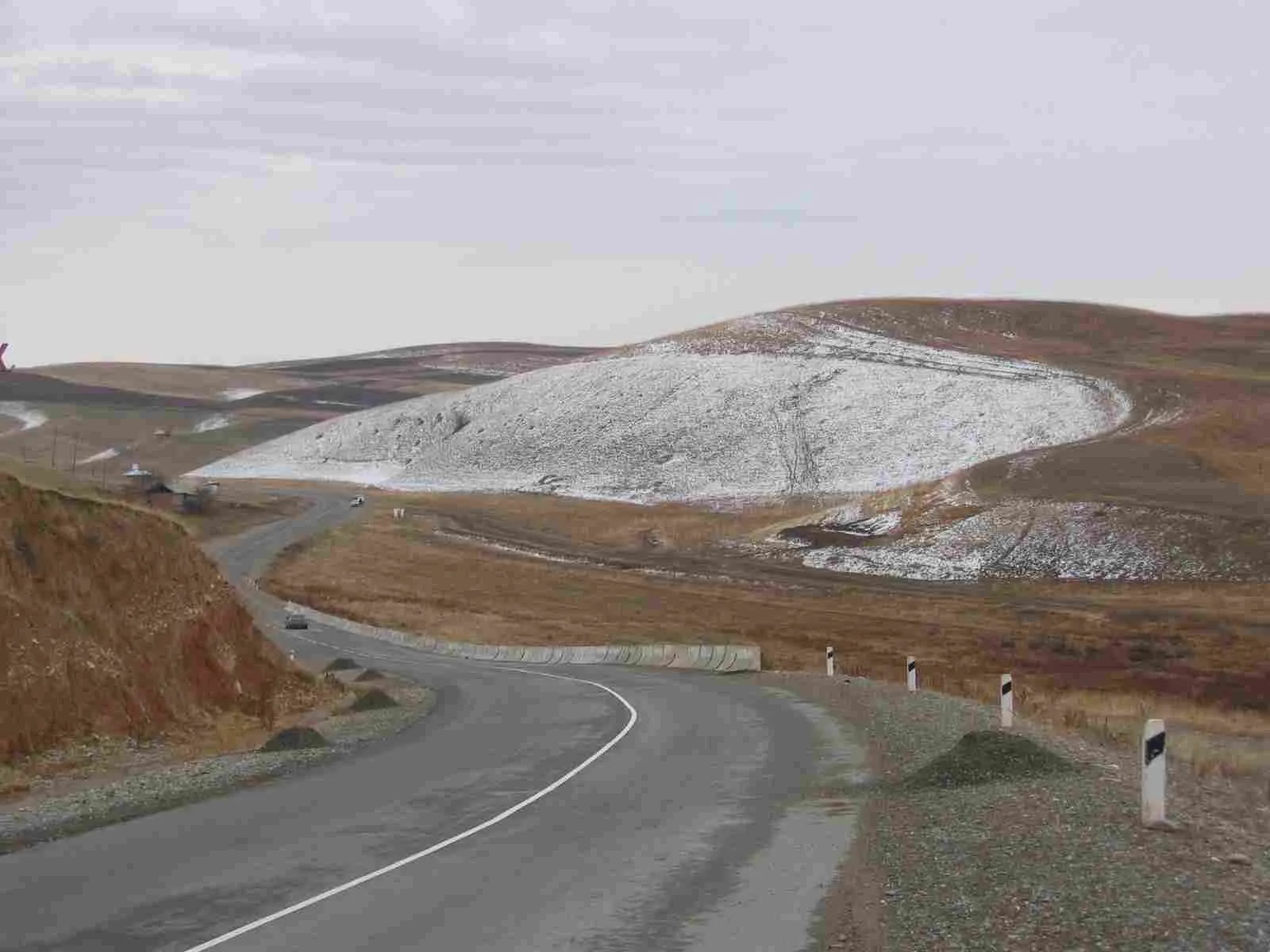 The road across southern Kyrgyzstan. Photo: celichowster, Wikimedia Commons, CC BY-SA 2.0; edited for this site.
For a first journey on an unfamiliar mountain road, we recommend a daylight departure. It is easier to understand the actual route and arrange help after a delay. Do not board an overloaded vehicle, and leave if the driver appears too tired or the driving feels unsafe. Our travel-safety guide covers the broader checks.
During snow, heavy rain or reported closures, check the Ministry’s road-passability page, then ask the operator about today’s service. An open road does not prove that a particular vehicle has departed.
International and transit routes
An international bus clearly crosses a border, but a border may also appear on a journey between two Kyrgyz towns. On the check date, the ministry timetable included routes between Bishkek and Talas Region via Taraz in Kazakhstan. A seasonal alternative may remain within Kyrgyzstan.
Before buying, ask which countries your exact service enters. Check entry and transit eligibility for your nationality, passport validity and rules for children. A ticket does not replace a visa or other permission. Our guide to entry into Kyrgyzstan covers the starting point; verify the transit country’s rules separately on its official government website.
At the border, every passenger depends on the queue and document checks. Do not promise an exact arrival time or plan a short connection after a border section.
Where you will be dropped off and how to cover the last mile
A town name on the route does not mean a stop beside your hotel or attraction. Open the terminus on a map before departure, save it offline and measure the distance to your accommodation. For a late arrival, arrange a transfer or learn where to find an official taxi in advance.
For a gorge, lake or village, intercity transport often covers only the main corridor. The last section may require a local marshrutka, a separate taxi or a pickup by your host. The wider choice of routes and alternatives is explained in our Kyrgyzstan transport guide.
What to check before departure
- Route. Exact towns and region, direct service or transfer.
- Boarding point. A pin for the entrance, platform or shared-taxi gathering place.
- Departure rule. Fixed time, interval or when seats fill.
- Payment. Price per person or vehicle, payment method and ticket confirmation.
- Luggage. Where it travels, whether it is included and whether the vehicle is large enough.
- Arrival. Final stop, approximate time and transport to the accommodation.
- Road. Weather, mountain passes, closures and time buffer.
- Documents. Passport, transit eligibility and requirements for every country on the route.
Save a screenshot of the agreement and the driver’s number, but treat them as working contact details rather than a guarantee. A reliable plan includes spare time and a clear alternative if the service is cancelled or the vehicle is full.
Share on social media
If you found this guide useful, share it on social media. It takes a moment and helps more travellers discover the project. Thank you!
Anything to add?
Share your experience, leave a comment or suggest an improvement.