Contents:
What does Osh plov mean?
Osh sits at the edge of the Fergana Valley, where Kyrgyz and Uzbek households, teahouses and small plov kitchens all cook the dish. There is no single city formula: the meat, fat, carrot, seasoning and extras change. The basic structure remains rice cooked above meat, onion and carrots in one kazan.
The strongest local connection leads to Uzgen in Osh Region. Uzgen rice is explicitly named in a published Kyrgyzstan recipe for plov. Market batches and processing vary, so the name by itself does not guarantee that every grain will have the same colour or behave identically in the pot.
It is more accurate to see Osh plov as a southern expression of a broad Central Asian tradition. That keeps the local detail without assigning a shared dish to one community alone. In Osh, plov works equally well as an everyday lunch, food for guests and a large family dish.
Where the flavour comes from
Rice determines the texture, but the flavour begins earlier. The cook browns meat in vegetable oil, adds onion and carrot, then simmers this base with water before the rice goes in. Salt and seasoning need to be distributed through the liquid because the rice layer is not stirred like porridge once it has been added.
Lamb gives a more pronounced meaty, fatty flavour, while beef usually tastes gentler. Barberries add occasional tart notes. Garlic, cumin, chickpeas, raisins, eggs and qazi appear in other household and restaurant versions, but do not have to arrive together. The longer the list of extras, the more useful it is to check the ingredients before ordering.
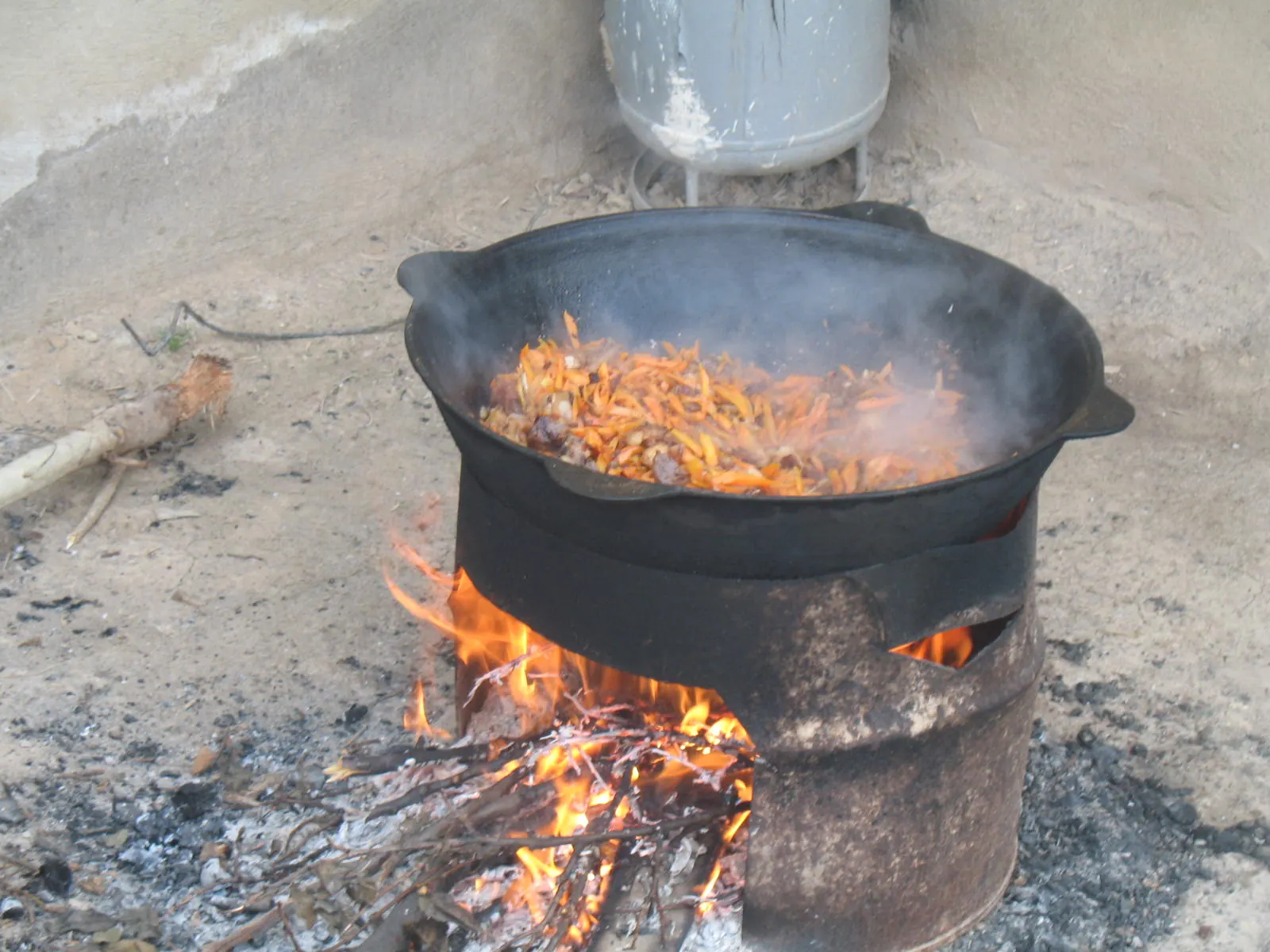 1/4. Plov in a kazan, Ak-Orgo, Chuy Region Photo: Firespeaker, Wikimedia Commons, CC BY-SA 3.0; edited for this site.
 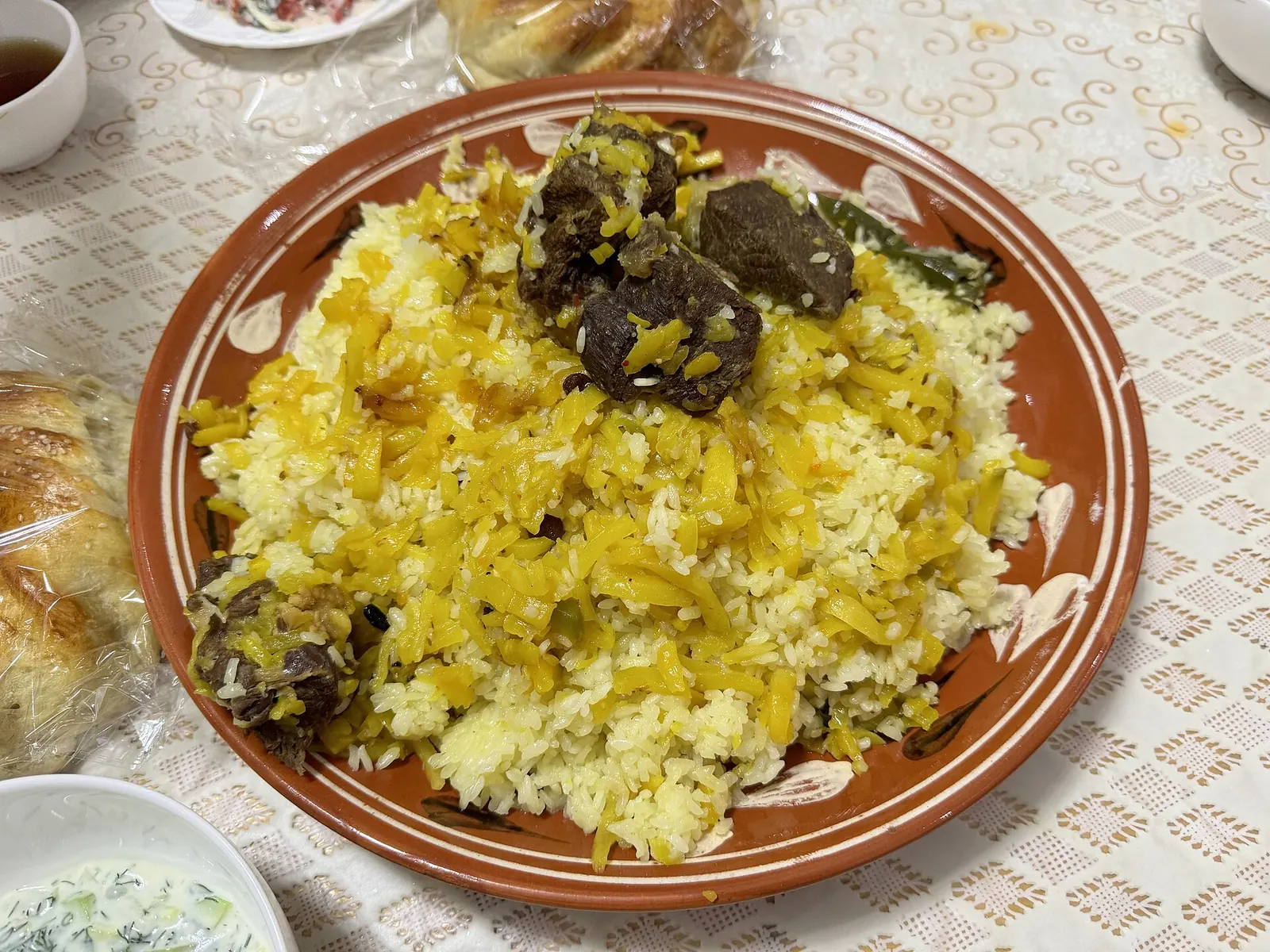 2/4. Homemade palov, Tashkent Photo: Jamshid Nurkulov, Wikimedia Commons, CC BY-SA 4.0; edited for this site.
 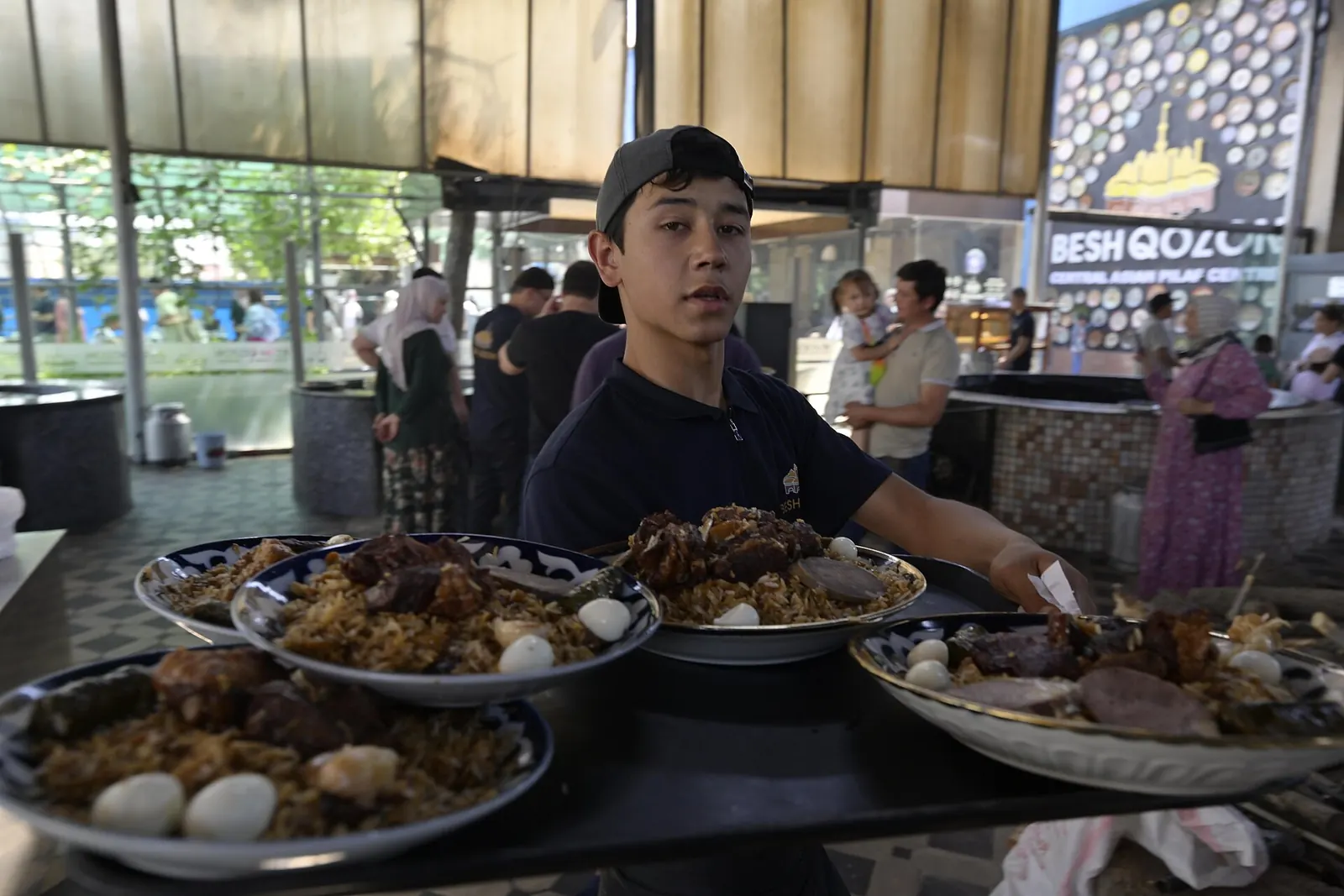 3/4. Large-scale palov service, Tashkent Photo: AIDEPCUL, Wikimedia Commons, CC BY 4.0; edited for this site.
 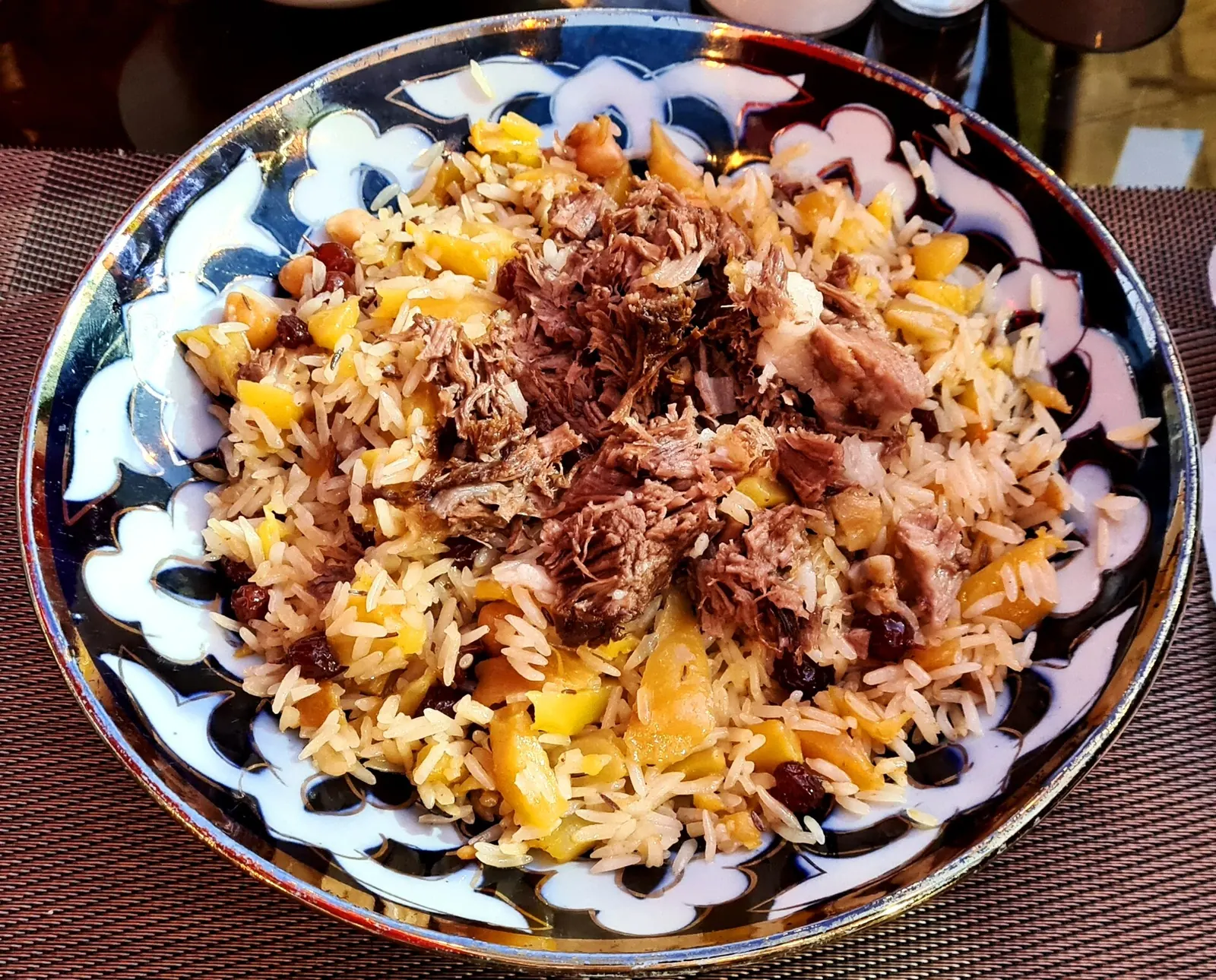 4/4. A neighbouring regional version, Tashkent Photo: BeshevI, Wikimedia Commons, CC BY-SA 4.0; edited for this site.
 How plov is cooked in a kazan
The work falls into three stages. First the cook browns the meat, onion and carrots, adds water and simmers the meat base. Next comes an even layer of washed or soaked rice. Once the liquid has been absorbed, the rice is gathered towards the centre, seasoned and finished under a lid over low heat.
The difficult part is not adding more spices but controlling water and heat. Too much liquid makes the rice soft; excessive heat dries the top before the centre is ready. An experienced cook therefore watches the actual batch of rice and adjusts as it cooks instead of trusting the timer alone.
Plov is turned onto a communal platter or served by the portion. The meat may remain on top or be distributed through the rice. A simple salad, fresh tandoor bread and tea make useful companions: they refresh a rich meal without hiding the rice.
Where and when to try it in Osh
Look for a specialist plov house, oshkana or teahouse that cooks one clearly visible daytime batch. The local tourism portal Destination Osh recommends going in the morning or around lunch because a limited batch may sell out well before evening.
Call ahead, or ask your host to check when the kazan will be ready. Restaurant names and opening hours age faster than the cooking method. A portion from today's batch matters more than reaching a place featured in an old ranking.
If you have half a day, combine plov with a trip to Uzgen. The link between dish and rice becomes tangible there through the market, the town and a local lunch. For the wider food context, start with our guide to Kyrgyz cuisine.
How to order without surprises
Ask which rice and meat are in today's batch and what comes with the base serving. Eggs, chickpeas, qazi, garlic and salad may be included or charged separately. If you avoid lamb or fatty cuts, say so before the plate is assembled.
One serving is often enough for a full lunch. A group can share a platter, but check its weight or intended number of diners first. Do not order several heavy meat dishes at once; add salad and bread, then save lagman or dymdama for another meal. Dymdama, with its meat and large vegetables, is a main dish in its own right rather than a side for plov.
Rice does not make a kitchen automatically safe for a strict gluten-free diet. Bread, noodles and sauces may be handled on the same surfaces. For an allergy or medical restriction, ask about separate utensils and the seasoning instead of checking only whether wheat appears in the plov recipe.
The home version below follows the proportions in recipe No. 3 of Kyrgyzstan’s Food Composition Table. We scaled the original serving by four, retained its cooked yield and did not add ingredients outside the published calculation.
Homemade plov with Uzgen rice and barberries
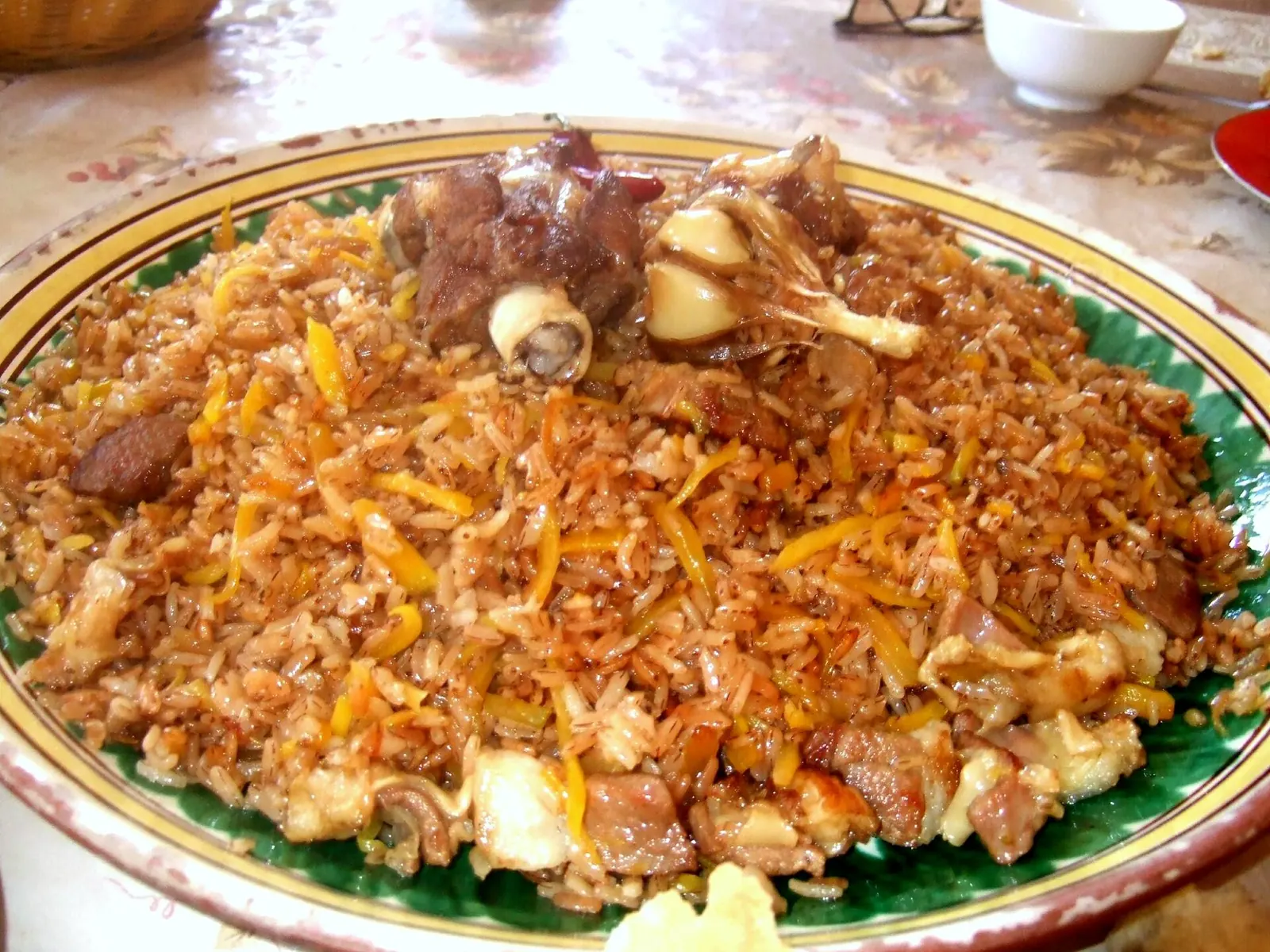
Photo: Thomas Depenbusch (Depi), Wikimedia Commons, CC BY 2.0; edited for this site.
A reproducible version yielding four 350 g servings. The proportions, cooked yield and nutrition are based on a published Kyrgyzstan recipe using Uzgen rice.
Cuisine: Southern Kyrgyzstan and Central Asia. Category: Main course. Yield: 4 servings, about 1.4 kg. Preparation: . Cooking: . Total time: .
Per 100 g: 203 kcal; protein 8.14 g; fat 10.5 g; carbohydrate 19.7 g.
Ingredients:
- 600 g bone-in lamb or beef, about 430 g edible meat
- 320 g Uzgen rice
- 400 g carrots before trimming, about 320 g prepared
- 145 g onion before trimming, about 120 g prepared
- 120 g vegetable oil
- 8 g dried barberries
- 8 g salt
- 320 ml water for the kazan, plus water for rinsing and soaking the rice
Method:
Step 1. Sort the rice, rinse until the water is reasonably clear and soak in lightly salted water while you prepare the other ingredients.
Step 2. Cut the meat into 12-16 large pieces. Slice the onion into half-moons and the carrots into long batons.
Step 3. Heat the oil in a kazan or heavy, wide pan. Brown the meat in batches until it develops a deep crust.
Step 4. Add the onion and carrots. Fry until the onion softens and the carrots settle without turning them to a purée.
Step 5. Pour in 320 ml water, add the salt and simmer the meat base over medium heat for 30-40 minutes.
Step 6. Drain the rice and spread it evenly over the meat and vegetables. Do not stir. Cook uncovered until the rice has absorbed the liquid.
Step 7. Gather the rice towards the centre, make several holes down to the base and add the barberries. Cover and finish over low heat for 25-30 minutes.
Step 8. Gently combine the rice with the carrots and onions before serving. Transfer to a large platter and arrange the meat on top.
Share on social media
If you found this guide useful, share it on social media. It takes a moment and helps more travellers discover the project. Thank you!
Anything to add?
Share your experience, leave a comment or suggest an improvement.