Contents:
Who should join an expedition to Lake Merzbacher?
Merzbacher suits travellers who already have experience of multi-day mountain routes, cope well with altitude and are prepared to stay in tented camps without reception. Even a short programme involves several days on foot. Full Inylchek routes normally require one to two weeks, including the vehicle transfer and a weather allowance.
No technical climb is necessary to reach the camp, but the route includes cold rivers, moraine boulders and sections beside the ice. Do not judge it solely by the relatively modest elevation gain: each day involves 6-7 hours of walking over unstable ground.
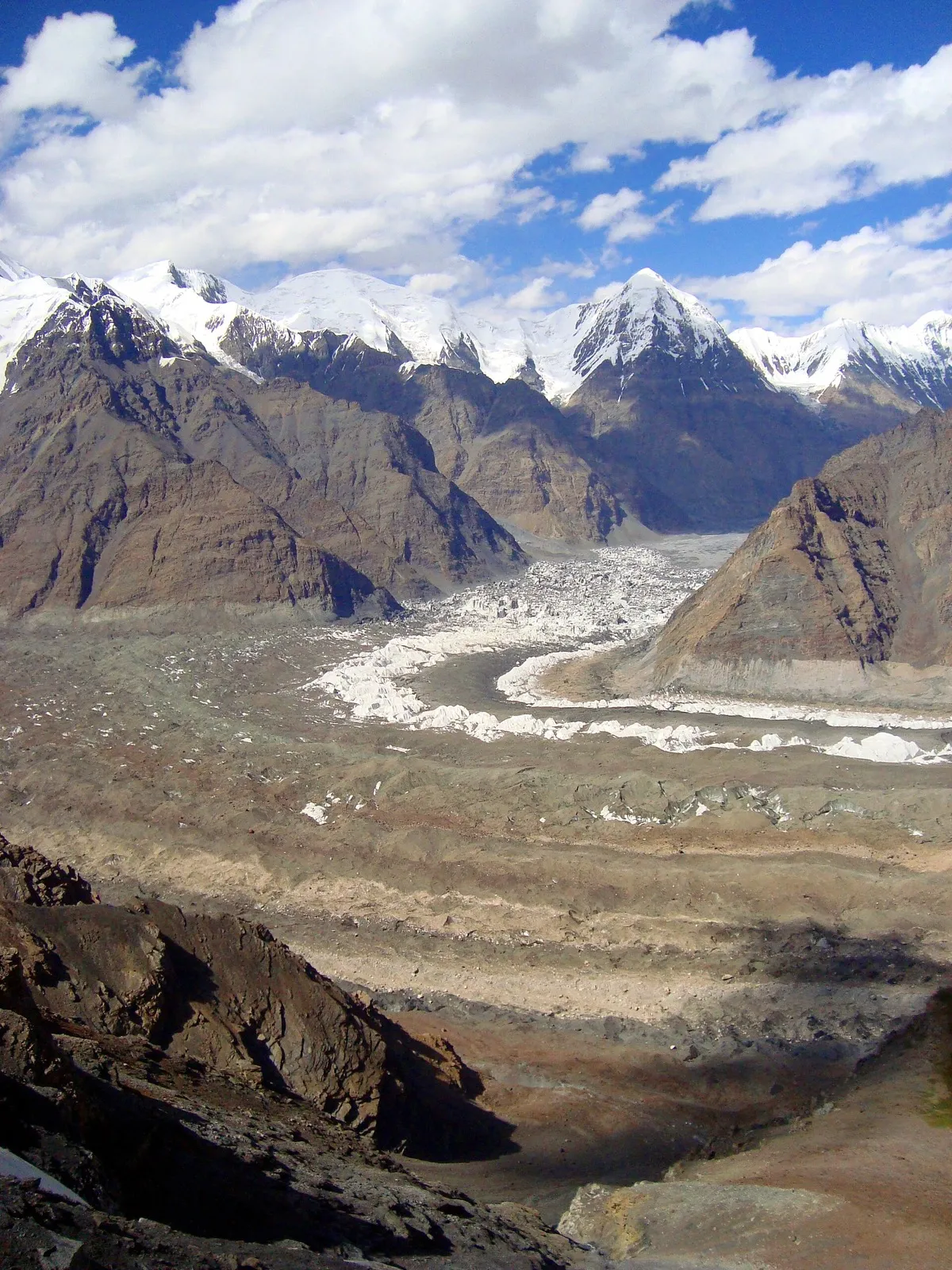 1/2. The basin after the lake drained Photo: Julia Neelmeijer, Wikimedia Commons, CC BY-SA 3.0 DE; edited for this site.
 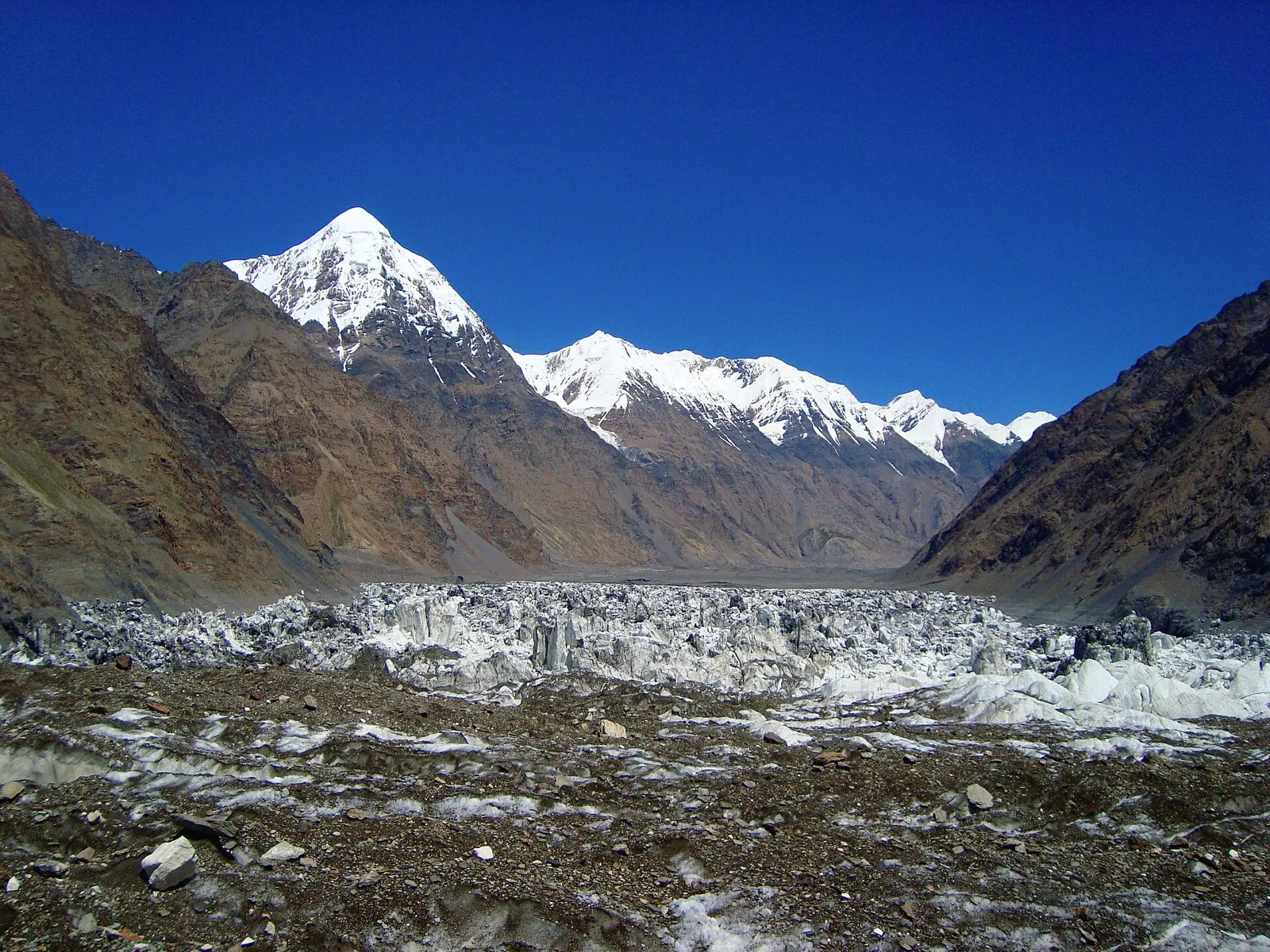 2/2. Ice debris in the empty basin Photo: Julia Neelmeijer, Wikimedia Commons, CC BY-SA 3.0 DE; edited for this site.
 The main expedition season is July and August. The lake fills and may drain in summer, so the old claim that the “risk of an outburst is lowest in summer” is wrong. You are equally likely to find a full basin with icebergs or a nearly empty hollow: the natural cycle does not adapt to tour dates.
How the route to Merzbacher works
The overland section begins in Karakol. A suitable vehicle crosses Chon-Ashuu Pass, the Sary-Jaz Valley and border control, then takes the group towards Echkilitash and the start near At-Jailoo. Road conditions and the final authorised point change, so an independent route based on a navigation app will not work here. A separate road trip to Enilchek village ends sooner and is not a substitute for the expedition transfer.
The group then walks up the Inylchek Valley through a series of seasonal camps. Programmes use names such as Iva, Glina and Merzbacher Glade. They help describe the stages, but do not replace a current track: river crossings and approaches change with the river and glacier.
Allow several walking days from the start of the trek to the lake area. Popular tables claiming “1-2 hours from Karakol” describe only part of the vehicle journey and give a false impression of accessibility.
Approaches to Khan Tengri continue deeper into the glaciated region and require a separate programme.
Inylchek lies in a border zone. Apply for the permit several weeks ahead and carry the original with your passport. Visit Kyrgyzstan explains the areas and application process on its page about border permits.
Why Lake Merzbacher drains
The South Inylchek Glacier blocks water draining from North Inylchek and acts as a moving ice dam. Meltwater fills the lower basin during summer. A drainage channel then opens beneath the glacier, water flows into the Inylchek and the lake level falls rapidly.
Research shows that the lower lake usually drains once a year. The date, speed and volume remaining vary from one season to another. The claim that there are “exactly two outbursts every year lasting 2-7 days” is therefore too categorical.
At high water, part of the ice dam begins to float, the ice surface rises and calving intensifies. Glacier movement around the lake also changes after it drains. A study of ice-dam dynamics examines this mechanism in detail.
The lake is named after the German geographer Gottfried Merzbacher, who described it for European science following an expedition to the central Tian Shan in the early twentieth century. The word “discovered” is conditional here: it refers to the history of scientific publication, not a claim that local people had previously been unaware of the valley.
Preparation and safety
An outburst is not a spectacle to watch from the shore. Water, ice fragments and undercut ground make riverbeds and lower sections dangerous. Stay on the expedition leader's route, keep away from the glacier face and do not step onto the ice without a specialist assessment.
You need well-worn boots, warm and waterproof layers, a sleeping bag rated below freezing, sun protection, a personal first-aid kit and supplies for delays. The operator should explain who carries group equipment, how river crossings are handled, whether satellite communication is available and which insurance covers evacuation.
Before setting out, register the route and an agreed check-in time with the Kyrgyz Ministry of Emergency Situations. Leave the same plan, the operator's contacts and the date after which they should raise the alarm with someone at home.
If you cannot fit the full expedition into your holiday, choose a more accessible route from Karakol, such as the hike to Ala-Kul. Do not reduce Merzbacher to a dangerous race for a single photograph.
Share on social media
If you found this guide useful, share it on social media. It takes a moment and helps more travellers discover the project. Thank you!
Anything to add?
Share your experience, leave a comment or suggest an improvement.