Contents:
Can you visit Tash Rabat now?
As of 27 August 2026, postpone a trip whose main purpose is to enter the caravanserai. The Ministry of Culture has temporarily restricted access and asked visitors to stay away until the main restoration stages are complete. The state programme is scheduled to continue in phases through 2027.
The restriction applies to the historical and architectural complex. Yurt camps in the valley are separate seasonal businesses, but an open camp does not mean that you can enter or approach the monument. Before booking, obtain two distinct confirmations: that the chosen camp is operating and that the monument may be visited on your date.
Current check. In a 6 August 2026 report, Kabar relays the ministry's notice: parts of the site are fenced and visitors are asked to stay away temporarily. Do not rely on an “open” label in a map app.
Do not use the surrounding valley as a way around the closure. Respect work fences, locked rooms and instructions from staff. Once the ministry announces renewed access, confirm the operating arrangement with your host before hiring a vehicle from Naryn.
What Tash Rabat is and why its date varies
Tash Rabat stands in the Kara-Koyun side valley of At-Bashy District at roughly 3,200 metres. Its name is commonly translated as “stone lodging” or “stone rabat”. Rabats were fortified way stations, and in its later use the building served as a caravanserai on a route across the Tien Shan towards Kashgar.
Official descriptions do not agree on a single construction date. Kyrgyzstan's Department of Tourism places Tash Rabat in the fifteenth century. Kyrgyz submissions to the UNESCO World Heritage Centre connect the stone building with the eleventh- to twelfth-century Karakhanid period and state that it remained in later use. It is therefore more accurate to describe a medieval complex with disputed dating than to repeat one certain year.
The theory of an earlier Christian or Buddhist monastery survives in legends and later interpretations. The evidence is not strong enough to present it as established history. Architecture, location and written references support the building's function as a road station and lodging place.
For the wider setting, the guide to the Silk Road in Kyrgyzstan connects Tash Rabat with the cities of the Chüy and Fergana valleys without presenting a modern highway as one proven ancient route.
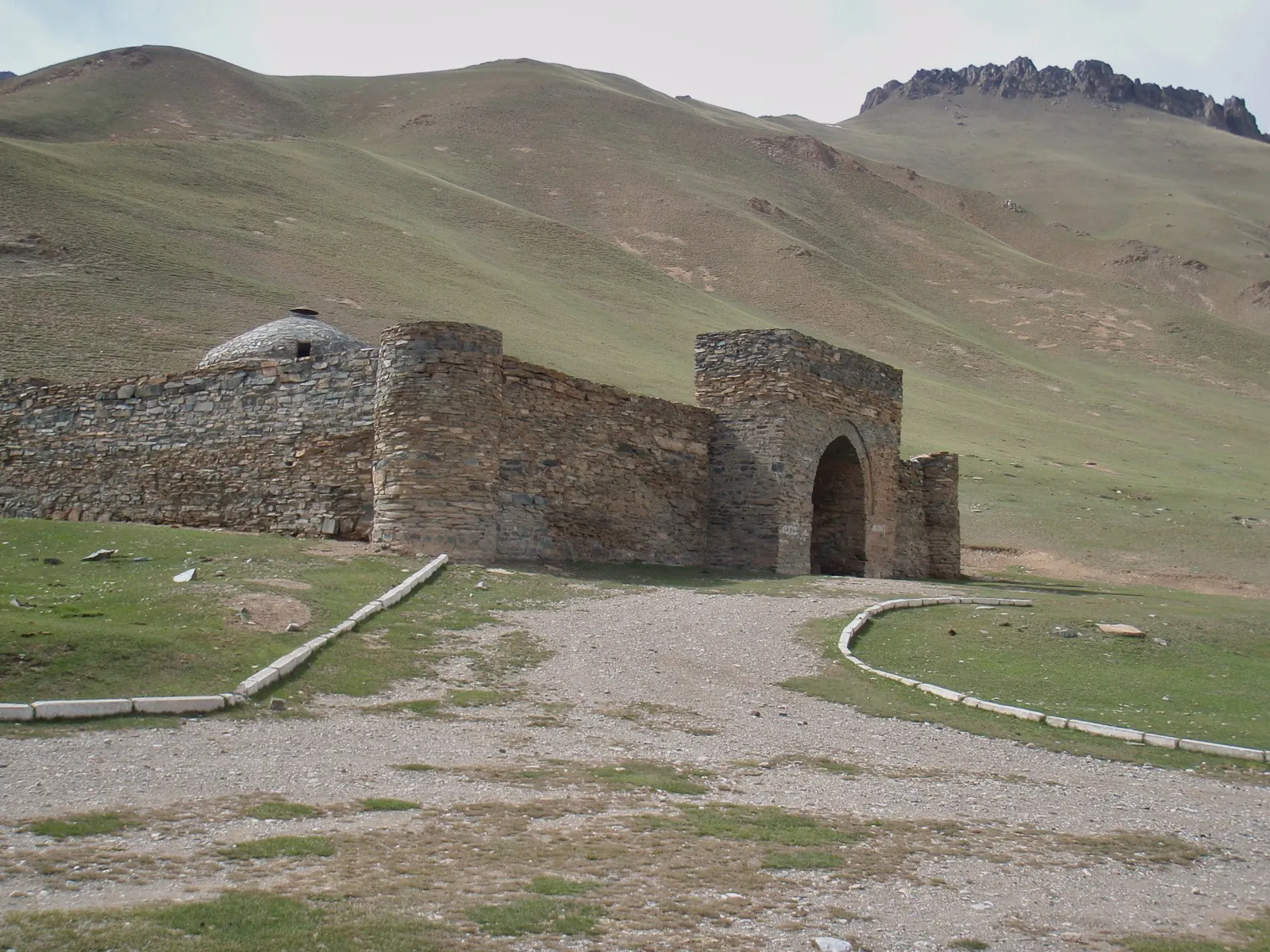 1/3. Main portal Photo: Raki_Man, Wikimedia Commons, CC BY 3.0; edited for this site.
 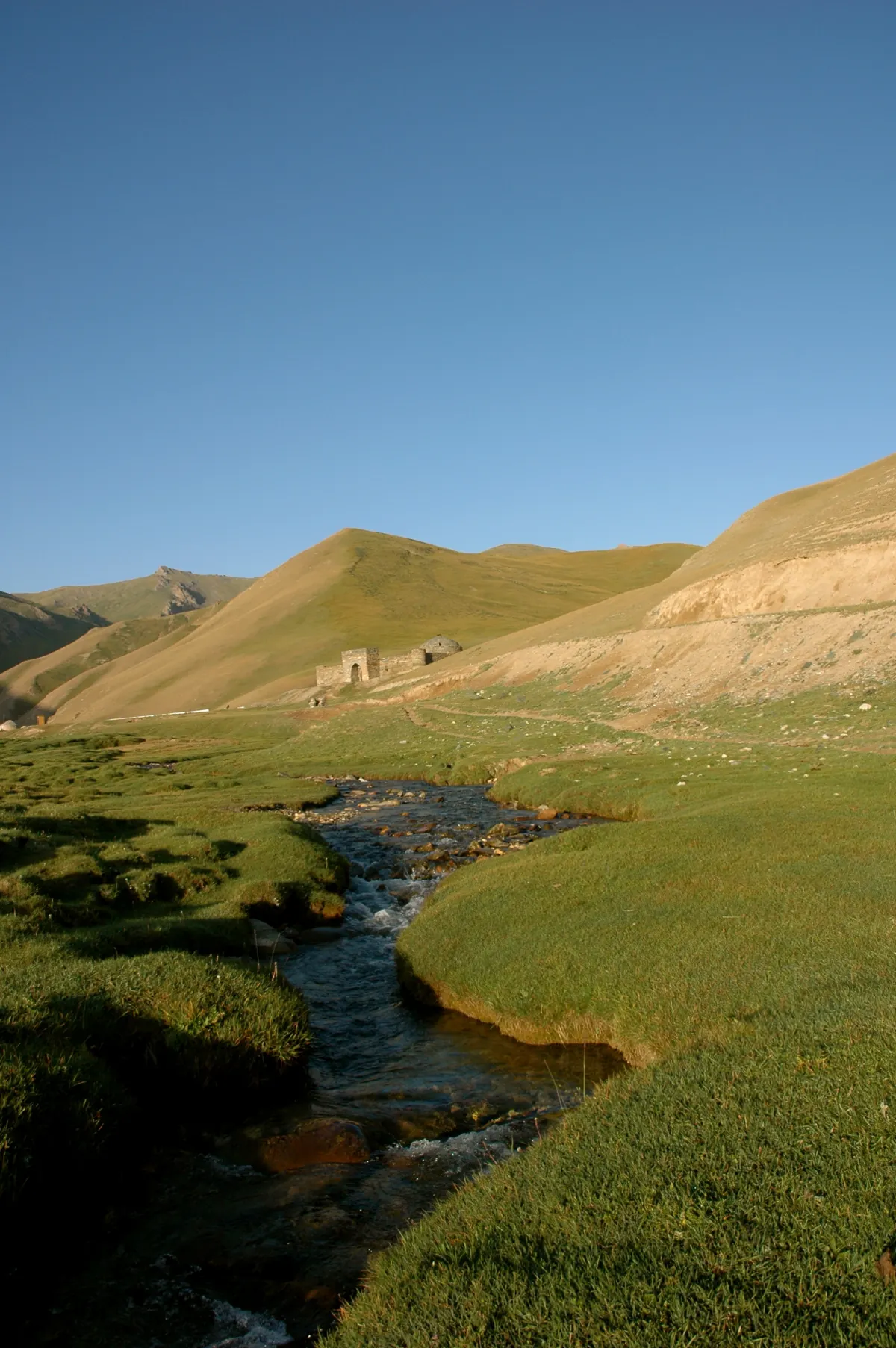 2/3. The monument in Kara-Koyun Valley Photo: Peter Schepens, Wikimedia Commons, CC BY 2.0; edited for this site.
 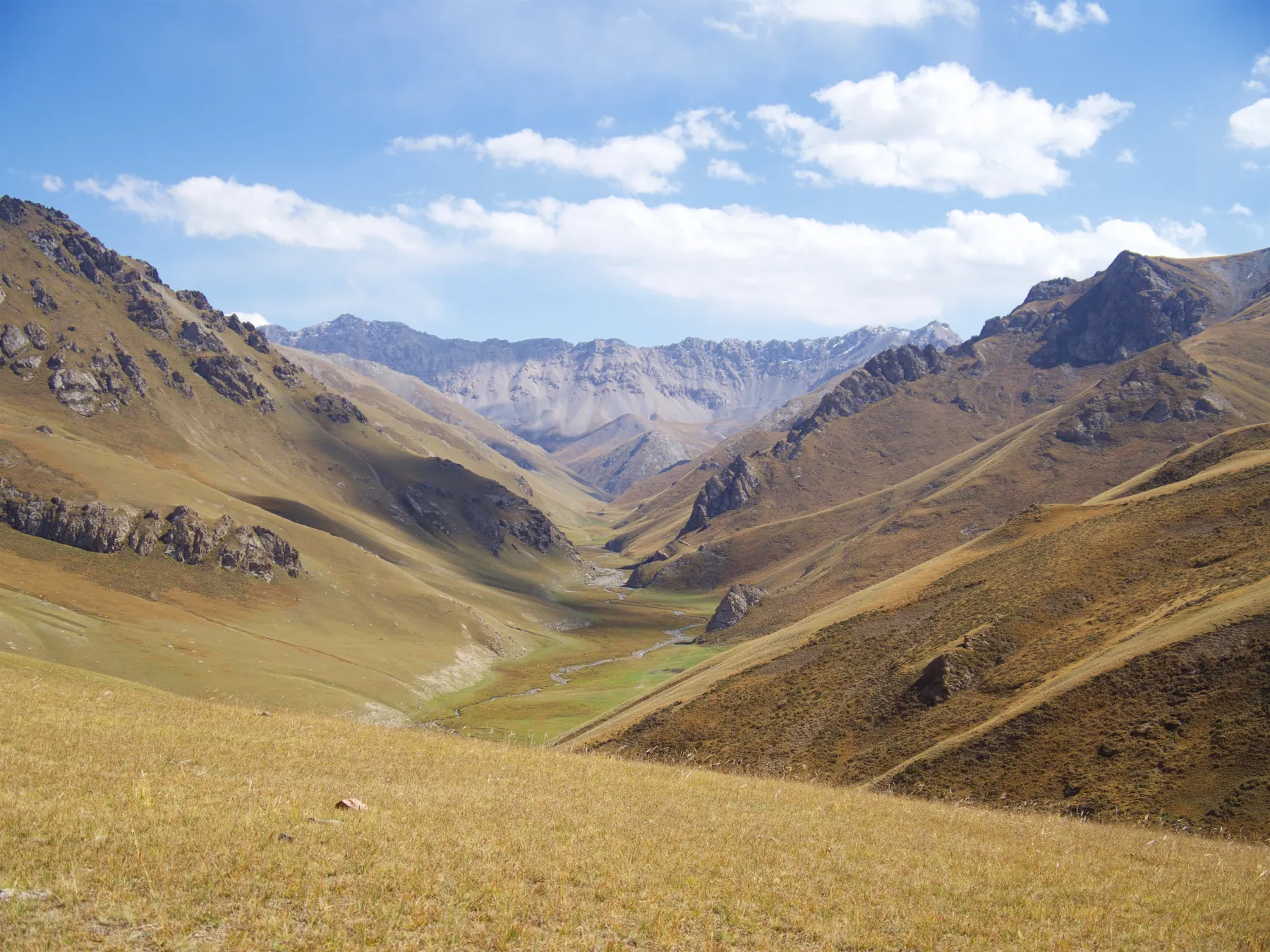 3/3. Terrain around the complex Photo: Laurent de Walick, Wikimedia Commons, CC BY 2.0; edited for this site.
 What to see inside after reopening
From outside, Tash Rabat appears as a low rectangular mass built partly into the slope. The east facade faces the valley, and two tower-like projections frame the portal. The walls are made from plates of local slate, while domes of different sizes form the roof.
A Kyrgyz report to UNESCO gives a plan of roughly 34 by 34 metres and 31 rooms. A dark corridor leads from the entrance, with small chambers opening on either side and a high central hall beneath the main dome. Openings in the vaults admit little light, so your eyes need time to adjust.
After reopening, allow 45-60 minutes for an unhurried look at the rooms and facades. Carry a small torch, but avoid shining it at other visitors. The interior is colder than the sunlit valley, the stone floor is uneven, and low passages require care. Do not climb onto the roof or walls: this is a monument, not a viewpoint.
Tash Rabat appears on the reverse of the current 20 som banknote. The banknote guide covers the issue and security features; at the site, pay attention to how the square stone plan disappears into the surrounding slope.
How to get there from Naryn and At-Bashy
Tash Rabat is about 110 kilometres from Naryn. The main route runs southwest through At-Bashy on the road towards Torugart, then turns into Kara-Koyun Valley. The final section follows the river on gravel. Allow around three hours each way before long stops.
Scheduled transport does not work for a visitor day at the monument itself. Arrange a vehicle and driver in Naryn or At-Bashy, and agree on the return time before departure. In dry weather a normal car often manages the final section, but rain, wet snow or roadworks make a same-day report from your camp and extra time essential.
If driving yourself, refuel in Naryn or At-Bashy and download an offline map. Mobile reception may disappear after the turn into the valley, and there are no shops or services. Do not follow an unknown track merely because the navigation app shows a shortcut.
Koshoy-Korgon fortress near At-Bashy can become a separate stop on the way. Once access is restored, the combination works as a long day with an early start. For an unhurried valley walk, stay south of Naryn rather than driving an unfamiliar road after dark.
Do you need a border-zone permit?
A standard visit to the caravanserai and nearby yurt camps does not usually require a separate border-zone permit. Carry your passport nevertheless: the road continues towards the Chinese border, and control arrangements and permitted areas can change.
Tash Rabat does not provide unrestricted access onwards to Torugart or Chatyr-Kul. Chatyr-Kul requires an advance border permit and an agreed visit within the nature reserve. Do not continue on foot or by road “for a view of the lake” without documents and a guide who knows the boundary of the permitted zone.
Give a precise destination when booking a driver. “Tash Rabat and then towards the border” is not a usable itinerary and may end at a checkpoint. List the caravanserai, camp, walk and any point farther south separately.
Where to sleep and eat
A summer stay at Tash Rabat usually means a yurt camp in the valley. Facilities vary: one camp may put a stove and individual beds in the yurt, while another has an outdoor toilet, limited electricity and weather-dependent hot water. The words “yurt camp” do not describe a standard level of comfort.
CBT Kyrgyzstan publishes contact details for a seasonal camp at Tash Rabat. Before paying, ask for exact opening dates, night heating, bedding, shower and toilet, device charging, mobile reception, dinner, breakfast and transfer. Confirm the separate restriction at the monument as well.
Order meals at the camp in advance. Dinner and breakfast there are usually more practical than carrying a complete kitchen, while water, snacks and a thermos should come from Naryn. Small camps do not keep a full menu for unexpected visitors, and the nearest shop is far away. Carry cash even when you have booked online.
The altitude of roughly 3,200 metres makes nights cold even in summer. A warm sleeping bag or liner, hat, dry socks and windproof layer are more useful than extra town clothes. Keep the first evening gentle, particularly if you slept much lower the night before.
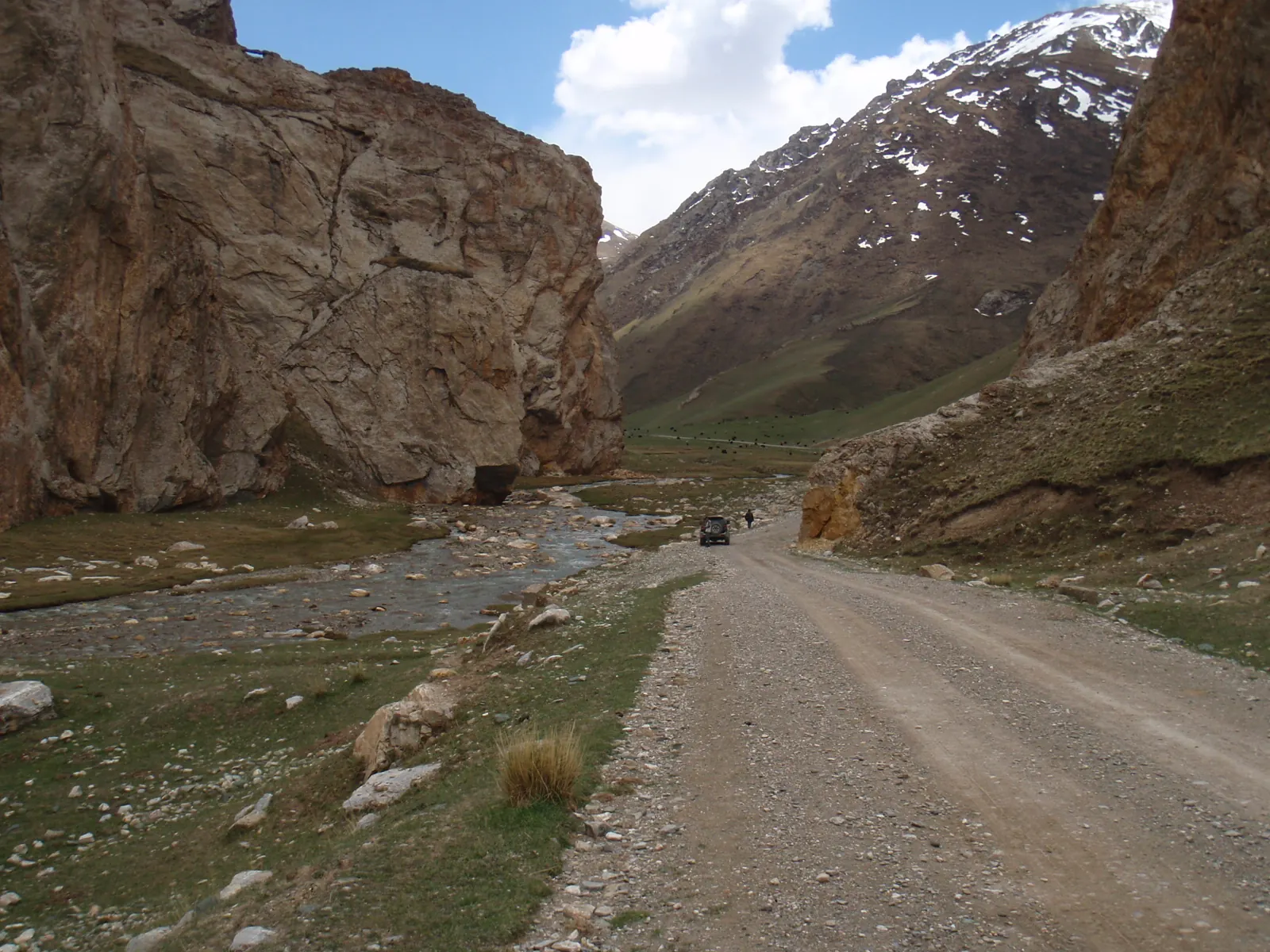 1/3. The final road section Photo: Raki_Man, Wikimedia Commons, CC BY 3.0; edited for this site.
 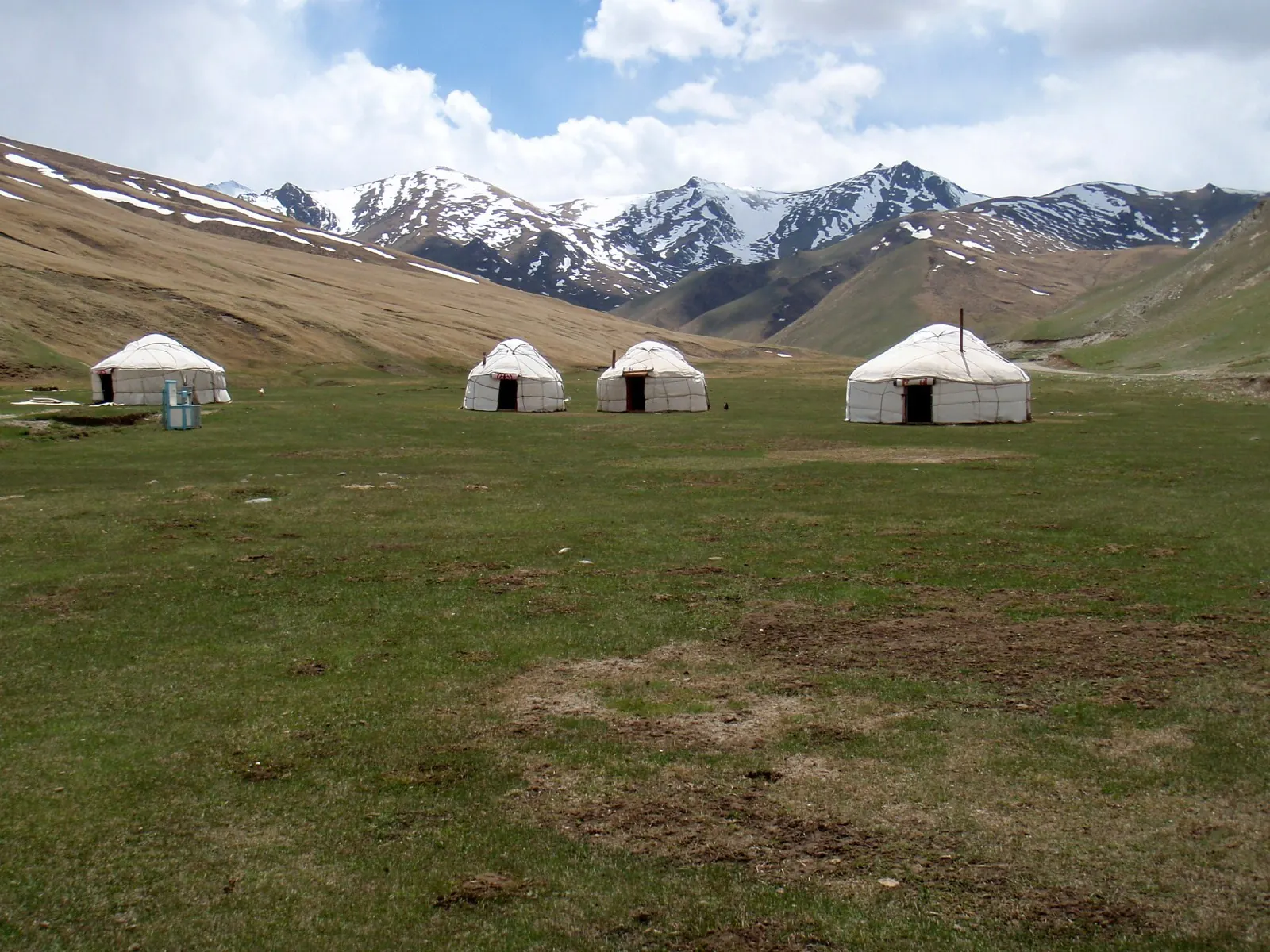 2/3. Seasonal yurt camp Photo: Raki_Man, Wikimedia Commons, CC BY 3.0; edited for this site.
 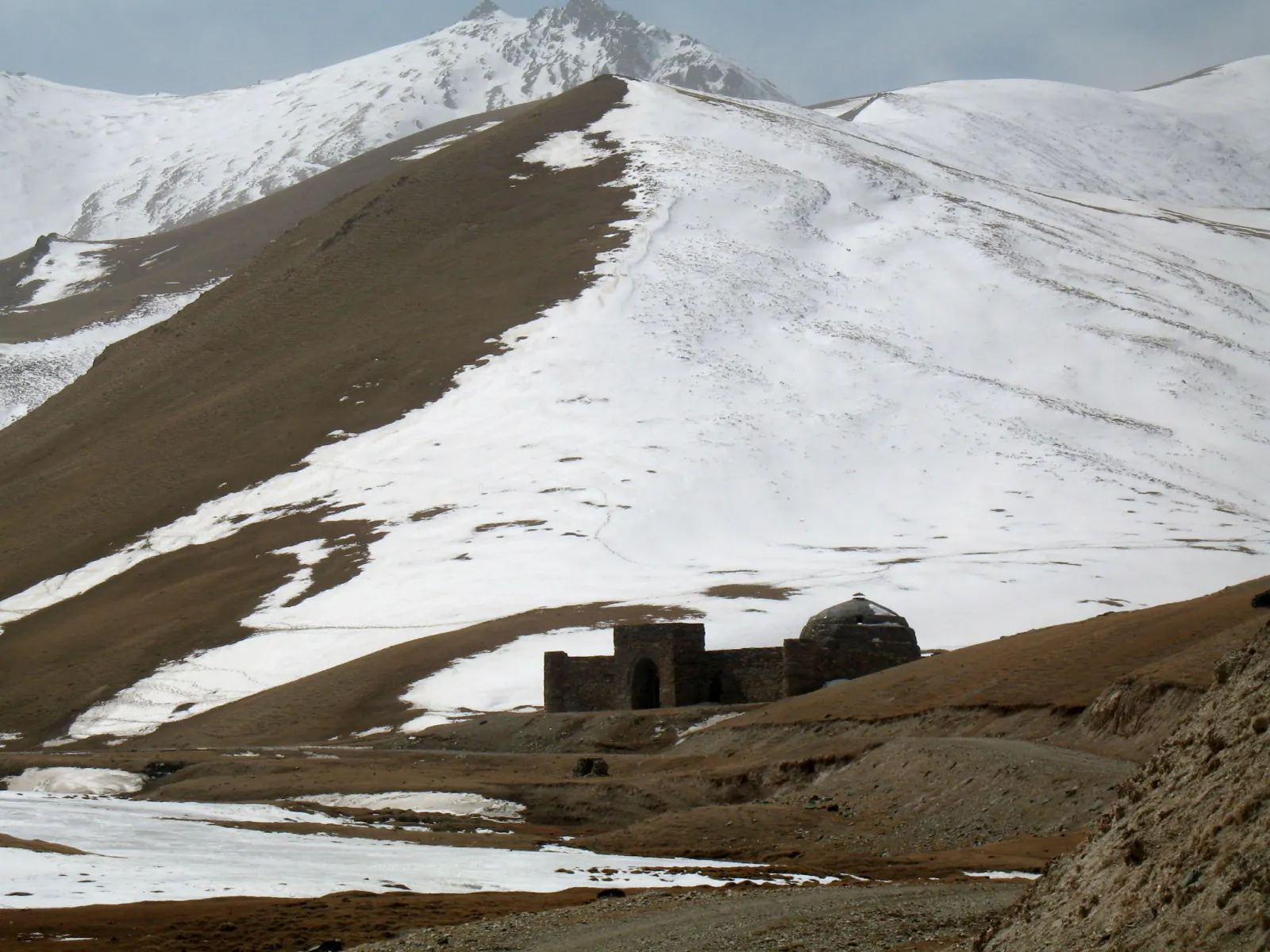 3/3. Snow outside the summer season Photo: Firespeaker, Wikimedia Commons, CC BY-SA 3.0; edited for this site.
 When to visit Tash Rabat
Spring
Snow melts unevenly and the gravel road becomes muddy.
- Yurt camps may not yet be operating.
- After snow or a thaw, confirm the road on the morning of departure.
Summer
The usual season for the road, camps and valley walks.
- Nights at altitude remain cold.
- In 2026 restoration takes priority over normal seasonality: do not leave without access confirmation.
Autumn
Visitor numbers fall, but daylight shortens quickly and camps begin to close.
- Confirm the final operating date of your accommodation.
- Bring a winter layer and plan to return before dark.
Winter
The route depends on snow, wind, road clearance and confirmed heated accommodation.
- A casual independent trip is unsuitable.
- Use a local driver, a checked forecast and a spare day.
Trip plans after access is restored
Postpone the visit
- Check for a new Ministry of Culture notice.
- Do not drive out expecting to enter the closed complex.
- Do not treat a camp booking as permission to visit the monument.
From Naryn and back
- Leave early via At-Bashy.
- Use Koshoy-Korgon as a short stop.
- Allow about one hour at the reopened complex.
- Return before dark.
A slower valley stay
- Check into a camp and take a gentle walk.
- Visit the caravanserai during confirmed hours.
- Have dinner, prepare for a cold night and leave in the morning.
A separate border route
- Visit Chatyr-Kul only with a permit and agreed access.
- Do not use Torugart as an improvised viewpoint.
- Do not try to arrange different permit regimes on site.
Tash Rabat fits naturally into a route through Naryn Region, but not as a quick detour between Song-Kul and Kel-Suu. Each destination needs its own road day, overnight plan and access check.
What to check before departure
- Access: whether the Ministry of Culture has published a new notice and removed restrictions at the monument.
- Camp: exact opening dates, heating, toilet, meals and contact method.
- Vehicle: meeting point, condition of the final road, waiting time and return hour.
- Documents: passports for everyone; a separate permit if the itinerary enters Chatyr-Kul or another border zone.
- Weather: precipitation, night temperature, wind and the road after recent rain or snow.
- Supplies: cash, water, food, offline map, torch, power bank and warm layers.
If access remains closed, do not replace confirmation with a long drive “just in case”. Return after an official reopening announcement: Tash Rabat deserves enough time for both its architecture and the high mountain valley.
Share on social media
If you found this guide useful, share it on social media. It takes a moment and helps more travellers discover the project. Thank you!
Anything to add?
Share your experience, leave a comment or suggest an improvement.