Contents:
Why stop in Kyzyl-Kiya
Kyzyl-Kiya sits near the eastern entrance to Batken Region and much closer to Osh than to the regional capital. It makes sense as a transfer point, lunch stop or overnight break on the road through Kadamjay. It is also worth considering if you are interested in the industrial history of the Fergana Valley and want to see an everyday southern city without a resort gloss.
Three or four hours are enough for a walk through the centre, market and city park, followed by a meal and time to organise the next ride. A full day is useful if you arrive late, enjoy reading urban landscapes or want an unhurried pause between Osh and the western part of the region.
Set the right expectation. Kyzyl-Kiya does not revolve around one headline attraction. Its interest lies in the story of a mining settlement, the shape of the town, its market and its role as a transport junction.
How the coal mines shaped the town
Kyrgyzstan's Archive Service dates the settlement to 1898. In 1926, Kyzyl-Kiya was classified as a workers' settlement because its population consisted mainly of employees and labourers from the local coal mines. Coal shaped the early housing, employment and links with the rest of the Fergana Valley.
Kyzyl-Kiya is now a city of regional significance within Batken Region. Russian sources use Kyzyl-Kiya, while the Kyrgyz form is Kyzyl-Kyya. Both spellings appear in maps and transport listings, so searching with each form can produce different results.
Industrial heritage does not make working or abandoned mines safe visitor sites. Stay off mine, railway and factory property even when an entrance appears open. Use public streets or a route explicitly agreed with a knowledgeable local guide.
What to see in a few hours
The central streets and market. Begin where shops, cafés and local transport cluster. The market reflects Kyzyl-Kiya's connections with the Osh side of the Fergana Valley and neighbouring towns, and it is a practical place to buy water, fruit and food for the road. Mark your departure point before setting off, as it may not be where you were dropped.
The city park. Its entrance displays the Kyrgyz spelling Kyzyl-Kyya. The park offers shade and a breather in summer, while the trees can be striking under winter frost. Paths may be icy in cold weather.
The mining townscape. Read the neighbourhoods, older infrastructure and roads as parts of one industrial story rather than a checklist of monuments. Ask your host or the city administration about any accessible local-history display or memorials, as opening arrangements can change.
A half-day or full-day plan
Half a day. Leave your luggage, confirm the next departure point and walk from the market through the central streets to the park. Eat near your transport stop afterwards. This plan works without a car and leaves time for a shared taxi or minibus to fill.
One day. Add more time for residential streets and conversations about the city's mining past. Do not turn spare hours into an improvised trip to industrial land or the border. If you are heading west the following morning, finish before dark and confirm the vehicle in advance.
Use daylight for onward travel across the region. Road conditions and the current border situation matter more than the number of stops. Our traveller safety guide covers documents, communications and sensible behaviour near border areas.
Getting there and travelling onwards
The main approach is by road from Osh. The official bus-station timetable lists a regular Osh to Kyzyl-Kiya route, but departure times, fares, operators and platforms can change. Reconfirm the service on the day and ask exactly where it stops in town.
Westbound traffic continues through Kadamjay towards Batken. A separate mountain road branches from Kadamjay to Aidarken, so treat the mining town as a planned detour rather than a stop on every through service to Batken. Shared taxis and minibuses may leave when full, so avoid planning a tight connection late in the day.
Most practical errands in central Kyzyl-Kiya can be handled on foot or with a short taxi ride. Show the driver a pin rather than relying only on a place name. The wider Kyrgyzstan transport guide explains the main ways to travel around the country.
Why the airport is not an option
Old photographs and maps may still show Kyzyl-Kiya Airport. Kyrgyzstan's Ministry of Transport says flights stopped in 1999; the airfield was later liquidated, and its runway is unfit for use. You cannot book a flight or build a connection around it. For most itineraries, Osh is the nearest practical air hub.
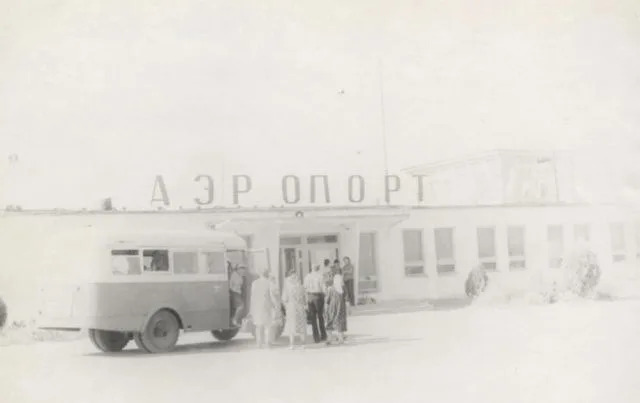 Kyzyl-Kiya Airport in a historical photograph. Photo: Garinoy N, Wikimedia Commons, CC0 1.0; edited for this site.
Railway and industrial infrastructure should not be treated as a passenger attraction either. Do not walk on the tracks or use service roads as shortcuts. Plan ordinary travel by road.
When to visit and where to stay
Spring and autumn are comfortable for a walk and an onward drive, with less midday heat and enough daylight to avoid rushing. After heavy rain, ask about regional road conditions before leaving the main route.
In summer, walk in the morning or evening, carry water and choose a café for shade and hygiene rather than proximity alone. In winter, expect frost and slippery patches. Check heating and hot water before booking a room.
An overnight stay is mainly useful for an easy connection or an early start. Choose accommodation near the actual departure point, confirm late check-in and arrange a taxi ahead of time. If your real destination lies farther into Batken Region, Kyzyl-Kiya works best as a purposeful pause rather than an extra night added simply to tick off another city.
Share on social media
If you found this guide useful, share it on social media. It takes a moment and helps more travellers discover the project. Thank you!
Anything to add?
Share your experience, leave a comment or suggest an improvement.